Master calculating share of voice: Win more with real-world methods
Tired of guessing your impact? Learn steps for calculating share of voice and quantify how much noise your brand makes with real-world methods.
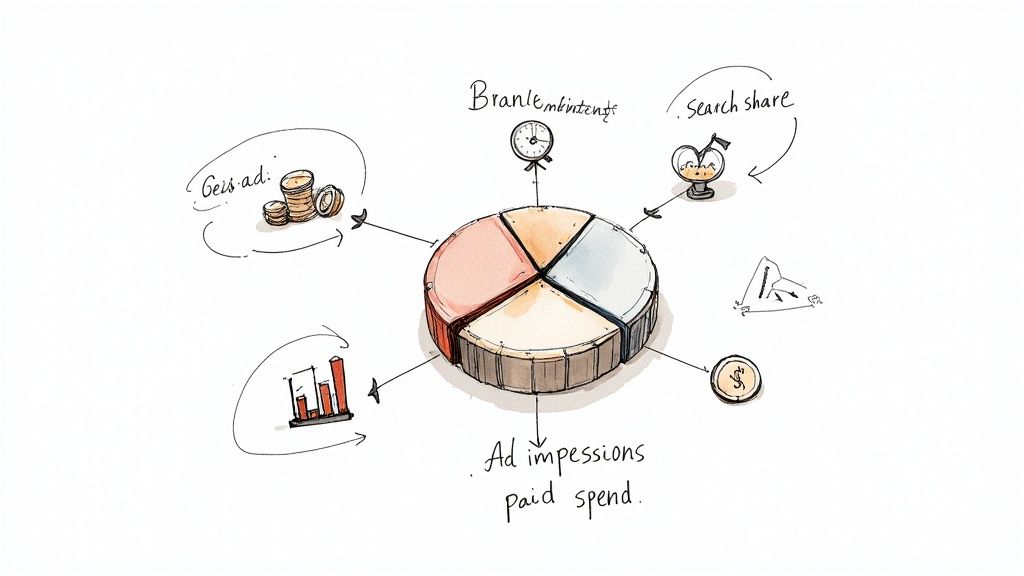
Think of "Share of Voice" as your brand's slice of the conversation pie. It’s a simple way to see how you stack up against your competitors. Are you the one everyone's talking about, a quiet contender, or just shouting into the void?
To figure it out, you just measure your brand's key metrics—like social media mentions or ad impressions—and compare them to the total for your entire market. Simple, right?
What Is Share of Voice and Why Bother Tracking It?
Let's be honest, "Share of Voice" sounds like a stuffy marketing term from a textbook nobody actually reads. But behind the jargon is a simple, powerful idea: how much of the conversation in your industry do you actually own? It’s basically your competitive radar, showing you if people are paying attention to you.
Flying blind without this data is a huge risk. A high SOV often leads directly to a bigger market share. This metric has its roots in old-school advertising, where it was tied directly to how much a brand spent on TV or radio ads. The logic was simple—spend more, get heard more.
It's More Than Just Ads Now
Today, that "conversation" happens everywhere, not just during commercial breaks on TV. Because of this, how we calculate Share of Voice has evolved to cover all the different battlegrounds where your brand competes for attention.
Here's a simple breakdown of the different kinds of SOV you can track and what they reveal about your brand's visibility.
A Quick Look at Different SOV Types
| SOV Type | What It Really Measures | Why It Matters | | :--- | :--- | :--- | | Social SOV | How often your brand is mentioned, tagged, or discussed on social media versus competitors. | Tells you who's winning the popularity contest online and capturing direct audience engagement. | | SEO SOV | How often your site appears in organic search results for your target keywords. | Shows your visibility on search engines, a key channel for customer research and discovery. | | Paid SOV | Your ad impression share compared to the total available impressions in your paid channels. | Reveals how dominant your paid advertising efforts are and if you're outspending the competition. |
This table just scratches the surface, but it gives you a good idea of how you can measure your presence across different channels.
Historically, there's a really strong link between a brand's SOV and its market growth. In consumer goods, for example, brands that achieve a share of voice higher than their market share tend to grow. Those that fall behind often shrink. If you want to nerd out on the history, Wikipedia has some interesting studies on this.
> The core idea remains the same whether you're a scrappy startup or a household name. Knowing your SOV is the first step to understanding where you stand and where you need to go. To really get into the nitty-gritty, this guide on how to calculate Share of Voice for brand dominance offers a fantastic deep dive.
Measuring Social Buzz and Brand Mentions
Welcome to the loudest room on the internet: social media. Calculating your Share of Voice here is all about eavesdropping on conversations, but in a totally non-creepy, data-driven way. You’re trying to answer a simple question: who's getting more buzz, you or your competitors?
The formula itself is laughably simple:
> Your Share of Voice = (Your Brand Mentions / Total Market Mentions) x 100
The real work isn't the math, though. It's figuring out what actually goes into those buckets. What really counts as a "mention"? Is it just your brand name? What about your product names, your slogan, or that weird hashtag your intern came up with last summer? You have to nail this down first.
Defining Your Battlefield
You don't need to track every single competitor on the planet. Just pick your top three to five rivals—the ones who keep you up at night. This keeps your "Total Market Mentions" from becoming an impossibly huge number to track. The goal is to get a useful snapshot, not boil the entire ocean.
This whole process of gathering and making sense of market data is a core part of building solid marketing intelligence. If you want to dive deeper into how this works, you can check out our guide on what marketing intelligence is and why it's so important for staying ahead.
Once you have your keywords and competitors locked in, you need a way to actually find all these conversations. Trying to do it manually is a one-way ticket to insanity. Luckily, there are tools for this.
Tools to Do the Heavy Lifting
There's a whole world of social listening tools that can do this for you. They scan platforms like X (formerly Twitter), Instagram, TikTok, and forums to count mentions for you and your competitors.
- The Big Guns: Tools like Sprout Social or Brandwatch are fantastic, offering deep analytics and sentiment analysis. But be warned, they can be expensive.
- The SEO Suites: Platforms like Ahrefs or Semrush also have brand monitoring features. They're powerful but come with a similarly hefty price tag, which might not be practical if you're just starting out.
- The Smart Alternative: For a more focused and accessible approach, tools like already.dev can help you identify who is being discussed in your specific market without requiring an enterprise-level budget.
Want proof that this matters? In the global smartphone market, Apple commanded a staggering 28% SOV on social channels during its Q4 product launches, while Samsung sat at 22%. This buzz directly contributed to a 2.1% uptick in Apple's market share the following quarter, showing a clear link between social chatter and sales. You can find more insights like this from Sprout Social on the power of social SOV.
Ultimately, remember that context beats volume. Ten mentions from genuine industry leaders are worth more than a thousand mentions from spam bots. Your social SOV isn't just a number; it's a measure of your brand's real-time relevance and cultural impact.
Winning the SEO Visibility Battle
When it comes to organic search, we're fighting a war for eyeballs. Your Share of Voice here is all about owning the search results for the keywords that actually matter to your business. Let's be real, ranking #1 for your own brand name is expected—that’s just table stakes. The real prize is how often you show up for the non-branded terms people are searching for when they have a problem you can solve.
This is what many of us in the trenches call Share of Visibility or SEO Share of Voice. It’s a straight-up measure of how much of the available organic traffic for your target keywords you’re actually pulling in compared to everyone else. A high percentage tells you your content strategy is working.
Building Your Keyword Hit List
First things first: you can't measure what you don't track. You need to build a realistic list of the most important non-branded keywords for your business. The best way to do this is to get inside your customer's head. What are they really typing into Google?
- Problem-focused keywords: Think about the pain points you solve. A good example is something like, "how to automate team reports."
- Solution-focused keywords: What category of product are they hunting for? This could be "best project management software for small teams."
- "Vs." keywords: These are pure gold. How do you stack up head-to-head? Think "asana vs monday."
A word of advice: don't boil the ocean. A tightly focused list of 50-100 core keywords is infinitely more useful than a bloated list of 10,000 that you can't possibly monitor effectively. This focused approach is a critical part of any good website competitive analysis.
The Not-So-Simple Math of Visibility
Figuring out your SEO SOV isn't as simple as just counting up rankings. A #1 spot for a keyword with 10,000 monthly searches is obviously way more valuable than ranking first for a term that only gets 10 searches a month. You also have to factor in click-through rates (CTR), because the higher you rank, the exponentially larger slice of the pie you get.
At its core, the calculation combines three key ingredients:
- Your ranking for each keyword you're tracking.
- The monthly search volume for every one of those keywords.
- The estimated CTR you'd get for each ranking position.
The formula is essentially (Your Estimated Traffic / Total Estimated Traffic for All Competitors) x 100. This spits out a clear percentage that shows if your content is actually capturing the traffic it deserves.
> Pro Tip: Don't get paralyzed trying to find the "perfect" CTR model. Just pick a standard one and stick with it. Consistency is what matters here, so you can see if your visibility is trending up or down over time.
Trying to do this by hand in a spreadsheet is a special kind of hell. This is where the tools come in. The big guys like Ahrefs or Semrush can automate this beautifully, but they often come with a price tag that'll make your eyes water. For a more accessible option, a tool like already.dev can help you map out your keyword footprint and see where you really stand without needing a VC-sized budget.
How to Calculate Paid Ad and Retail Media SOV
Money talks. And in the world of paid advertising, it practically screams. Calculating your share of voice here isn't about listening in on social media; it's about figuring out how much of the digital billboard space you're actually buying. This holds true whether you're duking it out on Google Ads or fighting for visibility on massive retail media networks like Amazon.
When it comes to paid search, Google, thankfully, doesn't make you guess. They hand you a wonderfully simple metric called Impression Share.
Think of it as Google telling you, "Of all the times your ad could have shown for your target keywords, it actually appeared this percentage of the time." A high impression share is a great sign—it means you’re consistently showing up right when customers are looking.
The Paid Search SOV Shortcut
You can find this golden metric right inside your Google Ads account. Let's say your Impression Share is 60%. Simple math tells you that you're missing out on the other 40% of potential ad views.
Why? It could be anything from your daily budget tapping out too early to your ad quality score needing a tune-up. It's a direct, no-fluff way to measure your share of voice in the paid search arena.
Dominating the Digital Shelf with Retail Media SOV
Then you have the wild west of retail media. On platforms like Amazon, Walmart, or Instacart, the game is all about owning that digital shelf space. Here, the formula is a bit more manual but follows the same logic we've been using:
> Retail Media SOV = (Your Ad Impressions / Total Category Ad Impressions) x 100
Now, getting that "Total Category Ad Impressions" number can be tricky. This is where specialized tools come into play, as they tap into the data from these retail media networks. Big players like Pacvue or Semrush are incredibly powerful but often come with an enterprise-level price tag. A more accessible alternative like already.dev can arm you with the data needed for a solid retail competitor analysis without breaking the bank.
Let's look at a real-world battlefield. During Amazon's Prime Big Deal Days in October, Procter & Gamble's beauty products pulled in a massive 1.2 million ad impressions. In a category with a total of 10 million impressions up for grabs, this gave them a 12% SOV. It was just enough to edge out their rival Unilever, who landed at 9%, and ultimately helped boost P&G's sales by 14% that month.
While the following diagram focuses on SEO, it perfectly illustrates the core concept of how different inputs—like keywords, rank, and visibility—are combined to calculate your overall share of voice.
This just goes to show that no matter the channel, SOV always boils down to measuring your performance against the total market opportunity.
Ultimately, your paid SOV is a direct reflection of your budget and strategy. But don't stop at impressions. To get a truly complete picture of your ad efficiency, you'll want to dig into metrics like Total Advertising Cost of Sales (TACOS). After all, it’s not just about being seen; it's about making sure every dollar you spend is pushing your brand further ahead of the competition.
So I've Calculated My SOV. Now What?
Alright, you've done the hard work. You’ve wrestled with the spreadsheets, crunched the numbers, and now you have your Share of Voice percentages neatly lined up. So... now what?
Let's be honest, data is just a bunch of numbers until you figure out what it's telling you. This is where you translate those percentages into an actual game plan. You have your SOV metrics—now it’s time to connect them to your business goals and make some smart calls.
Set Realistic Benchmarks, Not Pipe Dreams
First things first: you probably don’t need a 50% Share of Voice to win. If you're a challenger brand trying to take on an industry giant, aiming for that kind of market dominance right out of the gate is a surefire way to burn through your budget and your team's motivation.
A low SOV isn't a sign of failure; it’s your baseline. It's where you start.
Instead of obsessing over some huge, arbitrary number, think about what's realistic for your company.
- If you're the new kid on the block: Growing your SEO visibility from 2% to 5% in six months is a massive victory. It means your content strategy is working and you're starting to carve out a space.
- If you're an established brand: Your goal might be to protect your 30% social SOV from a scrappy competitor who’s making a lot of noise.
The objective isn't just a bigger number for the sake of it. It’s about seeing that number move in the right direction. A single snapshot in time is interesting, sure, but the trend line tells the real story.
Use Paid SOV to Juice Your Organic Growth
Here’s a little secret from the trenches: your paid and organic efforts aren't separate. They're constantly influencing each other. A high paid SOV—getting your ads in front of people consistently—can give your organic presence a serious lift.
Think about it. When someone sees your ads over and over, your brand name gets lodged in their brain. That familiarity often leads to more branded searches (people Googling "Acme Anvils" directly instead of just "heavy things to drop"). This is a powerful signal to search engines that you’re a real entity people care about, which can help your rankings across the board.
> Stop thinking of your ad budget as just buying clicks. It's a strategic investment in building brand authority that pays off in long-term organic growth. You're creating a rising tide that lifts all your marketing boats.
Track Trends to Uncover the Real Story
Calculating your SOV just once is like taking a single photo of a marathon. It shows you where everyone is at that one moment, but it doesn't tell you who's picking up the pace or who's about to fade.
The real insights come from tracking your SOV consistently—month-over-month, quarter-over-quarter. This is how you spot the narratives playing out in your market.
Did your SEO visibility suddenly jump by 5% last month? Time to investigate. Maybe that new blog series you poured your heart into is finally ranking for some killer keywords. On the flip side, did a competitor's social SOV just fall off a cliff? Maybe they pulled back on a big campaign, opening a window for you to jump in and grab that audience's attention.
When you make SOV a regular health check, you stop being a data collector and start being a strategist who can actually outmaneuver the competition.
A Few Lingering Questions on Share of Voice
Alright, we’ve covered a lot of ground—from the different types of SOV to the nitty-gritty of calculating it. But I know a few common questions are probably still rattling around in your head. Let's tackle those so you can move forward with confidence.
How Often Should I Be Calculating This Stuff?
Honestly, it all comes down to the pace of your industry. If you’re in a market where trends pop up on TikTok and die a week later, you should probably be checking in at least monthly. This lets you catch important shifts before they become full-blown problems (or massive opportunities you miss).
On the other hand, for channels with a much longer feedback cycle, like organic search, looking at it quarterly is usually more than enough. SEO takes time, and you need to give your content a chance to rank and Google a chance to catch up. The key isn't how often you measure, but that you do it consistently. Pick a cadence you can actually maintain, otherwise spotting real trends will be impossible.
My Share of Voice is Super Low. Should I Panic?
Take a deep breath. Absolutely not. A low Share of Voice isn't a grade on a report card; it’s just a dot on a map showing your starting point. If you're a startup or a smaller brand, a low number is completely normal. Panicking won’t help you.
> Think of it as your baseline, not a reason to beat yourself up. The objective isn't to overtake the industry leader overnight. It’s to achieve steady, intentional growth over time.
Instead of panicking, get focused. Don't try to win everywhere at once—you'll just spread your resources too thin. Pick a specific battlefield where you can make a real impact. Maybe that's a handful of niche, long-tail keywords, or maybe it's becoming the go-to voice on a single, highly relevant social media platform. Small, consistent wins are what build momentum.
Can I Do All of This for Free?
You sure can, but be ready to get your hands dirty. The free approach means more manual work, plain and simple. You'll be manually searching for brand mentions on social media, using the free (and limited) versions of SEO tools, and pulling the Impression Share data that Google Ads already gives you. It’s definitely doable if you have more time than money.
Of course, paid tools make life a whole lot easier by automating most of the process. The big names like Ahrefs or Semrush are incredibly powerful but can be expensive. That’s where more focused, budget-friendly alternatives like already.dev come into play, giving you the competitive intel you need without that scary enterprise-level invoice.
Feeling ready to ditch the guesswork and see exactly where you stand against the competition? Already.dev uses AI to do the heavy lifting, delivering a complete competitive analysis in minutes, not weeks. Start making smarter, data-driven decisions today. Uncover your true market position with Already.dev.