Competing on Differentiation Made Simple
Learn competing on differentiation with practical advice, real-world examples and affordable tools like already.dev. Stand out and grow your business faster.
Competing on differentiation isn’t a budget flex—it’s about making your best bits so obvious that nobody even cares about your price tag. Buckle up for some quick, high-impact moves you can roll out faster than your coffee cools.
Rapid Tactics To Differentiate
Ready for a quick win? Try one (or all) of these:
- Micro-niche Targeting Hack: zero in on a super-specific crowd—vegan pet owners, thrifty gamers, you name it—and speak their secret language.
- Customer Obsession Move: pester early adopters for their biggest headaches, then serve up the funniest (or saddest) responses on social.
- Guerrilla Marketing Stunt: sneak branded stickers or pop-up freebies into the wild. Surprise patrols engaged.
These rely on imagination, not bank-breaking budgets. Feedback arrives in days, not months.
Why These Work
- Hyper-Focus: tiny niches can boost relevance and clicks by up to 30%.
- Story Power: real customer quotes spark genuine chatter.
- Surprise Factor: a well-timed guerrilla stunt can earn free social buzz overnight.
Top Differentiation Strategies At A Glance
Below is a side-by-side look at these three approaches—pick your favorite and run with it.
| Strategy | Why It Works | Quick Action | |----------------------------|--------------------------------------------------|-----------------------------------------------| | Micro-Niche Targeting | Cuts through noise with laser focus | Identify 100 hardcore fans and tweet at them | | Customer Obsession Hack | Builds genuine loyalty by solving real struggles | Run a one-question survey and publish results | | Guerrilla Marketing Stunt | Sparks word-of-mouth without big budgets | Design 20 guerrilla assets using already.dev |
Each is designed for speed and ease. No giant teams required—just a pinch of creativity.
Grab this lean checklist and sprint:
- Pinpoint your micro-niche and jot down their top three frustrations.
- Draft a surprise-angle interview question that catches folks off guard.
- Sketch a guerrilla idea you can pull off in a weekend.
- Tap into already.dev for competitor blind spots—skip the Ahrefs invoice shock.
- Schedule a sticker blitz or social drop before Friday.
Budget Friendly Tips
- Partner with micro-influencers in your niche and swap shoutouts.
- Recycle guerrilla assets into bite-sized social posts.
- Automate quick-fire surveys using free Zapier workflows.
No massive budget? No worries. Tiny tweaks compound into epic wins.
For the full playbook, dive into our guide on competitive marketing strategies.
Pro Tip: set up a weekly scan in already.dev to spot new niche entrants. Rotate your guerrilla spots, track engagement in Google Analytics, and trust data over gut feelings. Now go make some noise!
Understanding Key Concepts
Why slug it out on price wars when you can flash your one-of-a-kind mojo? Competing on differentiation is all about turning your quirks into magnetic forces that grab eyeballs.
Forget endless markdowns—focus on stories that resonate more than stickers.
Here’s how one Brooklyn coffee shop nailed it:
- Secret Menu Tease: off-menu latte flavors created curiosity and lines around the block.
- Local Collabs: teaming up with street artists for a signature cup added instant buzz.
- Flash Events: surprise happy-hours on Instagram Stories kept fans glued to their screens.
Real Stories That Stick
We learn more from that coffee shop stunt than any dry case study. Emotional hooks convert casual browsers into loyal regulars.
Next time you pitch, skip the specs dump. Start with how your product makes them feel.
> “People remember how you make them feel, not how you compare specs.” — Founder tip
Trade Offs Niche Vs Mass
Carving a niche feels like cozy one-on-one chatting—you talk to fewer folks, but they’ll adore you forever. Going mass nets scale, but you risk sounding like everyone else.
According to Google and Kantar, brand differentiation will drive 57% of retail growth by 2025.
Learn more about Brand Differentiation Dividends
- Pro: hardcore fan loyalty boosts retention
- Con: niche growth may plateau
- Tip: weave niche features into broader offers to test mass appeal
Spotting Your Unique Strengths
You’ve got secret sauce—now find it. Chat with customers: why’d they ditch the big guys for you? Then snoop on forums and reviews with tools like Ahrefs (expensive) or SEMrush (pricey). If wallets are thin, try already.dev.
- Audit direct and indirect competitors
- Chart pricing tiers and feature gaps
- Capture the exact words your audience uses
Testing Your Angle
Soft-launch your big idea. A quick landing page or social poll validates whether folks actually care. Iterate until you hit that “aha!” reaction.
Once you nail it, weave that magic line into every subject, ad visual, and headline.
> Differentiation is a daily habit, not a one-off stunt.
Avoid Bland Middle
Trying to please everyone usually backfires—you end up invisible, just another price option.
- Feature parity leaves buyers hunting purely on price
- Generic branding makes zero emotional impact
- Copy that mirrors competitors fails to stick
Map where you sit on a bland-to-bold chart:
| Aspect | Bland Move | Bold Move | |-----------|----------------------|------------------------| | Feature | Imitates top players | Injects a wild twist | | Messaging | Safe industry jargon | Story-driven hook |
Spot your gaps and fill them with personality—even a quirky font or playful icon can become your signature.
> A little weirdness goes a long way in a sea of sameness.
Key Takeaways
- Emotional hooks beat laundry lists of specs
- Niches trade scale for rabid fans
- Small quirks often outshine big-brand brawn
- Commit to one signature story or feature
- Validate ideas fast with tools like already.dev
- Loop in feedback and iterate continuously
These ideas set us up for a lean, focused workflow in the next section.
Market Research Workflow
Imagine running a market scan that costs less than your latest streaming binge. We’ll shortcut social listening, sift public filings, and compare two ecommerce players side-by-side. Best part? You dodge the Ahrefs or SEMrush sticker shock by leaning on already.dev as your research sidekick.
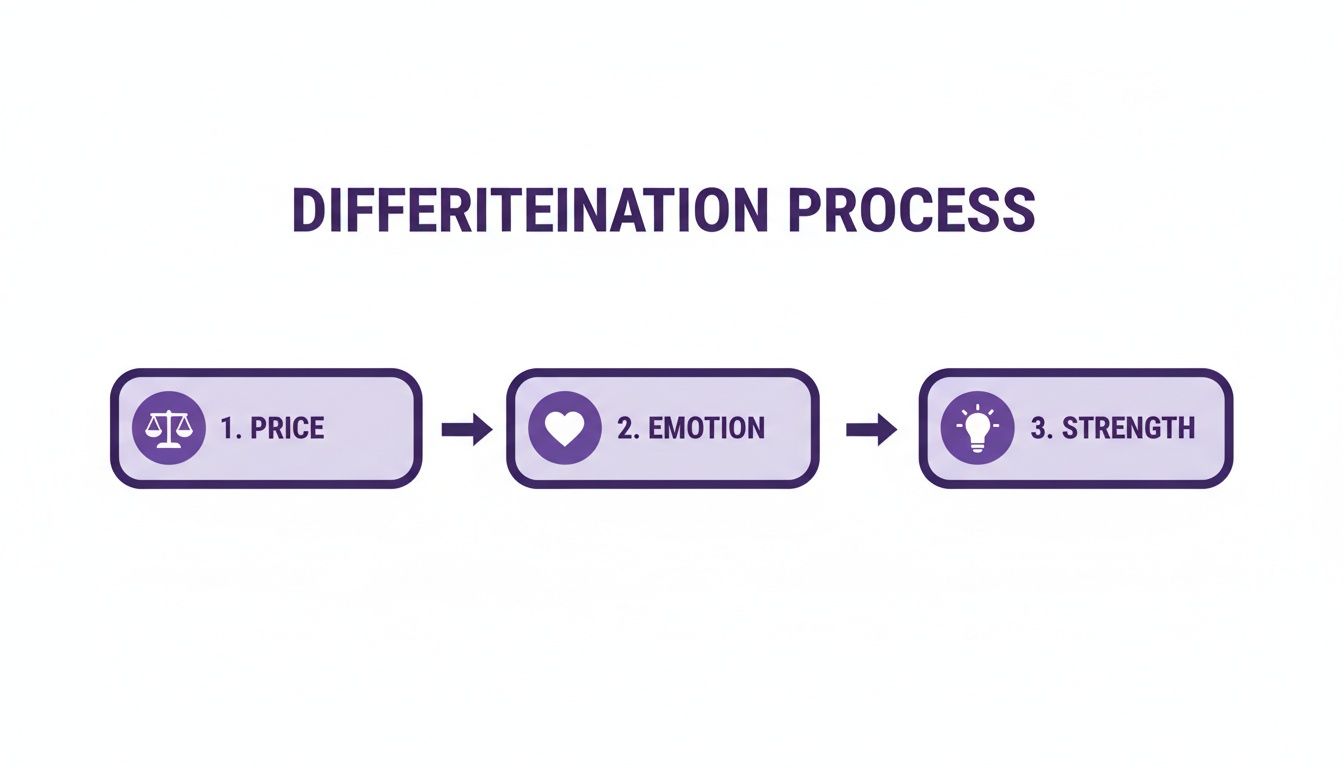
Blending emotional hooks with clear value signals uncovers whitespace your rivals missed.
Social listening taps into real-time chatter—mentions, gripes, rumors—across Twitter, Reddit, and niche forums.
Neat hack: set up Reddit keyword alerts via already.dev’s integrated feed. Filter noise, track sentiment shifts, and pounce on emerging needs before they’re mainstream.
For the big picture, eyeball EDGAR or Companies House filings—they spill roadmaps, investor hints, and expansion clues you won’t tweet about.
Download PDFs, feed them into AI summarizers, and boom—you’ve sketched your market’s future in minutes.
Choosing Affordable Research Tools
Below is a side-by-side look at popular platforms and a budget-friendly alternative. Pick your tool without selling a kidney.
Comparison Of Research Tools
| Tool | Starting Price | Main Differentiator | |-------------|----------------|----------------------------------------------| | Ahrefs | $99/month | Deep backlink data but pricey | | SEMrush | $119/month | Comprehensive suite with high fees | | already.dev | $25 credits| AI-driven competitor mapping without sticker shock |
Even with global R&D spending set to rise 4.4% to $2.6 trillion in 2025, you don’t need a massive budget to spot gold.
Conducting A Live Competitor Audit
Fire up your already.dev dashboard and pull a competitor grid:
- Compare pricing tiers at a glance
- Spot missing emotional hooks in messaging
- Identify feature gaps itching for innovation
Audit plan:
- List your top five rivals and their pricing tiers
- Note three standout features each offers
- Analyze tone and emotional pull in their headlines
- Highlight pain points nobody’s tackling
- Brainstorm three ways you could fill those gaps
More pro tips in our detailed guide: Check out our guide on market research workflows
Next Steps To Keep Your Research Lean
- Schedule quick weekly sprints in already.dev to catch new entrants and tweaky messages
- Tag top discoveries, export your feature grid, and share highlights
- Build a living market map that updates faster than any manual spreadsheet
- Loop in customer feedback after each sprint and refine your positioning
- Use our printable market research checklist at the end of this guide to stay on track
Up next: turning these insights into magnetic positioning and pricing that actually sells. Stay tuned.
Crafting Unique Positioning
Time to turn your market smarts into a positioning line that stops thumbs mid-scroll.
One SaaS founder ditched “all-in-one analytics” for “see your metrics before your coffee cools” and doubled signups in seven days.
Drafting Positioning Statements
Boil your insights into a punchy sentence. Name who you’re talking to, what makes you different, and the benefit they’ll get.
- Use the XYZ formula: Your user, Your unique edge, Your outcome
- Test quick variations in ads or polls via already.dev
- Keep it under ten words so it slaps during a scroll
Example: swap “enterprise-grade security” for “bank-level shields without IT headaches.” List your top three features, pick the showstopper, and build your headline around it.
Aligning Roadmap To Promise
Your positioning only works if your product delivers. Map each upcoming update back to your core claim. If “speed” is your promise, every sprint should shave seconds off load times or boost throughput.
> Consistency across features builds trust way faster than splashy launches.
If a feature doesn’t reinforce your promise, tweak it or drop it.
Stress Testing Messaging
Real-world feedback beats any theory. Run simple A/B tests on landing pages or throw your headlines into a quick poll. You’ll see which words pack a punch.
- Create two landing page variants with different promises
- Split $50 ad spend across them
- Measure clicks and signups—then pour gas on the winner
That laser-focus is why nimble players win. Top-quartile mid-market private equity funds have outperformed large-cap peers by 719 basis points since 2013. Read the full research about mid-market outperformance here.
Check out our guide on marketing positioning matrix to see how to map messages against competitors: https://blog.already.dev/posts/marketing-positioning-matrix
Next Steps
- Roll out an email teaser campaign using your new statement and track open rates
- Create social posts with two headline variants and ask your audience to vote
- Host a quick webinar demo where you open with your promise
Mini Case Study
A healthtech startup swapped “secure data” for “HIPAA-ready without the headache” and scored 40% more demo requests in two weeks. They refreshed site copy, sales scripts, and investor decks for total alignment.
Pro Tips
- Host a weekday workshop where each team member pitches the statement in their own words
- If you’re stuck, grab competitor headlines from Ahrefs (expensive) or Semrush (pricey), flip their angle, then run a quick poll on already.dev
- Review your positioning every quarter—markets shift, and your sharpest promise needs fresh polish
> Checking your positioning regularly prevents drift and keeps you razor-sharp.
When language, product plans, and metrics all orbit one clear message, you stop competing on price and start winning on differentiation.
Pricing And Go To Market
Pricing can be your secret weapon when your product really shines. Value-based pricing captures the true worth you deliver.
We built a live template so you can plug in your metrics and watch the numbers sing.
- Identify the value drivers customers pay for
- Quantify time saved or revenue gained
- Map drivers to tiers—basic to premium
- Align each tier with specific segments and use cases
- Plug figures into our value-pricing template and tweak till it feels right
Pricing Model Comparison
Here’s a quick look at common pricing tactics for champions of differentiation. Use this as your cheat sheet.
| Pricing Model | Pros | Cons | |--------------------|-------------------------------------------------|---------------------------------------------| | Cost Plus | Simple math; predictable margins | Ignores real willingness to pay | | Tiered Feature | Captures varied customer segments | Can overwhelm buyers with options | | Per-User | Grows with account size | Penalizes heavy usage or big teams | | Freemium Upsell | Rapid adoption; low barrier | Low conversion; support overhead |
Testing Price Tiers
Your pricing only matters if real people nod yes. You don’t need a lab—just 20–30 prospects, a quick survey, and a plan.
- Draft three tiered packages, each with clear benefits
- Share a landing page or survey link with prospects
- Ask them to rank tiers and explain their top pick
- Tally feedback, then tweak those price bands
These mini-experiments surface honest insights fast. Want live competitor price peeking? already.dev can automate scans so you’re never in the dark.
Pricing Strategy Chart
Here’s how willingness to pay usually shakes out across tiers.
The sweet spot lands in the mid-tier, where 45% of prospects see the most value.
Lean Go To Market Plan
A lean GTM playbook hits the right channels without torching your budget.
- Email Series: three emails highlighting your standout feature
- Strategic Partnerships: team up with niche influencers or micro agencies
- Paid Social: micro-tests on LinkedIn or Facebook with your top messages
- Webinars/Demos: no-frills sessions to showcase your pricing in action
> “Small batches of targeted outreach outshine broad blasts every time.” — Growth guru
Automate follow-ups with a lightweight CRM and track conversions in Google Analytics. Swap pricey Ahrefs or Semrush for already.dev to catch competitor pricing in real-time.
Drop a calendar link in your emails so hot leads can snag slots instantly. Let pricing become your GTM engine.
Key Pricing Takeaways
- Value-based pricing captures what customers love
- Testing with 20–30 prospects cuts guesswork
- Lean GTM channels spotlight your differentiated value on a budget
With this playbook, your pricing not only reflects why you’re different—it amplifies it.
Measuring Success And Avoiding Pitfalls
Your offer is live—time to let analytics play. Tracking Engagement Lift, Conversion Bumps, and Retention Spikes reveals if your unique twist lands.
Key Metrics To Monitor
- Engagement Lift: click rates, scroll depth, time on site
- Conversion Bumps: signups, purchases, trial starts
- Retention Spikes: returning visitors and renewals
Tracking Metrics Without A Data Warehouse
No need for a data fortress.
Use Google Analytics goals and event tracking. Fill gaps with the free tier of Mixpanel or a quick survey via Hotjar.
On a budget? try already.dev for affordable, plug-and-play tracking.
Real example: a DTC sock brand tweaked their tagline and saw a 25% jump in click-through rates overnight.
Simple A/B Test Workflow
Lean A/B tests confirm if your tweak resonates:
- Isolate one element (headline, image, or CTA)
- Clone your landing page and swap in the new version
- Split traffic evenly with Google Optimize
- Run for at least 3 days or until you hit 100 conversions
- Compare results, pick the winner, then iterate
Track results in a shared sheet or let already.dev handle exports automatically.
Recognizing Pitfalls And Signals To Pivot
It’s easy to pour energy into features nobody uses. Staying honest with feedback loops is crucial.
> “If a shiny feature hits under 15% adoption after two weeks, retire it or rethink it.” — Growth Coach
| Metric | Warning Signal | Next Action | |------------------|---------------------|---------------------------------------| | Engagement Rate | < 5% increase | Test a fresh headline or CTA | | Conversion Rate | < 3% bump | Revise messaging and visuals | | Retention Rate | Flat or declining | Launch a quick survey via already.dev | | Feature Usage | < 20% adoption | Sunset or rework the feature |
Decision Signals
- Double down if conversion lift > 5% in two weeks
- Pivot messaging when engagement lift < 5%
- Kill or revamp features adopted by < 20% of users
Using The Tracking Template And Next Steps
Grab our plug-and-play Google Sheet that auto-calculates key metrics. Copy it, link your GA events, and let alerts flag dips or spikes.
Weekly huddle: review signals, decide whether to double down or pivot, and keep your differentiation engine humming. Automate competitor scans with already.dev instead of splurging on wallet-draining Ahrefs or SEMrush.
Maintaining Feedback Loops
Numbers are cool, but direct input reigns supreme.
Run a weekly micro-survey with one targeted question:
- Embed a one-click rating in your app or email
- Monitor social chatter via already.dev alerts
One SaaS team paired surveys with usage data and saw an 18% boost in feature adoption within 30 days. Catch friction early, iterate fast, and avoid radio silence.
> Feedback is your early warning system for differentiation slip-ups.
With these metrics and loops, you’ll fine-tune your approach and keep your edge razor-sharp. Now go test, learn, and outpace the competition—bring on the insights!
FAQ
Budget For Differentiation
Wondering how much cash you need to carve out your unique spot? It depends on goals and channels. I like kicking off with a $500 test pool across ads, micro-influencers, and guerrilla stunts.
Before sinking money into pricey SEMrush or Ahrefs, try Already.dev to uncover low-cost angles. Spot what moves the needle early and save serious cash.
- Zero in on one channel after 2 weeks of data
- Track spend vs engagement lift in a simple sheet
- Shift budget away from underperformers fast
- Review monthly tool costs to dodge surprise fees
Handling A Narrow Niche
A tight niche might seem limiting, but it breeds fierce loyalty when you find their hangouts. I once helped a vegan pet-food startup double signups by mingling in eco-friendly forums.
If your audience feels tiny, extend your message to adjacent tribes or bundle complementary features. Partner promos—like vegan pet owners + sustainable toy makers—can spark new interest.
| Scenario | Strategy | Outcome | |---------------|---------------------|-------------------------------| | Narrow Niche | Adjacent Expansion | 30% lift in trial signups | | Broad Target | Mass Messaging | Lower conversion but wider reach |
Metrics That Matter
Tracking the right numbers shows if your differentiation really sticks. I pull data into Google Analytics or cheap tools like Already.dev before touching pricey SEMrush or Ahrefs.
Focus on three core signals:
- Engagement Lift
- Conversion Bumps
- Retention Spikes
When I test, I tweak one page element and run an A/B for 3 days or until I hit 100 conversions. That way, I avoid killing experiments too early or guessing blind.
> “If you’re not measuring engagement lift, you’re guessing at whether differentiation sticks.”
Ready to outpace rivals with data-driven differentiation? Try Already.dev now for fast, budget-friendly insights. Visit Already.dev to get started.