Your Guide to Competitive Marketing Intelligence
Stop guessing and start winning. This guide breaks down competitive marketing intelligence and shows you how to use it for a real strategic advantage.

Let's be real, "competitive marketing intelligence" sounds like something cooked up in a boardroom to make spying sound fancy. But it all boils down to this: ethically snooping on your competitors so you’re not flying blind.
It's just one piece of the bigger marketing intelligence puzzle, which you can read all about in our other guide: https://blog.already.dev/posts/what-is-marketing-intelligence.
So What Is Competitive Marketing Intelligence, Really?

Imagine you're playing poker. Would you go all-in without even looking at the other players? Heck no. You’d watch their tells, study how they bet, and try to guess what they're holding. Competitive marketing intelligence is the business version of that.
It’s about gathering up all the public info you can find to get a clear picture of your competitors' game plan—their strengths, weaknesses, and what they might pull next. We're not talking trench coats and secret briefcases here. It's just about being smart.
It's All About Answering the Questions That Keep You Up at Night
At its heart, this whole thing is about getting real answers instead of just running on gut feelings and a prayer.
You start asking sharp questions like:
- What are they building? Are they about to drop that killer feature your customers won't shut up about?
- How are they selling it? What's their pricing look like? Are they running some crazy sale or a sneaky free trial?
- Who are they selling to? Which specific customers are they targeting with their ads and blog posts?
- What are their customers saying? Are they getting showered with love on Reddit or absolutely roasted on Twitter?
Getting the dirt on this stuff gives you a massive advantage. You can spot an opening in the market, fix your own strategy before it’s too late, and stop yourself from wasting months building something nobody wants.
> The point isn't to just copy your competitors. That's a rookie move. It's to understand the whole playing field so you can make a move that nobody sees coming. It’s about being different, not a cheap knock-off.
Why This Matters More Than Ever
A few years ago, you could probably get by with a few Google searches and a hunch. Not anymore. The cost of ignoring your competition has gone from "oops" to "game over."
The AI-in-marketing world exploded from $12.05 billion to $47.32 billion in just five years. That's a 293% jump. With 88% of marketers now using AI, you can bet your competitors are moving faster and getting smarter. Sticking to manual research is like bringing a tricycle to a Formula 1 race.
Big-shot tools like Ahrefs or Semrush are great for this, but they can be crazy expensive. For teams that need sharp insights without the enterprise price tag, a platform like Already.dev can deliver deep analysis in minutes. It turns all that market noise into a clear strategy before your rivals even know you're making a move.
The Real Payoff: Why You Should Bother
Okay, so "competitive marketing intelligence" sounds cool, but what's in it for you? Is this just another excuse to make spreadsheets that die in a forgotten Google Drive folder?
Nope. This is how you make game-changing decisions that give your business a fighting chance. Think of it less like spying and more like getting the answers to the test beforehand.
The real win isn't a boring list of your competitors' features. It’s about finding golden opportunities that are hiding in plain sight. It’s the difference between building something people might want and something they're practically begging for.
From Wild Guesses to "Oh Heck Yes" Moments
Without solid info, you’re just guessing. You’re flying blind, relying on gut feelings that are probably wrong. With it, you start seeing the entire market in glorious high-definition.
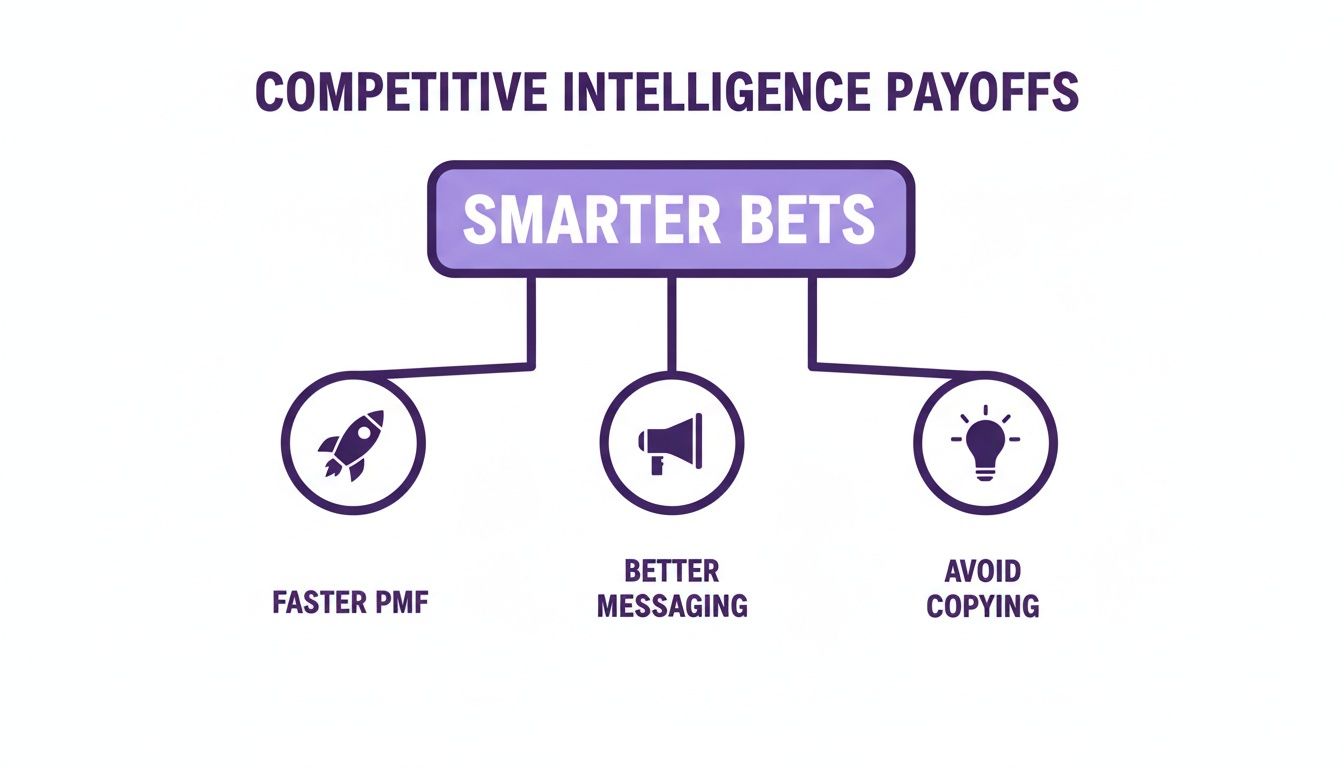
Here are a few wins you can actually take to the bank:
- Steal Your Next Killer Feature (Legally): Go read your competitor's reviews on sites like G2 or Capterra. It's a goldmine of complaints. Every time a customer says, "I love this, but I really wish it did X," they're handing you your next big idea on a silver platter.
- Own the SEO Keywords They Forgot: Sure, big tools like Ahrefs or Semrush can show you what your rivals rank for, but they can also drain your bank account fast. A more focused alternative like Already.dev analyzes their content to find the gaps—juicy keywords they’re completely ignoring. You can swoop in and steal that traffic before they know what hit them.
- Craft a Message That Doesn't Suck: Does your marketing sound just like everyone else's? Snooping on their ad copy and landing pages helps you find a unique angle. If they’re all yelling about "efficiency," you can whisper about "simplicity."
This isn't about tiny tweaks. It’s about making smarter bets with your limited time and money. It's how you avoid that gut-wrenching moment when you realize you just spent six months building a "me-too" product nobody cares about.
Startup Survival Is a Contact Sport
For startups, this isn't a "nice-to-have"—it's a survival tactic. Nailing product-market fit is a nightmare, but understanding the competition gives you a massive shortcut. You get to learn from their mistakes without making them yourself. To get a real feel for this, check out these lessons from competitive markets shared by founders who've been through the wringer.
> Competitive intelligence turns market noise into a clear signal. It helps you pivot faster, position your brand smarter, and build a product that stands out because it solves a problem better than anyone else.
The ultimate payoff is confidence. The confidence to go all-in on an idea because you’ve seen the gap. The confidence to charge more because you know you're offering something unique. And the confidence that comes from knowing you’re not just fumbling around in the dark.
Your Dirt-Digging Toolkit
Alright, enough theory. Let's get our hands dirty. But where do you even start? Competitive marketing intelligence can feel like trying to drink from a firehose.
The trick isn't to collect everything. It's to collect the right things. Think of yourself as a detective. You don't bag up every single leaf; you look for the clues that solve the case. This is your clue checklist.
The Product and Pricing Lowdown
This is ground zero. You have to know what your competitors are selling and for how much. Sounds obvious, but you’d be shocked how many companies build their product in a cave, only to launch and find their pricing is totally out of whack.
Get specific:
- Feature Sets: What can their product actually do? Make a list of their main features and any shiny new toys they've rolled out.
- Pricing Tiers: Don't just look at the price. Dig into what a customer gets at each level. Who are they targeting with their cheap plan? What's locked away for the big spenders?
- Free Trials & Demos: How do they let people try before they buy? A 14-day trial? A freemium model? Or do you have to sit through a boring sales demo? This tells you a ton about their sales game.
> Think of this as taking their business model apart piece by piece. When you map their features to their prices, you can instantly see where they're strong, where they're weak, and where there might be a pricing gap you can jump into.
Marketing and Messaging Signals
How your competitors talk about themselves is just as important as what they build. Their marketing is a direct window into who they think their customers are. Your job is to pick their story apart.
Start by looking at:
- Website & Landing Page Copy: What are their main headlines? What benefits are they pushing hard? Are they all about saving time, making money, or reducing risk?
- Content & SEO Strategy: What are they blogging about? What keywords are they trying to own? Tools like Ahrefs and Semrush are the big dogs here, but they come with a hefty price tag. For a more direct approach, an alternative like Already.dev can analyze this for you without the massive subscription.
- Social Media Presence: Where do they hang out online? Are they all business on LinkedIn, or are they cracking jokes on Twitter? Their tone tells you exactly who they're trying to reach.
Looking at these signals helps you avoid creating a "me-too" brand. If everyone is screaming about the same features, you can find a different story that makes you stand out. To get an edge, you might want to check out the 12 best AI SEO tools for competitive analysis that can help you crush it in search rankings.
For a deeper dive, check out our guide on the best competitive intelligence tools to build out your own spy kit.
What to Actually Track (The Cheat Sheet)
To make this dead simple, here’s a quick-and-dirty cheat sheet of what you should be grabbing on your competitors.
| Data Category | What to Look For | Why It Matters | | ---------------------- | ----------------------------------------------------------------------------------------------------------------- | ------------------------------------------------------------------------------------------------------------ | | Product & Features | Core functions, unique selling points (USPs), recent updates, hints about what's next. | Finds gaps in the market, shows you their game plan, and helps you decide what to build next. | | Pricing & Plans | Price tiers, free trials, freemium models, discounts, and what's included at each level. | Uncovers who they're trying to sell to and reveals chances to offer more value or a better price. | | Marketing Channels | SEO keywords, social media activity, paid ads, email marketing, blog posts, videos. | Shows you where they're finding customers so you can either compete there or find a different playground. | | Messaging & Tone | Website headlines, ad copy, brand voice (e.g., formal vs. funny), key benefits they stress. | Helps you sound different and find customer pain points they might be missing. | | Customer Feedback | Online reviews (G2, Capterra), social media comments, Reddit threads, testimonials. | An unfiltered look at what their users love and hate. This is pure gold for ideas. |
Keeping an eye on this stuff will give you a much clearer picture than just randomly browsing their websites.
How AI Just Broke the Old Rules
Remember the old way of doing competitor research? It was a soul-crushing nightmare of endless Google searches, clicking through a million tabs, and pasting links into a giant spreadsheet you’d never look at again.
You’d spend a full week on it, emerge from your research cave like a confused mole, and still feel like you missed something huge. Let's be honest—that old way is dead.
In a market where a new competitor can pop up and start eating your lunch in a few weeks, manual research isn't just slow; it's a death wish. Spending 40 hours on a spreadsheet is a great way to get left in the dust.
The New Way: Let a Robot Do the Boring Stuff
Now, imagine this instead: An AI agent does all that grunt work for you. You just tell it what you're building, and it scans hundreds of sources—from app stores to Reddit—to find every rival, every threat, and even the ghosts of failed startups you can learn from.
This isn't sci-fi; it's how competitive marketing intelligence gets done now. It’s about getting a full report in minutes, not days. The content intelligence market is set to hit $14.09 billion by 2034, and a wild 84% of research teams think AI will handle most of their work soon. You can learn more about the market's rapid growth and AI's role here.
> The goal isn't just to be faster. It's to replace one-off manual projects with an automated system that keeps you in the loop, so you’re never caught by surprise.
This shift is exactly why platforms like Already.dev exist. They give you that machine-speed advantage without needing a Ph.D. in data science.
Big Tools with Big Price Tags
Of course, powerful SEO platforms have been around for a while. Tools like Ahrefs or Semrush are monsters for digging into a competitor's SEO, backlinks, and ads. They give you a mountain of data, and big companies love them.
But let's be real: they can be ridiculously expensive. For a startup founder, dropping hundreds or even thousands a month on one tool is a joke. You need the intel, but you can't afford the enterprise price tag.
Smart, Fast, and Won't Break the Bank
The new wave of AI tools is all about making this stuff accessible. They're built for teams that need to move fast without a massive budget.
Instead of paying a fortune for a bunch of features you’ll never use, you can get focused, actionable insights when you need them. This is where a platform like Already.dev fits in. It’s built to do one thing perfectly: deliver a complete competitive analysis in minutes, bridging the gap between painfully slow manual research and overpriced enterprise software.
It’s the smart, fast, and affordable alternative for teams that need to understand their market, find opportunities, and get back to building. For a closer look at how this works, check out our guide on AI-powered market research.
A Simple Workflow That Actually Works
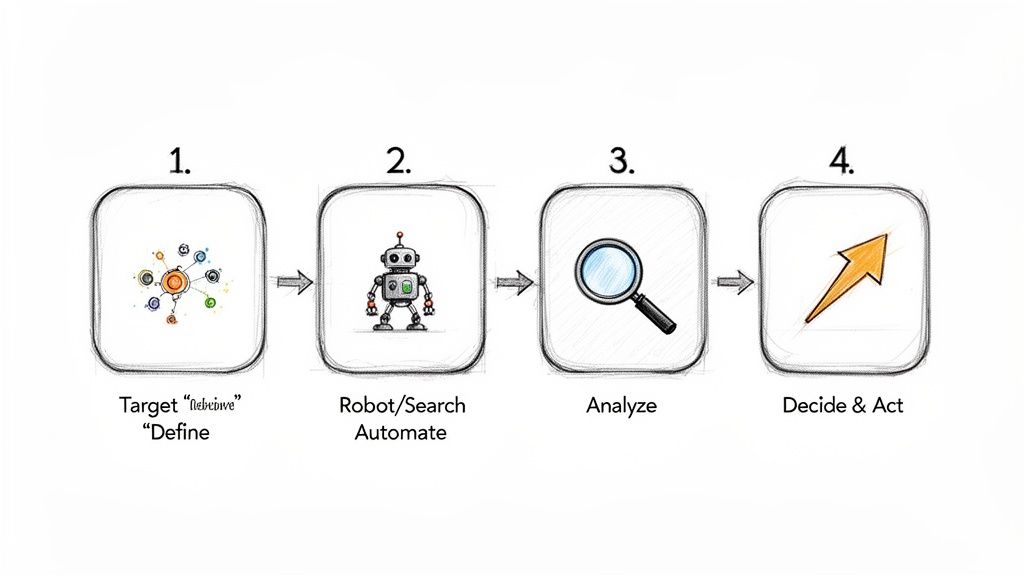
Alright, let's make this real. All this talk is useless if it doesn't lead to action. Here’s a simple workflow that turns a pile of data into a smart decision you can make this afternoon.
Forget 50-page reports nobody reads. This is a "get it done" guide for busy people. We’ll follow a fake startup, "TaskTamer," a new project management tool.
Step 1: Define Your Mission (Be Specific!)
First things first: what are you actually trying to figure out? "Analyze the competition" is useless. It’s like saying you want to "get fit." You need a specific goal, or you’ll just wander around aimlessly.
Your mission should be a sharp, focused question.
Let's look at TaskTamer:
- Bad Mission: "See what Asana is doing." (Vague, leads nowhere.)
- Good Mission: "How do our top three competitors price their entry-level plan for small teams, and what features do they hold back to force an upgrade?"
See the difference? The second one is a GPS coordinate. The first is just pointing at a map.
Step 2: Automate the Heavy Lifting
Now that you have your question, it's time to hunt for answers. This is where people used to burn a whole week Googling themselves into a coma.
Don't do that.
Automate the grunt work. Sure, you can use big-name tools like Ahrefs or Semrush to check out SEO, but they can be seriously expensive and overkill for a simple market overview.
A faster, more focused alternative is a tool like Already.dev. You just feed it your idea— "a project management tool for small creative agencies"—and it does the digging for you. It finds all the relevant players, not just the obvious ones.
This step should take you minutes, not days. The goal is to get a list of competitors and their basic info without doing the boring detective work yourself.
> Competitive marketing intelligence isn't about becoming a world-class spy. It's about using the right tools to get 80% of the answers in 20% of the time so you can get on with your life.
Step 3: Find the Pattern (Use Your Human Brain)
Now you have the raw data. This is where your brain comes in. The AI found the dots; your job is to connect them.
For TaskTamer, this means making a simple grid comparing the pricing and features of their rivals.
| Competitor | Entry Price (10 users) | Key Feature at this Tier | Feature Held Back for Upgrade | | :--- | :--- | :--- | :--- | | ProjectPro | $100/month | Unlimited Projects | Time Tracking | | FlowFlex | $120/month | Time Tracking | Custom Reports | | ZenBoard | $90/month | Unlimited Projects | Gantt Charts |
Boom. A pattern jumps out. Two of them hold a high-value feature (Time Tracking or Gantt Charts) hostage to push users to a pricier plan.
This is your opening.
Step 4: Decide and Act
This is the only step that matters. All that research is worthless if you don't do something with it. Based on the analysis, TaskTamer has a clear, data-backed move.
The decision: Offer Time Tracking in our entry-level plan for $95/month.
This move directly attacks the competition. It's a powerful, targeted decision based on a clear market gap—not a wild guess.
And that’s the whole point.
It’s Time to Stop Guessing
Let’s wrap this up. We've cut through the corporate jargon and laid out a modern game plan for competitive marketing intelligence. If you remember one thing, let it be this: flying blind is no longer an option.
Relying on gut feelings and messy spreadsheets is like trying to navigate a maze blindfolded while your competitors have a live satellite feed. You might stumble onto the right path eventually, but they'll have already crossed the finish line.
The New Bare Minimum for Winning
Using AI-powered intelligence isn't some fancy extra; it's the new cost of entry. It's the bare minimum for building a product that stands a chance. You wouldn't build a house without a blueprint, so why would you build a company without a clear picture of the market?
> This is about making sure all those late nights and all that hard work actually lead somewhere. It’s about building a product that doesn’t just launch, but one that wins.
The goal is to trade that nagging founder anxiety for solid, data-backed confidence. Instead of wondering if you’re building the right thing, you’ll know you are.
Your Unfair Advantage Is Hiding in Plain Sight
The good news is that these tools are no longer out of reach. While big platforms like Ahrefs or Semrush are powerful, they often come with a price tag that'll make you cry. This is where a more focused tool like Already.dev changes the game.
It’s built to give you that satellite view of the market without needing a massive budget. It handles the soul-crushing parts of research automatically, giving you a clear view of your competition in minutes. This is your chance to stop guessing and start making moves with real intelligence.
Your unfair advantage is right there, waiting for you.
Still Got Questions?
Got a few things still rattling around in your head? Good. Here are the most common questions we get.
How Often Should I Do This?
If you're thinking of a massive, once-a-year report that collects dust, you're doing it wrong. The market moves way too fast for that.
Think of it like a habit, not a huge project.
Do a deep dive when you're starting a new product or making a big pivot. That's your foundation.
After that, just stay current. A quick check-in every quarter is a great rhythm. It’s enough to catch new players, see who’s slashing their prices, or notice a competitor trying a weird new marketing angle. Tools like Already.dev are built for this, letting you refresh your analysis in minutes instead of starting from scratch.
Is This Legal? Am I a Spy?
Great question. The short answer: yes, this is 100% legal and ethical.
Competitive marketing intelligence is about gathering public information. We're talking about their website, blog posts, press releases, and what customers are saying on public forums like Reddit. You're not hacking their servers or bribing an employee.
> It’s the digital version of walking into a rival's store to check their prices. It's just smart business, not corporate espionage. You’re being observant, not sneaky.
Can I Do This on a Tiny Budget?
Absolutely. This is where things have gotten so much better. Not long ago, this kind of research was a luxury for huge companies with money to burn on pricey enterprise tools and consultants.
Today, that's completely changed. New tools have popped up that are built for solo founders and lean teams who don't have a spare $10,000 lying around.
Modern platforms give you the same strategic advantage without the terrifying price tag. The small cost of an intelligence report is a drop in the bucket compared to the soul-crushing cost of building a product nobody wants.
Ready to stop guessing and start building with confidence? Already.dev delivers the competitive clarity you need in minutes, not weeks. Run your first AI-powered market analysis and see for yourself.