12 Best Competitive Research Tools for Startups in 2025
Stop guessing. We reviewed the top 12 competitive research tools to help you find hidden rivals, nail your pricing, and build a better product. Find your edge.
Building a new product without checking out the competition is like trying to navigate a new city blindfolded. You might eventually get somewhere, but you'll probably walk into a few walls, fall into an open manhole, and end up miles from where you wanted to be. The good news? You don't have to guess. There's a whole arsenal of competitive research tools designed to give you x-ray vision into what your rivals are doing.
This guide is your map. We're cutting through the noise to give you a straight-up, no-fluff list of the best platforms for spying on your competition (ethically, of course). We'll cover everything from the big-name players like Semrush and Ahrefs, which can be ridiculously expensive, to more focused and affordable alternatives like Already.dev that give you deep insights without breaking the bank.
Forget generic feature lists. For each tool, we’re breaking down:
- What it actually does (in plain English)
- Who it’s for (founders, PMs, investors?)
- The real pros and cons (based on actual use)
- How much it costs (the stuff they hide behind the "contact sales" button)
To get the most out of these tools, it helps to have a solid framework in place. A strong market research methodology ensures you're not just collecting data for the sake of it, but turning competitor insights into actionable strategies for your own product. This list will help you find the right tools to power that strategy, complete with screenshots and direct links so you can start exploring immediately. Let's dive in.
1. Already.dev
Already.dev is an AI-powered competitive intelligence platform that turns the agonizingly slow process of market research into a four-minute task. You describe your startup idea in plain English, and its AI gets to work, building a custom research plan and scouring hundreds of sources way beyond a simple Google search. We're talking app stores, GitHub, Product Hunt, Reddit, and even paid datasets that most manual researchers miss.
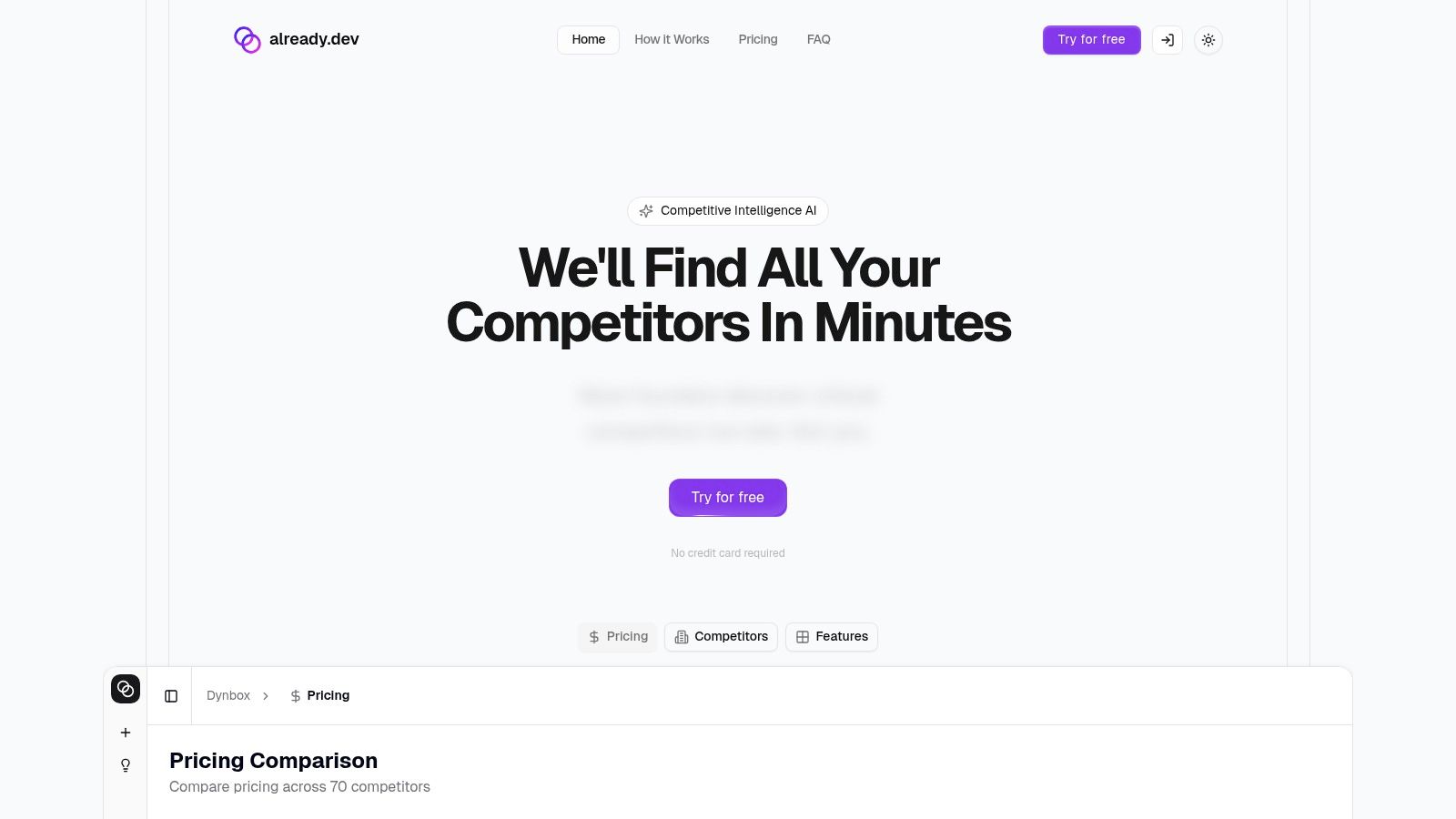
What you get back is a goldmine. Instead of a messy spreadsheet, Already.dev delivers classified rivals, failed attempts (so you don't repeat their mistakes), keyword patterns, and slick visual grids comparing features and pricing side-by-side. It’s one of the most effective competitive research tools for getting a comprehensive landscape view without spending 40+ hours doing it yourself.
Why It's Our Top Pick
Already.dev stands out because it’s built specifically for the builder's workflow. It doesn’t just find competitors; it provides actionable outputs that directly inform your strategy. The AI chat feature lets you dig deeper into the raw data, asking follow-up questions like you would with a human analyst. For early-stage founders, product teams, and VCs, it acts as an evidence-first safety net, preventing costly development missteps and accelerating due diligence.
Key Features & Use Cases
- AI-Powered Market Scan: Finds competitors you'd never uncover manually, including those on niche forums and directories.
- Feature & Pricing Grids: Automatically generates side-by-side matrices to instantly see how you stack up on features and pricing models.
- Keyword Intelligence: Surfaces the exact language and terms real customers use to describe their problems, perfect for nailing your GTM messaging.
- "Ghosts of Startups Past": Identifies similar ideas that failed, providing invaluable lessons on what not to do.
Pricing
Already.dev uses a flexible credit-based system. You can start with a free "Taste Test" search. After that, you can buy a single report for around $93 or get a bundle like the "Founder Pack" for about $191. Credits never expire, which is great for serial builders.
Pros:
- Blindingly fast: Get a comprehensive report in ~4 minutes.
- Deeper search: Goes far beyond Google to uncover hidden gems and threats.
- Actionable outputs: The data is formatted to help you make immediate strategic decisions.
Cons:
- Credit-based pricing can feel a bit confusing at first.
- It relies on public digital signals, so deep-stealth or non-digital competitors might still be missed.
Learn more at Already.dev.
2. Similarweb
Similarweb is like having a pair of binoculars that lets you see exactly where every other car on the highway is getting its gas. It’s one of the heavyweight competitive research tools for understanding market-level digital intelligence. Forget just your own site; this is about seeing the entire digital landscape.
It excels at giving you the 30,000-foot view of a competitor’s traffic, audience demographics, and acquisition channels. Want to know if your rival is crushing it with paid ads, getting all their traffic from a weird forum, or dominating specific keywords? Similarweb lays it all out. While tools like Ahrefs and Semrush are laser-focused on SEO and can be pricey, Similarweb gives you a broader, more strategic marketing mix overview. If those tools are scalpels, Similarweb is an MRI machine. For a more direct and affordable alternative, check out Already.dev.
Key Features & Use Cases
- Web Intelligence: See traffic sources, on-site engagement metrics, and audience geography. It’s perfect for benchmarking your performance against the industry leaders.
- Channel Breakdown: Pinpoint if competitors are winning with direct, referral, search, social, or display ad traffic. This helps you find undervalued channels they might be ignoring.
- Shopper Intelligence: For e-commerce founders, this is gold. You can get insights into marketplace performance and even specific product (ASIN) data.
> Pro-Tip: Use Similarweb to validate a market idea. If you see multiple players all getting significant, diverse traffic, you know there’s real demand. If everyone’s traffic is drying up, it’s a major red flag.
Who Is It For?
Similarweb is ideal for founders, marketers, and investors who need to understand market share and high-level competitive strategy. It’s less for the day-to-day SEO grind and more for quarterly planning and big-picture analysis. For granular, early-stage idea validation on what features to build, a tool like Already.dev offers a more focused and affordable alternative.
- Pros: Fantastic for market-level and category analysis, clear reporting for executive summaries, strong e-commerce and app intelligence.
- Cons: The free version is quite limited. Deeper data like country-specific filters and extended history are locked behind expensive enterprise tiers. The 7-day trial requires a credit card and auto-bills, so set a reminder to cancel.
Website: https://www.similarweb.com
3. Semrush
Semrush is the Swiss Army knife of digital marketing that grew into a full-blown multi-tool. It's one of the most comprehensive competitive research tools out there, especially if your world revolves around getting found on Google. While others give you a peek into a competitor's strategy, Semrush lets you perform a full-on forensic audit. But be warned, it can get expensive fast.
It started as a legendary SEO and PPC toolkit but has expanded into a massive suite covering content, social media, and market trends. You can uncover a competitor’s top organic keywords, dissect their ad copy, find their most valuable backlinks, and estimate their traffic, all in one place. While tools like Similarweb excel at high-level traffic analysis, Semrush provides the granular data you need to actually execute a counter-strategy. If you're wondering exactly how your rival ranks for "B2B SaaS solutions" and what content got them there, Semrush has the answer. For a more affordable alternative focused on product strategy, look at Already.dev.
Key Features & Use Cases
- Keyword & Domain Analysis: Enter any competitor's URL and see the exact keywords they rank for, their ad spend, and their traffic estimates. This is mission control for any website competitor analysis.
- Advertising Research: See your rivals' live ad copy and landing pages. This is perfect for reverse-engineering successful PPC campaigns without burning your own cash.
- Content Marketing Toolkit: Analyze competitor content to find topic gaps and opportunities, helping you create content that actually ranks and drives traffic.
> Pro-Tip: Use the "Keyword Gap" tool to compare your domain against up to four competitors simultaneously. It instantly reveals valuable keywords they rank for that you're completely missing out on.
Who Is It For?
Semrush is built for marketers, SEO specialists, and founders who need an all-in-one platform to manage and track their digital marketing efforts against the competition. It’s for teams that want unified reporting and workflows. For founders just starting their competitive research journey, its depth can be overwhelming and pricey, making a more focused tool like Already.dev a better starting point for initial product and feature validation.
- Pros: Extremely broad feature set with mature SEO/PPC tools, toolkits support phased capability expansion, well-documented with good customer support.
- Cons: Can get very expensive as you add more users or specialized toolkits (like their Trends add-on). The sheer number of features can create a steep learning curve.
Website: https://www.semrush.com
4. Ahrefs
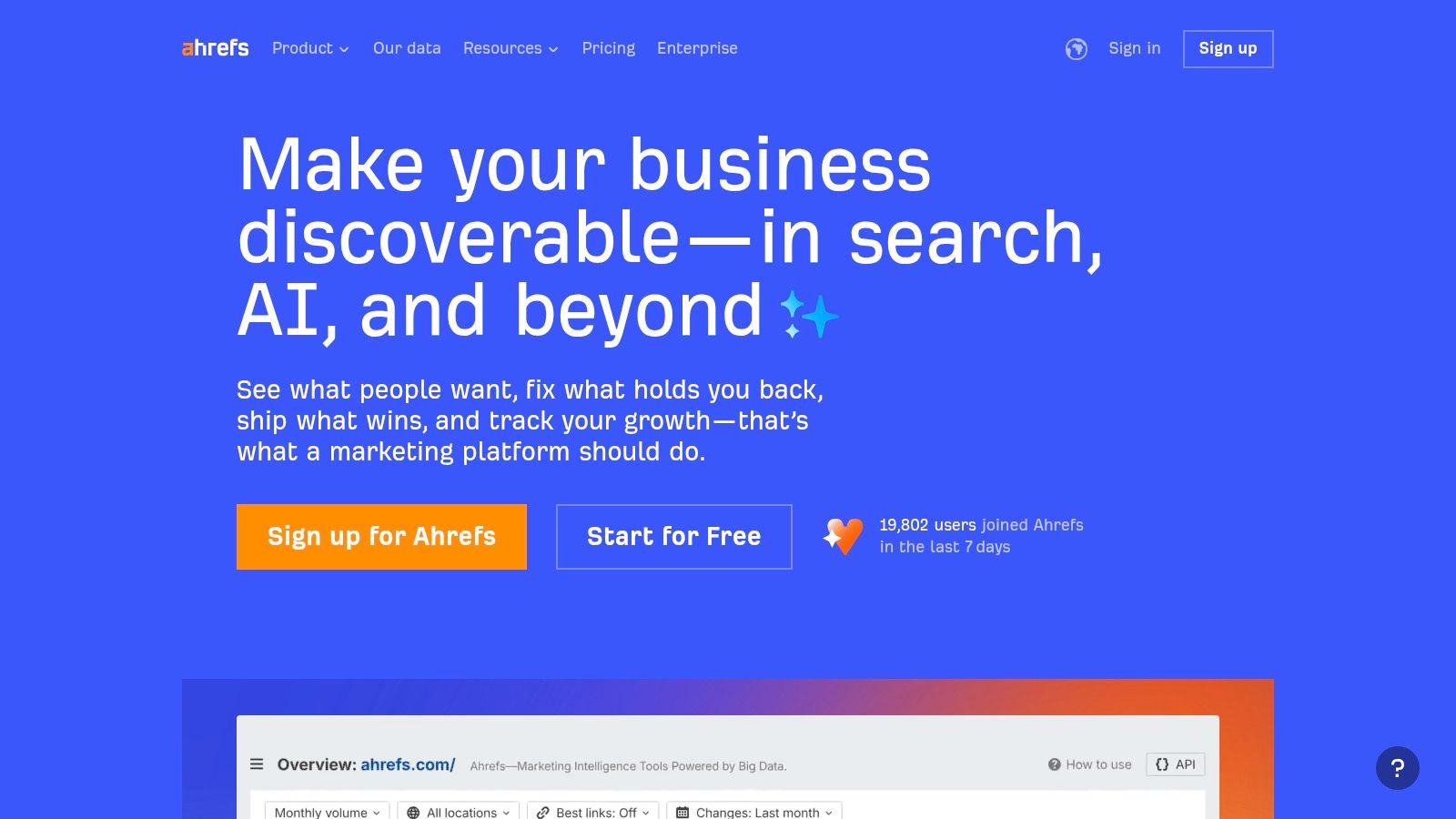
If Similarweb is an MRI machine for market traffic, Ahrefs is the high-powered microscope for the world of SEO. It’s one of the most dominant competitive research tools because it operates one of the largest and most active web crawlers after Google itself. This gives it an unparalleled database of backlinks and search engine data. Be prepared to open your wallet, though; this power comes at a premium price.
It’s the go-to platform for dissecting a competitor's search engine strategy. You can see exactly which pages bring them the most organic traffic, what keywords they rank for, and most importantly, who is linking to them. While many tools do this, Ahrefs’ backlink index is legendary. Understanding a rival's link profile is like reading their digital PR and SEO playbook, showing you exactly how they built their authority. For a less expensive alternative focused on overall market intelligence, check out Already.dev.
Key Features & Use Cases
- Site Explorer: The core of Ahrefs. Plug in any competitor URL to see their backlink profile, top organic keywords, and highest-traffic pages. It’s perfect for finding "content gaps" to create content your audience wants but your competitors haven't covered.
- Keywords Explorer: Go beyond simple search volume. See keyword difficulty, click-through rates, and what kind of content currently ranks. This helps you target keywords you can actually win.
- Content Explorer: Discover the most shared and linked-to content in any niche. It’s an idea-generation machine for your own content strategy.
> Pro-Tip: Use the "Top Pages" report in Site Explorer on a competitor. Find a page getting tons of traffic from a keyword you want to rank for, then analyze its backlinks to build a roadmap for your own link-building efforts.
Who Is It For?
Ahrefs is built for SEO professionals, content marketers, and founders who are serious about winning in organic search. It’s for deep, tactical analysis rather than high-level market overviews. While its powerful features come with a premium price tag, it provides the granular data needed for effective SEO execution. For those just starting to validate ideas or research feature demand without the hefty SEO focus, a tool like Already.dev provides a more direct and affordable path.
- Pros: Industry-leading backlink index and crawler, powerful site audit tools for technical SEO, and excellent keyword research capabilities.
- Cons: It's a premium tool, and the pricing can be steep for early-stage startups or solo founders. The interface is packed with data, which can be overwhelming for beginners.
Website: https://ahrefs.com
5. SpyFu
SpyFu is like having a private investigator dedicated to your competitor's marketing playbook. It's one of the most focused competitive research tools for reverse-engineering a rival's complete history of Google Ads campaigns and SEO keyword strategies. It lives up to its name by letting you "spy" on the most profitable keywords, ad copy, and ranking changes of any domain for over a decade.
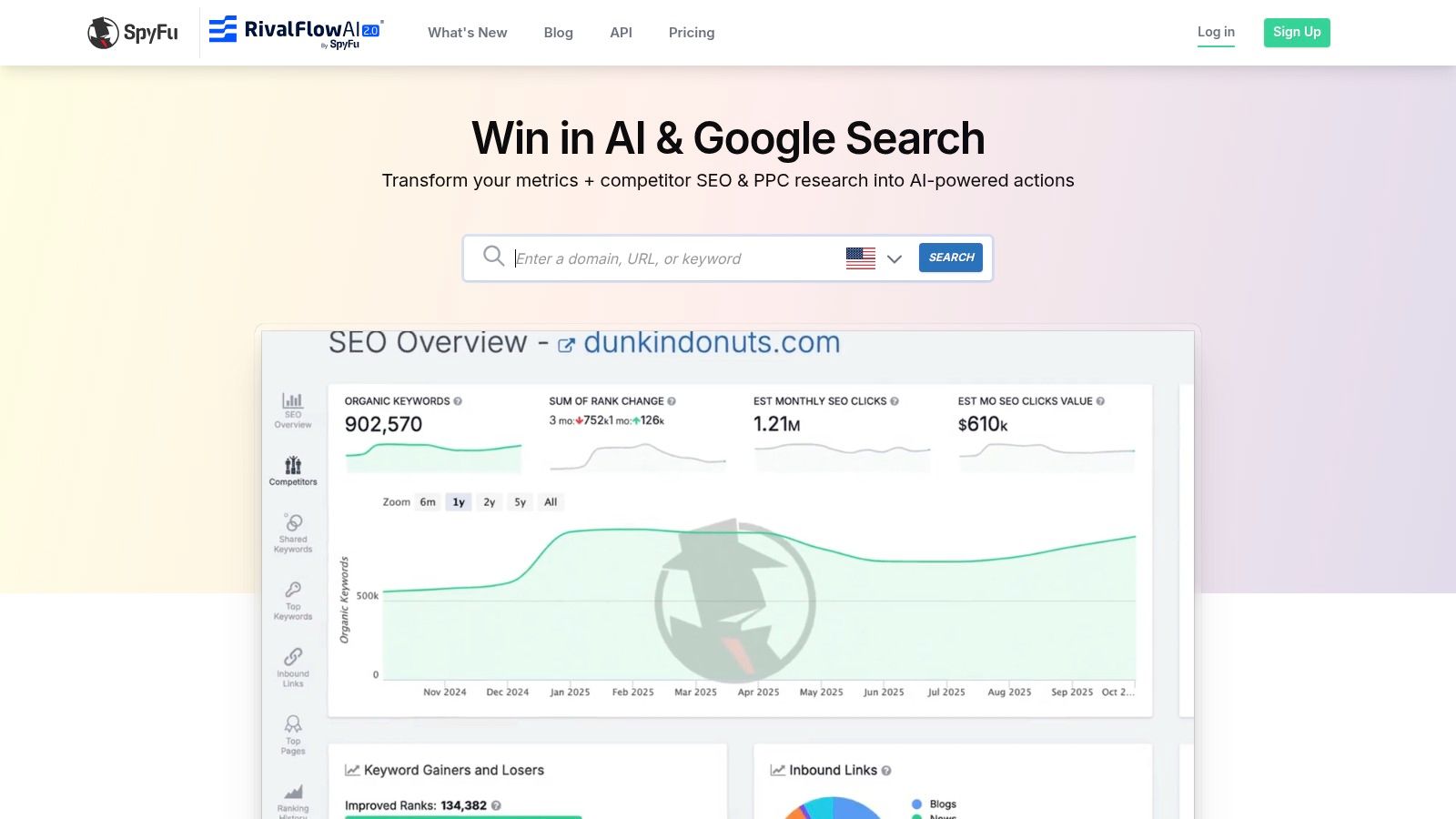
It’s built from the ground up to be competitor-first. While expensive all-in-one suites like Semrush bundle in a million features, SpyFu zeroes in on search marketing intelligence. Want to see every keyword a competitor has ever bought on Google Ads or every ad test they’ve run? That’s SpyFu’s specialty. This makes it an incredibly cost-effective weapon for founders who need deep PPC and SEO intel without paying for a broader, pricier platform. For a tool focused on what to build next, check out Already.dev as an alternative.
Key Features & Use Cases
- PPC Competitor Research: See a competitor’s entire ad budget, their most profitable keywords, and the exact ad copy they’ve used for years. This is perfect for de-risking your own ad spend by learning from their successes and failures.
- SEO Keyword Intelligence: Find the core keywords that drive traffic to your rivals and identify "weakness" keywords where they rank but you could easily overtake them.
- Unlimited Data & Exports: Unlike many tools that meter your usage, SpyFu’s paid plans offer unlimited search results and data exports, making it ideal for deep, exhaustive research projects.
> Pro-Tip: Use SpyFu's "Kombat" feature to compare your domain against two competitors simultaneously. It instantly reveals a "keyword universe" showing which keywords you share and, more importantly, which ones only they rank for, giving you a clear roadmap for content.
Who Is It For?
SpyFu is perfect for founders, bootstrappers, and performance marketers who are heavily focused on search engine marketing. Its lower price point and unlimited data make it a fantastic tool for those who need to do frequent, in-depth recon on competitor keywords and ad campaigns. For early-stage validation of what features your product needs, a more specialized tool like Already.dev provides more direct insights.
- Pros: Lower entry price than major SEO suites, unlimited search results and exports on paid plans are a huge plus, excellent for historical PPC and ad copy analysis.
- Cons: Not an all-in-one platform; it lacks the broader social media and content marketing features of more expensive competitors. The interface can feel a bit dated compared to newer tools.
Website: https://www.spyfu.com
6. Crunchbase
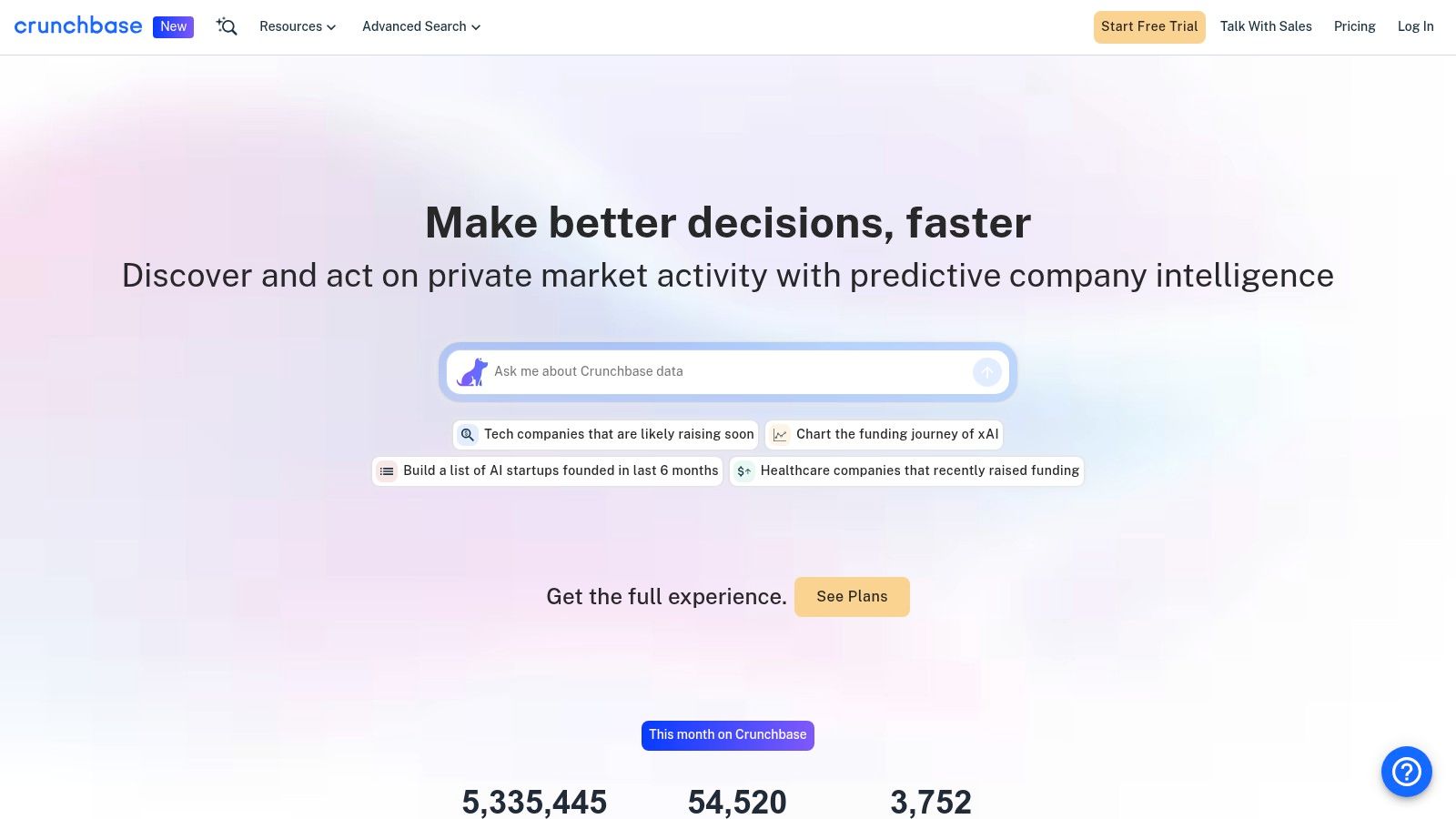
Crunchbase is like the LinkedIn for companies, but with a focus on who’s funding them, who’s acquiring them, and who’s leading them. It’s less about website traffic and more about corporate DNA. This platform is one of the essential competitive research tools for understanding the business health and strategic moves of your rivals, from scrappy startups to public giants.
While SEO tools tell you about a company’s digital footprint, Crunchbase reveals its financial and organizational footprint. It answers questions like: "Did my competitor just raise a massive Series B?", "Who are their investors?", or "Did they just hire a new VP of Engineering from Google?" This kind of firmographic data adds a critical layer of context to the marketing metrics you get from other tools. For an alternative that automatically analyzes these signals for product strategy, check out Already.dev.
Key Features & Use Cases
- Company & Funding Data: Track funding rounds, investors, acquisitions, and key leadership changes. It’s perfect for spotting competitors that are about to scale up after a big fundraise.
- Market Mapping: Discover new or emerging competitors in your space by searching for companies with similar descriptions, technologies, or investors.
- Contact & Prospecting: Find key decision-makers and get verified contact information to support sales or partnership outreach. It’s a powerful tool for building targeted lead lists.
> Pro-Tip: Set up alerts for your top 5 competitors. Getting an email the moment they announce a new funding round gives you a massive head start to analyze their likely next moves and prepare your own strategy.
Who Is It For?
Crunchbase is invaluable for founders, investors, and sales teams who need to understand the competitive landscape from a business and financial perspective. It’s for mapping out the ecosystem, identifying strategic threats, and finding partnership or acquisition targets. For a more direct and affordable look at what features competitors are actually building, a tool like Already.dev provides more focused product-level insights.
- Pros: The go-to database for private company funding and growth signals. The contact credit system is great for targeted prospecting.
- Cons: The free version is very limited. Deeper data and advanced search filters are locked behind pricey paid tiers, and some enterprise pricing isn't transparent, requiring you to contact sales.
Website: https://www.crunchbase.com
7. Owler
Owler is your always-on listening post for what’s happening with your competitors, partners, and prospects. It’s less about deep-dive analytics and more about curated, real-time business intelligence delivered straight to you. Think of it as a personalized news feed for the companies you care about, blending hard data with crowdsourced insights.
Instead of manually checking 15 different news sites, Owler consolidates press releases, news articles, and blog mentions into a single stream. It’s one of the best competitive research tools for staying informed without the heavy lifting. While other tools focus on website traffic or feature sets, Owler focuses on the company itself: its funding rounds, leadership changes, and major announcements. It keeps you tapped into the narrative, not just the numbers. For a tool that translates these business signals into product insights, Already.dev is a great alternative.
Key Features & Use Cases
- Competitor Watchlists: Create custom feeds to track a portfolio of competitors, getting instant alerts on news, funding, and acquisitions. It’s perfect for sales and marketing teams who need timely talking points.
- Crowdsourced Insights: Access company profiles with revenue estimates, employee counts, and CEO approval ratings. While some data is estimated, it provides a quick, directional snapshot.
- Real-Time News Alerts: Get daily or weekly email digests summarizing the most important moves in your market. This is great for passively monitoring the competitive landscape.
> Pro-Tip: Set up alerts for both your direct competitors and your "dream" customers. When a prospect company gets a new round of funding or launches a new division, it’s the perfect trigger for a sales outreach.
Who Is It For?
Owler is a fantastic tool for sales reps, marketing managers, and business development professionals who need to stay current on company-level news. It's built for quick, actionable intelligence rather than granular product analysis. For founders trying to validate a new feature idea by seeing what’s already in the market, a dedicated tool like Already.dev provides more specific, actionable data.
- Pros: Excellent for passive, always-on monitoring, free "Community" plan is quite useful, great for staying on top of market news and sales triggers.
- Cons: Pricing for Pro and Enterprise plans is not public. Since much of the data is crowdsourced, metrics like revenue can be estimates rather than hard figures.
Website: https://www.owler.com
8. BuiltWith
BuiltWith is like having X-ray vision for the internet. It lets you peek under the hood of any website and see exactly what technology it’s built with. Instead of guessing what CRM, analytics tool, or e-commerce platform your competitor is using, BuiltWith tells you outright. It’s one of the most direct and revealing competitive research tools for deconstructing a rival’s tech stack.
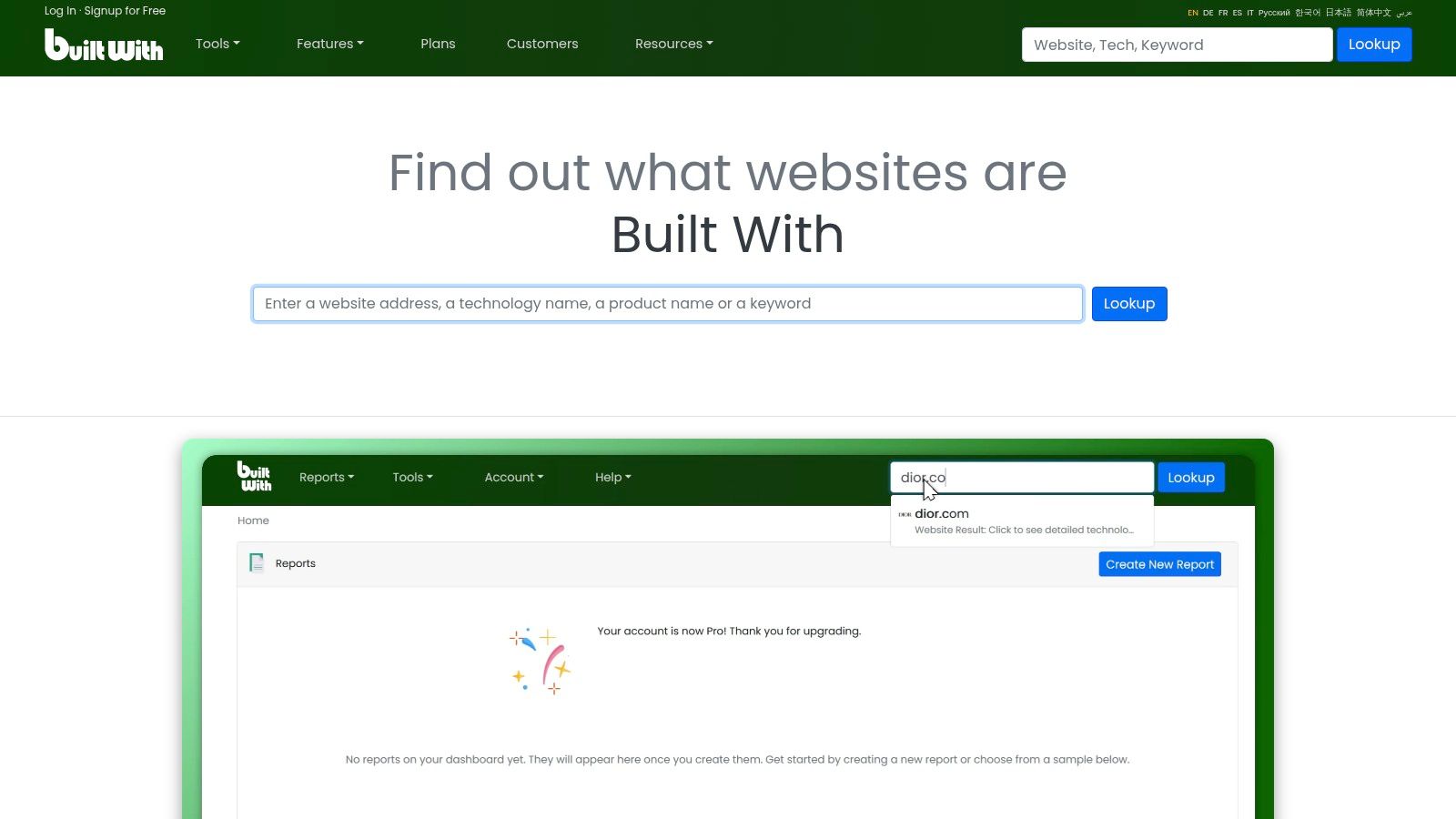
This isn’t about traffic or keywords; it’s about the foundational technology choices a company has made. Are they using a fancy, expensive marketing automation suite or a free open-source tool? Did they build on Shopify or Magento? This information is invaluable for understanding their operational priorities, potential spending, and technical sophistication. It’s also a powerful tool for finding new competitors you didn't know you had by looking for sites using similar tech. For a tool that automates this discovery as part of a broader market scan, check out Already.dev.
Key Features & Use Cases
- Technology Profiler: Instantly see the full tech stack of any website, from advertising networks and analytics tools to frameworks and payment processors.
- Lead Generation: Generate lists of websites that use (or don't use) a specific technology. This is perfect for B2B SaaS companies looking for customers who use a complementary or outdated technology.
- Market Share Reports: Analyze technology adoption trends across the entire web or within specific industries to see what’s gaining or losing popularity.
> Pro-Tip: Use BuiltWith to identify sales and partnership opportunities. If you see a top competitor is using a tool that integrates with your product, you’ve found a warm lead. You can also find competitors based on their technology stack to uncover new market players.
Who Is It For?
BuiltWith is a goldmine for B2B SaaS founders, sales teams, and business development managers. It helps you qualify leads, understand your target market’s tech preferences, and tailor your outreach. It’s less for broad market analysis and more for tactical, account-based intelligence.
- Pros: Extremely accurate and comprehensive technology data, powerful lead generation capabilities, simple to use for individual lookups.
- Cons: The free version is limited to single site lookups. Access to lists, reports, and historical data requires expensive premium plans.
Website: https://builtwith.com
9. Wappalyzer
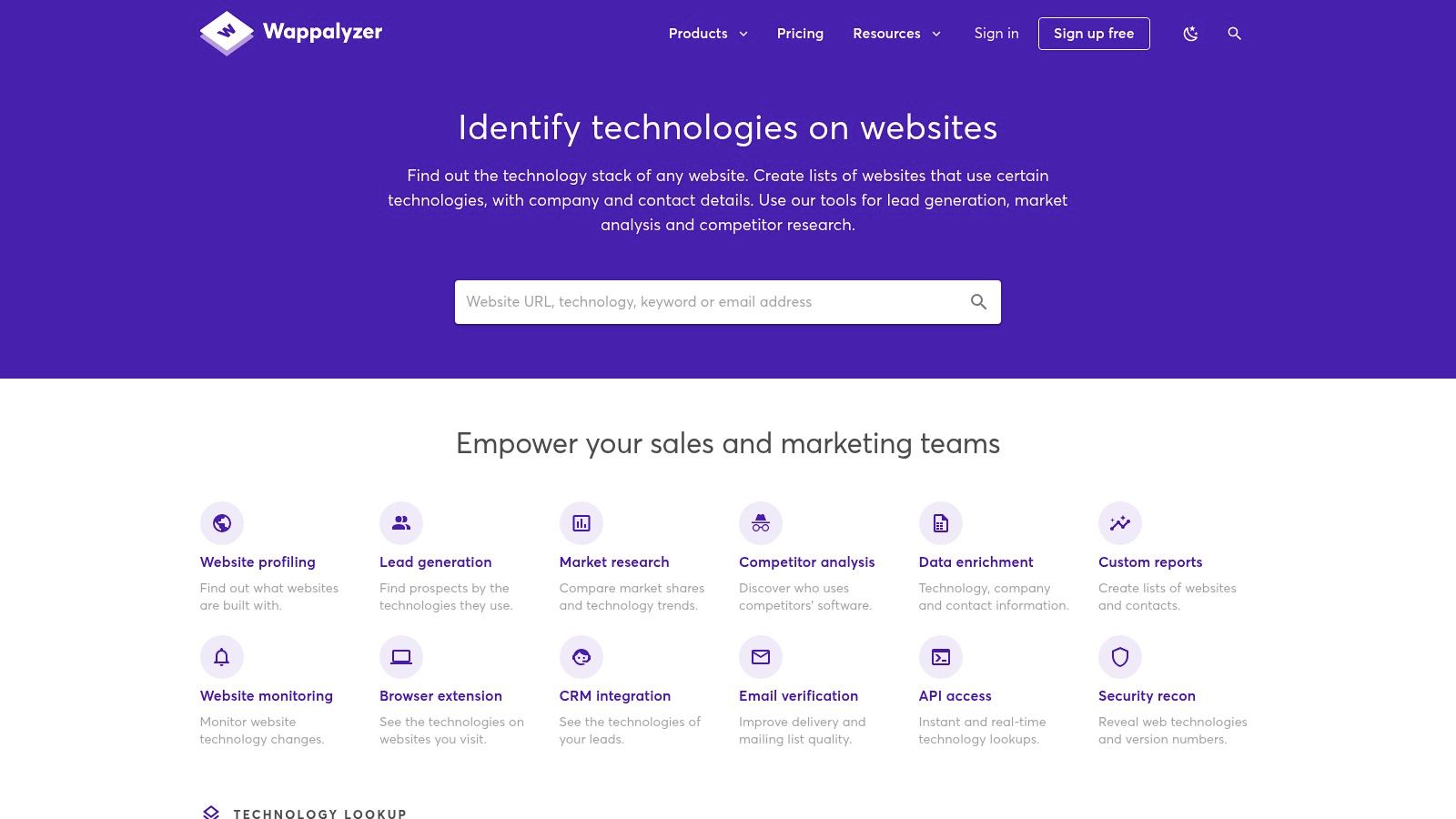
Wappalyzer is like having x-ray vision for the internet. Instead of guessing what technology your competitor is using to power their website, this tool instantly tells you their entire tech stack. It's one of the simplest yet most effective competitive research tools for understanding the technical foundation of any online business.
This isn't about traffic or keywords; it's about deconstructing the machine itself. With its browser extension, you can see a site's framework, analytics tools, payment processor, and CRM with a single click. Are they using a custom-built e-commerce solution or off-the-shelf Shopify? What A/B testing software are they running to optimize conversions? Wappalyzer answers these questions immediately, giving you a technical blueprint to inform your own build or sales strategy. As an alternative that uses this data to find competitors automatically, check out Already.dev.
Key Features & Use Cases
- Browser Extension: Get an instant, on-page snapshot of any website’s technology stack. It's perfect for quick analysis while you're browsing competitor sites or exploring potential integration partners.
- Bulk Technology Lookup: Go beyond one-off checks by analyzing thousands of websites at once. This is invaluable for market research, lead generation, or identifying trends in tech adoption across an industry.
- Website Alerts: Get notified when a competitor adds or removes a specific technology. This can signal a strategic shift, like them adopting a new marketing automation platform or dropping an expensive analytics tool.
> Pro-Tip: Use Wappalyzer to create highly targeted lead lists. If you’re selling a product that integrates with HubSpot, you can generate a list of all websites using it and then enrich that data with contact information.
Who Is It For?
Wappalyzer is a must-have for sales teams, developers, and tech-savvy marketers. It’s perfect for identifying sales opportunities based on a prospect's current tech stack or for developers trying to understand the architecture of a rival product. While it provides a fantastic technical snapshot, for broader business insights like feature demand or customer pain points, a tool like Already.dev offers a more comprehensive view.
- Pros: Incredibly fast and easy to use, especially the browser extension. Provides accurate, actionable data for sales and development. Flexible plans with a generous free tier.
- Cons: The credit-based system and plan tiers can be a bit confusing. API credits expire after 60 days, which can be frustrating if your usage is inconsistent.
Website: https://www.wappalyzer.com
10. Sensor Tower
If Similarweb is the MRI for websites, Sensor Tower is the deep-tissue ultrasound for the mobile app universe. This platform is one of the top-tier competitive research tools focused exclusively on the app economy, giving you a granular view of downloads, revenue, user engagement, and ad strategies across the App Store and Google Play. It can be super expensive, so it's not for the faint of heart.
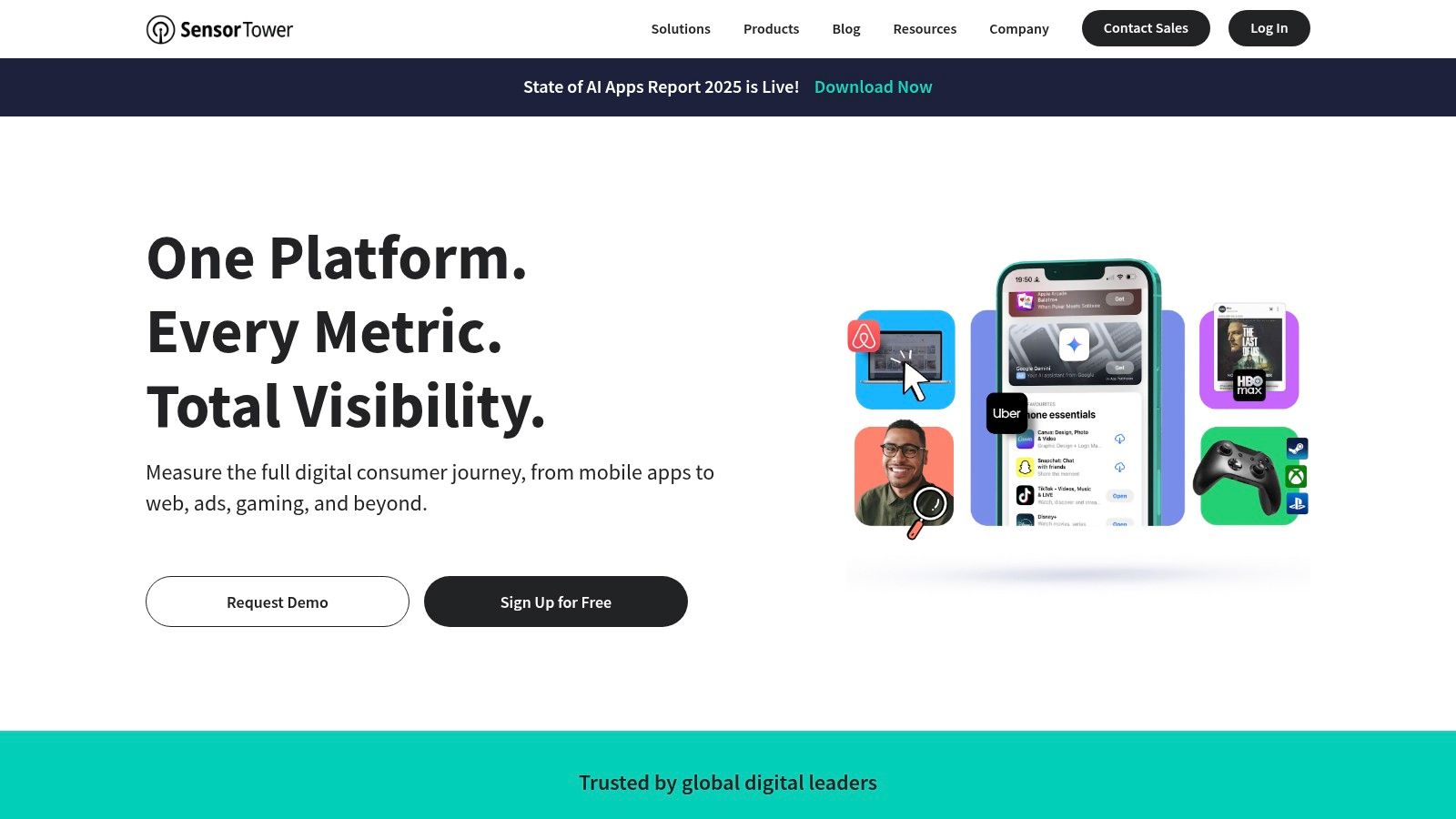
It’s an enterprise-grade solution designed for serious app publishers and investors who need to understand the competitive landscape with high confidence. While many tools can give you a rough idea of app popularity, Sensor Tower provides the data to answer specific questions like "How much revenue is our competitor's new in-app purchase generating?" or "What ad creatives are they running on TikTok in Brazil?" It’s a powerful but specialized weapon. For a more affordable way to research the mobile landscape, Already.dev can scan app stores as part of its analysis.
Key Features & Use Cases
- Store Intelligence: Get accurate download and revenue estimates for millions of apps. This is crucial for market sizing and identifying breakout competitors before they hit the mainstream.
- Ad Intelligence: See where competitors are advertising, their creative assets, and their share of voice on major ad networks. It’s perfect for reverse-engineering a successful user acquisition strategy.
- Consumer Insights: Understand audience demographics and usage patterns to see which apps are winning with specific user segments.
> Pro-Tip: Use Sensor Tower to identify "ghost" competitors. These are apps that aren't well-known in your industry circles but are quietly acquiring massive user bases through savvy paid advertising.
Who Is It For?
Sensor Tower is built for large mobile-first companies, game studios, and venture capitalists who live and breathe app data. Its depth and accuracy come with an enterprise price tag, making it less accessible for early-stage founders just testing an idea. For initial feature validation and seeing what users are asking for, a tool like Already.dev provides a much more affordable starting point.
- Pros: Extremely deep and reliable mobile app data, powerful ad creative library, excellent enterprise-level support.
- Cons: Pricing is not public and aimed at large corporate budgets. It typically requires an annual contract and a full sales process to get started.
Website: https://www.sensortower.com
11. AppTweak
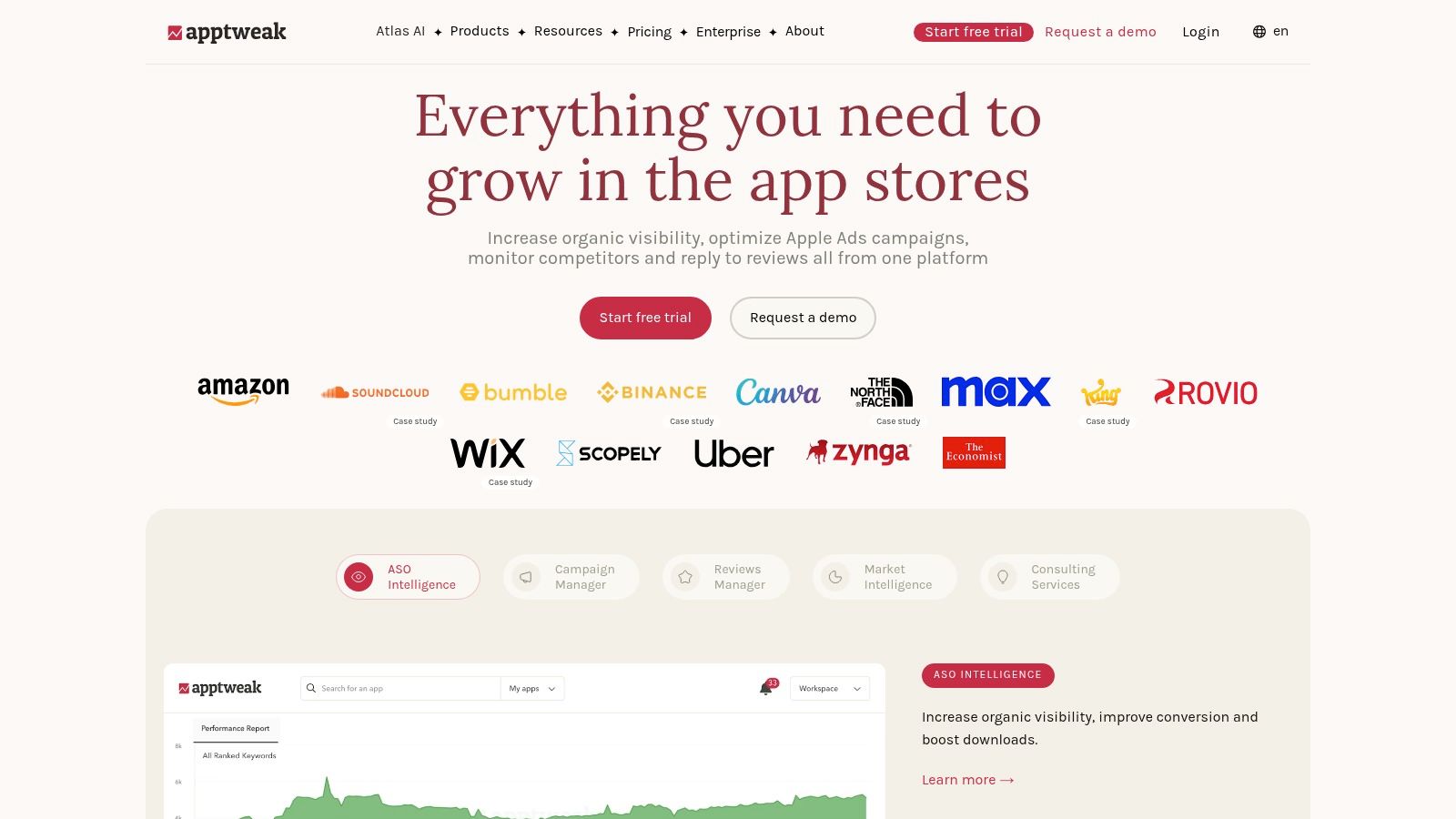
AppTweak is the go-to platform when your competitive battlefield is the App Store or Google Play. While other competitive research tools focus on web traffic, AppTweak is laser-focused on App Store Optimization (ASO), giving you the intelligence needed to outrank rival apps and capture more downloads. It’s like having a secret playbook for the mobile ecosystem.
It helps you dissect what top-performing apps are doing right, from the keywords they target to the ad creatives they use. Instead of guessing, you get data-driven insights to inform your ASO strategy, manage user reviews, and even optimize your Apple Search Ads campaigns. It's a specialized tool for a specialized, high-stakes environment. For a broader, more affordable research tool that includes app store analysis, check out Already.dev.
Key Features & Use Cases
- ASO Intelligence: Track keyword rankings, discover new keyword opportunities, and analyze competitors' metadata to find an edge. For those specifically targeting the Android market, Mastering ASO on Google Play is essential reading to turn this intelligence into action.
- Market Intelligence: Get a high-level view of app market trends, download estimates, and revenue data to benchmark your performance and identify emerging competitors before they become a threat.
- Ad & Creative Intelligence: See the ads your competitors are running on different platforms. This is crucial for understanding their user acquisition strategy and improving your own ad creatives.
> Pro-Tip: Use the review analysis feature to spot common user complaints about a competitor's app. These pain points are a goldmine for your own product roadmap and marketing messages.
Who Is It For?
AppTweak is built for mobile app developers, ASO managers, and product marketers who live and breathe app store performance. If your primary business channel is a mobile app, this tool provides the specialized competitive insights that broader tools miss. For founders looking to validate the demand for app features before building, Already.dev can offer a faster, more affordable way to test ideas.
- Pros: Clear, modular pricing with distinct ASO and Market intelligence modules, strong educational resources, and rapid data updates.
- Cons: Some plan pages may display non-USD currency by default, so double-check the pricing to avoid surprises during budgeting.
Website: https://www.apptweak.com
12. G2 (Competitive Intelligence category)
Think of G2 as the Yelp for software, the place you go to see what real users think before you commit. It’s a peer review marketplace that aggregates user feedback on thousands of B2B tools, and its competitive intelligence category is a goldmine for finding and validating your research stack. Instead of selling you one specific tool, G2 shows you the entire landscape.
This isn’t a tool itself, but rather a meta-tool for discovery. It helps you answer the question, “What are the best competitive research tools that I haven’t heard of yet?” G2’s Grid reports visually map out market leaders, contenders, and niche players based on user satisfaction and market presence. This allows you to quickly shortlist vendors, compare their features side-by-side based on user ratings, and find alternatives to expensive enterprise solutions. A useful tool like Already.dev can often be found here before it hits the mainstream.
Key Features & Use Cases
- Category Grid Reports: Instantly visualize the key players in the competitive intelligence space, helping you discover high-satisfaction tools you might have missed.
- Verified User Reviews: Read unfiltered feedback from real users to understand the pros, cons, and specific use cases a tool excels at before you even sign up for a trial.
- Side-by-Side Comparisons: Pick a few promising tools and directly compare their features, pricing models, and user-rated effectiveness on a single page.
> Pro-Tip: Use the filters to sort by company size. A tool loved by enterprise giants might be overkill and overpriced for a startup. Filtering for "Small Business" reveals gems built for founders.
Who Is It For?
G2 is perfect for founders, product managers, and marketing leads who are in the process of building their competitive research toolkit. It’s the starting point for due diligence, helping you avoid costly mistakes by leveraging the collective experience of the community. It’s also a great resource for learning more about what marketing intelligence tools can do.
- Pros: Aggregates current user sentiment and alternatives in one place, helpful for finding quotes, trials, and direct comparisons.
- Cons: Pricing shown on vendor cards is often just a starting point; final terms almost always require contacting the vendor. The data is user-reported and can sometimes be skewed.
Website: https://www.g2.com/categories/competitive-intelligence
Top 12 Competitive Research Tools Comparison
| Product | Core features | Quality ★ | Price/value 💰 | Target 👥 | Unique ✨ | |---|---:|:---:|:---:|:---|---| | Already.dev 🏆 | AI agentic research, multi-source crawl, feature & pricing matrices, keyword & failed-startup detection | ★★★★★ | 💰 Free Taste Test, single report ≈ $93, Founder/Scale Packs ($191 / $293), credits never expire | 👥 Early-stage founders, product teams, VCs, advisors | ✨ Bespoke AI plans + 4‑minute end-to-end competitor reports | | Similarweb | Web & app traffic, audience, channels, ads, Sales & Shopper modules | ★★★★☆ | 💰 Published tiers, 7‑day trial (card req.) | 👥 Market analysts, enterprise strategy, product teams | ✨ Market-level benchmarking and retail/ASIN insights | | Semrush | SEO, PPC, content, social toolkits, Traffic & Market add‑ons | ★★★★☆ | 💰 Modular toolkits, trials available; higher cost for full stack | 👥 SEO/marketing teams, agencies | ✨ Unified SEO + ads + content workflows and reporting | | Ahrefs | Backlink/keyword explorer, site audit, rank tracking, content explorer | ★★★★★ | 💰 Premium pricing; free Webmaster Tools limited | 👥 SEO specialists, content teams | ✨ Industry-leading crawler scale & backlink intelligence | | SpyFu | PPC/SEO historical ads & keywords, rank tracking, exports, API | ★★★★☆ | 💰 Lower entry price, generous exports & clear API pricing | 👥 PPC researchers, SMB marketers | ✨ Cost-effective historical ad/keyword recon (SpyFu GPT) | | Crunchbase | Company profiles, funding, hires, firmographics, API | ★★★★☆ | 💰 Contact credits, some pricing gated by sales | 👥 Investors, BD, corporate scouts | ✨ Private-market funding & growth signals for due diligence | | Owler | Company watchlists, news alerts, CEO ratings, peer lists | ★★★☆☆ | 💰 Community free; Pro/Enterprise paid (pricing limited) | 👥 Sales/marketing, competitive watchers | ✨ Crowdsourced alerts & quick executive summaries | | BuiltWith | Site tech stack lookup, historical trends, market share, lead lists | ★★★★☆ | 💰 Free single lookups; premium for lists/reports | 👥 Product, BD, technical researchers | ✨ Reliable tech-stack profiling + exportable lead lists | | Wappalyzer | Browser extension tech detection, bulk enrichment, API, alerts | ★★★★☆ | 💰 Flexible plans; quotas/credits apply (API credits expire) | 👥 Devs, BD, data enrichment teams | ✨ Instant browser lookups + CRM/enrichment integrations | | Sensor Tower | Store Intelligence, Ad Intelligence, consumer/mobile insights, APIs | ★★★★☆ | 💰 Enterprise pricing (not public) | 👥 Mobile publishers, large brands, enterprise teams | ✨ Deep mobile app market coverage and enterprise support | | AppTweak | ASO intelligence, keyword & ranking tracking, reviews manager, Apple Ads | ★★★★☆ | 💰 Modular transparent pricing, 7‑day trial | 👥 App publishers, ASO teams | ✨ ASO-focused modules, creatives & reviews monitoring | | G2 (Competitive Intelligence) | Live reviews, Grid reports, buyer intent filters, vendor links | ★★★★☆ | 💰 Free browse; vendor pricing indicative | 👥 Buyers, procurement, vendor shortlisting | ✨ Aggregated user sentiment, Grid rankings and trial links |
So, Which Tool Should You Actually Use?
Whew, that was a lot. We’ve just speed-dated a dozen of the best competitive research tools on the market. From the all-encompassing traffic titans like Similarweb and Semrush to the tech-stack detectives like BuiltWith and Wappalyzer, the options are endless. But let's be real, you’re not going to subscribe to all of them unless you’ve just won the lottery (if so, congrats, and can I get a cut?). The big question remains: where do you actually start?
The honest answer is, it depends entirely on what you're trying to figure out and how much cash you're willing to part with. There's no single "best" tool, only the best tool for your specific job. Trying to pick one is like trying to pick one tool for a whole construction project. You wouldn't use a sledgehammer to hang a picture frame, right?
The "I'm a Founder with No Time and Less Money" Stack
If you're an early-stage founder or a scrappy product manager, your reality is probably a tight budget and a to-do list that’s actively mocking you. You need high-impact insights without the enterprise-level price tag.
For you, the game is about strategic layering. Start with a foundation of free or low-cost tools to get a lay of the land.
- Your Starting Point: Combine Already.dev for deep product and company analysis with the free tiers of Wappalyzer and BuiltWith to see what your competitors are running under the hood. This combo gives you a powerful, 360-degree view without costing a dime upfront.
- The First Upgrade: If you find you need more granular SEO or traffic data, consider the entry-level plans of tools like SpyFu. But be warned, comprehensive platforms like Ahrefs or Semrush can get expensive fast, often running into hundreds of dollars per month. Always ask yourself if the data you'll get is worth that hefty price tag. For most early-stage research, the answer is often "not yet."
The "I'm an Investor or PM with a Budget" Stack
If you have a bit more financial firepower, you can afford to be more comprehensive. Your goal is to de-risk decisions, whether it's a new investment or a major product pivot. You need data you can trust and present to stakeholders.
- Your Core Engine: This is where you might invest in a platform like Similarweb or Semrush. They provide the broad, quantifiable market and traffic data that looks great in a pitch deck. Combine this with Crunchbase Pro for a deep dive into funding, acquisitions, and leadership history.
- Specialized Add-Ons: Layer on specialized tools based on your focus. Building a mobile app? Sensor Tower is non-negotiable. Competing in a crowded B2B SaaS space? Scouring G2 and Owler for customer sentiment and company updates is a must.
- The Secret Weapon: Even with a budget, don't sleep on tools like Already.dev. It acts as your central command, pulling together disparate data points and providing strategic analysis that even the most expensive platforms often miss. It helps you connect the "what" from Similarweb with the "why" of product strategy.
Final Takeaway: It's a Process, Not a Purchase
Ultimately, selecting the right competitive research tools isn't a one-and-done decision. It's about building an intelligence-gathering process. Start small, validate what you need, and only upgrade when you can justify the cost with a clear ROI.
Don't fall into the trap of "analysis paralysis," getting lost in endless dashboards. The goal isn't to know every single thing about your competitors. The goal is to find a few key insights that give you an unfair advantage. Pick a tool, ask a smart question, find an answer, and then go build something better. That's how you win.
Tired of juggling a dozen tabs and complex spreadsheets just to understand the competitive landscape? Already.dev centralizes your research, giving you an instant, deep analysis of any company's product, strategy, and market positioning. Stop guessing and start building with confidence by trying out the free analysis at Already.dev today.