A Founder's Guide To Competitor Intelligence Analysis
Stop guessing. This guide makes competitor intelligence analysis simple, with actionable steps to uncover market gaps and give your business a real edge.

Let’s be real, competitor intelligence analysis sounds like something you'd hear in a spy movie, probably whispered by a guy in a trench coat. And honestly? It's not that far off. It's the art of ethically snooping on your rivals to figure out what they’re up to, what's working for them, and how you can totally crush them. Think of it as your secret playbook for a crowded market.
What Competitor Intelligence Analysis Really Means

Forget the boring business school definitions. At its core, competitor intelligence is about seeing around corners. It’s the craft of piecing together public clues to decode your competition's entire game plan. This isn’t about digging through their trash cans at midnight; it's about making smart moves based on data that's just sitting there, waiting for you.
Good intel is what separates a product launch that lands with a dull thud from one that people are buzzing about for weeks. In today's market, flying blind isn’t just risky—it’s basically a business suicide mission.
Why It's More Than Just Googling Your Competitors
Googling your competitor is a start, but that's like calling yourself a chef because you successfully made toast. True intelligence work goes way deeper. It’s a real process designed to give you an actual strategic edge. It involves gathering raw data and then giving it context, often through practices like company data enrichment, which turns basic info into actionable insights about what they're really up to.
You're basically a detective, trying to answer the big questions:
- What are they selling? And do their features actually stack up against yours, or is it all marketing fluff?
- How much are they charging? Are they the cheap option or the fancy, pinky-out premium choice?
- Who are they selling to? Are you two fighting over the same small pool of customers?
- What's their marketing playbook? Where are they dropping ad money, and what story are they telling?
The point isn't to become a cheap knock-off. It’s about finding their blind spots, spotting gaps in the market they've completely missed, and feeling confident about what makes you awesome.
> A solid competitor intelligence analysis helps you stop guessing and start making data-backed moves. It’s about learning from their wins and (even better) their screw-ups so you don't have to learn everything the hard way.
The Growing Need for Smart Intel
This isn't just for giant corporations with entire floors dedicated to "synergy" anymore. The competitive intelligence industry was valued at a whopping USD 8.2 billion in 2023 and is projected to more than double to USD 16.8 billion by 2030. That kind of growth tells you one thing: this is now a must-have for everyone.
For startup founders, AI-powered platforms are a total game-changer, generating custom reports that break down a rival's whole strategy in minutes, not weeks. Instead of spending days glued to a screen, you can use tools to do the boring part for you.
While big-name SEO tools like Ahrefs or Semrush are super powerful, they can be crazy expensive. For a more focused approach, a tool like Already.dev automates the most annoying parts of the process, delivering clear, useful insights without you having to sell a kidney.
Why Competitor Analysis Is Your Startup's Best Kept Secret
Let's be honest, you've got a million things to do. The thought of spending hours sifting through what your competitors are up to probably sounds exhausting. But what if I told you this isn't just another box to check? It's actually a shortcut to saving a massive amount of time and, more importantly, a ton of cash.
Think of building a startup like trying to cross a minefield. Every step you take is a gamble. A solid competitor intelligence analysis is like getting your hands on the map showing where all the mines are. It helps you dodge the kind of explosive mistakes that have blown up countless other businesses.
Avoid the Classic Trap: Building Something Nobody Wants
The startup graveyard is littered with beautifully crafted products that solved a problem no one actually had. It’s a heartbreaking and expensive lesson to learn. By looking closely at your competitors, you can see which features their customers can't live without, what they're constantly complaining about, and what they're practically begging for in online forums and reviews.
This kind of intel is pure gold. It lets you:
- Validate your core idea before you even think about writing a single line of code.
- Spot crucial feature gaps that you can swoop in and fill, giving you an instant edge.
- Dodge the temptation to over-engineer your product with shiny features your target audience simply doesn't care about.
Instead of just guessing what the market might want, you're making smart, informed decisions based on real customer behavior. That's how you build something people are genuinely excited to pay for right out of the gate.
Carve Out Your Niche in a Crowded Market
In a noisy market, being just another "me-too" product is a surefire way to fail. Competitor analysis is your secret weapon for finding a unique spot to call your own. Once you understand exactly how your rivals position themselves, you can find the gaps and create a Unique Selling Proposition (USP) that actually means something.
Maybe your biggest rival is notorious for terrible customer service. Boom—there's your opening. Or perhaps everyone is laser-focused on huge enterprise clients, leaving a massive, underserved market of small businesses wide open. You can only see these opportunities if you're actually paying attention.
> Ignoring your competitors is like playing poker without looking at the other players. You might have a great hand, but you have no idea what you’re up against, and you’re probably going to lose your shirt.
This isn't just a gut feeling; the numbers tell the same story. The competitive intelligence market was valued at USD 2.5 billion and is projected to explode to USD 6.8 billion by 2033. This incredible growth highlights just how vital it is for founders and VCs to get a grip on the competitive landscape. It's the best way to avoid becoming one of the 42% of startups that fail simply because there's no market need. You can read more about how market trends are shaping this space.
Make Smarter Moves, Faster
From setting your price to figuring out your marketing message, every decision you make is a calculated risk. Good intel dramatically improves your odds. Wondering if a freemium model is the way to go? See how it’s playing out for others in your niche. Not sure which marketing channels to pour your budget into? Find out where your competitors are getting their best traction.
Of course, tools like Ahrefs or Semrush can give you a firehose of SEO data, but they can be expensive and way too complex for what a startup really needs. A more focused platform like Already.dev is built to answer these big strategic questions quickly. It can turn what would have been a week of tedious, manual research into a clear, actionable report, helping you stop wasting money on dead-end experiments and start making moves that actually push your business forward.
Your Competitor Analysis Playbook
Alright, game time. You get that this stuff is important, but where do you actually start? Let’s turn this from a vague concept into a simple, actionable playbook. Think of it less like a boring research project and more like a strategic mission.
First things first, you need to know who you’re really up against. It's not always the company that looks just like yours. You’ve got to identify all three types of rivals lurking out there.
Know Your Enemies
Your competitors fall into a few key categories, and ignoring any of them is a rookie mistake.
- Direct Competitors: These are the obvious ones. The Coke to your Pepsi. They sell a very similar product to the same audience, trying to solve the exact same problem.
- Indirect Competitors: This is where it gets interesting. These folks solve the same core problem but with a totally different solution. Think about a restaurant’s indirect competitors—it’s not just other restaurants, but also meal delivery kits and even grocery stores.
- Future Competitors: These are the upstarts and giants who aren’t in your space yet but could easily pivot and become a major threat. A good competitor intelligence analysis keeps an eye on the horizon for these potential disruptors.
Once you’ve got your list, the real fun begins. It's time to gather the intel that actually matters. Don't fall into the trap of collecting every scrap of data you can find; you'll just drown in spreadsheets. Focus on the good stuff.
What Data Is Actually Worth Collecting
Your mission is to find actionable insights, not to write a novel about every competitor. Zero in on the data points that will help you make smarter decisions.
- Pricing and Business Model: How much do they charge? Is there a free trial, a freemium plan, or annual discounts? This tells you how they value their product and who they’re trying to attract.
- Key Features and USP: What are their killer features? More importantly, what’s their Unique Selling Proposition (USP)? What’s the one big thing they shout about in all their marketing?
- Customer Reviews and Complaints: Scour sites like G2, Capterra, and Reddit. Customer complaints are a goldmine of opportunities, highlighting their weaknesses and unmet needs you can solve.
- Marketing Angles and Channels: Where are they spending their time and money? Are they all over LinkedIn ads, or are they crushing it with SEO and content? This shows you which channels work in your niche. We have a whole guide on how to structure this process if you want to go deeper on how to conduct a competitive analysis.
This process is exactly how competitor analysis helps you dodge risks, save money, and save time on your path to building something great.
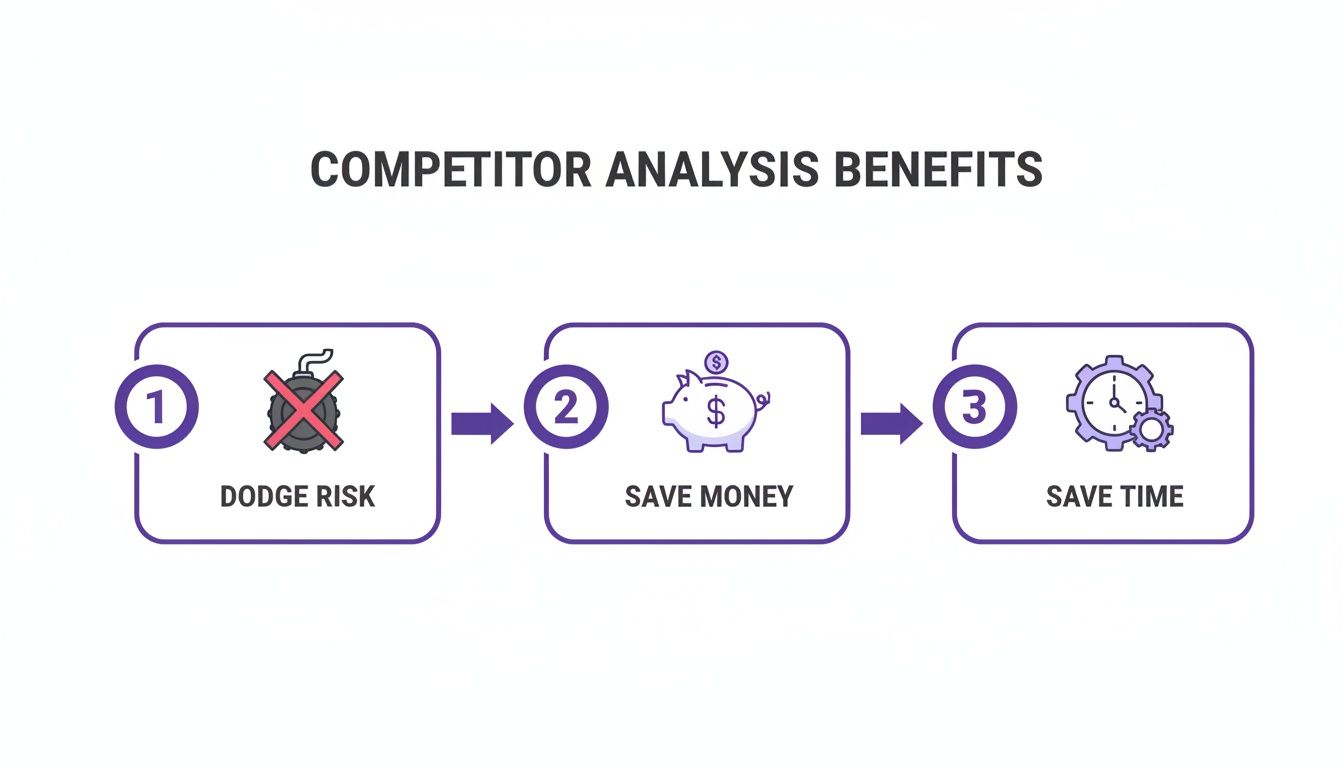
The takeaway here is simple: good intel helps you sidestep market landmines and avoid wasting precious resources on dead-end ideas.
The Old Way vs The Smart Way
So, how do you actually gather all this information? You could do it the old-fashioned way. Fire up a dozen browser tabs, create a monster spreadsheet, and manually copy-paste everything you find. You’ll get there eventually, but it’s a soul-crushing, 40-hour slog that’s tedious, prone to errors, and outdated the moment you finish.
Or, you can do it the smart way.
> The biggest shift in competitor intelligence is moving from manual grunt work to automated insight. The goal isn’t to have more data; it’s to get to the right answers faster.
Let's look at a quick comparison.
Manual vs. Automated Competitor Research
This table really spells out the trade-offs between grinding it out by hand and letting a smart tool do the heavy lifting.
| Aspect | Manual Research (The Hard Way) | Automated with Already.dev (The Smart Way) | | :--- | :--- | :--- | | Time Investment | 20-40+ hours of tedious, manual work. | Under 5 minutes to get a comprehensive report. | | Data Scope | Limited to what you can find and copy yourself. | Scans hundreds of sources, from review sites to job boards. | | Accuracy | High risk of human error and outdated information. | Real-time, up-to-date data with minimal error. | | Insight Quality | You're stuck connecting the dots on your own. | AI-powered analysis uncovers hidden patterns and opportunities. | | Cost | "Free" if your time is worthless. Otherwise, very expensive. | Affordable and provides a massive ROI in saved time. |
The difference is pretty stark.
This is where AI-powered tools come into the picture. While big platforms like Semrush or Ahrefs are fantastic for deep SEO data, they're often expensive and overkill for founders who need answers about product and strategy, not just keywords.
A specialized tool like Already.dev is built for this exact mission. You just describe your idea, and it automatically scours the web to find every competitor, analyze their features, map their pricing, and summarize what customers are saying.
What used to be a week of manual labor becomes a concise, automated report in minutes. This frees you up to do what actually matters: thinking, strategizing, and building a better product.
Choosing Your Competitor Intelligence Tools
Alright, let's talk about your spy kit. You've got the mission, now you need the right gadgets. A solid competitor intelligence analysis hinges on having the right tools for the job, but that doesn't mean you need to break the bank.
In fact, you can start gathering intel for the low, low price of free. Seriously.
Never underestimate the power of a well-crafted Google search. Using advanced operators like "site:" or putting phrases in quotes can unearth customer complaints, hidden pricing pages, and marketing content you'd otherwise miss. Pair this with Google Alerts for your competitors' brand names, and you've got a free, automated system tracking their every public move.
Starting with the Free Stuff
Before you ever pull out a credit card, you can paint a surprisingly detailed picture of the competitive landscape. Your initial toolkit should include:
- Social Media Sleuthing: Go beyond just following their accounts. Dive into the comments on their posts. What are customers loving? What are they complaining about? This is pure, unfiltered feedback.
- Review Site Reconnaissance: Websites like G2, Capterra, and even Reddit are absolute goldmines. You'll learn about feature gaps, pricing frustrations, and customer service nightmares—all prime opportunities for you.
- Newsletter Sign-ups: Get on their email list. You’ll see exactly how they talk to their audience, what they're promoting, and the kinds of deals they offer.
This manual approach is a fantastic starting point. The catch? It's slow, tedious, and it’s entirely on you to connect all the dots. When you’re ready to level up, it’s time to look at paid tools.
The Big Guns (And Their Big Price Tags)
This is where you'll hear names like Ahrefs and Semrush. These platforms are incredibly powerful for digging into SEO, keyword strategies, and backlink profiles. They can tell you exactly what your competitors are ranking for and where their website traffic is coming from.
But let's be real—they can be wildly expensive. We're talking hundreds, sometimes thousands, of dollars a month. They’re also complex, often built for marketing agencies, not a founder or product manager who just needs clear, strategic answers. It’s like using a sledgehammer to hang a picture frame. If you want something that doesn't require a second mortgage, check out an alternative like Already.dev. When picking your platforms, it's smart to explore various AI tools for B2B marketing that can sharpen your analysis without the enterprise-level cost.
A Smarter, Faster Alternative
This is where a purpose-built tool really shines. Instead of drowning in a sea of SEO metrics, you need a platform designed to answer the core strategic questions that actually matter.
> The best tool isn't the one with the most features; it's the one that gets you to the right answer the fastest. You're looking for actionable insights, not a data firehose.
This is exactly why we built Already.dev. It’s not another overwhelming SEO suite. It's a focused, AI-driven platform designed to automate the most painful parts of competitor research. You don’t need to juggle a dozen different tools and spreadsheets—you just tell it about your idea, and it does the heavy lifting.
The platform immediately gets to work, generating a research plan tailored to uncover both your direct rivals and indirect threats. It’s all about replacing hours of manual clicking and copying with a single workflow that delivers answers in minutes. For a deeper dive into your options, check out our guide on the best competitive intelligence tools available today.
The demand for these smarter tools is skyrocketing. The global market is expected to jump from USD 495.2 million to over USD 1.1 billion by 2032. With 90% of Fortune 500 companies using competitive intel, it's clear that this isn't a trend; it's a necessity for survival.
How To Turn Your Findings Into Action
So, you’ve done the hard work. You’ve gathered a mountain of data on your competitors, and it’s all sitting there in a beautiful spreadsheet or a neat report, looking official and important.
Now what?
Don’t let that effort go to waste and become a digital paperweight. The whole point of competitor intelligence analysis isn't just to know things—it's to do things. This is the moment you turn all that raw intel into your next big strategic move.
Think of it this way: you’ve just scouted the other team’s playbook. Now it’s time to call your own plays.
The Stop-Start-Continue Framework
Forget those stuffy, old-school frameworks that feel like homework. Let's keep this dead simple. For every single competitor you've looked at, run their strategies through this basic filter: What should we STOP doing, START doing, and CONTINUE doing?
This simple gut-check forces you to translate vague findings into concrete actions for your product, marketing, and sales teams.
Here’s what that looks like in the real world:
- STOP: Did you find out a competitor tried a specific marketing channel and it completely bombed? Perfect. You can stop even considering that channel for now and save yourself a ton of cash.
- START: Are your competitor's customers constantly complaining in online reviews about a missing feature? Fantastic. That’s a massive signal for you to start building it.
- CONTINUE: Is your main rival getting absolutely hammered because their pricing is a confusing mess? Excellent. That’s validation to double down on your simple, transparent pricing model.
This isn’t about blindly copying what others are doing. It's about learning from their wins and—even more importantly—their very public mistakes.
> Competitor intelligence isn't about looking over their shoulder to cheat on the test. It's about seeing which questions they got wrong so you don't make the same mistakes.
Turning Intel into Product Strategy
Your product roadmap shouldn't be built in a bubble. What your competitors are doing (and not doing) is a goldmine of ideas for what to build next.
Spotting Feature Gaps: Your competitor’s customer reviews are your secret weapon here. When you see a dozen people begging for a specific integration or griping about a clunky workflow, that's not just feedback for them—it's a neon sign flashing directly at you. This is how you find high-demand features your rivals are sleeping on.
Anchoring Your Pricing: Figuring out pricing can feel like one of the scariest decisions for any founder. Use your competitor’s pricing as an anchor point. Are they positioning themselves as the expensive, premium option? Maybe there’s a huge, untapped market for a more affordable, focused solution. Are they in a race to the bottom on price? That’s your chance to go the other way and offer a higher-touch, premium service.
Stealing Their Marketing Playbook (The Right Way)
You don’t have to reinvent the wheel with your marketing. Your competitors have already spent their own money testing what works in your market.
Just look at where they’re succeeding and where they’re falling flat. If their blog is pulling in tons of organic traffic, that’s a pretty good sign that content marketing works in your niche. If their social media ads are getting roasted in the comments, you know exactly what messaging to avoid.
While big SEO tools like Ahrefs or Semrush can give you tons of data, they can also be seriously expensive. For a more direct and affordable approach, a tool like Already.dev can quickly show you the keywords and marketing angles your rivals are actually using to win over customers.
This is also where sales teams can gain a massive edge. Understanding a competitor's weaknesses helps them create powerful talking points that close deals. You can build out detailed profiles, often called competitor battle cards, to arm your sales reps with the exact ammo they need to win.
At the end of the day, the goal is to make confident, strategic decisions that push your business forward. Good intelligence is the fuel for that engine—it turns pure guesswork into a clear, actionable plan for winning your market.
Common Competitor Analysis Mistakes To Avoid
We all make mistakes. It’s part of the process. But when you’re digging into competitor intelligence, some fumbles are way more costly than others. Here’s a quick rundown of the classic blunders to sidestep so your hard work actually moves the needle.
Getting this right turns your analysis into a genuine strategic weapon, not just another report that gathers digital dust.
Mistake 1: Only Watching the Big Dogs
It's tempting to fixate on the household names, the big players everyone in your industry talks about. But here’s the problem: while you’re tracking your biggest rival’s every move, some scrappy startup you’ve never even heard of is quietly eating your lunch.
Ignoring the smaller, indirect, or emerging competitors is a massive blind spot.
Think about it: a luxury hotel chain might only have other five-star hotels on its radar, completely missing that high-end Airbnb rentals are carving out a huge piece of their market. They aren't a direct one-to-one competitor, but they solve the exact same problem for a growing number of customers.
Mistake 2: Getting Stuck in Analysis Paralysis
You've got the data. Piles of it. You've built spreadsheets that could make a grown accountant weep and charts so beautiful they belong in a museum. And then… nothing. You never actually do anything with it.
Welcome to analysis paralysis, the place where good intelligence goes to die.
> The point of competitor intelligence isn’t to build the world’s most perfect report. It’s to make one smart decision, faster.
Don’t wait for every last data point to fall into place. Gather enough to see a clear opportunity or a glaring weakness, and then make a move. An imperfect action today is always better than a perfect plan that never leaves the drawing board.
Mistake 3: Treating It Like a One-Time Project
Here’s a tough pill to swallow: your competitor analysis is obsolete the moment you hit "save." The market is always in motion. New players jump in, pricing models shift, and marketing campaigns change overnight.
Treating this as a one-and-done project is like planning a road trip with a map from 1985. It’s a recipe for getting lost.
Think of it more like checking the weather. You wouldn’t just look at the forecast on Monday and assume it’s good for the whole week. You need to keep an eye on it. This should be an ongoing rhythm—a quick pulse check weekly, a deeper dive every quarter.
Mistake 4: Blindly Copying Instead of Innovating
This is perhaps the most dangerous mistake you can make. You see what a competitor is doing successfully and decide to just… do the same thing. Learning from their wins is smart, but your goal isn't to become a slightly worse clone of them.
The real goal is to find their weaknesses and build something better.
Copying their pricing or features without understanding the why behind their strategy is a surefire way to fail. Use your intelligence to spot the gaps they've missed. Find the customer needs they aren't serving. That’s where you build your unique advantage. That’s how you win.
Got Questions? We’ve Got Answers.
Still have a few things you’re wondering about? That’s a good sign—it means you’re thinking like a strategist. Let’s clear up some of the most common questions about competitor intelligence so you can get started.
How Often Should I Be Doing This?
Think of it less like a one-off task and more like a continuous part of your business rhythm. A really thorough, deep analysis every quarter is a great baseline. This is where you dig into the big strategic shifts.
But you should also be doing more frequent "pulse checks," maybe weekly or bi-weekly. This is just a quick look at what your main rivals are up to—new pricing, a big marketing push, or what their customers are saying on social media. The market doesn't wait, and neither should your intelligence gathering.
Is This Actually Legal?
One hundred percent, as long as you're using information that's out there for the public to see. Ethical competitor intelligence analysis is all about piecing together the puzzle from public sources: websites, press releases, social media, product reviews, and news articles.
Where you get into trouble is when you cross into corporate espionage—think hacking, stealing internal documents, or misrepresenting yourself to get confidential info. So, unless you're auditioning for a spy movie, stick to the public domain and you’re golden.
> Here's a simple rule of thumb: Reading your competitor's public blog? Smart business. Trying to read their internal Slack messages? That's a crime. Keep it public.
How Do I Figure Out Who My Real Competitors Are?
It’s tempting to just list the companies that look exactly like you, but the real picture is much broader. A competitor is anyone or anything that solves the same fundamental problem for your customers.
Break it down like this:
- Direct Competitors: They offer basically the same thing you do. Think McDonald's vs. Burger King.
- Indirect Competitors: They solve the same problem, but with a different solution. For a cinema, this isn't just another cinema—it's Netflix.
- Future Competitors: Keep an eye on those small, fast-moving startups or big companies in adjacent markets that could easily step onto your turf.
Can I Do This If I Have Almost No Budget?
You absolutely can. In fact, you can start right now for free. Set up some Google Alerts for your competitors' names, follow their social media accounts, and regularly browse their websites. That alone will give you a ton of insight.
When you have a little bit of cash to spend, you don't have to leap straight to expensive enterprise tools like Semrush or Ahrefs. Platforms like Already.dev are built to give you powerful, automated insights without the massive price tag, making it a perfect first step up from purely manual work.
Ready to trade guesswork for a data-backed strategy? Already.dev can take what used to be a 40-hour research headache and turn it into a clear, actionable report in just a few minutes. Discover your competitors, deconstruct their playbook, and find your winning edge. Get started for free at Already.dev.