Your Competitor SWOT Analysis Template That Actually Works (and Isn't Boring)
Stop guessing. Download our free competitor SWOT analysis template and learn how to uncover the insights that give your startup a real edge.
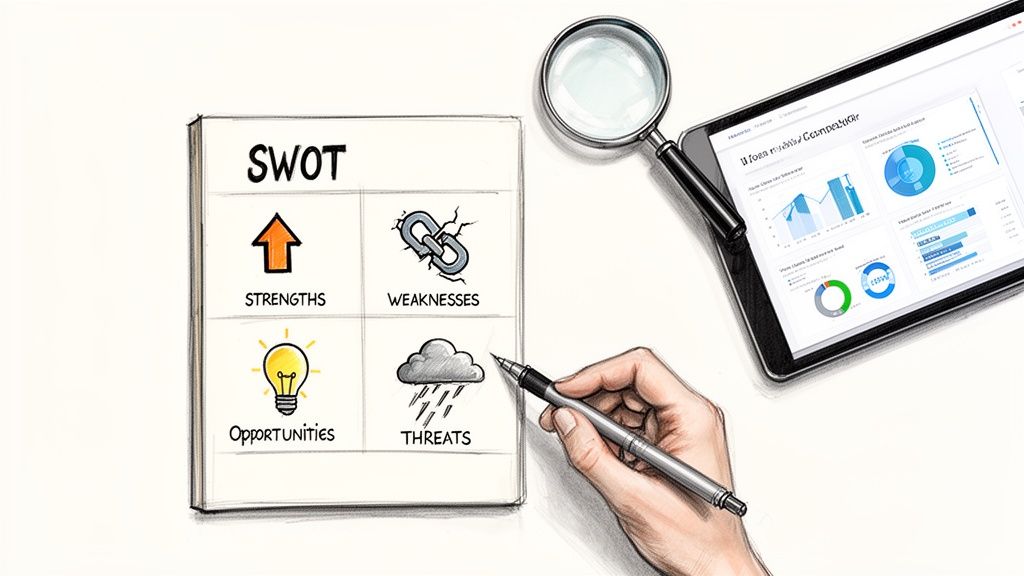
A competitor SWOT analysis template is just a fancy name for a simple grid that helps you figure out your rivals. You map out what they're great at (Strengths), where they suck (Weaknesses), lucky breaks that could help them (Opportunities), and stuff that could totally wreck their business (Threats). Think of it as your cheat sheet for turning a messy pile of research into a killer game plan.
Why Bother With a Competitor SWOT Analysis?
Let's be real, "SWOT analysis" sounds like a term from a business school textbook that's 90% dust. It feels like homework nobody wants to do. But what if that boring four-box grid is the one thing that stops you from building a product nobody wants or lighting your marketing budget on fire?
Running a competitor SWOT analysis isn't about making pretty charts to impress your boss. It’s about making smarter, faster decisions. It’s a shortcut to understanding the battlefield before you charge in screaming.
Find Gaps Before Your Competitors Do
A good analysis shines a spotlight on where your rivals are dropping the ball. Maybe their customer service has a reputation for being slower than a sloth on tranquilizers, or their pricing is so confusing it scares people away. These aren't just weaknesses; they're giant, flashing neon signs that scream, "YOUR OPPORTUNITY IS HERE!"
By mapping out their blind spots, you can slide in and present your product as the obvious, better solution. This whole process is a cornerstone of competitive intelligence, which you can read more about in our guide on what is competitive intelligence.
Stop Making Expensive Mistakes
Guessing is the most expensive business strategy. A SWOT forces you to look at cold, hard facts instead of just going with your gut.
By spotting market threats early—like some new AI tech that could make their product obsolete or a shift in what customers want—you can pivot before it’s too late. It’s the difference between using Google Maps and driving blindfolded with the radio blasting. For a great primer on this, check out a practical guide to competition SWOT analysis.
> A SWOT analysis isn’t a crystal ball, but it’s the next best thing. It replaces "I think" with "I know" by forcing you to look at reality—the good, the bad, and the ugly.
Ultimately, this exercise gives you the confidence (backed by actual data) to pitch investors, change your product, or double down on a marketing campaign. It’s way less about theory and way more about survival.
Breaking Down The SWOT Boxes In Simple Terms
Alright, let's ditch the MBA jargon. A competitor SWOT analysis template is just a simple four-box grid. That's it. It's not scary. Your only job is to figure out which box to drop your research into.
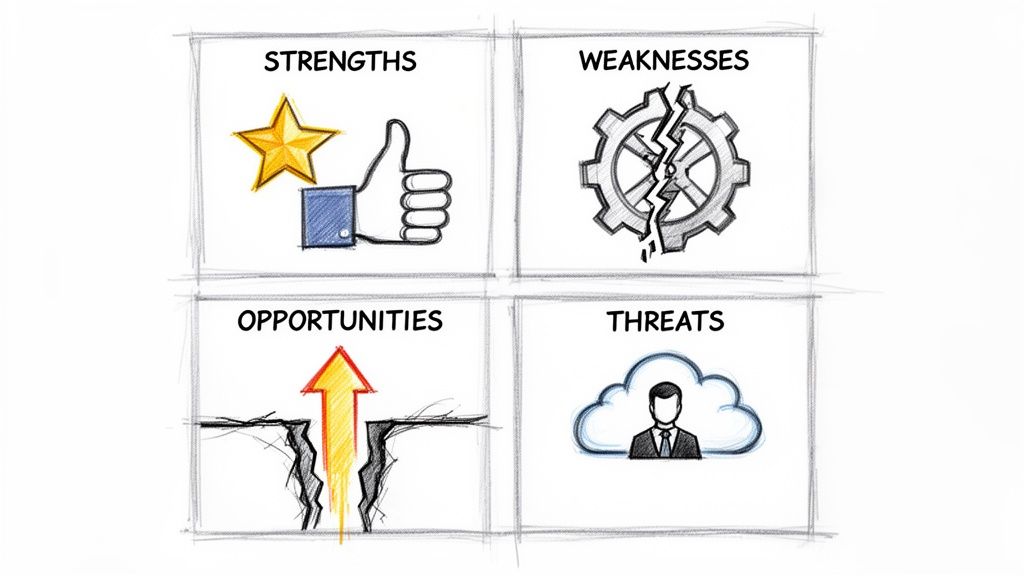
The only tricky part is remembering the difference between what’s happening inside their company versus what’s happening outside in the world. Strengths and Weaknesses are internal things they can (mostly) control. Opportunities and Threats are external things happening to them that they can't control.
Here’s a quick cheat sheet to keep it all straight.
SWOT Quadrant Cheat Sheet
This table breaks down each box into a simple question. Super easy.
| Quadrant | What It Means (Internal/External) | The Simple Question to Ask | | :--- | :--- | :--- | | Strengths | Internal Advantage | What are they awesome at? | | Weaknesses | Internal Disadvantage | Where are they dropping the ball? | | Opportunities | External Advantage | What lucky breaks could help them? | | Threats | External Disadvantage | What could totally mess them up? |
Think of this as your compass. Whenever you find a new piece of intel, just look at these questions to know exactly where it belongs.
The Internal Stuff: Strengths & Weaknesses
Strengths are the things your competitor absolutely nails. This is their secret sauce, the stuff they brag about on their homepage. It’s why their customers love them.
- Ask yourself: What gives them an unfair advantage?
- Think: A giant email list they've built for a decade, a brand name everyone knows, or patented tech that’s basically impossible to copy.
Weaknesses are your competitor's Achilles' heel. These are the things customers constantly complain about in reviews or on social media. They're the cracks in their armor you can attack.
- Ask yourself: Where are they failing their customers?
- Think: A clunky website from 2010, customer support that never replies, or a product that hasn't been updated since flip phones were cool.
> The best place to find weaknesses isn't on their shiny website; it's in their 1-star reviews and angry Reddit threads. That’s where the truth lives.
The External Stuff: Opportunities & Threats
Opportunities are lucky breaks or trends in the market that your competitor could ride like a wave. These are things happening in the world that could give them a huge boost if they're smart about it.
- Ask yourself: What market trends could they jump on right now?
- Think: A new social media platform taking off where their customers hang out, a global shift to remote work that creates demand for their tool, or a new law that makes their product more appealing.
Finally, Threats are the storm clouds on the horizon. These are external forces that could seriously mess up their business. They have zero control over these, but how they react is everything.
- Ask yourself: What could completely knock them off their game?
- Think: A rich new competitor entering the market, new data privacy laws that screw up their business model, or an economic downturn that makes their customers go broke.
Nailing these four boxes is the whole game. It’s how you turn a pile of random notes into a strategic map that shows you where to attack, where to defend, and where the buried treasure is.
How To Find The Data That Actually Matters
Alright, let's get down to it. A blank competitor SWOT analysis template is about as useful as a screen door on a submarine. The data you feed it is what brings it to life.
But where do you find this juicy data without spending a fortune?
Good news: you don't need a private investigator. You just need to know where to look. Forget corporate espionage; the best intel is usually hiding in plain sight, left behind by their customers.
Be A Scrappy Researcher First
Before you touch any fancy tools, put on your detective hat. Your first stop should be the places where people praise and complain about brands openly.
Start digging through:
- Customer Reviews: Scour sites like G2, Capterra, and Trustpilot. Ignore the 5-star reviews for a minute and head straight for the 2, 3, and 4-star ones. This is where you find the gold—what almost works and what drives people nuts. Perfect for the "Weaknesses" box.
- Social Media & Forums: Search Reddit, Twitter, and niche forums for your competitor's name. What are people griping about? What features are they begging for? This is a goldmine for finding unmet needs, which are prime "Opportunities" for you.
- Their Hiring Page: Check their careers page or LinkedIn jobs. Are they suddenly hiring a ton of AI engineers? That’s a huge clue about where their product is going. Are they hiring a sales team in Europe? That tells you they're expanding.
> The most honest feedback about your competitor won't come from their marketing team. It will come from a frustrated customer on Reddit at 2 AM. Find that customer.
Using The Big Guns (Without Breaking The Bank)
Eventually, you'll want to look at SEO and marketing data. This is where powerful tools like Ahrefs and Semrush come in. They can show you what keywords your competitors rank for, but man, they can be expensive.
For a critical edge, you also need to understand their pricing strategy. To get a handle on this, you'll need to learn how to monitor competitor prices, which provides crucial market intelligence for your SWOT.
But let’s be real, who has time for all this manual work? You're trying to build a business, not become a full-time researcher.
The Ultimate Shortcut To Actionable Data
Instead of spending days gluing everything together by hand, you can automate the whole process. This isn't about being lazy; it's about being smart.
Platforms like already.dev are built to be your AI research assistant. You just describe your idea, and it automatically scours the web to find your competitors, analyze their features, and map out their pricing. What used to take a week of painful copy-pasting now takes minutes. You get the full picture, so you can spend your time on strategy, not data entry. Our own guide on how to find competitors can give you more scrappy ideas to go with this.
This combo of smart automation and old-school digging is how you fill your competitor SWOT analysis template with insights that actually help you win.
Putting Your SWOT Template to Work
Okay, you've done the digging. You're swimming in data, customer reviews, and market chatter. Now what? All that info is just noise until you give it some structure. This is where we go from research to strategy.
Staring at a blank template can be a little intimidating, but filling it out is easier than you think. Just boil down your findings into simple, direct statements that fit into those four boxes.
From Raw Notes to Real Insights
Let's say you're building a new project management tool for small businesses, and your main rival is "ProjectKing."
Here’s how you turn a mess of notes into clean SWOT points:
-
Raw Note: "I keep seeing tweets and G2 reviews saying ProjectKing’s support takes forever to reply."
-
Translation (Weakness): Slow, terrible customer support.
-
Raw Note: "There's a bunch of chatter on Reddit about small businesses freaking out over new data privacy laws."
-
Translation (Threat): New data privacy laws could be a huge headache for big, slow-moving companies.
-
Raw Note: "ProjectKing just integrated with Salesforce. They seem to only care about huge companies."
-
Translation (Strength): Strong enterprise integrations and a locked-in corporate customer base.
See? You're just summarizing the main idea. Don't write a novel in each box. The goal is a high-level snapshot you can understand in seconds.
The "So What?" Factor Changes Everything
Once your template is filled out, the real fun begins. For every single point you’ve listed, you have to ask the most important question in business: "So what?"
This is how you connect their situation to your opportunity.
> A SWOT analysis without a "So what?" is just a business diary. It might be interesting, but it won't help you win. The "So what?" is what turns your analysis into a weapon.
Let’s stick with our ProjectKing example:
-
Their Weakness: Slow, terrible customer support.
-
So What? We can make fast, friendly, human support our main selling point. Our marketing can literally say, "Talk to a real person in under 60 seconds."
-
Their Threat: New data privacy laws.
-
So What? We can build our tool from day one to be super compliant and market it as the secure, worry-free option.
-
Their Strength: Strong enterprise integrations.
-
So What? Trying to beat them there would be suicide. Instead, we should double down on the small teams and freelancers they're totally ignoring.
This is where your strategy comes to life. You're not just collecting facts; you're figuring out how to outsmart them.
Of course, getting the data to start this process involves a few different approaches, from scrappy manual research to paid tools or even a clever AI shortcut.
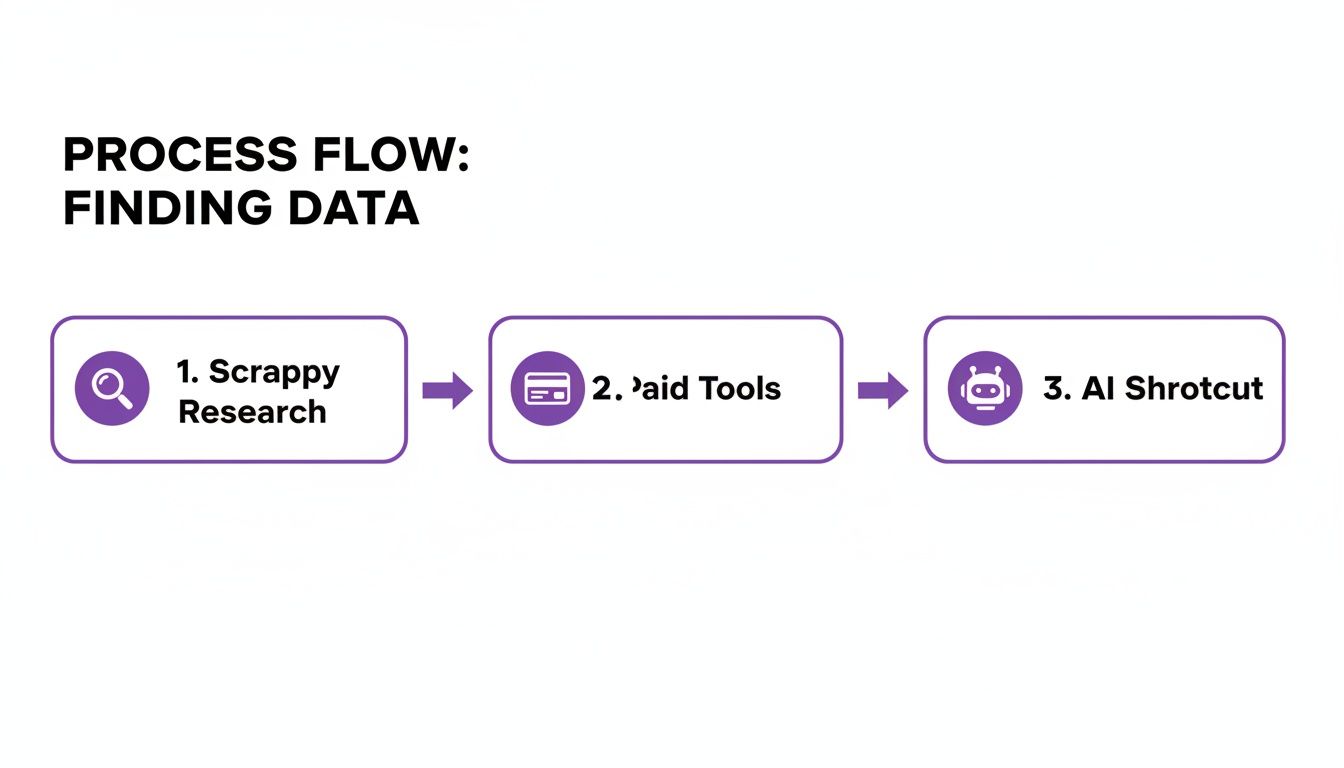
While you can dig for this data yourself or pay for expensive tools, an AI platform like already.dev gives you the fastest path to these insights. That leaves you more time to focus on the "So what?"—which is where the money is. This is just one piece of the puzzle, and you can dive deeper with our complete free competitor analysis template.
Turning Your SWOT Analysis Into A Winning Strategy
So, you've filled out your competitor SWOT template. Cool. But don't celebrate yet—that's the starting line, not the finish line.
All that research is just a pile of facts until you turn it into decisions that win customers. This is where you connect the dots from analysis to action. The goal is to use what you found to sharpen your marketing, rethink your pricing, and build a better product.
From Quadrants To Game Plan
Think of your completed SWOT as a strategic matching game. You're not just staring at four separate lists; you're looking for killer combos.
Here’s how to connect the dots:
- Strengths + Opportunities (Attack Mode): How can you use what you’re good at to jump on a market opportunity? Let's say your strength is a super-flexible API, and you spot a growing niche that needs custom solutions. Boom. Your strategy just wrote itself.
- Weaknesses + Threats (Defense Mode): Where are you most vulnerable? If your biggest weakness is a tiny team and a major threat is a new, rich competitor, your strategy might be to find partners or raise money to scale up, fast.
This simple exercise forces you to move beyond just looking at the market and start plotting your next moves. It’s the difference between knowing it might rain and actually bringing an umbrella.
> Your SWOT analysis isn’t just a report; it’s a recipe. The insights are your ingredients, but the real magic happens when you start combining them to create a strategy that tastes like victory.
Pitching Your Plan With Confidence
This isn't just for you—it's a huge advantage when you're trying to raise money. Walking into a pitch with a deep understanding of the competitive landscape shows investors you’ve done your homework and aren't just winging it.
You can literally use your SWOT to prove you have a plan to win. It shows you’re not just building a cool toy; you’re building a real business that's ready for a fight. That's exactly what investors want to see. Want more examples? Check out these free SWOT analysis templates.
Common Questions About Competitor SWOT Analysis
So, you get the idea. But let's be real, a few questions always pop up when you're staring at that blank template. Let's knock them out.
How Often Should I Do This?
Think of your SWOT as a living thing, not a stone tablet. It's not a one-and-done task.
For startups and companies in fast-moving industries (like SaaS), doing a quarterly review is smart. It keeps you on your toes. If your market is more stable, you can probably get away with doing it once or twice a year.
The real key? Revisit your SWOT anytime something big happens—a new competitor gets a ton of funding, a rival launches a killer feature, or the market completely changes.
What's The Biggest Mistake People Make?
Two things trip people up: being way too vague and failing to actually do anything with the analysis.
Listing a competitor's strength as "good marketing" is useless. It tells you nothing. But identifying their strength as "they own the #1 spot on Google for 'project management for freelancers'"? Now that's an insight you can fight. Get specific.
The other huge mistake is doing all this research, making a beautiful SWOT grid, and then letting it die in a forgotten folder.
> Your SWOT analysis is a compass, not a decoration. If it doesn't directly influence your next decision, you wasted your time.
Can I Do A SWOT For My Own Company Too?
Absolutely. In fact, you 100% should. The real magic happens when you put your own SWOT right next to your competitor's.
That side-by-side view is like turning on the stadium lights. It makes it painfully obvious where you have an edge, where you’re weak, and where the biggest opportunities are hiding. Honestly, doing an internal SWOT first often helps you ask much smarter questions when you start digging into the competition.
Ready to skip the manual data digging and get straight to the insights? already.dev uses AI to do the heavy lifting, giving you a complete competitive landscape in minutes, not days. Find out what you're up against at https://already.dev.