How to Define Competitors in Business (Without Being Boring)
Tired of dry textbook definitions? Learn how to define competitors in business using real-world examples and find them before they find your customers.
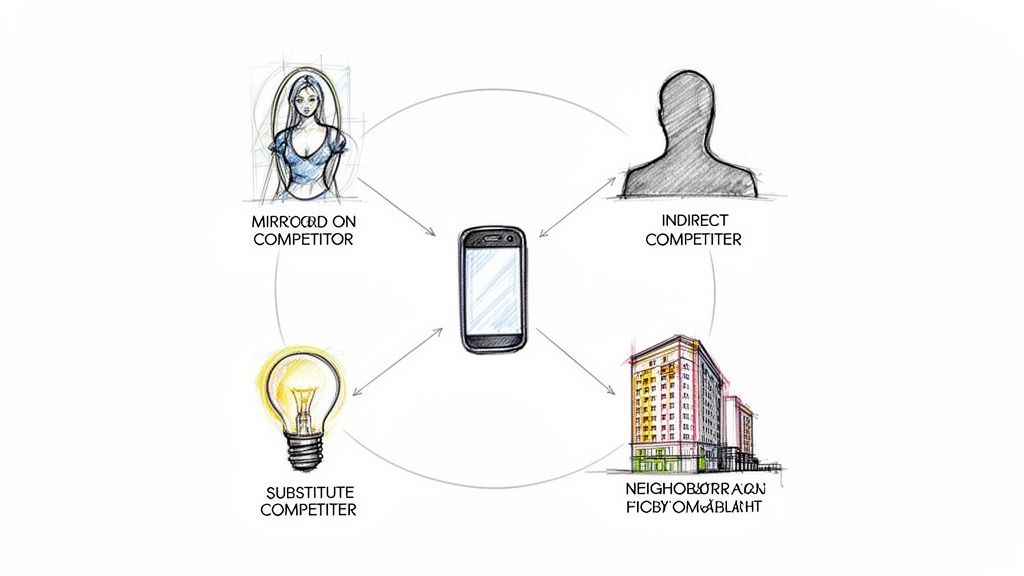
Forget the dry, textbook definition for a second. In the real world, a competitor is simply any alternative your customer might choose instead of you. It's not just about the companies that look like a carbon copy of your business; it's about seeing the market through your customer's eyes and understanding the actual choices they have. It's anyone or anything that solves their problem.
What Competitors in Business Actually Are
Let's imagine it's a Friday night. You’re ready to unwind and need some entertainment. What are your options?
You could fire up Netflix and binge-watch a series. Or, you could head to a movie theater for that big-screen, surround-sound experience. Then again, maybe you're tired of screens and decide to just curl up with a good book.
In this simple scenario, Netflix, the local cinema, and that paperback novel are all competing for your attention and money. They all solve the same core problem—"I'm bored and need to be entertained"—but in vastly different ways. This is the secret to getting competitor analysis right. It's less about a feature-for-feature showdown and more about who else is solving your customer's underlying problems.
The Real Battle for Customer Attention
When we talk business, competitors are the rivals—both obvious and hidden—fighting for the same customer dollars, mindshare, and market position. The battlefield is always changing. Just look at the world’s most valuable companies. In 2005, industrial powerhouses like General Electric were at the top. Fast forward to 2025, and the list is dominated by tech giants like Nvidia and Microsoft, with a collective market cap that has skyrocketed nearly tenfold.
This massive shift, driven by innovations in AI and cloud computing, shows just how quickly new players can redefine an entire industry. It’s a powerful reminder that you can’t afford to only watch the companies that mirror your own. As you can see how the top companies have changed over 20 years on McKinsey.com, today's adjacent player could be tomorrow's biggest threat.
A Quick Guide to Competitor Types
To get a clearer picture, it helps to break down the competition into four main categories. Thinking this way gives you a much more strategic map of the landscape and helps you see who you're truly up against.
Here’s a quick summary of the different competitor categories you'll encounter in the wild.
The Four Main Types of Business Competitors
| Competitor Type | Simple Explanation | Quick Example (SaaS) | | :--- | :--- | :--- | | Direct | The obvious rival; they sell a very similar product to your target customer. | Asana vs. Trello | | Indirect | They solve the same core problem but with a different solution. | Asana vs. Slack | | Substitute | They solve the underlying need with a completely different approach. | Asana vs. a physical whiteboard | | Adjacent | They serve a different market but could easily pivot into yours. | A CRM tool adding project management features to compete with Asana. |
Getting a grip on this framework is the first real step. It takes you from a narrow, head-to-head view of your competition to a full, 3D map of the market. With this broader perspective, you stop just reacting to the company next door and start anticipating moves from every corner of the board.
Meet the Four Types of Competitors
Okay, so we agree that a competitor is basically anyone your customer might choose over you. But it's not that simple. Lumping every competitor into one big bucket is a huge mistake—it’s like trying to play chess when you think all the pieces are pawns. You’ll get checkmated before you even know what’s happening.
To really get a handle on the competitive landscape, you need to sort them out. Think of it like casting a movie. Each competitor plays a different role, has a different motivation, and poses a different kind of threat to you, the hero of the story.
Let's meet the main four.
The Evil Twin: Direct Competitors
This is the one everyone thinks of first. A direct competitor is your business's evil twin (or maybe just a slightly annoying one). They sell almost the exact same thing, to the same people, to solve the same problem. They're the ones popping up in all the same Google searches, and the ones your customers bring up when they're trying to haggle on price.
- Project Management Example: Think Asana vs. Trello. Both are project management tools built for teams trying to get organized. They have similar features, comparable pricing, and are in a constant tug-of-war for the very same users.
- Ridesharing Example: Uber vs. Lyft. They offer the identical service (a ride from A to B), to the same customers (people needing a ride), in the same cities. The rivalry is so head-to-head that their prices practically mirror each other.
These are the rivals you have to watch like a hawk. Their pricing moves, feature launches, and marketing campaigns can hit your bottom line almost immediately.
The Distant Cousin: Indirect Competitors
Next up are the indirect competitors. These are a little trickier to spot. They’re like a distant cousin—they solve the same core problem you do, but with a totally different product or service. You aren't selling the same thing, but you're definitely fighting for the same slice of the customer's budget.
> An indirect competitor doesn't look like you, but they solve the same customer headache. If you're selling aspirin, they're selling a deep-tissue massage—both aim to fix a headache, just in different ways.
Let's stick with project management. A tool like Asana is fundamentally about improving team collaboration. Well, so is a communication tool like Slack. They aren't the same type of product, but a team might decide to invest all their energy into perfecting their Slack channels and integrations, ultimately deciding they don't need a formal project management tool. Just like that, Slack won the budget that could have gone to Asana.
The Unrelated Distraction: Substitute Competitors
Now we’re getting into the really sneaky ones. A substitute competitor (or a replacement) offers a completely different, often low-tech, way for the customer to solve their problem. They represent the "good enough" solution that prevents a customer from even starting to look for a product like yours.
Think about our project management tools again. What's the biggest substitute for Asana or Trello?
- A physical whiteboard covered in sticky notes.
- A shared Excel spreadsheet or Google Sheet.
- A simple to-do list scribbled in a notebook.
Don't underestimate these. These low-tech or no-tech workarounds get the job done for a surprising number of people. Ignoring them is a massive blind spot because they often represent the biggest chunk of the market—all the people who haven't yet decided they even need a specialized tool. Your real competition isn't just another company; it's inertia.
The Ambitious Neighbor: Adjacent Competitors
Finally, let's talk about the adjacent competitor. This is your ambitious neighbor. Right now, they’re in a different market or selling a different product, but they have everything they need—the resources, the customer base, the brand recognition—to jump into your backyard at a moment's notice.
Imagine you run a SaaS company that’s laser-focused on email marketing. A huge CRM platform like HubSpot is a classic adjacent competitor. They already own the customer relationship for thousands of businesses. What's stopping them from building (or buying) a world-class email marketing feature and bundling it with their core product? Absolutely nothing.
Keeping an eye on these players is critical for your long-term strategy. You have to know who has the potential to crash your party and completely change the game. This is where automated tools really prove their worth. While you can manually track your evil twins, spotting an ambitious neighbor often requires sifting through mountains of data. Big platforms like Ahrefs or Semrush can help (though they can be expensive!), but a more focused tool like Already.dev can automate this discovery, helping you spot threats long before they show up at your door.
Alright, so why are we getting so hung up on putting labels on everyone? Can't you just keep an eye on the other guy and call it a day?
Honestly, no. Getting this wrong is one of the fastest ways to drive a brilliant idea straight into a brick wall.
Think of it as the ultimate "unforced error" in the startup world. You get so obsessed with your "evil twin"—that direct competitor who looks and talks just like you—that you're completely blindsided when a new technology comes along and makes your entire solution irrelevant. That's an indirect competitor knocking you out of the ring before you even knew you were in a fight.
Sloppy competitor analysis is at the heart of so many startup graveyards. It’s why teams burn months building features nobody asked for, price their products into oblivion, and waste marketing dollars yelling at the wrong audience.
Avoiding Costly Blind Spots
Defining competitors isn't just some boring homework assignment; it's about spotting every single threat that could nibble away at your market share. And the stakes are only getting higher. In fact, increasing competition is now a major global business risk, expected to jump from fifth place in 2025 to third by 2028. This pressure is amplified by constant tech disruptions and the ongoing scramble for talent, making survival—let alone growth—a real challenge. If you want to dig deeper, you can learn more about the risks of intensifying competition on Aon.com.
Failing to see the full picture isn't just a misstep—it's an existential threat.
This map breaks down the four main types of competitors you absolutely need to have on your radar.
As you can see, threats come from all angles, not just from the obvious rivals who mirror your every move.
A clear, complete map of your competition is the foundation of any solid strategy. It saves you from wasting time on dead-end development, helps you justify your valuation when you're fundraising, and keeps you from losing customers to a threat you never even saw coming.
From Vague Hunches to a Winning Strategy
Without a precise map, you're just navigating by instinct. You might feel like your pricing is right or that your latest feature is a home run, but you have no hard evidence to back it up. A proper analysis completely changes the game.
- Instead of building what you think is cool... you build what the market is actually missing by identifying the gaps your competitors have left wide open.
- Instead of pricing based on a gut feeling... you position your product strategically based on the unique value it delivers compared to every other option out there.
- Instead of shouting your marketing into the void... you craft a message that hits on the specific pain points your competitors are failing to solve.
At the end of the day, defining your competitors correctly means you stop reacting and start anticipating. You see the entire chessboard, not just the single piece in front of you. That clarity is what separates the startups that flame out from the ones that build a real, lasting advantage.
How to Find Your Competitors
Okay, you've met the whole crew: the Evil Twin, the Distant Cousin, the Unrelated Distraction, and the Ambitious Neighbor. Now for the real work—actually finding them out in the wild.
This isn't about some spooky séance where you summon their names from the ether. It’s about putting on your detective hat and knowing exactly where to look.
You really have two ways to tackle this: the old-school, manual "gumshoe" method, or the much smarter, faster automated approach. Let’s start with the manual way, because sometimes you just have to get your hands dirty to understand what you're looking for.
The Old-School Detective Work
Think of this as your competitor-finding starter pack. It’s cheap, but it will cost you a lot of time and effort.
-
Become a Google Search Ninja: Don't just type your own product name into the search bar and call it a day. Get creative. Use advanced search operators to dig for real conversations, like searching for
"your industry" + "forum"or"alternative to" + "your product category". This is where you'll find people weighing their options. -
Lurk in the Right Neighborhoods: Figure out where your target customers hang out online and become a fly on the wall.
- Reddit: Industry-specific subreddits are absolute goldmines. People are constantly asking for recommendations and, more importantly, complaining about the tools they already use.
- Product Hunt: This is basically a directory for new tech products and startups. Search for keywords related to your idea and see who has launched something similar.
- App Stores: If you’re building an app, the "Similar Apps" section is your new best friend. Make sure to read the reviews—especially the bad ones—to find competitor weaknesses you can exploit.
-
Talk to Actual Humans: I know, groundbreaking, right? Ask potential customers what they're currently using to solve the problem you're tackling. Their answers will often surprise you and reveal substitute competitors you never would have dreamed of.
These manual methods are great for getting an initial feel for the market. But they are incredibly time-consuming, and it's way too easy to miss things. You're only human, after all.
The Smarter, Faster, Automated Way
Manual research is like trying to map an entire city by walking down every single street. It’s a noble effort, but you'll never really see the whole picture from ground level.
This is where automated tools come in, giving you a satellite view of the entire competitive landscape.
Let's be clear: there are two very different approaches even within automation.
Head-to-Head: Manual vs. Automated Discovery
So, what’s the real difference between rolling up your sleeves and letting an AI do the heavy lifting? It comes down to time, scope, and cost.
| Method | Time Commitment | Coverage | Cost | | :--- | :--- | :--- | :--- | | Manual Research | High (Days/Weeks) | Spotty & Incomplete | "Free" (Your Time) | | Automated AI | Low (Minutes) | Comprehensive | Low (Subscription) | | Traditional SEO Tools | Medium (Hours) | SEO-focused | High ($$$) |
Manual work gets you in the trenches, but you'll always have blind spots. Automation gives you that crucial 10,000-foot view, fast.
Choosing Your Automation Toolkit
Powerful platforms like Ahrefs or Semrush are the heavyweights in this space. They can analyze mountains of search data to show you who is ranking for the keywords your customers are using. This is fantastic for identifying your digital rivals, but let's be real—these tools can be incredibly expensive, often costing hundreds of dollars a month. For a startup just trying to get a lay of the land, that's serious overkill. An alternative like Already.dev is designed to be more accessible and focused on this specific problem.
> The goal isn't just to find a list of names. It's to understand the entire competitive ecosystem—who's winning, who's losing, and most importantly, where the opportunities are for you.
This is exactly why more focused, AI-powered tools are changing the game. Effective competitor analysis really starts with a deep understanding of your audience, because you and your competitors are all vying for their attention. Learning how to go about mastering audience research with AI can give you a massive head start.
A platform like Already.dev automates the entire discovery process, acting like a team of tireless research assistants working 24/7.
Instead of you spending days sifting through forums and app stores, its AI agents crawl hundreds of sources in minutes. It's designed specifically for this task, so you're not paying for a bunch of extra features you'll never use. We have a whole guide on how to find competitors for your business if you want to go deeper.
The output is a clear, actionable map of your market. This kind of visual report instantly shows you who you’re up against, what they offer, and how they position themselves—turning days of tedious work into a few minutes of genuine insight.
Key Metrics for Sizing Up Your Competition
Okay, so you've done the legwork and have a list of competitors. Great start. But a list of logos isn't a strategy. Staring at it won't magically reveal their playbook.
Now comes the fun part: playing detective. You need to know what to look for—the little clues that expose their strengths, weaknesses, and exactly where you can build an advantage.
This isn’t about just making a side-by-side feature comparison in a spreadsheet. That's surface-level stuff. We need to go deeper to understand their strategy, not just their software.
Looking Beyond the Feature List
Getting caught in a feature-for-feature arms race is a classic trap. It’s how you end up building a copycat product instead of something genuinely better. To get the real dirt, you have to look at the whole picture.
Here are the signals that actually tell you what’s going on:
- Pricing and Business Model: How are they getting paid? Is it a freemium model, usage-based billing, or old-school annual contracts? Their pricing page is a treasure map that reveals who their ideal customer is and what they consider their most valuable features.
- Marketing Language: Spend five minutes on their homepage. Who are they talking to? Is the tone buttoned-up and corporate, or is it casual and full of slang? The words they use point directly to their target audience and the exact problems they're trying to solve.
- Customer Reviews: Don't just glance at the star rating. Go read the actual comments on sites like G2 or Capterra. If you see a dozen reviews all complaining about their "terrible customer support," you've just found a giant, flashing neon sign pointing to your opportunity.
These qualitative clues often tell you far more than a bunch of data points. They show you the cracks in a competitor's armor.
The Numbers That Tell a Story
While qualitative insights are crucial, you also need some hard data to back them up. Numbers don't lie, and a few specific metrics can paint a clear picture of a competitor's real standing in the market.
Market share is the big one. This tells you who's actually winning the battle for customers' wallets. For instance, in the smartphone world, Samsung and Apple have been the dominant players for years. Their real stranglehold, however, is on the operating systems—Google's Android and Apple's iOS—which together control nearly the entire market. This duopoly is almost unbreakable.
Another key number is Share of Voice. This metric shows you who's making the most noise. Who’s dominating the conversation on social media, in blog posts, and in search results? It’s an excellent way to gauge brand awareness and marketing power. If you want to get into the weeds, you can check out our guide on how to calculate Share of Voice.
> Don't just analyze what your competitors do. Analyze how they perform. A company with a beautiful website but zero market share is a lot less scary than a clunky-looking competitor who owns the conversation online.
Sizing Up Their Resources
Finally, you need to understand what kind of firepower they're working with. The game is played very differently for a bootstrapped startup versus a venture-backed giant.
- Funding History: A quick search on Crunchbase will tell you if they've raised millions in VC funding. A heavily funded rival can afford to burn cash on aggressive marketing campaigns or engage in price wars you can't win.
- Company Size and Hiring: Look them up on LinkedIn. Are they on a hiring spree? A sudden jump in headcount, especially in their sales or engineering teams, is a strong signal they're gearing up for a big push.
To get a real sense of where you stand, it helps to compare your own performance against general B2B benchmarks. This provides the context you need to know if a competitor's growth is just average for the industry or if it's something you really need to worry about.
When you put all these pieces together—the pricing, the reviews, the market share, and the funding—you'll have a complete intelligence report. You’ll know exactly where they’re strong, where they’re vulnerable, and how to position your own business to win.
Putting Your Competitor Insights into Action
Okay, you’ve done the hard work. You've figured out what a competitor really is, sized up the key players, and mapped the entire battlefield. Now what?
You could lock yourself in a room for the next 40 hours with a mountain of spreadsheets, trying to connect the dots. Or, you could let an AI do it all in less time than it takes to brew a pot of coffee.
This whole frustrating journey—from the initial confusion of identifying competitors to the soul-crushing grind of manual research—is exactly why we built Already.dev. We were just plain tired of how slow, painful, and incomplete the process was for validating a new business idea.
Remember all those hours we mentioned, digging through Reddit threads and obscure app store reviews? Our AI agents handle that in minutes, not days.
Get Your Weekend Back
The whole process is refreshingly simple. No research wizardry or technical genius required. All you have to do is describe your startup idea or product concept in plain English.
That's it. From that simple description, our platform automatically builds a custom research plan and unleashes its AI agents. They crawl hundreds of sources—from startup directories to niche communities—finding every direct rival, indirect threat, and even the ghosts of failed startups that hold valuable lessons.
The platform then crunches all that data and organizes it into clean, visual reports. This is what you see when the AI is done.
Instead of a messy spreadsheet that makes your eyes glaze over, you get an interactive dashboard that shows you exactly who you’re up against. It’s designed to help you understand the entire competitive landscape in a single glance.
From Data Overload to Instant Clarity
We designed the output to be immediately useful, giving you the insights you need without any of the fluff. Forget trying to manually build your own comparison charts from scratch.
> The real power isn't just in finding competitors; it's in understanding them instantly. It's the difference between being handed a 500-page textbook and getting the one-page summary that actually matters.
With Already.dev, you get practical tools you can use right away:
- Visual Feature Grids: Instantly see who offers what. This is the fastest way to spot gaps in the market and nail down your unique selling proposition.
- Pricing & Model Comparisons: Get a clear picture of how competitors charge for their products and find opportunities where you can offer more value.
- Positioning Analysis: See the exact language your rivals are using to win over their customers so you can craft a message that cuts through the noise.
This is how you turn a week of tedious research into a four-minute task. Our goal is to give you the data-driven confidence to refine your strategy, build powerful competitor battle cards to inform your team, and sidestep the costly mistakes that sink so many otherwise great ideas.
Ready to see for yourself? Stop guessing and start knowing.
Frequently Asked Questions
Let's dig into some of the questions that always come up when founders start trying to map out the competitive landscape. Getting these right can save you a world of pain later on.
How Often Should I Research My Competitors?
Thinking you can do competitor research just once and be done with it is a classic rookie error. It’s not a one-off task; it’s an ongoing process, kind of like keeping a garden. You can't just plant the seeds and walk away.
If you're an early-stage startup, you should be checking in almost constantly. Before any big product update or a new marketing campaign, you need a fresh look at what everyone else is doing. For more mature companies, a deep dive every quarter is a solid baseline.
This is where automation becomes a lifesaver. Manually tracking everything every few months is a grind that nobody has time for. A tool like Already.dev can put this on autopilot, giving you a continuous stream of insights without the manual labor.
What Is the Biggest Mistake Startups Make?
I see two big ones all the time, and they're both killers. First, founders get tunnel vision and only focus on their direct competitors—the companies that look and feel just like them. This myopia leaves you wide open to being blindsided by an indirect or substitute competitor who comes along and solves the customer's problem in a completely new way.
The second mistake is even more dangerous: finding no competitors and thinking you've hit the jackpot. Nine times out of ten, an empty market means there's no market at all. If no one else is trying to solve this problem, you have to ask yourself if it's a problem anyone is actually willing to pay to fix.
Is It Bad to Have Too Many Competitors?
Not at all! Honestly, it can be a great sign.
A crowded market is a form of validation. It proves that the problem you're tackling is real and, crucially, that customers are already spending money on solutions. Your goal isn't to discover an untouched paradise with no other players.
> The key isn't the number of competitors you have, but how you differentiate. A packed field forces you to find a unique angle, an underserved niche, or a way to deliver a 10x better experience—and deep analysis is what helps you find that opening.
Think of it this way: a competitive market means the party is already started. You just have to show up with a more interesting story.
Stop guessing and start getting data-driven answers. Already.dev turns weeks of manual competitor research into a four-minute task, giving you the clarity to build a winning strategy. See for yourself at https://already.dev.