How to Actually Stand Out from the Competition (Without a Giant Pile of Cash)
Discover differentiation from competition tactics that actually work to own your niche. Practical, actionable strategies inside.
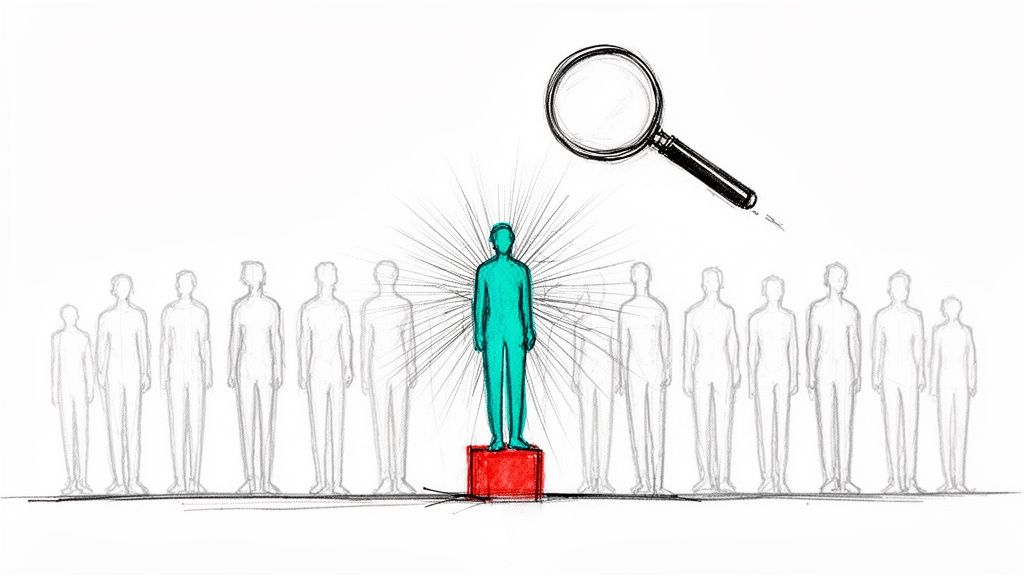
Trying to stand out from the competition isn't about being just a little bit better. It's about being fundamentally different.
Honestly, playing the "better" game is a fast track to burning through cash and fading into the background. Why? Because any killer feature you build will eventually get copied.
Why Being "Better" Is a Losing Game
Let's get real for a second. You're not going to out-Google Google. The startup graveyard is full of companies that tried to be a "better" version of an established giant.
They might have had a slicker interface, a 10% cheaper price tag, or one extra bell and whistle. And you know what? Nobody cared. A slightly "better" product is a flimsy advantage and rarely gives customers a real reason to go through the hassle of switching.
Think about any mature market, from project management tools to email software. After a while, all the products start to look eerily similar. This isn't an accident. It's what happens when competitors just benchmark and copy each other, creating a sea of sameness.
> One of the hardest things to do is be original. If you only read what everyone else is reading, you will likely think just what everyone else is thinking.
This copycat cycle just leads to a feature arms race. You launch a new report, and a few months later, they launch a similar one. They add a cool integration, so you scramble to add it too. It’s exhausting, expensive, and ultimately, you're just playing their game by their rules.
The Myth of the Killer Feature
So many founders fall into the trap of thinking one killer feature will be their golden ticket. The problem is, any feature that's genuinely a hit will get copied.
You might get a six-month head start, but your competitors will catch up. What was once your unique selling point quickly becomes a standard, expected part of any product in the category.
- Toothpaste: It used to compete on "fights cavities." Now, whitening and plaque removal are just table stakes. You have to buy it.
- Smartphones: Remember when a high-resolution screen was a major selling point? Today, it’s just the cost of entry.
- Software: Tools like Ahrefs or Semrush are incredibly powerful, but also incredibly complex and can be expensive. Newcomers can't win by just adding one more report. They have to rethink the entire approach, which is why a tool like Already.dev focuses on a completely different workflow to solve the same underlying problem.
The Real Goal: Be Different, Not Just Better
The goal isn't to be a slightly improved version of the market leader. The goal is to change the rules of the game entirely.
So, instead of asking, "How can we be better?" start asking, "How can we be different in a way a specific group of customers will absolutely love?" This shift in mindset is the foundation of a real differentiation from competition strategy.
It's how that local coffee shop with a unique vibe can thrive right next to a Starbucks. They don't win on price or speed; they win by offering an experience the giant corporation can't easily replicate. They're unapologetically themselves, and that's their superpower.
Find The Gaps Your Competitors Are Ignoring
Your competitors aren’t perfect. Far from it. In fact, they’re probably ignoring huge chunks of their own audience, and those blind spots are your gold mines. Finding these gaps isn't about some stroke of genius; it's about being a detective who knows where to look.
Forget just staring at the first page of Google—that's the tourist map. We're going deep into the trenches.
The real magic happens when you stop looking at what competitors say they do and start listening to what their customers complain about. These complaints are a literal roadmap to building something people will happily switch to.
This quick 3-step visual nails the simple path from finding a gap to actually winning in the market.
The takeaway here is crystal clear: trying to be "better" is a dead end. Focusing on being different is the direct route to winning.
Become A Market Detective
Your mission is to find the "unsolved mysteries" in your market. Where are customers consistently frustrated? What features do they beg for in app reviews, only to be ignored? These are the clues that lead to a powerful differentiation strategy.
Start digging in places where people are brutally honest:
- Reddit & Niche Forums: Search for things like "[Competitor Name] alternative" or "[Competitor Name] sucks." You'll uncover unfiltered rants that are pure strategic gold.
- App Store Reviews: Zero in on the 2- and 3-star reviews. These aren't just haters; they're users who wanted to love the product but were let down by a specific, painful flaw.
- G2 or Capterra: B2B review sites like these often have incredibly detailed feedback on what a tool does well and, more importantly, where it falls short for specific use cases.
While big SEO tools like Ahrefs or Semrush can spot keyword gaps, they’re often expensive and only tell part of the story. They show you what people are searching for, but not the emotional pain points behind those searches. A solid competitive analysis framework is crucial to truly understand your market and pinpoint the gaps your rivals are overlooking.
Map The Battlefield To Find Open Territory
Once you've gathered your intel, you need to map it out. Don't just keep it all in your head. Create a simple spreadsheet or use a tool to visually compare everyone on the key things customers actually care about.
In the AI software world, speed is everything. The global market is projected to explode from US$122 billion to US$467 billion by 2030—that's a blistering 25% CAGR. In a space this hot, the battle isn't just about tech; it's about the speed and depth of your competitive intelligence.
Spending 40 hours on manual research is a losing game. Modern tools can deliver AI-powered reports in minutes by crawling hundreds of sources, saving 99% of the time.
A quick look at why this matters so much:
Manual vs Automated Competitor Research
A quick look at why spending 40 hours on manual research is a losing game compared to getting the job done in minutes.
| Research Aspect | Manual Method (The Old Way) | Automated with Already.dev (The Smart Way) | | :--- | :--- | :--- | | Data Collection | Hours spent manually scraping websites, forums, and review sites. | Crawls hundreds of sources automatically in minutes. | | Competitor Discovery | Limited to known competitors and top Google results. | Uncovers hidden and emerging competitors you didn't know you had. | | Analysis Speed | Takes an average of 40 hours to compile a single report. | Generates a comprehensive report in under 5 minutes. | | Data Freshness| Instantly outdated. Market shifts before you finish the report. | Real-time data and alerts, so you're always ahead of the curve. | | Bias Potential | High. Easy to miss data or focus on personal biases. | Objective, data-driven insights without human error. |
Simply put, you can't afford to be slow. This is where a dedicated platform like Already.dev becomes a no-brainer. It automates this painful digging process, finding rivals you never knew existed and organizing them by features and pricing so the gaps become obvious.
Connect The Dots To Your Unique Angle
Looking at your map, the gaps should start to jump out at you.
Maybe everyone targets large enterprises, leaving small businesses with clunky, overpriced options. Perhaps no one offers a decent mobile experience. Or maybe every tool is powerful but hideously complicated to use.
> The goal isn't just to find a gap; it's to find a gap that you are uniquely equipped to fill. It's the intersection of a real market need and your team's genuine passion and skills.
This is your moment of clarity. This is where you move from just analyzing to forming a real strategy. It’s not about tacking on a tiny feature. It’s about spotting a fundamental customer need that everyone else has walked right past.
Once you find that overlooked need, you have the seed of a powerful differentiation strategy—one that isn't just a marketing slogan, but the very core of your business.
Craft A Value Proposition People Actually Remember
Let's be honest. If your value proposition is "we're the best," you've already lost. That's the marketing equivalent of a weak handshake—it says absolutely nothing. Nobody believes it, nobody remembers it, and it does zero to help you stand out.
Once you’ve found that sweet spot in the market, your next job is to nail down your messaging. You need a message that sticks in your ideal customer’s brain like a catchy pop song. This isn't about stringing together a bunch of buzzwords; it's about making a single, powerful promise they can't ignore.
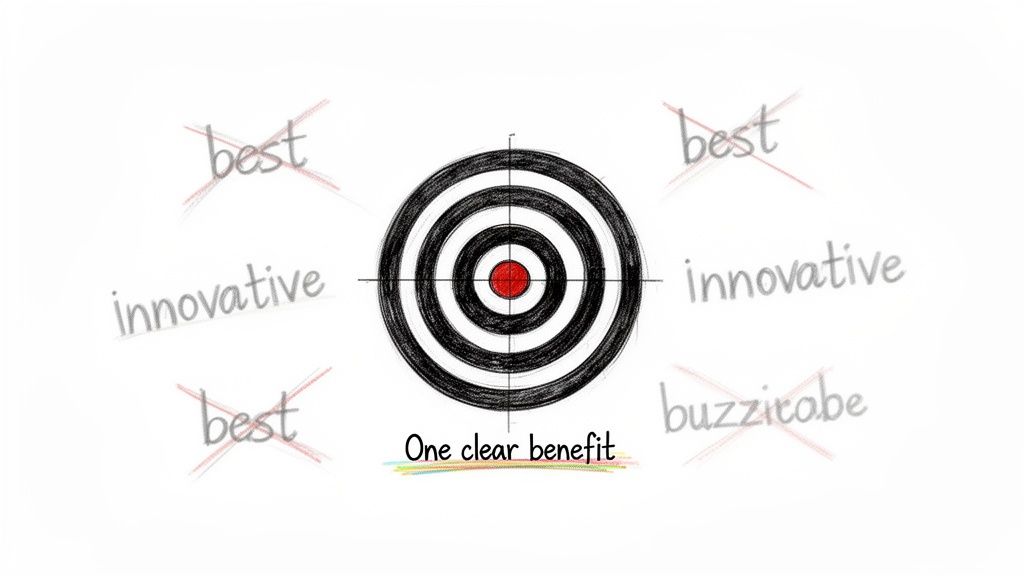
This is precisely where most companies trip over their own feet. They try to be everything to everyone, rattling off a dozen features and benefits. The result? A muddy, forgettable message that screams, "We're just like everyone else, but with more bullet points."
Ditch The Buzzwords And Focus On One Thing
Your customer has the attention span of a goldfish in a blender. Seriously, you have about three seconds to grab them. The absolute best way to do that is to focus on one clear benefit.
What is the number one, most painful problem you solve for them? What is the one thing you do better, differently, or more specifically than anyone else on the planet? That right there is your anchor.
- Bad Example: "We offer a robust, scalable, AI-powered synergy platform for business optimization." (I fell asleep just typing that.)
- Good Example: "We help freelance designers get paid in under 24 hours." (Clear. Specific. I know exactly who it's for and what it does.)
The second example works because it speaks directly to a real, painful problem for a specific audience. It doesn't try to impress with jargon; it promises a tangible outcome.
Talk To Their Pain, Not Just Your Features
People don't buy products; they buy solutions. They're really buying a better version of themselves. Your value proposition needs to connect directly to their biggest headache.
> The easiest way to think about differentiation is to give people a reason to choose you over others. It answers the simple question: "Why should I buy from you?"
Put yourself in your customer’s shoes right before they start looking for a solution like yours. Are they drowning in spreadsheets? Losing sales because their website is too slow? Are they just plain tired of expensive, complex tools like Ahrefs or Semrush and need a simpler way to find competitors, like the automated workflow in Already.dev?
Frame your value prop around that specific pain. This shows you "get" them on a deeper level, building an instant connection that a list of features just can't create.
A Simple Template For A Killer Value Prop
Look, you don’t need a marketing degree for this. Just fill in the blanks on this simple template. It forces you to be specific and keep the focus squarely on the customer.
[Your Brand] helps [Your specific audience] do/get [The #1 benefit] by providing [Your unique approach/feature].
Let's see it in action:
- For Stripe: "Stripe helps online businesses accept payments by providing a simple, developer-friendly API."
- For ConvertKit: "ConvertKit helps professional creators earn a living by providing an easy-to-use email marketing platform."
- For a hypothetical tool: "Already.dev helps startup founders validate ideas by instantly uncovering every competitor in their niche."
This structure forces you to be concise and makes your unique differentiation from competition impossible to miss. It clearly states who you serve, the primary benefit you deliver, and what makes you different.
Don't overthink it. A clear, simple statement that solves a real problem will beat a clever, complicated slogan every single time. Your goal isn't to win a poetry contest; it's to win a customer.
Execute Your Strategy Without Going Broke
An amazing idea is worthless without execution. You've identified a gap in the market, you've figured out what makes you special, and now it's time to actually do the thing. The good news? You don’t need a Scrooge McDuck-sized vault of cash to make a real impact.
This is all about turning that killer differentiation strategy into reality, even if you're on a ramen-noodle budget. Smart differentiation from competition isn't about out-spending everyone by adding more features. It’s about being clever, focused, and sometimes, a little bit weird.
The secret isn't a massive budget; it's intense focus. It is far, far better to be amazing at one single thing than to be just okay at ten.
Rethink The Entire Business Model
One of the most powerful ways to stand out is to completely change how people pay. So many SaaS companies are stuck in the same old boring subscription rut. But what if your customers just don't fit that mold?
Think about it:
- Pay-per-use: Instead of a flat monthly fee, what if you charged only when your service delivered a tangible result? This is a game-changer for tools that people use sporadically.
- Freemium with a twist: A free tier is pretty standard, but what if yours was ridiculously generous in one specific area (like unlimited contacts) while limiting another (like the number of emails sent)? This can pull in a specific type of user that your competitors are totally ignoring.
- Result-based pricing: This is the boldest move of all. You only get paid if your customer hits a specific, measurable outcome. Talk about putting your money where your mouth is—it's a massive vote of confidence in your own product.
These aren't just pricing gimmicks. They are fundamental differentiators that can win over customers who feel burned by the rigid, one-size-fits-all subscription world.
Deliver Service They Can't Afford To Replicate
Big, bloated companies are often absolutely terrible at customer service. Their support teams are outsourced, sluggish, and forced to follow rigid scripts. This is your chance to shine.
Delivering an unbelievable customer experience is one of the most durable differentiators you can build because it's incredibly hard to copy. It comes from a genuine company culture of caring, not just a bigger budget.
Just look at Zappos. They built an entire empire not on selling shoes, but on legendary customer service. Their support reps don't have scripts or time limits on calls. That's a differentiator you can feel.
> The goal isn't just to solve a ticket; it's to create a fan. A happy customer who feels heard will tell their friends. An angry customer who feels ignored will tell everyone.
This isn't about buying expensive tools. It's about empowering your team to be human, responsive, and genuinely helpful. Answer emails quickly. Be active and useful on social media. Heck, send a hand-written thank you note. These small, human touches are things your giant competitors are too lazy or inefficient to ever replicate.
Build A Tribe, Not Just An Audience
People don't just buy products; they buy into identities. What does your brand stand for? If the only answer you have is "a good price," you're in for a world of hurt.
Building a community around a shared value or belief creates a powerful moat around your business. Your competitors can copy your features, but they can't copy your tribe. Think about Patagonia—people buy their jackets not just because they're warm, but because it says something about who they are and what they care about.
You can start small:
- Spin up a Slack or Discord channel for your power users.
- Host virtual meetups or casual Q&A sessions with your founding team.
- Make your customers the heroes by featuring their success stories everywhere.
This makes people feel like they're part of something bigger than a simple software transaction. They become your evangelists, ready to defend and promote your brand for free.
The Power Of Knowing Your Global Playground
Executing on a budget also means knowing exactly where to point your energy. In the enterprise AI space, for instance, North America currently holds the largest revenue share at 42.49%, but the Asia-Pacific market is exploding with a 19.92% CAGR. Spotting trends like this early is a make-or-break moment, especially when you consider the total enterprise AI market is set to swell from USD 114.87 billion to USD 273.08 billion by 2031. Too many startups drown trying to manually scan global directories and forums, which just adds noise to an already complex market. Modern AI agents change the game, letting you find direct rivals and indirect threats across the globe in an instant. You can check out more insights on this exploding AI market and its regional dynamics on Mordor Intelligence.
Tools like Ahrefs and Semrush are fantastic for deep keyword research, but their price tags can be brutal for a startup. For a more budget-friendly way to map out the competitive landscape, a platform like Already.dev can give you the deep insights you need without the enterprise cost. And if you're looking for other options, you might be interested in our guide on the best free competitor analysis tools.
The point is, being innovative isn't just about the code you write; it’s about being smarter with your resources. Pick one area—be it service, community, or your business model—and become legendary at it.
Communicate Your Difference And Build A Moat
So, you’ve pinpointed a gap in the market, nailed down a killer value proposition, and figured out how to make it happen without a massive budget. Awesome. But here's the reality check: if you’re different and nobody knows it, do you even exist? This is the final boss battle—getting the word out and building a defense that lasts.
Having a unique differentiator is your secret weapon. Now it's time to shout about it from the rooftops, but in a way that actually connects with people instead of just adding to the noise. You have to weave your special sauce into every single thing you do.
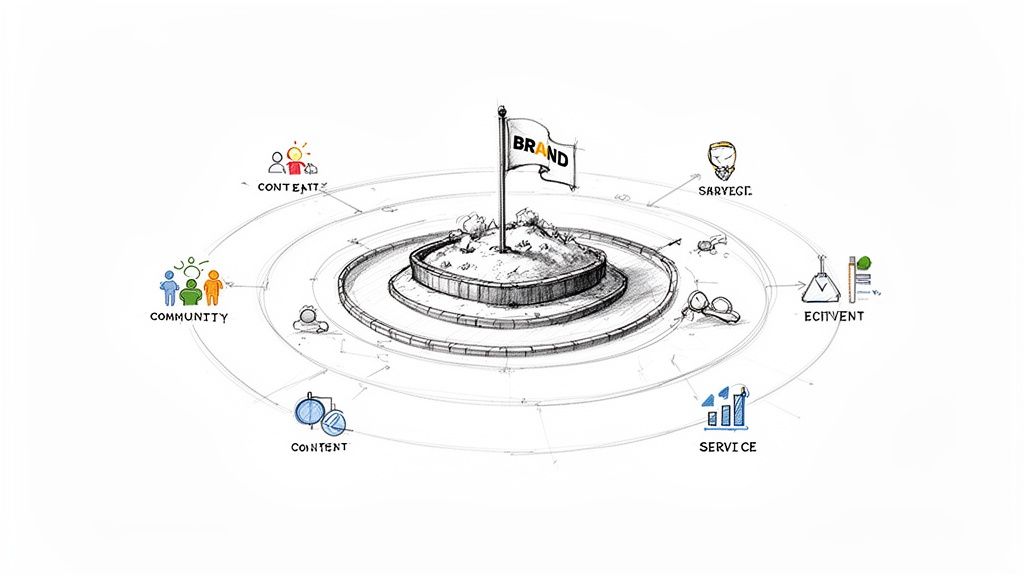
This goes way beyond a marketing campaign. It's about building an entire ecosystem around your brand that competitors can't just copy and paste. It's about creating a moat.
Hammer Home Your Unique Angle Everywhere
Consistency is your best friend here. Your unique angle needs to be the drumbeat behind every piece of content, every ad, and every customer chat. If your differentiator is "simplicity for freelancers," then your website copy, blog posts, and even your error messages should feel simple and talk directly to freelancers.
- Website Homepage: Your headline should scream your differentiator. Don't make people dig for it three clicks deep.
- Content Marketing: Every blog post should subtly reinforce why you're different. If you’re the simple solution, write guides on "How to Simplify Your Workflow."
- Social Media: Your bio and posts need to echo your core message. Don't just post random updates; make it all tie back to your unique identity.
The end game? You want people to instantly associate your brand with that one specific thing you do better than anyone else. When they think of the problem you solve, your name should be the first one that pops into their head.
> A brand moat isn't built with features; it's built with a consistent story, a fanatical community, and an experience that's impossible to clone. It's the reason people stick with you even when a cheaper, shinier option comes along.
This kind of consistency is what builds a powerful brand identity. It’s what separates fleeting novelties from the companies that lead markets for years.
Turn Customers Into Your Loudest Evangelists
Your first handful of customers are pure gold. They're not just revenue; they're your future marketing department. If you've genuinely solved a painful problem for them in a way no one else has, they'll be ecstatic. Your job is to bottle that excitement and pour gasoline on it.
How do you pull that off?
- Create a feedback loop: Don't wait for them to come to you—actively seek out their stories. Ask them, "What was life like before our product, and what is it like now?" Use their exact words in your testimonials.
- Build a community space: It doesn't have to be complicated. A simple Slack or Discord channel for your power users can work wonders. It gives them a place to connect, feel special, and give you priceless, unfiltered feedback.
- Surprise and delight: Do things that don't scale. Send a handwritten thank you note. Feature their business in a case study. Small, human gestures build a fierce loyalty that no competitor can buy with a big ad budget.
By zeroing in on your early adopters, you create a tribe of evangelists who will spread the word far more effectively than any ad campaign ever could. For some practical ideas on how to communicate your unique value and build that edge, check out these 10 B2B differentiation strategy examples.
Build A Moat Your Competitors Can’t Cross
A moat is what makes your differentiation from competition stick. It’s the defensive barrier that makes it painfully difficult for others to copy you, even if they figure out your secret. And no, this isn't just about patents.
In a cutthroat space like AI, your moat might be speed and insight. With the AI market expected to explode from USD 390.91 billion to an incredible USD 3,497 billion by 2033, the ultimate weapon is time-to-insight. Automated tools that can slash research from 40 hours to 4 minutes are a game-changer, especially as North America holds a 35.5% market share while Asia-Pacific is growing the fastest. That kind of speed gives you a data advantage that’s incredibly hard for slower, manual-research-reliant competitors to replicate.
Here are some of the most effective moats you can build for a modern business:
- Network Effects: Think of platforms like Facebook or Slack. The more people use them, the more valuable they become for everyone else, making it almost impossible for a new challenger to get a foothold.
- Brand: A strong brand is a seriously powerful moat. People choose Nike or Apple not just for the product, but for what the brand says about them. It's an emotional connection that goes way beyond features.
- Data Advantage: The more data you collect and learn from, the smarter your product gets. A tool like Already.dev becomes more powerful with every competitor it analyzes, creating a virtuous cycle that new entrants just can't match.
Your goal is to make your difference a core, inseparable part of your company’s DNA. By consistently communicating your unique value and building that defensive moat, you ensure you’re not just a passing trend, but a force to be reckoned with. And for more ideas on this, take a look at our guide on competitive marketing strategies.
Got Questions? We've Got Answers
Alright, we've walked through the entire process, from spotting those golden opportunities in the market to crafting a brand that actually means something. But I know how it is—you've probably still got a few questions bouncing around. Let's tackle the big ones I hear all the time.
What's The Real Difference Between A Feature And A Differentiator?
This is a classic one, and it trips up a lot of people. It’s simple, really. A feature is just a thing your product does. Think "exports to CSV" or "has a dark mode." It's a functional line item.
A differentiator is the fundamental reason someone picks you over the next guy. It’s that gut feeling that makes you the only viable option for them. A killer feature can certainly be part of that, but true differentiation usually runs much deeper.
> Your differentiator is rarely just one feature. It’s your business model. It's your ridiculously helpful customer service. It’s the tribe you build around your product.
Look at it this way: a competitor can copy a feature in a weekend coding session. But can they replicate the trust and loyalty you've built with your audience over two years? Not a chance. That's your fortress.
How Often Should I Be Spying On My Competition?
This isn't a one-and-done kind of deal. If you're just starting out, I'd recommend doing a serious, deep-dive analysis at least once a quarter. That cadence is frequent enough to keep you from getting blindsided by a competitor's pivot.
But that's the formal check-in. You should always have a casual eye on the landscape. A few simple tricks work wonders:
- Set up Google Alerts for their brand names.
- Spend five minutes a week scrolling through their latest app store reviews.
- Follow their founders on social media.
Big-gun tools like Ahrefs or Semrush are great for deep analysis but can come with a hefty price tag. If you want to keep tabs on things automatically without breaking the bank, a service like Already.dev is designed specifically for this—it gives you the intel without making competitive research your full-time job.
Is It Even Possible To Stand Out In A Super Crowded Market?
Heck yes! A crowded market is actually a great sign—it means people are spending money there. You've got proven demand. The trick isn't to go head-to-head with the 800-pound gorillas. It's to find the corner of the playground they're ignoring.
Forget being the best for everyone. Start asking better questions:
- Who finds the current tools way too complicated? Could you build a radically simpler version for them?
- Is there a specific industry the big guys treat as an afterthought? Think "CRM for freelance florists."
- Is there a local or regional market that’s getting zero love from the global players?
Winning in a packed space isn't about grabbing the biggest piece of the pie. It's about finding a small, hungry slice that no one else sees and becoming their absolute favorite. That’s how you build a business that lasts.
Ready to stop guessing and start building with confidence? Already.dev takes hours of painful research and turns it into a 4-minute, AI-powered report, showing you every competitor so you can build something that truly stands out. Find your unique angle today.