How to Find the Keywords Your Competitors Are Using (Without Feeling Like a Creep)
Learn how to find keywords used by competitors and boost your SEO with practical tactics, tools, and a step-by-step plan.
To find the keywords your competitors are using, you really just need to pop their top-ranking pages into an SEO tool. This little trick spits out the exact search terms that are pulling in their organic traffic, giving you a proven list of keywords to build your own strategy around. Think of it as an SEO cheat sheet that lets you skip months of guesswork.
Why Peeking at Competitor Keywords Is a Genius Move
Let's be real—we're all looking for a shortcut. Guessing which keywords your audience might be typing into Google feels a lot like throwing spaghetti at a wall to see what sticks. But when you find the keywords used by your competitors, you're getting a direct roadmap to what’s already resonating with your target market.
This isn't about being nosy; it’s just smart, efficient strategy.
Think of it as ethical spying. Your competitors have already invested the time and money to figure out which keywords attract customers who are ready to buy. By analyzing their wins (and their flops), you get to:
- Decode Your Audience: See the exact language your potential customers use.
- Save Time and Money: Bypass the painful trial-and-error phase and go straight for terms you know work.
- Spot Market Trends: Notice what topics your rivals are suddenly writing about, giving you a heads-up on where the industry is moving.
This simple process—decoding what they're doing, spotting trends, and then grabbing the keywords—is a cornerstone of modern SEO.
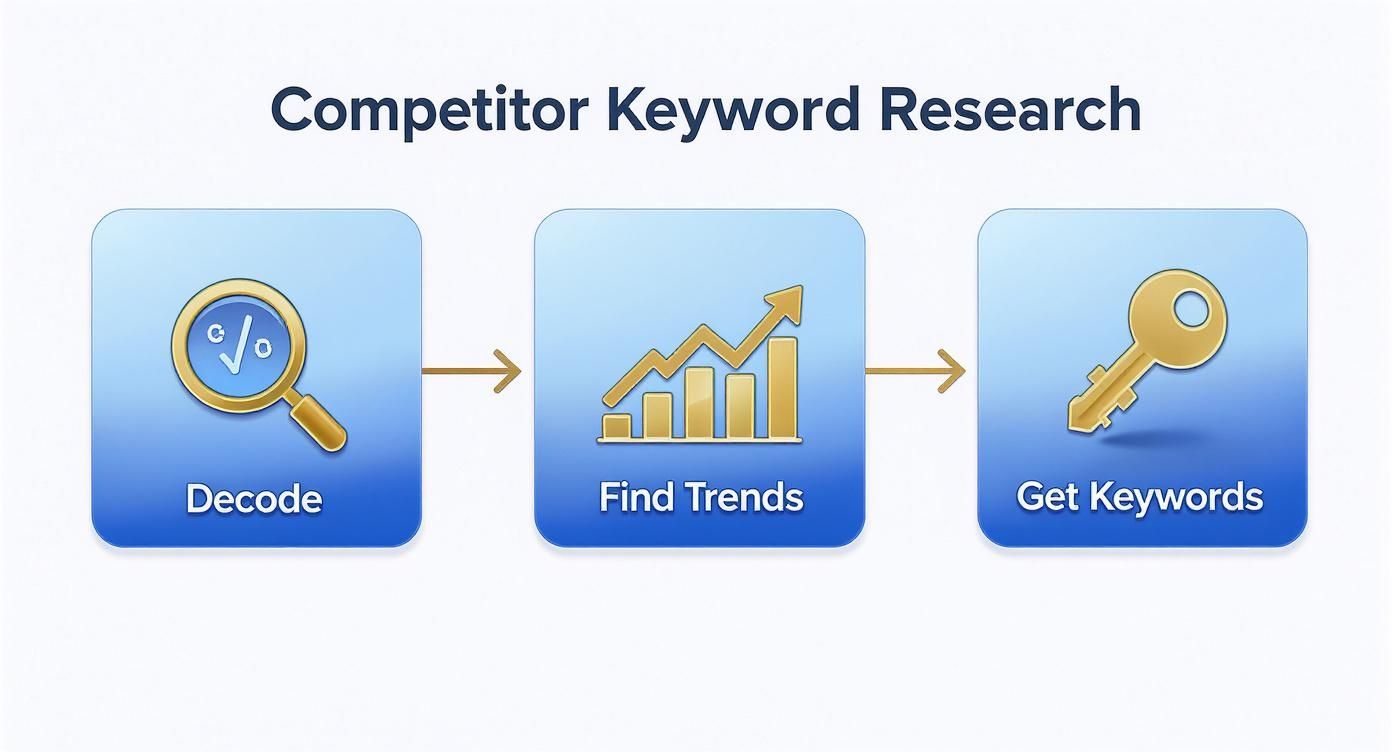
This whole process isn't some complex mystery. As you can see, it’s a pretty straightforward flow from initial digging to having a list of actionable keywords.
A Data-Driven Advantage
The sheer volume of online searches makes this approach more critical than ever. Back in 2012, Google was handling around 3.5 billion searches a day. Fast forward to 2022, and that number skyrocketed to 8.5 billion. With your competitors pulling from a massive, ever-growing pool of search queries, just guessing simply won't cut it anymore.
To really get the full picture, you can learn a lot by looking at what your rivals are doing with their paid ads. A deep dive into PPC competitive analysis can show you exactly which keywords they value enough to put their money behind.
> Key Takeaway: Analyzing competitor keywords isn't about stealing their ideas. It's about understanding the market, validating customer demand, and making data-backed decisions that give you a huge head start. Why reinvent the wheel when your competitors have already built the car?
How to Manually Spy on Competitor Keywords for Free
Alright, let's roll up our sleeves. You don't need a fat wallet to start figuring out what keywords your competitors are using. In fact, some of the best initial intel comes from good old-fashioned manual snooping—all you need is a web browser.
For a moment, forget the fancy, expensive software. Put on your detective hat. Your competitor's website is the crime scene, and their keywords are the clues scattered everywhere. The most obvious place to start is right on their homepage and main product pages.
So, what are you looking for? Pay close attention to the most prominent text on the page.
- Title Tags: This is the text you see at the very top of your browser tab. It's a massive signal to Google telling it what the page is all about.
- H1 Headings: This is almost always the big, main headline. If their H1 is something like "The Easiest Project Management Tool for Remote Teams," well, you've just struck gold on a prime keyword phrase.
- Subheadings (H2s, H3s): Now, scan the smaller headlines. These often target related, secondary keywords that flesh out the main topic.
Just by reading their key pages, you can get a surprisingly clear picture of their core keyword strategy. It’s almost like they’re handing you their playbook.
Digging Deeper into Their Site Structure
Once you've scoped out the main pages, it’s time to zoom out and look at their website's overall structure. A site's architecture is a goldmine for understanding their content themes and keyword priorities.
A great place to start is with their URLs. Notice any patterns, like competitor.com/blog/saas-metrics or competitor.com/features/time-tracking? The words they use here are completely intentional. Folders like /blog/ and /features/ reveal their main content pillars, while terms like "saas-metrics" and "time-tracking" are the specific keywords they're chasing. This is a fundamental part of any website competitor analysis you'd run.
Want another sneaky trick? Look for their sitemap. You can usually find it by just typing competitor.com/sitemap.xml into your browser. This file is literally a roadmap to every important page on their entire site.
> Pro Tip: Don't just give the sitemap a quick once-over. Look for clusters of URLs that revolve around a similar topic. If you spot ten different blog posts that all include the phrase "customer onboarding," you’ve just uncovered one of their most important keyword clusters.
Sure, these manual checks won't give you the hard search volume numbers that paid tools do. But they give you something just as valuable: a genuine, intuitive feel for your competitor’s marketing language and where their strategic focus lies. It’s the perfect, zero-cost first step.
Let's Get Serious: Using Tools for Keyword Reconnaissance
Manual checks are a great starting point, a way to get your hands dirty and understand the landscape. But if you're serious about finding the keywords your competitors are using to win, it's time to bring in the heavy machinery. SEO tools are your best friend here, turning what would be days of painstaking manual work into a few simple clicks. They lift the veil and show you every single keyword a rival ranks for, often complete with juicy data like traffic estimates and difficulty scores.
The big players in this field, like Ahrefs or Semrush, are absolute powerhouses. They also can be expensive, easily running into hundreds of dollars a month—a tough ask for a startup or a lean product team. The good news? You don’t have to shell out that kind of cash. More focused, accessible alternatives like already.dev give you the core insights you need without the enterprise-level cost. We've got a deeper dive into these options in our guide to the best competitor analysis tools.
To give you a better idea of the tool landscape, here's a quick breakdown of what's out there.
Competitor Analysis Tool Comparison
This table gives you a quick look at different types of tools for competitor keyword research, focusing on what they're best for and their typical cost.
| Tool Category | Best For | Cost Level | Example(s) | | :--- | :--- | :--- | :--- | | All-in-One SEO Platforms | Deep, comprehensive analysis; backlink tracking, rank tracking, and site audits. | High | Ahrefs, Semrush | | Focused Competitor Tools | Quick, actionable keyword gap and opportunity analysis without the extra features. | Low to Medium | already.dev, SpyFu | | PPC Intelligence Tools | Uncovering paid ad strategies, ad copy, and landing pages. | Medium to High | iSpionage | | Free Browser Extensions | Quick on-the-fly checks of a specific page's keyword density and on-page SEO. | Free | SEOquake |
As you can see, you can pick your weapon based on your budget and specific needs. You don't always need the most expensive tool to get the most valuable insights.
Running a Domain Overview
Your first move with any of these tools is almost always a "Domain Overview" (or something similar). You just grab your competitor’s URL, pop it into the search bar, and let the tool do its thing. Think of it as telling the tool, "Show me everything this site does that Google likes."
What you get back is a firehose of data—a list of every single keyword driving organic traffic their way. It can be overwhelming at first, often numbering in the thousands. But don't panic. This raw data is where the real work—and the real fun—begins.
This is a quick look at how a tool can visualize the content and keyword opportunities on a competitor's site.
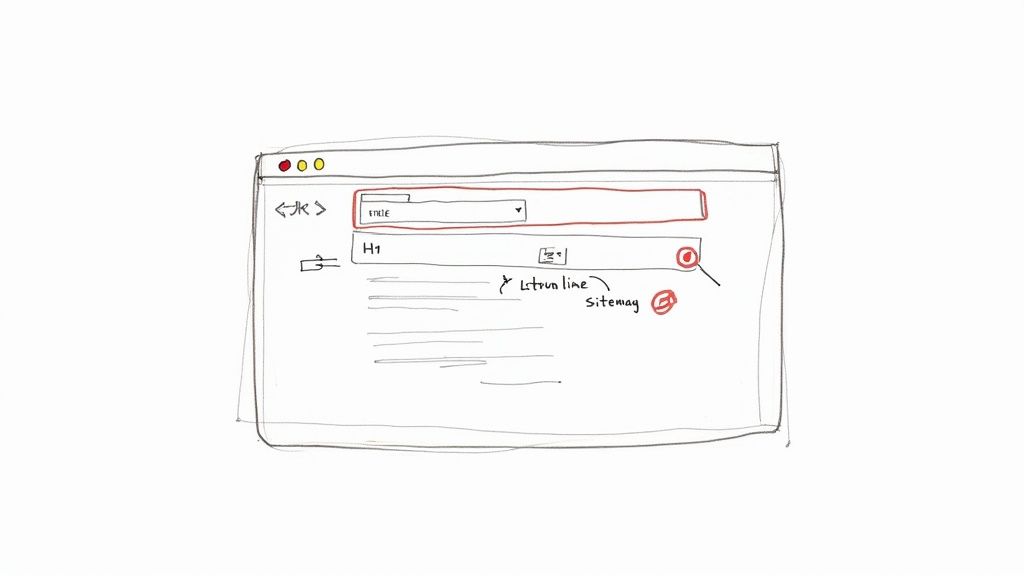
Seeing the full list is one thing; the real skill is using filters to pan for gold.
Filtering for the Hidden Gems
A giant, unfiltered keyword list is mostly noise. Your job is to find the signal—those golden opportunities that are a perfect fit for your business. This is where filters become your superpower, helping you trim a list of 10,000 keywords down to an actionable handful.
Here’s what I typically look for:
- Keyword Difficulty (KD): This is the tool’s best guess at how hard it will be to crack the first page of Google. I always start by filtering for low KD scores—anything under 30 is a good starting point to find low-hanging fruit.
- Search Volume: This tells you roughly how many people are looking for this term each month. You need enough volume to make it worth your time, but not so much that you're competing against giants.
- Ranking Position: Zero in on keywords where your competitor is already ranking in positions 1-10. Why? Because it proves the keyword is a viable traffic-driver for a business just like yours.
> By combining these filters, you create a "sweet spot" list: keywords with decent search volume, low competition, and a proven track record for a direct competitor. This isn't just a list of words; it's the blueprint for a smart, data-driven content strategy.
And this process is only getting easier. As technology gets smarter, AI-powered tools are revolutionizing keyword research and content strategy, making this kind of reconnaissance faster and more precise than ever. It's no longer a guessing game; it's a surgical strike.
Finding Keyword Gaps and Understanding Search Intent
So, you’ve run a tool and now you're staring at a spreadsheet with thousands of your competitor's keywords. It feels like you've struck gold, but a giant pile of raw, unrefined gold isn't actually that useful. The real magic isn’t just having the data; it’s in finding the strategic gaps.
A keyword gap analysis sounds a lot more complicated than it is. You're just looking for valuable keywords that one or more of your competitors rank for, but you don't. Think of it as finding the empty chairs at their party—prime spots you can slide right into.
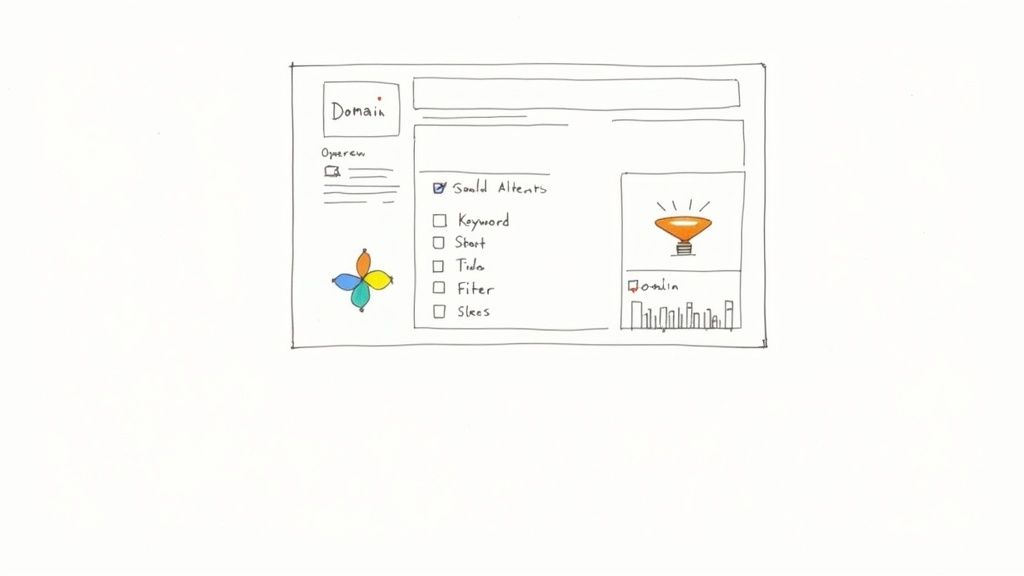
This is where you stop simply copying their strategy and start actively exploiting its weaknesses. Most decent SEO tools can do this for you pretty much automatically. You can plug in your domain and a few of your rivals' sites, and the tool will spit out a list of "gap" keywords. This is your first real, actionable treasure map.
Beyond the Keyword to the Why
Okay, but just finding keyword gaps isn't the whole story. You absolutely need to understand the why behind the search. We call this search intent, and honestly, it’s the most critical part of this entire process. Getting this right is the difference between attracting random internet traffic and attracting actual, paying customers.
Is your competitor using their keywords to pull in people just looking for information? Or are they targeting users who have their credit cards out, ready to buy? You have to decode their game plan.
Most keywords fall into a few key intent buckets:
- Informational: Someone wants to learn something. Think "how to improve team productivity." These are perfect for blog posts, tutorials, and guides.
- Commercial Investigation: The searcher is weighing their options before a purchase, like "best project management software for startups." This is where comparison pages and in-depth reviews shine.
- Transactional: They are ready to buy now. A search like "buy Asana business plan" is a clear signal. These keywords belong on your product, feature, and pricing pages.
> By categorizing your competitor's keywords by intent, you're not just seeing what they rank for; you're seeing how they've structured their entire customer journey. You can literally map out their sales funnel and find where they're strong and, more importantly, where they're weak.
Mapping Out Their Entire Strategy
When you map your competitor's keywords to search intent, you get a bird's-eye view of their business priorities. If 80% of their top keywords are informational, it's a dead giveaway that they're all-in on a content marketing play, trying to hook users early in their journey. If it's mostly commercial, they're playing an aggressive bottom-of-funnel game, going straight for the sale.
Understanding this distribution is a huge advantage. For instance, data shows that 52.65% of all Google searches are purely informational, while only a tiny fraction are directly transactional. A competitor who ignores all that top-of-funnel content is leaving a massive gap wide open for you. If you want to dive deeper, you can read about how search intent statistics shape SEO strategy and discover why over 58% of searches result in zero clicks—a fact that really hammers home the importance of winning things like featured snippets.
By analyzing intent, you can find the keywords your competitors use and pinpoint exactly where to strike. If they’re buried in informational content, maybe you can win by creating much better commercial comparison pages. If they only have product pages, you can swoop in with helpful guides and become the go-to educational resource in your niche.
This is how you stop chasing their tail and start leading the pack.
Winning the Long-Tail Keywords Your Competitors Ignore
https://www.youtube.com/embed/aD4PCKN8tZ8
Let your competitors duke it out over the big, flashy, ego-boosting keywords. You know the ones—phrases like “project management software” that pull in massive search volume but are nearly impossible to rank for. While they're pouring their budget into that fight, you can play a much smarter, sneakier game.
Your secret weapon? The long-tail keyword.
These are the longer, super-specific search phrases that don’t look like much on their own. But here’s the magic: they have ridiculously high conversion rates because the person searching knows exactly what they want.
Uncovering the Hidden Gems
Finding these gems doesn't always require breaking the bank on expensive enterprise tools like Ahrefs or Semrush. While those platforms are fantastic for deep-dive analysis, you can get started with some clever sleuthing in places your competitors probably overlook. More accessible tools like already.dev are also great for spotting these patterns without the hefty price tag.
Here are a few of my favorite goldmines for long-tail keywords:
- Competitor Reviews: Dig through sites like G2 and Capterra. What specific problems or features are customers raving or complaining about? Phrases like "software that integrates with Slack for small teams" are pure long-tail gold.
- Forums and Reddit: Find the subreddits where your ideal customers are hanging out. Look for post titles that start with "How do I..." or "What's the best tool for..." You're literally seeing the exact language people use to describe their problems.
- Google's "People Also Ask" Box: This is Google handing you a cheat sheet on a silver platter. Type in a broad competitor keyword and see what questions pop up. Each one is a potential long-tail keyword you can build content around.
Long-tail keywords are the backbone of modern search. In fact, they account for around 70% of all search traffic, even though each one has a low individual volume. It's a massive strategic blind spot for so many companies. If you want to dive deeper, you can discover more SEO statistics and see how an incredible 94.74% of keywords get 10 or fewer searches a month—proving the long-tail is where the real action is.
> Key Takeaway: Stop chasing the same five keywords as everyone else. The real opportunity lies in answering the highly specific, urgent questions your customers are actually asking. These long-tail keywords attract less traffic, but it’s the right kind of traffic—the kind that buys.
Prioritizing them is pretty straightforward. Start with the questions that show the most pain or purchase intent. Think about it: a keyword like "best alternative to [competitor] for budget-conscious startups" is a much hotter lead than someone just searching a broad industry term.
Go after those quick wins first. You'll build momentum and start attracting hyper-qualified visitors right away.
Turning Your Findings Into an Actionable SEO Plan
Alright, you've done the heavy lifting and now you're staring at a massive list of keywords your competitors are ranking for. Awesome. But a spreadsheet full of terms isn't a strategy—it's just data.
Having a list of keywords without a plan is like having a pantry full of amazing ingredients but no recipe. You’ll just end up making a mess. The real work starts now: turning that raw data into a concrete content plan. We need to move from "what are they ranking for?" to "what are we going to create to beat them?"
This is all about smart prioritization. Not every keyword is a winner, and you can't go after everything at once. You have to slice and dice your list to find the opportunities that will actually move the needle for your business.

Prioritize Like a Pro
I like to use a simple traffic light system to make sense of a big keyword list. Just start bucketing your terms into three categories, weighing their relevance, search volume, and difficulty.
- Green Light (Go Now): These are your low-hanging fruit—the low-difficulty, highly relevant keywords. They might not have eye-popping search volume, but they're the quick wins that build momentum and get the ball rolling. These are your top priority.
- Yellow Light (Plan For It): Here you have terms with solid volume and relevance, but they’re a bit more competitive. Ranking for these will require a well-researched, genuinely helpful piece of content. Slot these into your content calendar for the next 2-3 months.
- Red Light (Maybe Later): These are the high-volume, high-difficulty trophy keywords. Don't ignore them, but definitely don't attack them first. Keep them on a "someday" list for when your site has built up more authority.
This simple sorting method turns an overwhelming list into a clear roadmap. Remember, it's far better to rank #1 for a keyword with 100 monthly searches than to be stuck on page nine for one with 10,000.
Map Keywords to Content Types
With your priorities straight, the next move is to figure out what to create for each keyword. The keyword's intent dictates the content format. You wouldn't write a 3,000-word blog post for someone trying to buy a product right now, would you? (Please, say no.)
> Pro Tip: Match the searcher's intent to the content type. If your competitor ranks with a product page for "buy red widgets," you'll probably need a product page, too. Don’t try to fight a pricing page with a blog post—you’ll lose every time.
Here’s a quick guide for mapping it out:
- Informational Keywords ("how to," "what is"): Perfect for blog posts, guides, and tutorials.
- Commercial Keywords ("best," "vs," "review"): These demand comparison pages, in-depth reviews, or detailed feature breakdowns.
- Transactional Keywords ("buy," "pricing," "trial"): These map directly to your product, pricing, or signup pages.
Mapping keywords correctly ensures the content you create actually solves the searcher's problem. This process also sets you up to track your progress against the competition. To see how you're really stacking up, you can learn how to calculate your share of voice in the market. Folding these new, targeted keywords into your content calendar isn't just an SEO exercise; it’s about systematically carving out your space in the search results.
Got Questions About Competitor Keyword Research?
Good. When you start digging into what your competitors are doing, a bunch of questions always bubble up. Let's tackle some of the most common ones I hear so you can get back to smartly swiping their traffic.
Think of this as your quick-and-dirty guide to the tricky parts. These are the questions that often trip people up, but the answers are usually simpler than you think.
How Often Should I Check My Competitors' Keywords?
This definitely isn't a one-and-done task, but you don't need to be glued to your screen 24/7 either.
For your main rivals, a quarterly check-in is a solid rhythm. That’s enough time to spot new content strategies or a shift in their focus without getting bogged down in daily fluctuations.
But if you're in a lightning-fast industry—think fashion, crypto, or a new tech niche—you might want to tighten that up. A quick monthly scan is a smart move in those cases. You don't want to miss a major shift and get left behind.
What If My Competitor Is a Huge Brand?
Going head-to-head with a behemoth like Amazon or HubSpot on massive, broad keywords is a losing battle. It’s like trying to win a fistfight with a bulldozer. Don't even try. The key is to pick your battles wisely.
Instead of trying to analyze their entire domain (which is a mess of a million different topics), zero in on the specific product lines or categories that actually compete with you.
Most tools will let you analyze a specific subfolder of a site, like brand.com/specific-product-category. This cuts through all the noise and lets you find the niche keywords where you can actually put up a fight—and win.
> Key Takeaway: You can't out-muscle a giant, but you can definitely out-smart them. Get hyper-specific with your analysis to find the chinks in their armor instead of taking them on where they're strongest.
Is It Better to Target Keywords They Rank For or Ones They Miss?
The real answer? You need to do both. This isn't an either/or scenario; it's a "yes, and..." strategy.
- Keywords They Rank For: Chasing these is a proven move. You already know there's search demand, and Google clearly sees these terms as relevant to your space. This is how you build your core, foundational traffic.
- Keywords They Miss: This is where you get to be creative. Finding these keyword gaps lets you plant your flag and become the authority on a topic they’ve completely overlooked. It's your blue ocean.
A really strong SEO plan balances both. You compete where it's necessary, and you dominate where they haven’t even shown up to the party.
How Can I See Their Paid Keywords?
Ah, now we're getting to the good stuff. When a competitor is willing to spend money on a keyword, it's a massive signal. It tells you exactly what they consider most valuable—these are often high-intent keywords that lead straight to conversions.
Most solid SEO tools have features for peeking into paid search (PPC) campaigns. The big platforms like Semrush can be expensive, but they do this well. More focused tools like already.dev give you this insight too, often for a lot less money. You just plug in their domain, and you can see a list of keywords they're bidding on in Google Ads. It’s like getting a direct look at their paid acquisition playbook.
Ready to stop guessing and start winning? Already.dev uses AI to automate this entire process, delivering a complete competitive analysis with actionable keyword insights in minutes, not hours. See what your competitors are up to and find your strategic advantage today at https://already.dev.