12 Free Market Research Tools You Need in 2025
Stop guessing. We found 12 actually useful free market research tools to help you find competitors, analyze trends, and validate ideas without a huge budget.

Look, market research sounds expensive, complicated, and frankly, a bit boring. It often involves consultants who charge a small fortune to produce a 50-page report you’ll never read. But figuring out if your big idea has legs, who you're really competing against, and what your customers secretly want doesn't have to drain your startup's bank account. What if you could get the most critical insights without spending a dime?
This isn't another list of "freemium" teasers that lock you out after three searches. We’ve compiled a guide to genuinely free market research tools that deliver real value. These are the tools that help you move from pure guesswork to data-backed decisions. We're talking about everything from uncovering the exact questions people are typing into Google to analyzing your competitors' every move and even tapping into powerful (and surprisingly interesting) government data. You don't always need to pay thousands for expensive platforms like Ahrefs or Semrush when you can get started for free, or use a more streamlined alternative like https://already.dev to tie it all together.
In this guide, we’ll break down each tool with no-fluff summaries, screenshots, and direct links. We'll show you exactly what each one is good for, what its limitations are, and how you can combine them to create a powerful, cost-free research workflow. Let’s get you some answers.
1. Already.dev
When it comes to competitive intelligence, most free market research tools barely scratch the surface, leaving you to piece together clues from Google's front page. Already.dev is a different beast entirely. It’s an AI-powered research platform designed to automate the painful, time-consuming process of scouting the competitive landscape, compressing what would normally take weeks of manual work into a report that's ready in about four minutes.
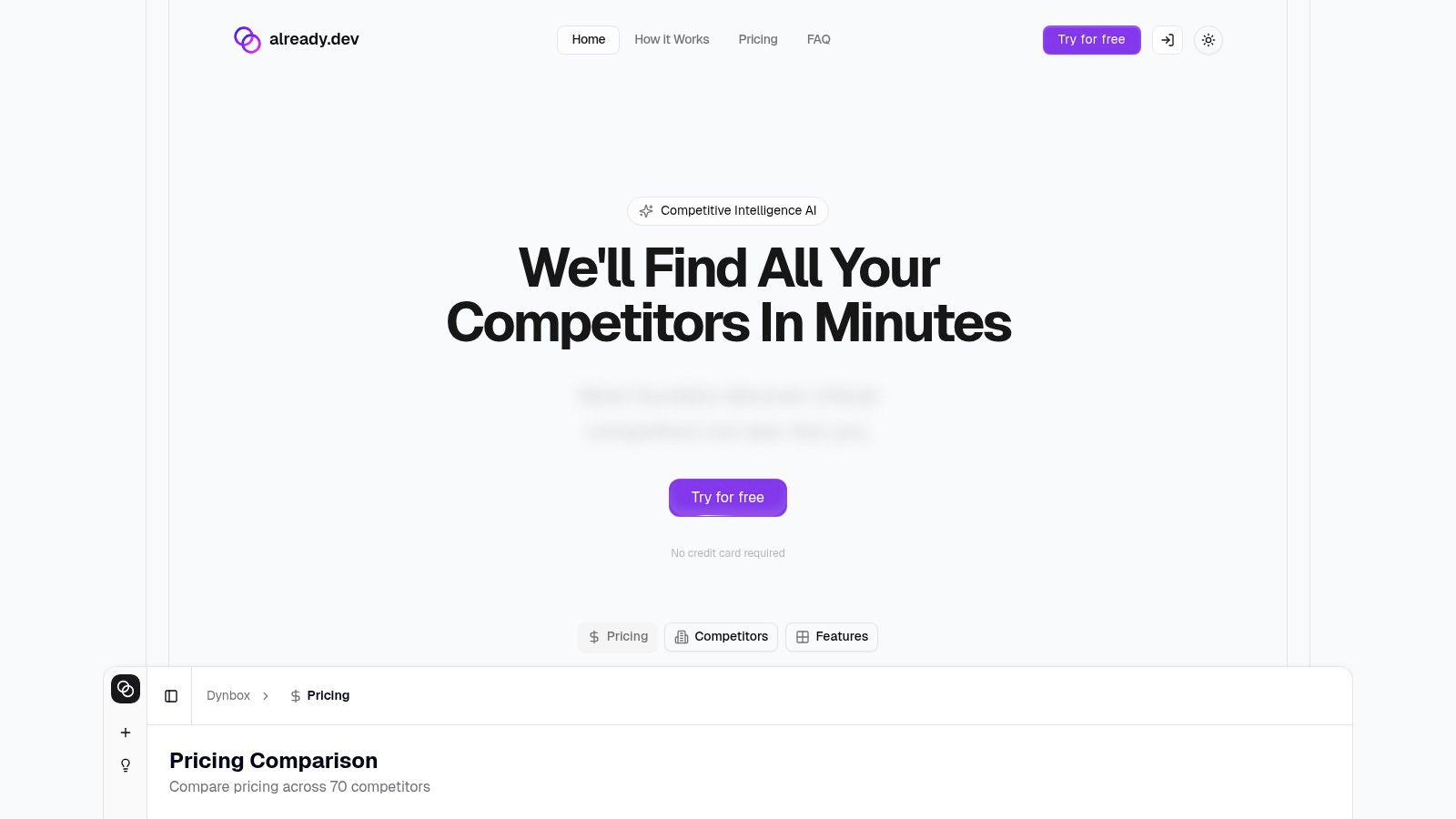
You start by describing your business idea in plain English. From there, its AI agent builds a custom research plan and simultaneously scours hundreds of sources far beyond a simple search. It digs through app stores, GitHub repositories, Product Hunt, niche forums like Reddit and Hacker News, and even paid data sources to give you a complete picture.
Why It's Our Top Pick
The real magic of Already.dev isn't just speed; it's the depth of its insights. Instead of just listing top-ranking competitors, it uncovers:
- Hidden & Indirect Rivals: Find competitors that don’t show up on Google but are actively discussed in niche communities or hiding in app stores.
- Failed Attempts: Learn from the ghosts of startups past. The platform surfaces similar ideas that didn't make it, helping you avoid the same expensive mistakes.
- Actionable Outputs: The reports are built for decision-making. You get smart keyword maps showing the actual language customers use, visual feature-gap grids, and detailed pricing comparisons across dozens of players.
While many teams rely on expensive tools like Ahrefs or Semrush for keyword data, Already.dev integrates this analysis directly into its competitive overview, focusing specifically on the terms and positioning that your actual rivals are using to win customers. It’s an incredibly efficient way to validate an idea, refine your positioning, or pivot with confidence before you write a single line of code.
Getting Started
Already.dev operates on a credit-based model. You can run your first report completely free without a credit card to see the power for yourself. After that, you can purchase single reports (around $93) or get multi-report packs like the Founder Pack (10 reports for ~$191) which makes it highly accessible for early-stage teams.
Website: https://already.dev
2. Google Trends
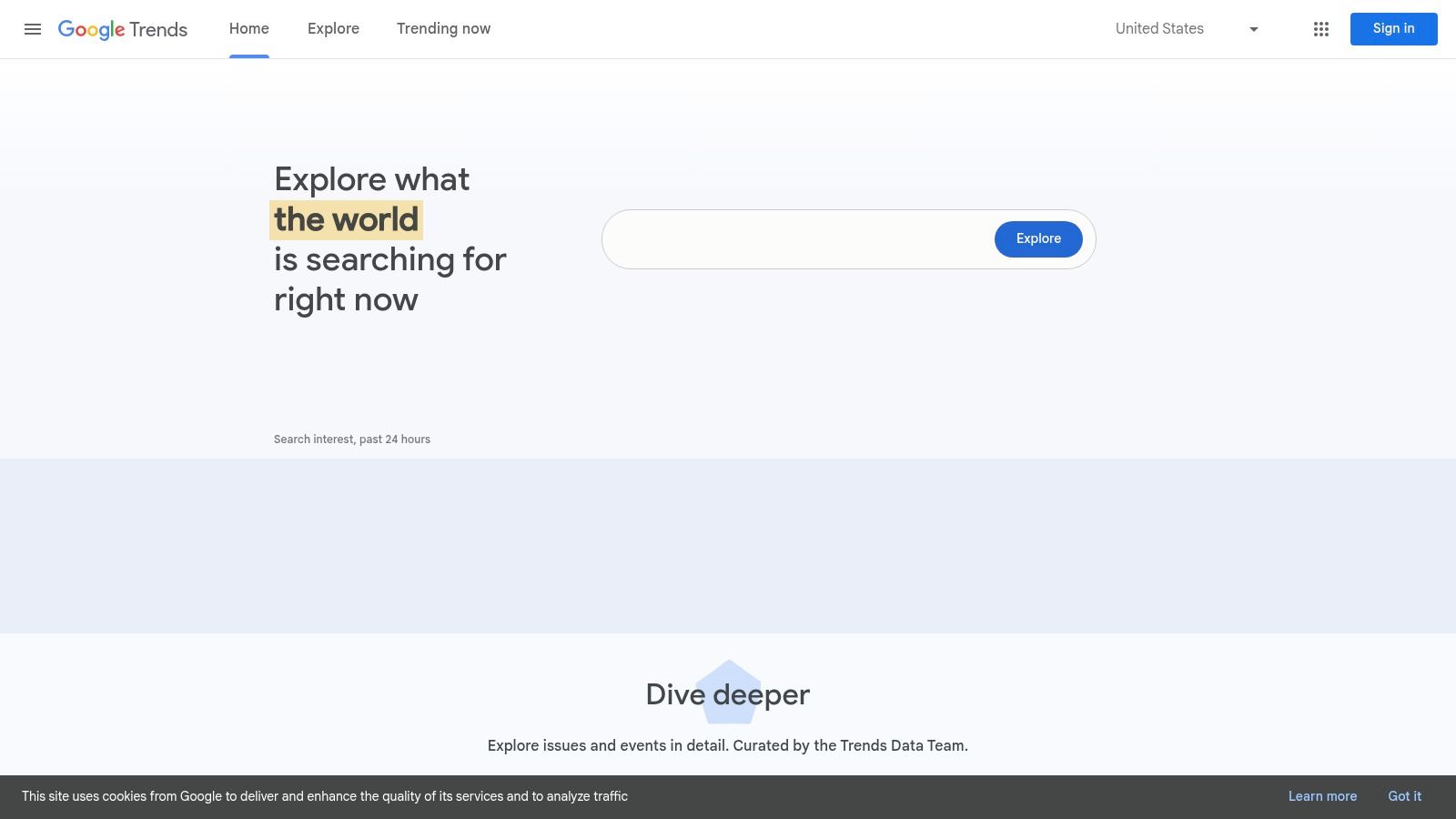
Google Trends is your secret weapon for understanding the pulse of the internet. It doesn't give you exact search numbers, but it shows the relative popularity of a search term over time. Think of it less like a spreadsheet and more like an EKG for public interest, showing you what’s hot, what’s not, and what’s about to be. It’s one of the most powerful and intuitive free market research tools available for spotting emerging trends and understanding seasonality.
Want to know if "kombucha" is more popular in California or Texas? Or see if "quiet quitting" is just a fad or a lasting movement? This is the place. It's brilliant for validating an idea by seeing if anyone is actually looking for it.
Use Cases & Limitations
Best For:
- Spotting Seasonality: Perfect for figuring out when to launch a marketing campaign for "winter jackets" versus "swimsuits."
- Comparing Ideas: Pit two or more search terms against each other (e.g., "keto diet" vs. "paleo diet") to see which has more traction.
- Geographic Targeting: Discover where your topic is most popular, right down to the city level, to focus ad spend and localize content.
- Content & SEO: Find breakout topics in the "Related queries" section to create timely content that captures emerging interest.
Limitations: While fantastic for directional insights, Google Trends isn’t a keyword research tool. It provides an index score from 0-100, not absolute search volume. For that, you’d need expensive tools like Ahrefs or Semrush, or a more integrated platform like https://already.dev. For a deep-dive into using this data, check out our guide on how to analyze market trends.
- Access: Completely free
- Website: https://trends.google.com/
3. Similarweb
Similarweb is like having a spyglass to peek at your competitors' website traffic. While the full-blown platform can get pricey, its free offering gives you a surprisingly detailed snapshot of any domain's performance. It’s an essential tool for benchmarking yourself against the competition and understanding where their visitors are coming from, giving you a high-level view of what marketing channels are working for them.
Curious about how much traffic a rival gets or if their visitors primarily come from social media, direct search, or paid ads? Similarweb lays this out in a clean, easy-to-digest dashboard. It's one of the go-to free market research tools for a quick competitive reality check, helping you validate whether a market is as big as you think it is.
Use Cases & Limitations
Best For:
- Competitor Benchmarking: Quickly see estimated monthly visits, engagement rates (like bounce rate and page views), and traffic ranking for any competitor.
- Traffic Source Analysis: Get a breakdown of a website’s traffic channels (e.g., Direct, Search, Social) to inform your own marketing strategy.
- Geographic Insights: Discover which countries are driving the most traffic to a competitor’s site, helping you spot potential new markets.
- Audience Demographics: Get a glimpse into the age, gender, and interests of a competitor's audience.
Limitations: The free version is a fantastic starting point, but the data is limited. You only get a few months of historical data and a handful of results per category. For in-depth keyword analysis or granular data cuts, you’ll hit a paywall and need to upgrade or look at expensive enterprise tools like Ahrefs. A more focused and affordable alternative for competitive intelligence is https://already.dev. For more on this, see our deep dive on conducting website competitor analysis.
- Access: Free with limited data; 7-day free trial available for more features.
- Website: https://www.similarweb.com/
4. Semrush
Semrush is a beast in the digital marketing world, known primarily as an all-in-one SEO suite. While many of its core features are behind a hefty paywall (and we mean hefty), its free account offers a surprisingly useful entry point for competitor analysis and keyword discovery. It’s one of the few professional-grade free market research tools that gives you a taste of enterprise-level data without immediately asking for your credit card.
Think of the free version as a keyhole view into your competitors' online strategy. You can peek at their top organic keywords, see where their traffic comes from, and analyze their backlink profile. It's an excellent way to benchmark your performance and find quick-win opportunities that your rivals are already capitalizing on. While you won't get the full picture, you'll get enough to make smarter decisions.
Use Cases & Limitations
Best For:
- Competitor Traffic Analysis: Get a high-level overview of a competitor's website traffic, top-performing pages, and primary traffic sources.
- Keyword Gap Analysis: Identify keywords your competitors rank for but you don't, uncovering valuable content opportunities.
- Top-Level Domain Audits: Run a limited site audit to find critical technical SEO issues that could be hurting your visibility.
- Backlink Checking: See who is linking to your competitors to inform your own outreach and link-building strategy.
Limitations: The free account is, by design, very limited. You'll hit your daily query limits quickly, and the data is a small sample of what's available in the expensive paid plans. For a more integrated and affordable platform that consolidates this kind of research, a tool like https://already.dev is a strong alternative. Also, be mindful that the 7-day trials will convert to a paid subscription if not canceled.
- Access: Free account with limited queries; 7-day trials available for specific toolkits.
- Website: https://www.semrush.com/
5. Ahrefs Webmaster Tools (AWT)
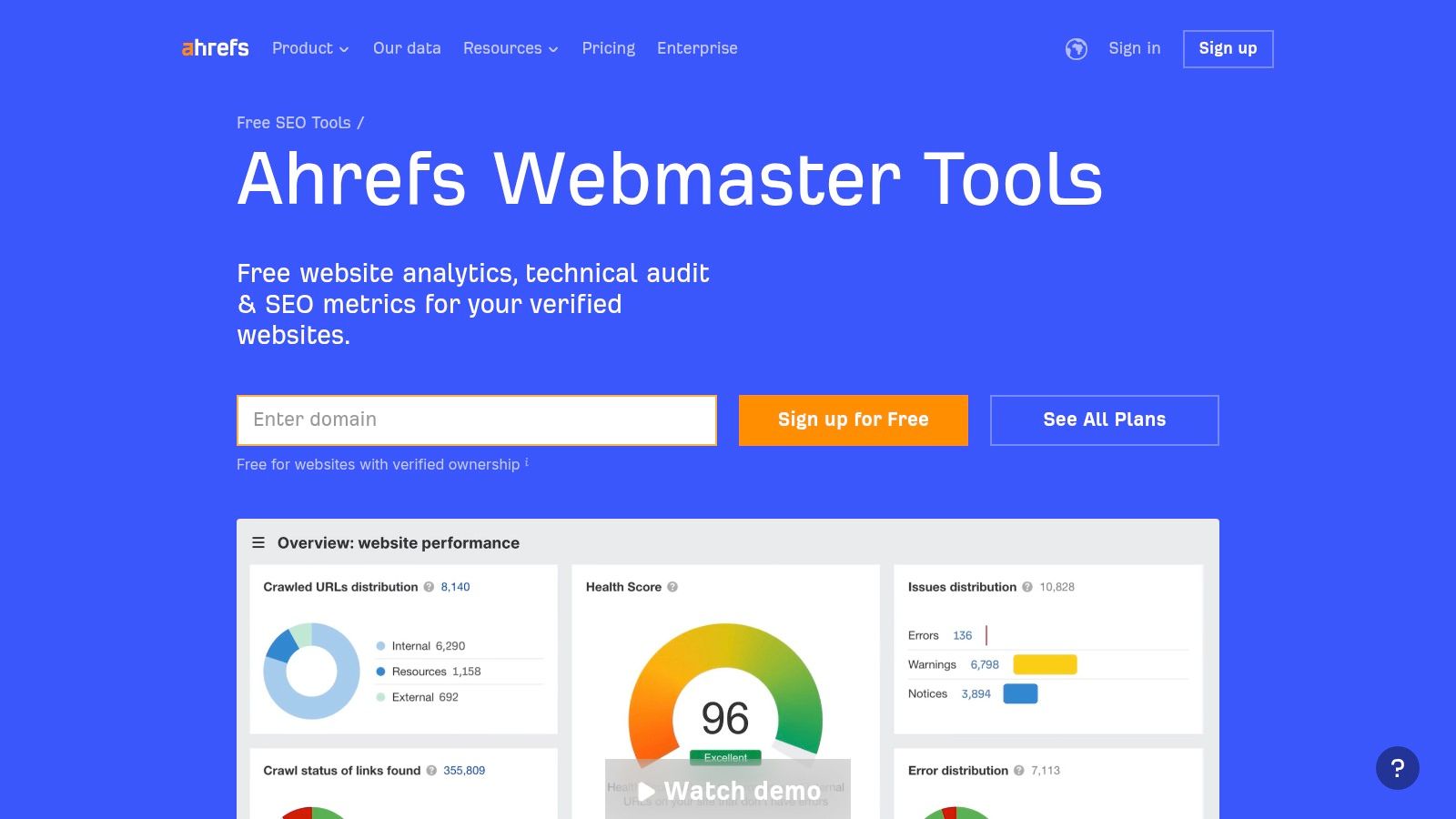
Ahrefs Webmaster Tools (AWT) is like getting a peek under the hood of a Formula 1 car, but for your own website, and for free. While the full Ahrefs suite is a paid (and famously expensive) powerhouse for deep competitor analysis, AWT gives you access to its industry-leading Site Audit and Site Explorer tools for any website you can verify you own. This lets you diagnose your site's health and see the foundational data that shapes your market presence.
It’s less about spying on competitors and more about getting your own house in order. By understanding how search engines see your site and what keywords you're ranking for, you gain crucial context for where you stand in the market. It’s one of the best free market research tools for doing a technical self-assessment.
Use Cases & Limitations
Best For:
- Technical SEO Audits: Run a comprehensive crawl to find over 100 technical issues like broken links, slow pages, or redirect chains that could be hurting your visibility.
- On-Page SEO Analysis: See the keywords your site already ranks for, discover which pages bring in the most organic traffic, and check your backlink profile.
- Benchmarking Your Foundation: Understand your website's baseline "Domain Rating" and "Health Score" to measure the impact of your marketing efforts over time.
- Finding Content Gaps (on your own site): Identify keywords you're ranking for but not on page one, giving you quick-win opportunities for content optimization.
Limitations: AWT's generosity ends with your own verified domains. You can’t use it for in-depth competitor research; that requires a pricey Ahrefs subscription. It’s fantastic for internal diagnostics but won't give you the full market picture. For that, you’d need to upgrade or use an integrated platform like https://already.dev.
- Access: Free for verified site owners
- Website: https://ahrefs.com/webmaster-tools
6. U.S. Census Bureau – data.census.gov
When you need to get serious about market sizing and customer demographics, you go straight to the source. The U.S. Census Bureau’s data portal is an absolute goldmine of authoritative information on population, housing, and the economy. It’s the definitive dataset for understanding American consumers, and it’s one of the most powerful free market research tools for anyone building a business in the U.S.
Forget guesswork about your total addressable market. Here, you can find granular data to answer questions like, "How many households with two children and an income over $100k live in the Boston metro area?" It’s not the flashiest tool on the list, but the sheer depth and reliability of the data are unmatched for foundational research.

Use Cases & Limitations
Best For:
- Market Sizing: Get precise population counts to build bottom-up or top-down market size estimations.
- Customer Segmentation: Create detailed customer profiles using real demographic data like age, income, education, and family size.
- Location Analysis: Identify ideal locations for physical stores or targeted marketing campaigns by analyzing geographic data down to the zip code.
- Economic Analysis: Understand industry trends, business patterns, and workforce statistics to inform your strategy.
Limitations: The biggest hurdle is the user interface and learning curve. It can feel clunky and overwhelming compared to modern SaaS tools. Finding the exact dataset you need often requires patience and a good understanding of how the surveys are structured. While the data is free, making sense of it can be a real time-sink. For an easier way to get insights, you could try a platform like https://already.dev.
- Access: Completely free
- Website: https://data.census.gov/
7. Pew Research Center (Datasets)
If you need to ground your ideas in solid, sociological data, the Pew Research Center is an absolute goldmine. It's a nonpartisan "fact tank" that provides downloadable raw datasets from their extensive surveys on public opinion, technology, media, and demographics. This isn't just a summary report; you get the actual microdata, allowing you to slice and dice the information to find answers to questions no one else has even asked yet. It’s one of the most credible free market research tools for understanding the "why" behind broad societal shifts.
Want to know how different age groups feel about AI in the workplace or the specific demographics of social media platform users? This is where you find methodologically rigorous data to benchmark your own findings or build a bulletproof business case. It's a bit more academic, but the insights are unparalleled.

Use Cases & Limitations
Best For:
- Customer Persona Development: Use their demographic and attitudinal data to create incredibly detailed, evidence-backed user personas.
- Benchmarking Your Own Surveys: Compare your primary research findings against a nationally representative sample to see if your audience is an outlier.
- Trend Validation: Find hard data to support or debunk the cultural and technological trends you're seeing on platforms like Google Trends.
- Content Marketing: Pull fascinating statistics and create original charts for blog posts, reports, and presentations that position you as a thought leader.
Limitations: The biggest hurdle is the learning curve. You can't just browse this data; you need statistical software (like R or SPSS) and some analytical know-how to process the datasets. It’s not for quick-and-dirty insights. Also, since these are large-scale studies, the data might not be updated as frequently as you'd like for fast-moving topics. For more accessible data integration without the heavy lifting, a platform like https://already.dev can be a more practical starting point.
- Access: Completely free
- Website: https://www.pewresearch.org/data/datasets/
8. Statista
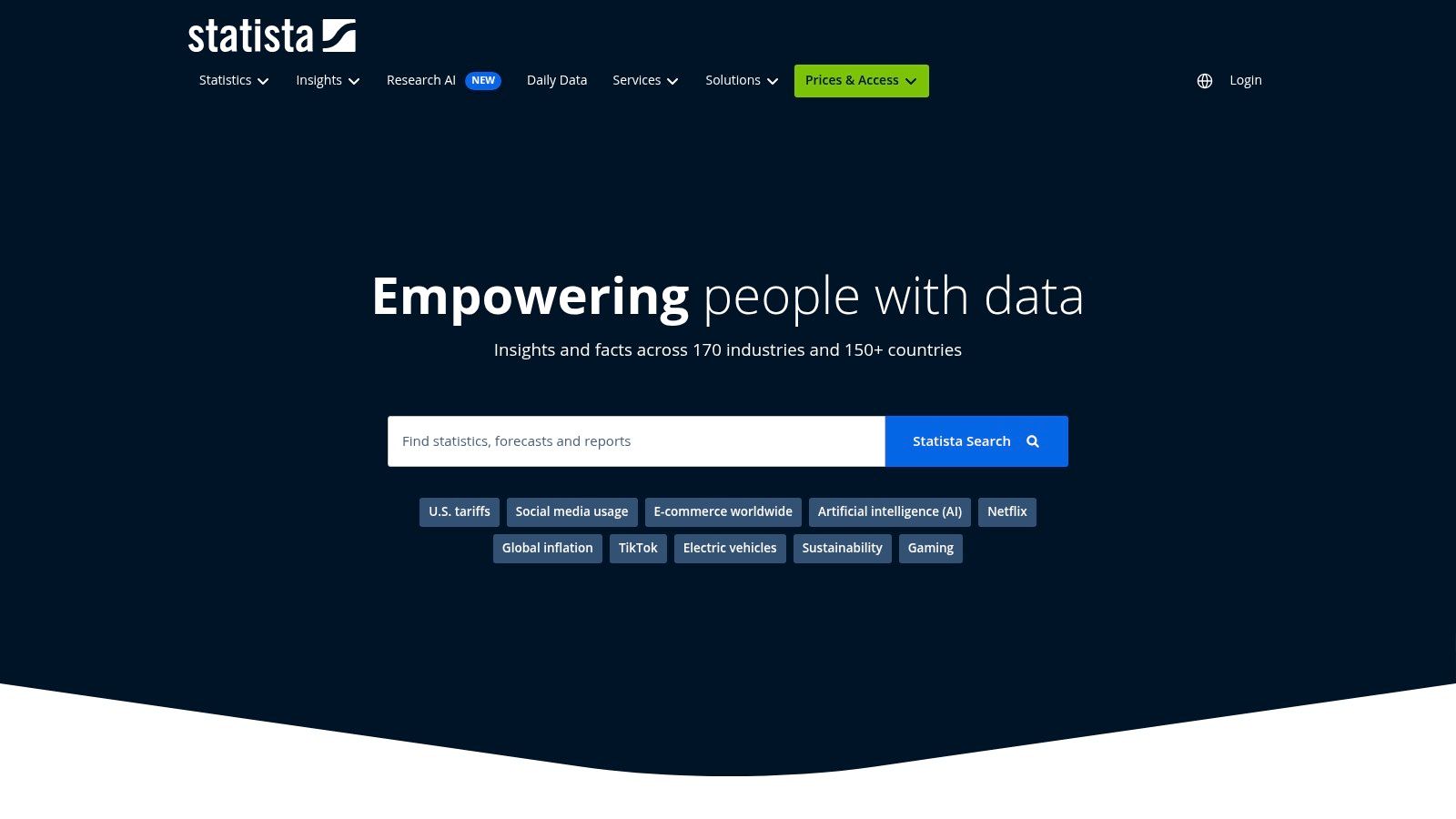
Statista is your go-to encyclopedia for quick market and consumer statistics. It’s a vast library of charts, graphs, and data points covering almost any industry you can imagine. While many of the in-depth datasets are behind a hefty paywall, its free Basic account is a goldmine for getting quick, directional figures to back up a hunch or add weight to a presentation. Think of it as the Wikipedia of market data, but with professionally curated visualizations.
Need a quick stat on the size of the global SaaS market or the adoption rate of electric vehicles? Statista likely has a chart for that. It’s one of the best free market research tools for high-level desk research and getting a foundational understanding of a market before you dive deeper.
Use Cases & Limitations
Best For:
- Initial Desk Research: Quickly find top-level market size, growth projections, and consumer behavior stats.
- Validating Assumptions: Get a fast, data-backed answer to questions like, "Is this market actually growing?"
- Enriching Presentations: Download free PNG charts to drop into your pitch decks and reports for instant credibility.
- Industry Overviews: Use their topic hubs to get a bird's-eye view of a specific industry's key metrics and trends.
Limitations: The biggest catch with Statista's free offering is the lack of depth and export options. You can see the chart, but you can't download the raw data in XLS or get the full source details without a premium subscription, which can be quite expensive. For critical business decisions, you should always try to verify the original sources. Platforms like https://already.dev often integrate multiple data sources to give a more holistic and actionable view without the high costs.
- Access: Free Basic account with limited access; paid plans for full datasets and exports.
- Website: https://www.statista.com/
9. Bureau of Labor Statistics (BLS)
The Bureau of Labor Statistics (BLS) is the U.S. government's go-to source for heavy-duty economic data, and it's a goldmine for anyone needing to understand the bigger picture. Forget trends; this is about the fundamental economic forces that shape consumer behavior, like inflation (CPI), employment rates, and wages. It's the kind of data that helps you understand if people actually have the money to buy your product, or if your target industry is hiring or firing.
Think of it as the foundational layer of your research. While other tools tell you what people are searching for, the BLS tells you about their economic reality. It’s one of the most authoritative free market research tools for grounding your strategy in hard data, especially for B2B or products sensitive to economic shifts.

Use Cases & Limitations
Best For:
- Economic Context: Use the Consumer Price Index (CPI) to understand inflation's impact on your customers' purchasing power and adjust pricing strategies.
- Industry Health Analysis: Dive into employment and wage data for specific sectors to assess market growth, talent availability, or potential B2B customer health.
- Strategic Planning: Analyze long-term productivity and labor trends to inform business forecasts and expansion plans.
- Validating B2B Ideas: Check occupational outlook data to see if the professional roles you're selling to are growing or shrinking.
Limitations: The BLS provides macro-level data; it won't tell you anything about specific brands or niche consumer interests. The site can also feel a bit academic, with professional terminology and complex datasets that require some effort to interpret. It gives you the "what" of the economy but not the "why" of consumer sentiment, which you'd need survey or social listening tools to uncover. For a more streamlined analysis combining different data types, a platform like https://already.dev can provide a clearer picture.
- Access: Completely free
- Website: https://www.bls.gov/
10. AnswerThePublic
AnswerThePublic is like having a direct line into your customers' brains. It takes a seed keyword and visualizes all the questions, prepositions, and comparisons people are actively searching for around that topic. Instead of guessing what problems your audience has, this tool lays out their exact phrasing, making it an incredible resource for understanding customer pain points and intent. It’s one of the best free market research tools for getting a quick, unfiltered look at the voice of the customer.
It organizes search queries into categories like "who," "what," "why," and "can," presenting them in a distinctive visual wheel or a simple list. This format helps you instantly grasp the context behind user searches, moving beyond basic keywords to understand the human curiosity driving them.

Use Cases & Limitations
Best For:
- Content Ideation: Instantly generate dozens of blog post, FAQ, or video ideas that directly answer questions your audience is asking.
- Voice-of-Customer Research: Understand the exact language and terminology your target market uses when discussing their problems.
- Uncovering Long-Tail Keywords: Discover conversational, long-tail queries that are often less competitive and highly specific.
- Sales & Copywriting: Identify customer objections and concerns (e.g., "product X vs product Y") to address them directly in your copy.
Limitations: The free version is quite restrictive, offering only a few searches per day and hiding advanced data like search volume and cost-per-click. For comprehensive data and unlimited searches, you'd need their paid plan, which can be pricey. Platforms like https://already.dev offer a more integrated approach to capturing these kinds of customer insights without the daily search limits.
- Access: Freemium (limited daily searches)
- Website: https://answerthepublic.com/
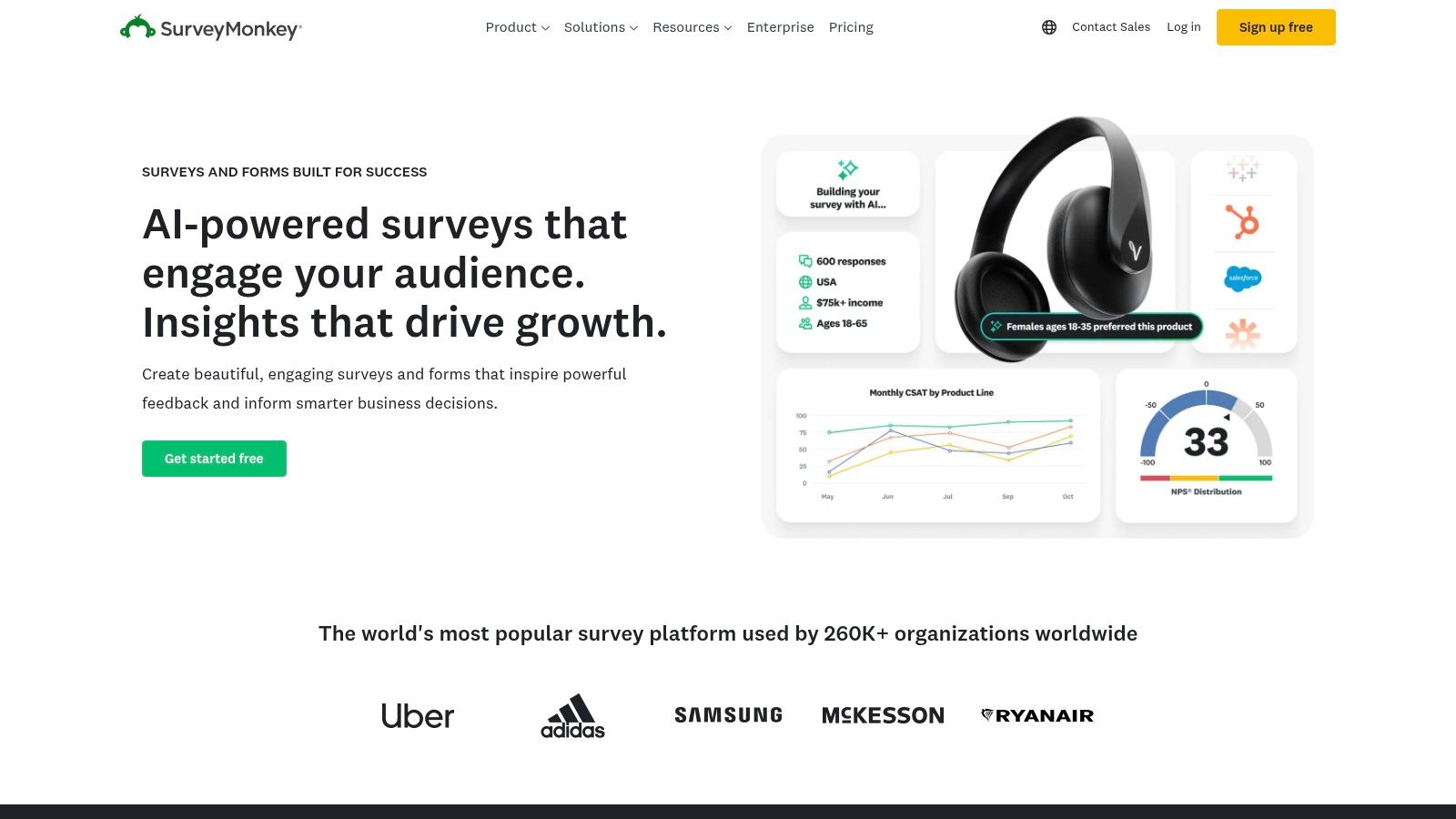
11. SurveyMonkey
SurveyMonkey is a household name for a reason. It's the go-to platform for when you need to stop guessing and start asking real people questions. If you want to validate a new feature idea, gauge customer satisfaction, or figure out what messaging resonates with your target audience, a well-crafted survey is invaluable. Its free tier offers a powerful entry point into the world of primary market research, letting you build and launch surveys without touching your wallet.
This platform is fantastic for getting quick, direct feedback. Instead of relying solely on indirect data, SurveyMonkey lets you go straight to the source. It’s one of the most accessible free market research tools for gathering qualitative and quantitative data directly from your market.
Use Cases & Limitations
Best For:
- Customer Feedback: Create simple Net Promoter Score (NPS) or customer satisfaction (CSAT) surveys to check the pulse of your user base.
- Validating Ideas: Quickly poll a small segment of your audience to see if your next big idea has legs before you invest heavily in development.
- Simple Market Polls: Use their templates to easily create surveys about brand perception or product preferences.
- Content Generation: Gather data and opinions that you can turn into unique blog posts, reports, or infographics.
Limitations: The free plan has its guardrails. You’re limited to a certain number of questions per survey and can only view a set number of responses, which can be a dealbreaker for larger studies. Advanced features like logic branching, custom branding, and data exports are locked behind a paywall. While SurveyMonkey offers a robust free tier, you may also want to explore other top free survey tools to expand your data collection capabilities. For a deeper guide on integrating surveys into your strategy, read our post on how to conduct market research.
- Access: Freemium model with a solid free plan
- Website: https://www.surveymonkey.com/
12. Exploding Topics
If Google Trends is the EKG for public interest, Exploding Topics is the early-detection system that tells you what’s about to cause a spike. It uses a mix of machine learning and human curation to identify fast-growing topics, products, and companies before they hit the mainstream. This makes it an invaluable tool for finding an untapped niche or validating a new idea that seems a bit ahead of its time.
Unlike tools that just track existing popular keywords, Exploding Topics focuses on momentum. It shows you what’s starting to bubble up from the depths of the internet, giving you a head start on content, product development, or investment opportunities. It’s one of the best free market research tools for true trend-spotting.

Use Cases & Limitations
Best For:
- Early Idea Validation: See if your "next big thing" is already showing signs of life online.
- Content & SEO Strategy: Discover under-the-radar topics to create content around before they become competitive.
- Product & Niche Discovery: Find emerging product categories or business ideas that are gaining traction.
- Staying Ahead of the Curve: Quickly scan what’s growing in categories like tech, health, and finance without spending hours on research.
Limitations: The free version is fantastic for browsing and getting a feel for emerging trends, but it’s a teaser. Deeper analytics, historical data, and trend forecasting are locked behind the Pro version. While it’s great for identifying what is trending, you'll still need to use other tools for the why and to validate the signals with more robust data from a platform like https://already.dev.
- Access: Free browsing available; Pro plan required for full features.
- Website: https://explodingtopics.com/
Free Market Research Tools — 12-Tool Comparison
| Tool | Key features | Ease & Speed ★ | Value & Pricing 💰 | Target audience 👥 | Unique strength ✨ | |---|---:|:---:|:---:|:---:|---| | Already.dev 🏆 | Automated competitive crawl (web, app stores, GitHub, forums), keyword maps, feature & pricing grids | ★★★★★ — reports in ~4 mins | 💰 Free trial (first search), single ≈$93, Founder Pack ≈$191 (10), Scale ≈$293 (30) — credits never expire | 👥 Founders, VCs, PMs, corporate innovation | ✨ Agentic AI + hidden/failed-venture detection; actionable visual reports | | Google Trends | Search interest, related queries, geo & time filters | ★★★★ — near real-time, instant charts | 💰 Free | 👥 Marketers, researchers, product folks | ✨ Fast seasonality/interest signals and regional breakdowns | | Similarweb | Traffic estimates, channel mix, engagement, benchmarking | ★★★ — quick domain snapshots | 💰 Freemium + 7-day trial; paid for depth | 👥 Digital marketers, growth teams, analysts | ✨ Channel-mix visibility and competitive traffic benchmarking | | Semrush | Keyword research, site audits, rank tracking, backlinks | ★★★★ — integrated SEO toolset | 💰 Freemium + trials; tiered paid plans | 👥 SEOs, content marketers, agencies | ✨ All-in-one SEO & market-intelligence toolset | | Ahrefs Webmaster Tools (AWT) | Site Audit, limited Site Explorer for verified sites | ★★★ — in-depth diagnostics for owned domains | 💰 Free for verified sites; upgrades to paid Ahrefs | 👥 Site owners, SEOs, devs | ✨ Strong technical SEO diagnostics from Ahrefs | | U.S. Census Bureau (data.census.gov) | Demographics, ACS, decennial data, API, maps | ★★★★ — authoritative but steeper learning curve | 💰 Free | 👥 Market researchers, planners, economists | ✨ Granular, official U.S. demographic & economic data | | Pew Research Center (Datasets) | Downloadable survey microdata, docs, weighting info | ★★★★ — rigorous but needs analysis skills | 💰 Free | 👥 Academics, analysts, policy researchers | ✨ Methodologically robust public-opinion datasets | | Statista | Market stats, pre-made charts, industry hubs | ★★★ — fast visuals for desk research | 💰 Freemium; paid for full exports & datasets | 👥 Execs, analysts, content teams | ✨ Broad topic coverage with ready-made visualizations | | Bureau of Labor Statistics (BLS) | CPI, employment, wages, productivity time series | ★★★★ — timely authoritative series | 💰 Free | 👥 Economists, analysts, financial teams | ✨ Official labor & price indicators with long histories | | AnswerThePublic | Question & query maps, multi-platform coverage | ★★★ — quick VOC and content ideation | 💰 Limited free (≈3 searches/day); paid for exports | 👥 Content marketers, SEO, product teams | ✨ Visual question wheel to surface customer language | | SurveyMonkey | Survey templates, logic, dashboards, audience options | ★★★ — quick to field basic surveys | 💰 Freemium; paid for advanced features & large samples | 👥 Product teams, researchers, HR | ✨ Easy DIY surveys with shareable reporting | | Exploding Topics | Curated + ML trend discovery, topic histories | ★★★ — fast scanning for emerging trends | 💰 Free browsing; 7-day Pro trial for deeper data | 👥 Founders, content strategists, product teams | ✨ Early signals of rising topics/products via ML + curation |
From 'Free' to 'Focused': When to Upgrade Your Toolkit
Alright, we've just journeyed through a treasure trove of free market research tools. From spying on traffic with Similarweb to decoding customer psyche with AnswerThePublic and getting hard data from the U.S. Census Bureau, it’s clear you can get shockingly far without opening your wallet. You can absolutely stitch together a solid, initial market overview using nothing but these free resources.
The key takeaway is that "free" doesn't mean "worthless." Far from it. These tools are the perfect starting block for any lean startup, bootstrapped founder, or product manager trying to validate an idea. You can build a surprisingly detailed picture of your market, customers, and competitors by combining insights from Google Trends, Ahrefs Webmaster Tools, and a well-crafted SurveyMonkey poll.
The Turning Point: When Free Isn't Enough
But let's be real, there's a ceiling to what free can do. You’ll know you’ve hit it when your days are consumed by what I call "spreadsheet hell." This is the point where you're spending more time manually copying and pasting data, juggling a dozen browser tabs, and trying to make sense of conflicting metrics than you are actually building your product or talking to customers.
Here are the classic signs you're outgrowing your free toolkit:
- You need deeper data: Free plans often give you a taste of the good stuff. You can see some keywords or some backlinks, but the real game-changing insights are locked behind a paywall.
- Manual work is killing your productivity: If you're spending 10-15 hours a week just gathering competitive intelligence that could be automated, the "cost" of free is your own valuable time. Time that could be spent on strategy.
- Your data is disconnected: Juggling five different tools means your data lives in five different places. Connecting the dots between keyword trends, competitor traffic, and customer feedback becomes a massive, error-prone headache.
Making the Smart Upgrade
When that time comes, the knee-jerk reaction is often to look at the big, expensive all-in-one platforms. Tools like the full paid versions of Semrush or Ahrefs are incredibly powerful, no doubt, but they can be a bazooka when you just need a scalpel. They often come with a hefty price tag and a learning curve that's a project in itself.
Instead of going from zero to a thousand, think about the single biggest bottleneck in your research process. For most early-stage ventures, it isn't keyword tracking, it's competitor discovery. Finding every direct and indirect player in your space, including the ones that have already tried and failed, is a brutal, time-consuming manual task.
This is where a more focused, strategic investment pays off. Instead of a do-everything suite, a specialized tool like https://already.dev can automate the most painful part of the process. It does the heavy lifting of mapping your entire competitive landscape in minutes, giving you back dozens of hours you can then use to analyze the data with the free tools we've discussed. For a deeper dive into competitive landscapes, especially when free tools fall short, advanced options like AI competitor analysis tools can provide invaluable insights.
The ultimate goal isn’t to stay on free tools forever. It's to use them to get as much momentum as possible, then make a smart, targeted investment to break through your next growth barrier. Use free to explore, validate, and learn. Then, invest to focus, automate, and scale.
Tired of spending weeks manually mapping your market? Let Already.dev deliver a complete competitive landscape report to your inbox in minutes, not months. Stop guessing who your competitors are and start building a better product.