Marketing Competitive Intelligence: Your Guide to Winning (Without Being Creepy)
Learn what marketing competitive intelligence is, why it's crucial for growth, and how to use it to outsmart your competition without breaking the bank.
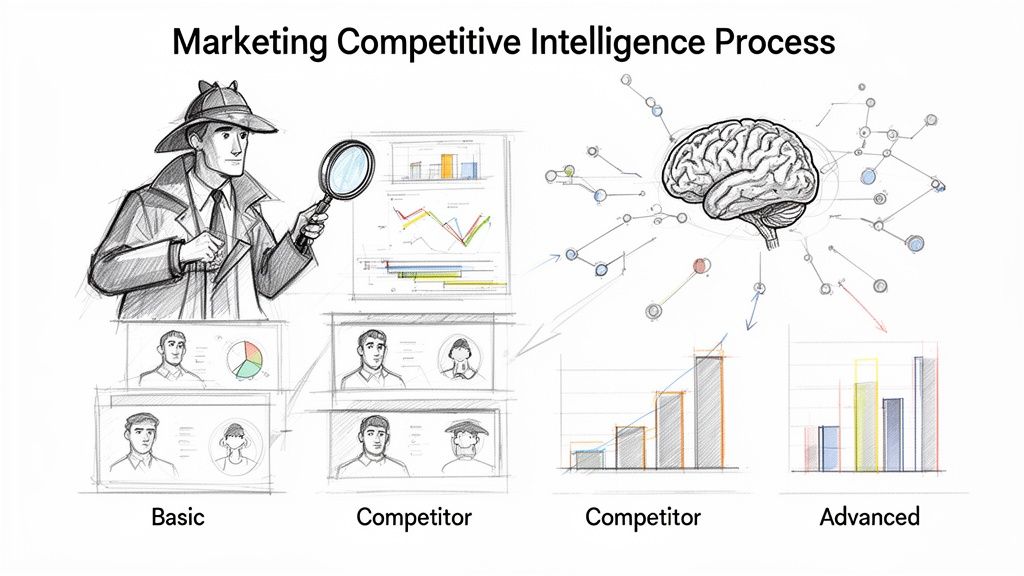
Let's be real: marketing competitive intelligence is just a fancy way of saying you're legally spying on your competition. It’s all about figuring out their game plan so you can build a better one. Think of it as turning their playbook into your cheat sheet.
What Is Marketing Competitive Intelligence Anyway?
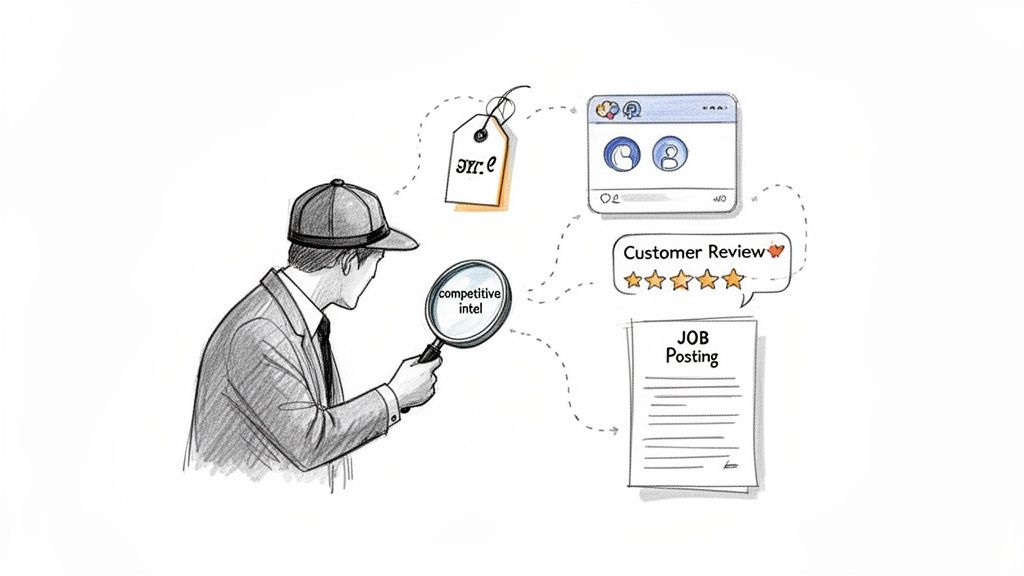
Imagine you're a detective. Your business is the client. Your mission? Gather clues—all the publicly available stuff you can get your hands on. We're not talking about trench coats and secret listening devices; this is all about smart, ethical snooping.
You're digging into their pricing pages, deconstructing their social media ads, and scrolling through customer rants on Reddit. You’d be surprised what you can learn. Even their job postings are a goldmine, often revealing which new products or markets they're planning to tackle next.
Why This "Spying" Is So Important
This isn't some fun side project; it's a must-do. Launching a new product or a big marketing campaign without this intel is like driving blindfolded with the radio blasting. You’re pretty much guaranteed to waste time, burn cash, and hit a wall you never even saw coming.
The goal is to get a clear picture of a few key things:
- What are they doing right? Figure out what's working for them so you can... uh... get inspired by their wins.
- What are they doing wrong? Their mistakes and customer complaints are basically opportunities handed to you on a silver platter.
- Where are they headed next? If you can anticipate their moves, you can stay two steps ahead.
> Competitive intelligence is your best alarm clock. It ensures you’re never caught off guard by a sudden market shift or a rival’s brilliant new campaign. You snooze, you lose.
This process is so critical that companies are pouring serious money into it. The market for competitive intelligence tools was valued at $6.637 billion and is projected to skyrocket to $16.82 billion by 2035. That massive growth tells you one thing: businesses are waking up to the fact that you need real-time insights just to stay in the game.
Turning Clues Into a Winning Strategy
At the end of the day, marketing competitive intelligence gives you the context needed to make much smarter decisions. It’s the difference between guessing what your customers want and knowing what they're already complaining about to your competitors.
It’s not just about hoarding data. It's about connecting the dots to find your unique edge in a noisy market.
For a deeper look at the big picture, check out our guide on what is marketing intelligence. Understanding the entire landscape helps you build a strategy that doesn't just compete—it dominates.
Why You Can't Afford to Ignore Your Competition
So, we've covered the "what," but let's get real about the "why." Why should a busy founder or marketer like you carve out time for this? Simple. Good marketing competitive intelligence isn't just another task on your to-do list—it's the difference between a calculated success and a spectacular flameout.
We’ve all seen it happen. Someone pours their life savings and a year of sleepless nights into a "game-changing" product, only to launch to the sound of crickets. The fatal mistake? They built something that was already out there, just with a slightly different logo. A little homework could have saved them from that financial and emotional gut punch.
Sidestep a World of Hurt
Flying blind in business is just another way of saying you're gambling with your time, your money, and your team's sanity. The market is a graveyard of brilliant ideas that were simply crushed by bad timing or clumsy positioning.
Think about these all-too-common (and painful) scenarios:
- The "Me-Too" Trap: You launch a product that's functionally identical to a well-known competitor, without giving customers a single compelling reason to switch. It's a one-way ticket to obscurity.
- The Pricing Nightmare: You release an amazing SaaS tool but price it so low you can't keep the lights on. Or, you go the other way, pricing it for the stratosphere and scaring off every potential customer.
- The Tone-Deaf Campaign: You spend a fortune on a marketing message you think is pure genius, but it falls completely flat because you didn't realize a competitor already owns that angle.
These aren't just hypotheticals—they happen every single day. The good news? They are almost entirely avoidable. Competitive intelligence is your early-warning system, flagging these landmines long before you step on them.
> Think of it like this: You're navigating a dense jungle. Your competitors are in there too, but most are just hacking away with a machete and hoping for the best. Competitive intelligence gives you a map and a compass. You can see the clear paths, the hidden traps, and the fastest way to the prize.
Find Your Unfair Advantage
Beyond just avoiding disaster, this intel is how you find your winning edge. It helps you uncover that perfect little gap in the market—the one your competitors are either too big to see or too slow to act on.
This is where you shift from playing defense to playing offense. Instead of just reacting to what others are doing, you start making strategic moves. Maybe you spot a customer frustration that everyone else is ignoring. That's your opening to build a feature or a message that truly connects.
For example, you could be analyzing a rival's customer reviews and notice a pattern: people love the product but absolutely despise the customer support. Boom. There's your angle. You can build your entire brand around being "the tool you love, backed by support from real people who care."
Stop Guessing, Start Winning
Ultimately, the biggest win here is clarity. You get to swap that gut-wrenching anxiety of "are we doing the right thing?" for the confidence of knowing your next move is backed by real data. This alone can save you months of wasted effort and kill those endless, circular debates in meetings.
You can finally answer those critical questions with conviction:
- Which feature should we actually build next?
- Is our pricing right for the market?
- What marketing message will actually get noticed?
While powerful tools like Ahrefs or Semrush are great for deep dives into keywords and ads, they can be pretty expensive. For a faster, more affordable way to get a clear picture of the competitive landscape, a platform like Already.dev can map out your rivals and their strategies in minutes. It’s about making smart moves without needing a massive budget.
This isn’t about creating some dusty report that gets filed away and forgotten. It’s about building a continuous habit of observation that feeds smarter, faster, and more confident decisions every single day.
The Old Grind Versus The New AI-Powered Way
Remember the old-school approach to competitor research? It was a soul-crushing marathon fueled by lukewarm coffee and a spreadsheet with way too many columns. You'd have 30 browser tabs open, manually stalking your rivals' websites, squinting at their pricing tiers, and scrolling endlessly through their social media updates.
This manual grind was more than just tedious; it was a leaky bucket. You were guaranteed to miss crucial details buried in forums, app store reviews, or niche communities where real customers were actually talking. It was slow, inefficient, and by the time you finished your report, the data was already stale.
The Rise of the Machines (In a Good Way)
Thankfully, we've moved on from that dark age. The modern way of doing marketing competitive intelligence isn’t about working harder; it’s about working smarter with AI-powered tools. This isn't about replacing humans with robots. It’s about giving a busy founder or marketer superpowers.
Today’s smart platforms automate all that heavy lifting. They dig deep into the corners of the internet you’d never have time to check. They can analyze thousands of data points in the time it takes you to brew another pot of coffee, uncovering insights you would have never found on your own. Many of these tools now use advanced AI techniques like Retrieval-Augmented Generation (RAG) to pull together rich, accurate insights from mountains of raw data.
This concept map breaks down how business intelligence from these tools directly benefits your strategy, helping you pinpoint market gaps and make more confident decisions.
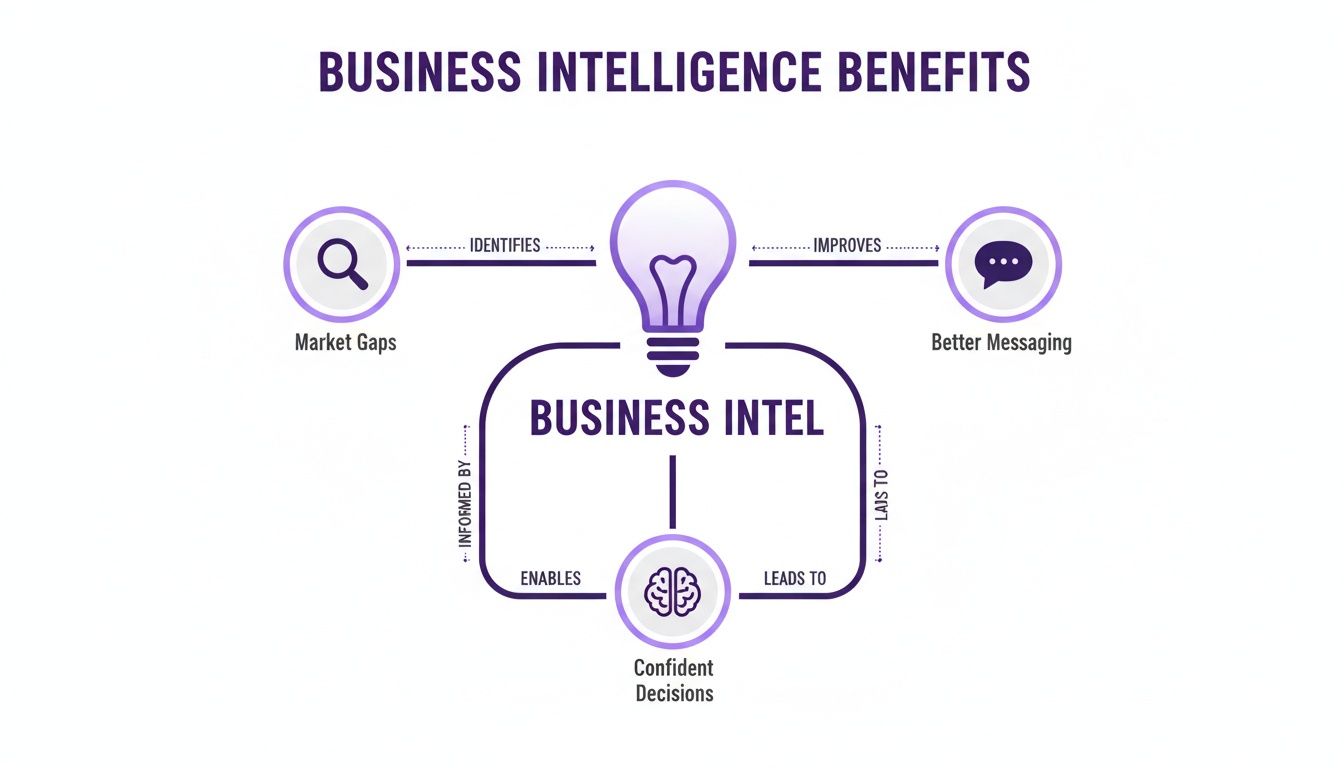
As you can see, good intel isn't just a pile of data; it's the bedrock for crafting better messaging and building a much stronger business.
A Quick Reality Check: Manual vs. AI
Let's make this real. Imagine you're tasked with mapping out a competitor's entire product feature set and pricing strategy.
Here's a quick comparison of the old-school manual approach with modern AI-driven efficiency.
Manual Grind vs AI-Powered Intelligence
| Aspect | The Old Way (Manual) | The New Way (AI-Powered) | | :--- | :--- | :--- | | Data Collection | Hours of clicking through websites, social feeds, and forums. Very easy to miss things. | Automated crawling of websites, reviews, and public data sources in minutes. | | Depth of Insight | Surface-level. You only get what's immediately visible. | Deep and comprehensive. Uncovers hidden patterns, customer sentiment, and historical changes. | | Speed & Efficiency | Painfully slow. A single report can take a full day or more. | Incredibly fast. Get a complete picture in the time it takes to grab a coffee. | | Data Freshness | Outdated the moment you finish the report. | Real-time or near-real-time updates, keeping you ahead of the curve. | | Example Time Cost | 8-10 hours to map out one competitor's basic strategy. | 4 minutes to get a detailed, multi-source analysis of the same competitor. |
The difference is pretty stark, right? Manual research gives you a snapshot of what you can find if you have endless time. AI-driven intelligence gives you a panoramic view of what you need to know, right now.
This isn’t an exaggeration. The speed and depth offered by AI platforms are fundamentally changing the game. For startups and product teams where every hour counts, this kind of efficiency is non-negotiable.
Sure, big-name tools like Ahrefs or Semrush offer powerful analytics, but their subscriptions can be seriously expensive, often running into hundreds or thousands of dollars a month. For teams that need comprehensive competitor mapping without the enterprise price tag, platforms like already.dev provide a cost-effective alternative.
Ultimately, the choice is clear. You can either stick with the manual slog and risk operating on incomplete, outdated information, or you can embrace the modern approach. For a closer look at how AI is reshaping this field, you might be interested in our guide on AI-powered market research. The new way gives you speed, depth, and the strategic advantage you need to actually win.
Building Your Competitive Intelligence Toolkit
Alright, theory is great, but how do you actually get this done without drowning in a sea of spreadsheets? It's time to build your marketing competitive intelligence toolkit. The good news? You don't need a secret agent's budget to get started.
Let's start with the usual suspects in the SEO world. Tools like Ahrefs and Semrush are absolute powerhouses for digging into a competitor's keyword strategy, backlink profile, and even their paid ad campaigns. They show you exactly which terms your rivals are ranking for and where their traffic is coming from.
The catch? They can be expensive. Seriously, the subscription fees can make a startup founder’s eyes water, which is a tough pill to swallow when you’re trying to stay scrappy.
Moving Beyond Just SEO Tools
While SEO intel is a massive piece of the puzzle, it's still just one piece. To get the full picture, you need to map out the entire competitive landscape—not just the players who pop up on page one of Google. A core part of this is knowing how to conduct market research that actually informs your strategy. It’s a foundational skill.
This is where more focused, modern tools enter the chat. Instead of just analyzing keywords, they help you find and understand all your competitors: direct, indirect, and even the ones that tried and failed. Trust me, their ghosts can teach you a lot.
A platform like already.dev offers a smarter, faster, and much more cost-effective approach. The magic is in its simplicity. You describe your business idea in plain English, and its AI gets to work, building a research plan and spitting out a full report in minutes.
This kind of interface lets you kickstart deep research just by explaining your concept, saving you hours of painful manual setup. So instead of spending a full day hunting down competitors, you get a comprehensive map of the market before your coffee gets cold.
The Rise of AI in Your Toolkit
This shift toward AI-driven tools isn't just a trend; it's a fundamental change in how competitive intelligence gets done. Artificial intelligence is absolutely turbocharging this field. The AI market's marketing and sales segment is expected to grab a 28.01% share of a global market projected to explode from $371.71 billion to $2,407.02 billion by 2032.
This incredible growth is fueling tools that scan rivals faster than any human ever could. For venture capitalists and product managers, this means platforms like Already.dev aren't just a "nice-to-have" anymore—they're becoming essential for survival.
> Think of it this way: AI-powered tools are like having a team of a hundred junior analysts working for you 24/7, but without the massive payroll and HR headaches.
Building a Realistic and Affordable Toolkit
So, what does a practical toolkit look like for a startup or a small team? It’s all about blending different methods to cover your bases without breaking the bank.
Here’s a simple, layered approach that works:
- The Free Foundation: Start with the basics that don't cost a dime. Set up Google Alerts for your competitors' names, key brand terms, and even their executives. This is your passive listening system, delivering news and mentions straight to your inbox.
- The Social Listening Layer: Actively follow your rivals on social media. But don't just look at what they post; pay close attention to what their customers are saying in the comments. That’s where you’ll find the unfiltered, honest feedback.
- The AI-Powered Deep Dive: When you need a comprehensive, bird's-eye view of the entire market, bring in a dedicated platform. This is where a tool like already.dev shines. It automates the heavy lifting of competitor discovery and analysis, giving you a massive strategic edge without draining your budget.
This combination gives you both the high-level overview and the granular details needed to make smart moves. The goal isn't to have the most tools; it's to have the right tools that deliver actionable insights. For a deeper look at specific platforms, check out our guide on the best competitive intelligence tools.
Putting Your Competitive Intel to Work: A Simple 3-Step Framework
Alright, so you’ve done the digging. You’ve got spreadsheets full of data, a deep-dive on your top rivals, and maybe even a few fancy charts. So... now what? Raw data is pretty useless on its own. It's like having a pantry full of amazing ingredients but no recipe.
This is the exact spot where most companies stumble. They do all the upfront research, feel super smart for a bit, and then slide right back into making decisions based on old habits and gut feelings. We're not going to do that.
Instead, here’s a straightforward, no-nonsense framework to turn that pile of research into actual, measurable results.
Step 1: Analyze and Hunt for the Gaps
First things first, stop looking at your data as just a long list of facts. It’s time to put on your detective hat again and start searching for patterns and connecting the dots. The real goal here isn't just to know what your competitors are up to, but to understand why it's working (or not working) and where they've left a door wide open for you.
A simple visual grid can be a game-changer. Create a table comparing your business against your top three competitors. List out key features, pricing models, and even the core marketing messages they hammer home. You'll be surprised how quickly the patterns start to emerge.
- You notice: Competitor A has a fantastic feature you don't offer, but they've buried it in a ridiculously expensive enterprise-only plan.
- You spot: Competitor B’s entire brand is built around "speed," but a quick look at their reviews shows a flood of complaints about slow customer service.
- You see: Absolutely no one in your space is making a serious effort to serve a specific niche, like freelance creatives or local non-profits.
These aren't just random observations. They are massive opportunities—gaps in the market big enough to drive a truck through.
Step 2: Strategize Your Counter-Move
Once you've pinpointed the gaps, it's time to figure out exactly how you're going to exploit them. This is the moment your marketing competitive intelligence transforms from a research document into a real-world strategy. Forget about copying what others are doing; this is about making a calculated, informed move based on the weaknesses you’ve found.
> This is the "aha!" moment. It's when you shift from just knowing things about your competition to knowing exactly how you're going to beat them.
Drawing from the gaps we just identified, your next move might look something like this:
- Refine your product roadmap: That super-expensive feature from Competitor A? You could build a slightly simpler version and include it in your mid-tier plan. Bam. Instant competitive advantage.
- Tweak your marketing message: Competitor B talks a big game about speed but can't back it up. You could change your website headline to "Powerful Tools, Supported by Real Humans in Under 5 Minutes."
- Adjust your pricing strategy: You see a wide-open sweet spot between a cheap, flimsy tool and an overpriced behemoth. That's where you position your new pricing tier.
This is where the rubber meets the road—making the critical decisions that will actually propel your business forward.
Step 3: Execute and Watch the Reaction
A plan is nothing more than a wish until you put it into action. The final step is execution. Launch the new feature, update your website copy, roll out the new pricing. But don't pop the champagne just yet, because your work isn't finished.
Marketing competitive intelligence isn't a one-and-done task; it’s a continuous feedback loop. As soon as you make your move, you need to be watching to see how your competitors respond. Do they slash their prices? Do they scramble to copy your new feature? Their reaction is pure gold—it tells you that you've hit a nerve and gives you the intel you need for your next move.
This agile, responsive approach is why modern tools are so important. Cloud-based competitive intelligence platforms are taking over, holding a massive 75.9% market share because they’re built to be flexible and slot right into a team’s daily workflow. The truth is, companies that use real-time intel make decisions 5-10x faster. That's a huge edge, especially when so many startups fail simply because they misread the market. You can discover more insights about these market trends and their impact.
Just remember this simple three-step loop: Analyze, Strategize, Execute. Then do it all over again. This is how you stop guessing and start building a business that consistently outmaneuvers the competition.
Stop Guessing, Start Winning
So, we've walked through what marketing competitive intelligence is and why it's not just another nice-to-have. If you take one thing away from all this, let it be this: in a market this crowded, your biggest risk isn't what your competitors are doing. It's what you don't know they're doing.
Flying blind on gut feelings and old assumptions is just a creative way to burn cash. It’s like trying to navigate a new city without a map—you might get somewhere eventually, but you'll waste a lot of time and energy going in circles.
Make This Your Secret Weapon
When you swap guesswork for a real strategy, you’re not just avoiding disaster; you’re building a repeatable system for growth. It’s a complete game-changer.
- Build products that sell themselves because you know they solve a real problem your competitors have overlooked.
- Craft marketing that actually connects, using messages that speak directly to customer pain points, not just what sounded good in a meeting.
- Make bold moves with confidence, knowing your decisions are backed by solid evidence, not just a reaction to market noise.
> Ultimately, competitive intelligence isn't some tedious task to check off a list. It's a winning habit. Think of it as a strategic superpower—once you get the hang of it, you’ll wonder how you ever got by without it.
This shift turns you from a bystander into the one calling the shots. While powerful tools like Ahrefs or Semrush offer incredible data, their price tags can be a barrier. For a more direct and accessible way to get this kind of clarity, tools like already.dev can give you a clear map of the competitive terrain in just a few minutes, making this crucial practice available to everyone.
The real key is to bake this into your routine, not just treat it as a once-a-year audit. Do that, and you'll find yourself setting the pace instead of just trying to keep up.
Frequently Asked Questions
Still have some questions about jumping into marketing competitive intelligence? Good. It means you're thinking strategically. Let's tackle a few common ones we hear from people who are just getting started.
How Often Should I Do Competitor Research?
The short answer? It's not a one-and-done project. Think of it less like a single event and more like a continuous process. You wouldn't check your car's oil once and then assume it's good for the next 10 years, right? Same idea here.
For the big picture, strategic decisions—like a major product launch or expanding into a new market—a deep-dive analysis every 6 to 12 months is a solid plan. But for the day-to-day tactical stuff, you have to keep your ear to the ground.
You’ll want to be on the lookout for things like:
- Sudden price drops from a key rival.
- A new social media ad campaign they just launched.
- Major feature updates or brand-new product announcements.
For that kind of intel, you need a lightweight, ongoing system. Simple things like setting up alerts or using a tool like already.dev to run quick quarterly reports can keep you in the loop. It’s about staying aware without getting bogged down in constant, heavy research.
Is This Kind Of Competitor Research Ethical?
Absolutely, as long as you're playing fair. We're talking about ethical competitive intelligence, which is all about analyzing publicly available information. This isn't about donning a trench coat and trying to pull off some corporate espionage.
You're simply looking at their website, their public pricing pages, what they post on social media, and what customers are saying in reviews. Think of it like a football team studying game footage of their opponents to understand their playbook. It’s not just ethical; it's just smart business.
> Where you cross the line is when you venture into illegal or shady tactics like hacking, stealing private documents, or trying to bribe former employees for inside information. Everything we've discussed here is completely above board and a standard part of a healthy business strategy.
I'm A Solo Founder With No Budget. Can I Still Do This?
You bet. You just have to be a bit more resourceful. You might not have the budget for enterprise-grade tools like Ahrefs or Semrush, which can cost a pretty penny, but that doesn’t mean you have to operate in the dark.
Start with the free (and surprisingly powerful) methods. Set up Google Alerts for your competitors' names, follow their execs on LinkedIn, and sign up for their newsletters. This creates a simple, free listening post that costs you nothing but a bit of time to set up.
When you're ready for more powerful insights without the huge price tag, a platform like already.dev is the perfect next step. It's built to give you the kind of AI-powered research that used to be reserved for companies with huge marketing departments. You can uncover a massive amount of insight for a fraction of the cost, leveling the playing field.
Ready to stop guessing and start winning? Already.dev gives you the complete competitive picture in minutes, not days. Get started for free and build your first report today.