SEO Competitive Intelligence: Your Sneaky Guide to Outranking Rivals
Unlock the power of SEO competitive intelligence. Learn how to ethically analyze rivals, find keyword gaps, and build a strategy that dominates search.

Let's be honest, "SEO competitive intelligence" sounds a bit stuffy, like something cooked up in a marketing lab. But really, it’s just a fancy way of saying you’re ethically peeking at what your online competitors are doing. It’s all about understanding their SEO game plan so you can craft an even better one. No trench coat required.
So What Is This SEO Spying Stuff, Anyway?

Picture this: you and a rival both own coffee shops on the same street. Every morning, they have a line out the door. SEO competitive intelligence is the digital equivalent of walking over, buying a latte, and figuring out what makes their brew so popular. You’re not stealing their secret bean blend; you're just learning what works so you can perfect your own.
In the online world, this means digging into a few key areas:
- Their Keywords: What search terms are bringing them actual, paying customers? More importantly, are there any goldmine keywords they’ve completely overlooked?
- Their Content: Which of their articles, guides, or landing pages are magnets for traffic and engagement? What’s the magic ingredient that makes that content work so well?
- Their Backlinks: Who’s linking to them? Are they getting nods from major industry blogs, news outlets, or influential creators? Every quality link is like a vote of confidence in Google’s eyes.
The goal isn't to just copy-paste their strategy. That’s lame. It’s about understanding their playbook to find gaps, spot their weaknesses, and pounce on opportunities they've missed. For a broader look at this concept, our guide on what is competitive intelligence explains the full picture.
Why It's a Game-Changer Right Now
Let's face it, the internet is a crowded place. With the SEO market expected to balloon to $106.15 billion by 2030, everyone and their dog is vying for that top spot on Google. Just creating content and hoping it sticks is like whispering in a hurricane—you won't be heard.
> By analyzing what’s already working for your competition, you essentially let them do all the expensive trial-and-error for you. You get to learn from their wins and their fumbles without burning through your own budget. It's a massive shortcut.
Keeping It Simple (and Affordable)
Powerhouse tools like Ahrefs or Semrush are fantastic for this kind of detective work, but their price tags can make your eyes water. The good news is you don’t need a massive budget to get started.
An alternative like already.dev can give you the core insights you need without the hefty subscription fee. The point is to get data you can actually use, not to get lost in a sea of spreadsheets. Think of yourself as a clever detective, not a data scientist, making smart moves based on the clues your rivals leave behind.
So, Why Bother With All This?
You get the gist: SEO competitive intelligence is basically a fancy term for legally snooping on your competition's online strategy. But the real question is, is it actually worth your time?
The short answer is a resounding yes.
Think of it less as another item on your marketing to-do list and more like getting the answers to the test before you walk into the exam room. It’s about turning a mountain of abstract data into tangible business advantages that save you a ton of time, money, and guesswork.
Imagine discovering a trove of keywords your rivals are crushing it with, keywords you never even thought to target. That's a direct line to new customers. Or what if you found out their most popular article is painfully outdated? That’s a wide-open invitation to create something better and siphon off their traffic.
Let Your Competitors Do the Heavy Lifting
Honestly, one of the best parts of this whole process is that you get to let your competitors do all the expensive, time-consuming grunt work for you. They’re the ones spending a fortune on content that might totally flop or chasing keywords that lead nowhere.
You just get to watch what works, learn from what doesn't, and cherry-pick the winning strategies. It's like letting someone else do the trial-and-error on a new recipe so you can skip right to the perfect version.
By seeing their successes and failures, you can make smarter decisions about everything, from the topics you write about to the links you build.
Finding Your Golden Opportunities
Every single competitor has a blind spot—an Achilles' heel. Your job is to find it and use it to your advantage. Here are a few classic examples of what to look for:
- Content Gaps: What questions are their customers asking that they haven't bothered to answer? That's your cue to jump in.
- Stale Content: Find that high-traffic blog post they published back in 2019 and haven't updated since. You can easily create a 2024 version that blows it out of the water.
- Weak Backlinks: Are their top pages propped up by links from questionable, low-quality sites? That’s a huge opportunity for you to outrank them by building stronger, more authoritative links.
> The real magic of SEO competitive intelligence isn't just about finding data; it's about changing your entire approach. You stop guessing what might work and start making decisions based on what’s already working in your market.
This shift from reactive to proactive makes all the difference. In the cutthroat world of SEO, companies that regularly analyze their rivals are seeing incredible results. Studies show they achieve an average 20% boost in online visibility. A really thorough competitor analysis can even drive a 50% increase in organic traffic in as little as six months. If you want to go deeper, you can explore how comprehensive competitor analysis fuels SEO success.
Of course, powerhouse tools like Ahrefs or Semrush can give you all this data, but they come with a hefty price tag. That’s where more focused tools like already.dev can be a game-changer, giving you the critical intel you need without breaking the bank. It's all about finding the right clues to build your own winning strategy.
A Simple Framework for Analyzing Competitors
Alright, let's get our hands dirty. Enough with the theory—it's time for the "how-to" part. You don't need a Ph.D. in data science to pull off effective SEO competitive intelligence. What you really need is a simple, repeatable plan.
Think of it like a four-course meal for spying on your rivals. Each course reveals something new, helping you build a complete picture of their strategy. Forget about messy spreadsheets and confusing jargon; this is your step-by-step guide to turning raw data into a killer action plan.
Four Pillars of SEO Competitive Intelligence
To make this super clear, I've boiled the process down into four core areas of analysis. Think of these as the foundation of your entire strategy. Answering the key question for each one will put you miles ahead of anyone just guessing what to do next.
| Pillar of Analysis | What It Is | Key Question to Ask | | :--- | :--- | :--- | | 1. Competitor Discovery | Identifying who you're really competing with in the search results. | Who consistently ranks for the keywords I want to own? | | 2. Keyword & Gap Analysis | Finding the valuable keywords they rank for that you don't. | What topics and search terms are they winning that we've missed? | | 3. Backlink Analysis | Deconstructing where their authority and "link juice" come from. | Which high-quality sites are linking to them, and why? | | 4. Content Analysis | Auditing their most successful pages to see what works. | What type of content is driving the most traffic for them? |
Getting a solid handle on these four pillars is the secret to moving from reactive SEO to a proactive strategy where you're always one step ahead.
Pillar 1: Find Your Real SEO Competitors
First things first: you have to know who you’re actually up against. This might sound obvious, but your biggest business competitor isn't always your biggest SEO competitor.
Your true SEO rivals are the websites that consistently show up for the keywords you want to rank for. It could be a niche blog, a review site, or a publication you've never even heard of. They are the ones hogging the digital shelf space you need.
Start by Googling your top 5-10 most important keywords. Who keeps popping up on page one? Those are your primary targets. Don’t just look at the big brand names; pay close attention to the scrappy underdogs who are clearly doing something right.
Pillar 2: Analyze Their Keywords and Find the Gaps
Once you know who you’re fighting, it’s time to figure out their secret weapon: their keywords. Your mission here is to find the "keyword gap"—the valuable search terms they rank for that you don't. This is where the gold is buried.
Ask yourself these simple questions:
- What keywords do they own on page one that we’re stuck on page five for?
- Are there any "low-hanging fruit" keywords they rank for with what looks like minimal effort?
- What topics are they covering that we’ve completely ignored?
This process uncovers massive opportunities. You might find a whole cluster of customer questions your competitor is answering that you can tackle with better, more in-depth content. Tools like Ahrefs or Semrush are the big guns for this, but they can be seriously expensive. For a more focused and affordable approach, already.dev can help you uncover these critical keyword insights without the enterprise-level price tag.
This quick chart shows the simple wins you get from this kind of analysis, focusing on keywords, weaknesses, and ultimately, making more money.
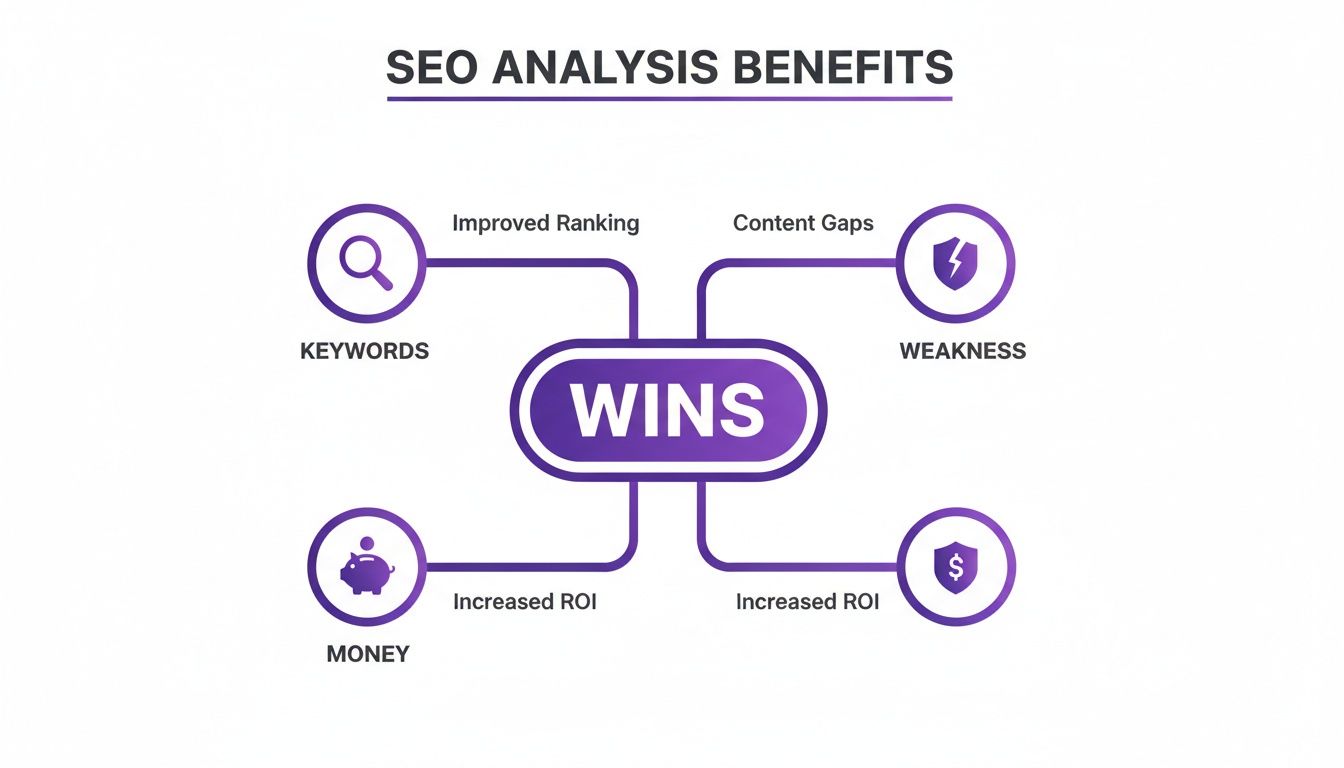
As you can see, understanding a competitor's keywords and weak spots directly leads to better strategic wins and a healthier bottom line.
Pillar 3: Dissect Their Backlinks
If keywords are what your competitors say, backlinks are who vouches for them. A backlink is simply a link from another website to theirs, and in Google's eyes, it's a powerful vote of confidence. Analyzing their backlink profile is like finding out who their most influential friends are.
> Don't just count how many links they have. Focus on the quality. One link from a major industry publication is worth more than a hundred links from spammy, irrelevant blogs.
Your goal here is to spot the patterns. Are they getting links from guest posts? Product reviews? Podcast interviews? This tells you exactly what kind of outreach strategy is working in your niche, so you can build on it. For a more structured approach, you can learn about building a comprehensive framework of competitive analysis that goes beyond just links.
Pillar 4: Audit Their Top-Performing Content
Finally, it’s time to look at their greatest hits. What specific pages or posts on their site bring in the most organic traffic? This isn't about copying their articles word-for-word. It's about understanding why their content is so successful in the first place.
Is it a super-detailed "how-to" guide? An original research report with unique data? A free tool that solves a common problem? To truly understand how to outrank rivals, a detailed competitor analysis forms the bedrock of any strong SEO strategy.
By identifying the format and angle of their most popular content, you get a blueprint for what resonates with your shared audience. Your job is to take that blueprint and build something even bigger and better. Find their best piece of content and create something that makes it look like a rough draft. That's how you win.
The Right Tools for Your Spy Kit

Alright, every good spy needs their gadgets. You can’t exactly conduct SEO competitive intelligence with just a notepad and a hunch. To really peek behind the curtain and see what your rivals are up to, you need the right tools.
Luckily, your options range from "I'm on a ramen noodle budget" all the way to "I have a corporate credit card and I'm not afraid to use it." Let's break down what belongs in your spy kit.
The Heavy Hitters (with Heavy Price Tags)
When you talk about SEO tools, two names inevitably pop up: Ahrefs and Semrush. Think of these platforms as the Lamborghinis of the industry—they're incredibly powerful, packed with features, and can do just about anything you ask of them.
These tools can show you every single keyword a competitor ranks for, every backlink they've ever earned, and even estimate their page-level traffic. They are, without a doubt, amazing.
But let's be real: they're also ridiculously expensive. For a small business, a startup, or a freelancer, dropping hundreds of dollars every month just isn't in the cards. It’s like buying a Formula 1 car just to drive to the grocery store; for most of us, it’s total overkill.
The Smart and Scrappy Alternative
So, what do you do when you need that crucial competitive data but don't want to sell a kidney to get it? This is where more focused and accessible tools come into play.
A platform like already.dev is designed to give you the actionable intel you need without the overwhelming complexity and cost of the big guys. It helps you quickly identify your real competitors and understand their positioning, giving you a clear path forward. You get the key insights—like who you're really up against and where their focus lies—without the enterprise-level invoice. It's the perfect middle ground.
> Remember, the goal is to get data that leads to action, not to get lost in a sea of a million different charts and graphs. The best tool is the one you'll actually use to make smarter decisions.
This mindset is especially important when you zoom out to look at broader market trends. For a deeper dive on using specialized tools for market analysis, the Top Takeaways From Similarweb's 2025 Report Generative AI Landscape offers some fascinating insights.
The "Completely Free" Toolkit
Don't have any budget at all? No problem. You can still do some effective snooping with tools you already use. It definitely requires more manual work, but hey, the price is right.
-
Google Search Operators: Think of these as secret cheat codes for Google. Using them lets you find very specific information about a competitor's site. For example, typing
site:competitor.com "keyword"will show you every page on their domain that mentions your target keyword. It’s a dead-simple way to see how they’re targeting certain topics. -
Google Alerts: This is your free, 24/7 watchdog. Just set up alerts for your competitors' brand names. Any time they're mentioned in a new article, blog post, or forum, you'll get an email notification. It’s an incredibly easy way to keep tabs on their PR and link-building efforts without lifting a finger.
Ultimately, choosing the right tool comes down to your budget and your needs. Whether you go with a powerhouse platform, a smart alternative like already.dev, or the free DIY route, the key is to just start gathering that intel. You can’t win the game if you don’t know who you’re playing against.
Turning Your Intel into Actionable Wins
Alright, you’ve done the snooping. You've gathered a pile of data on your competitors that would make a spy proud. Now what? Let’s be honest: that data is completely useless until you actually do something with it.
This is where the fun begins. It's time to stop analyzing and start acting. We’re going to turn that juicy intel into real, tangible SEO wins that bring more traffic to your site. This is the bridge from "huh, that's interesting" to "wow, our rankings just jumped."
Think of it as a series of simple "if this, then that" scenarios. You spot an opportunity, and you pounce on it with a clear, straightforward plan.
Spotting Content Weaknesses
Let’s start with the most common and powerful opportunity: weak content. Your competitors are almost certainly ranking for important keywords with articles that are, well, a bit rubbish.
Scenario 1: You find an outdated, high-ranking article.
Your competitor has a blog post from 2019 that’s still pulling in traffic for a keyword you want. The information is stale, the images are blurry, and it reads like it was written by a sleepy intern.
- Your Move: This is a classic "Skyscraper Technique" opportunity. Your job is to create a piece of content that is 10x better. Update all the stats, add new insights, embed a video, create a custom infographic, and make it the undisputed best resource on that topic. Once it’s live, you have a much better asset to promote.
Scenario 2: They're ranking with thin or shallow content.
You notice they rank on page one for "how to choose the best X" with a measly 500-word article that barely scratches the surface.
- Your Move: Go deeper. Write the definitive, 2,500-word ultimate guide. Include expert quotes, a comparison table, and answer every possible follow-up question a reader might have. Google loves comprehensive content that satisfies user intent, and you can easily blow their thin article out of the water.
This whole process of finding gaps and executing a plan is fundamental. For a deeper look, you can check out our guide on how to conduct competitive analysis for a structured approach.
Capitalizing on Backlink Opportunities
Next up is links. You’ve analyzed their backlink profile with a tool and found out who is giving them all that sweet, sweet authority. This isn't just data; it's a treasure map.
Scenario 3: They get tons of links from "best of" listicles.
You see that your main rival is featured in a dozen articles like "Top 10 Tools for Marketers."
- Your Move: Create a target list of those exact same websites. Reach out to the authors with a friendly, non-pushy email. Mention their great article and politely suggest that your tool/product would be an excellent addition for their next update. It’s a proven formula.
Scenario 4: You find a broken link pointing to their site.
While snooping, you find a high-authority blog linking to a page on your competitor's site that no longer exists (a 404 error). Bingo!
- Your Move: This is called broken link building. Create a piece of content on your own site that is similar to (or better than) their dead page. Then, email the editor of the site with the broken link, let them know about the dead link, and kindly offer your resource as a perfect replacement. You're helping them fix their site while earning a great link.
> Acting on SEO competitive intelligence delivers a massive ROI, with some long-term strategies seeing returns up to 700%. As Google's landscape changes, with AI Overviews now triggering for 13% of queries and dropping traditional click-through rates, using intel to create fresh, superior content becomes even more critical. Discover more insights about these SEO statistics on seoprofy.com.
Whether you're using pricey tools like Ahrefs and Semrush or a more accessible alternative like already.dev, the goal is the same: find a weakness and turn it into your strength. The difference between companies that grow and those that stagnate is often just a matter of execution.
Got Questions About SEO Spying?
Okay, let's tackle the questions that are probably buzzing in your head right now. You've seen the theory, but what about the reality? It's totally normal to have a few "but what about..." moments.
Let's run through a quick Q&A to clear up some of the most common hangups. Think of this as the final check-in before you jump into the driver's seat.
Is This Stuff Actually Ethical?
This is the big one, and the answer is a resounding yes—as long as you're doing it right. Here’s the way I see it: everything you’re looking at is public information. Your competitors’ websites, the articles they publish, their social media activity, the sites linking back to them—it’s all out there for the world to see.
SEO competitive intelligence is a lot like a football coach studying game film. You're simply analyzing your opponent's public performance to understand their plays and find weaknesses in their strategy. You're not tapping their phones or sneaking into their locker room.
> What’s unethical? Hacking their website, bribing an employee for insider info, or spreading fake news about them. What's smart? Analyzing the breadcrumbs they leave all over the public internet. You're just being a sharp business owner.
So, relax. This isn't corporate espionage; it's just really, really good market research.
How Often Should I Analyze My Competitors?
Great question. The honest-to-goodness answer is, it depends. If you're in a fast-paced industry like ecommerce or a new tech niche, the landscape can shift in a matter of weeks. If you're a local plumber, things probably move a lot slower.
But for most businesses, this is a solid rhythm to follow:
- The Deep Dive (Quarterly): Every three months or so, block off some time for a thorough review. Look at their new keyword rankings, their best-performing content, and any juicy backlinks they've picked up. This helps you spot major strategic changes before they leave you in the dust.
- The Quick Check-In (Monthly): Once a month, just take a quick peek. Did they launch a big new feature page? Publish a monster blog post that's getting a ton of shares? A quick 30-minute scan is all it takes to stay current.
- Ongoing Monitoring (Always On): This is the easy part. Set up a few Google Alerts for your competitors' brand names. You'll get an email whenever they get a big press mention or a link from a notable site. It’s passive intelligence.
The key is not to get obsessed. You don’t need to refresh their stats every single day—that's a fast track to burnout. A consistent, scheduled approach keeps you informed without making you go crazy.
What's the Biggest Mistake People Make?
Hands down, the single biggest mistake is "analysis paralysis." It's when you get so lost in gathering data and filling up spreadsheets that you never actually do anything with it. You build this beautiful, color-coded dashboard of competitor insights, and then it just... sits there.
Remember, the entire point of this is to find actionable ideas to improve your own SEO.
It's far better to find one small, clear opportunity and act on it this week than it is to find a hundred opportunities and act on none of them. Don't try to build the perfect, all-encompassing report. Just look for one good idea you can run with. Maybe that's updating an old blog post to one-up theirs. Maybe it's reaching out to one website that links to them but not you. Start small, get a win, and build momentum.
Can I Really Do This if I'm a Total Beginner?
Absolutely. One hundred percent. You don't need to be an SEO guru to get real value out of this. In fact, simply paying attention to the basics will put you miles ahead of competitors who are just flying blind.
Forget all the complicated tools and overwhelming charts for a second. Just start by asking a few simple questions:
- What are the top three things I really want to rank for?
- Who shows up on page one for those searches right now?
- What kind of content do they have? Is it a blog post, a video, a category page?
- Honestly, can I create something that's just a little bit more helpful or comprehensive?
That's it. That's the heart of SEO competitive intelligence. You don't need to jump straight into expensive subscriptions with tools like Ahrefs or Semrush. While they're incredibly powerful, they can be overkill at the start. A more focused tool like already.dev can give you exactly what you need to get going, or you can even start with nothing more than a simple Google search.
Every big journey starts with a single step. Yours is just getting curious about what’s working for everyone else. You've got this.
Ready to stop guessing and start winning? Already.dev gives you the AI-powered competitive intelligence you need to see the entire market, uncover hidden rivals, and build a strategy based on data, not hunches. Ditch the 40-hour manual research and get actionable insights in minutes.
Start your free trial at https://already.dev and see what your competitors are really up to.