What Is Market Validation And Why It Matters
Learn what is market validation and how to test your business idea before you build. Our no-nonsense guide helps you find customers and avoid costly mistakes.
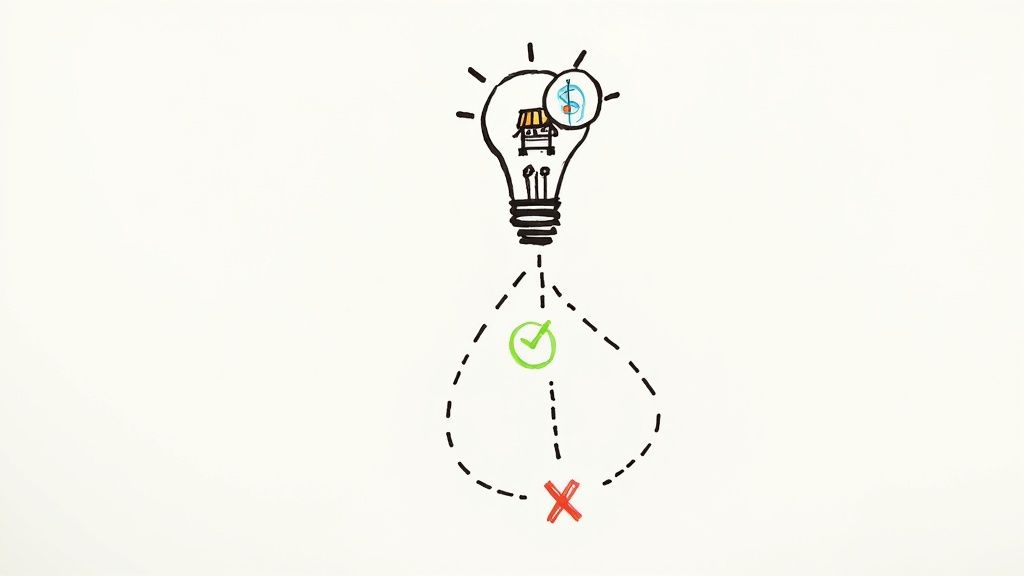
Let's be honest, every founder is convinced their idea is a unicorn in disguise. A brilliant idea is awesome, but it’s just that—an idea. The real work is figuring out if anyone will actually pay for it. That, my friend, is market validation. It’s the critical step that separates a game-changing business from an expensive hobby you’ll regret later.
Your Brilliant Idea Might Be A Terrible Business
So, you have an idea. It’s a world-beater, the kind of concept that keeps you up at night with excitement. But before you quit your day job, drain your savings, or convince your friends and family to invest, you have to answer one brutal question: does anyone else actually care?
That’s market validation in a nutshell. It’s not about asking your mom if she likes your app idea (of course she does, she’s your mom). It’s about getting cold, hard evidence from real, unbiased people that a market for your product not only exists but is hungry for a solution.
Think of it like dating your business idea. You wouldn't propose marriage on the first date, right? You’d test the waters, see if you're compatible, and figure out if there's a real future before making a huge commitment. Market validation is the dating phase for your startup.
> The whole point of market validation is to confirm your idea solves a real problem for real people. Study after study shows the #1 reason startups fail is a lack of market need—they built something nobody actually wanted. Don't be that person.
Don't Build It And Hope They Come
The old "if you build it, they will come" mantra is a recipe for disaster in today's world. A much smarter approach is to find out who's coming before you even lay the first brick. This means getting out of your own head and into the minds of your potential customers.
The goal is to prove, with data, that you're solving a problem painful enough for people to open their wallets. Before pouring time and money into development, it's essential to understand how to validate a startup idea to ensure your brilliant concept isn't just wishful thinking.
This process is more than just a gut feeling; it’s foundational. And it's not just for scrappy startups. Even in highly technical fields, validation is everything. Take the global AI Testing and Validation Market, for example. It was valued at a staggering USD 806.7 million and is only expected to grow, showing just how critical this step has become.
Ultimately, market validation protects you from your own biases and helps you build a business based on reality, not just dreams.
Market Validation vs Market Research What Is the Difference
People often use these terms interchangeably, but they serve different purposes. Think of it this way: market research helps you see the whole forest, while market validation helps you find the right path through it. One is about broad understanding, the other is about specific proof.
Here's a quick breakdown to help you see the difference:
| Aspect | Market Research | Market Validation | | ---------------------- | --------------------------------------------------------- | ------------------------------------------------------------- | | Primary Goal | To understand a market, including its size, trends, and competitors. | To test a specific product idea with a target audience. | | Timing | Often done early, before an idea is even fully formed. | Done after you have a specific idea or prototype. | | Key Question | "What problems exist in this market?" | "Will people pay for my specific solution to this problem?" | | Typical Activities | Surveys, competitor analysis, industry reports, focus groups. | A/B testing, landing page tests, MVP feedback, interviews. | | Outcome | A broad understanding of the market landscape. | A data-backed "go" or "no-go" decision for your idea. |
While different, they work together beautifully. Solid market research gives you the context you need to form a strong hypothesis, and market validation is how you test that hypothesis in the real world. To get started on the research side, check out our guide on conducting market research for a new product.
How to Validate Your Idea Without Going Broke
So, you've made peace with the fact that your genius idea might actually be a terrible business. What now? The good news is that you don't need a seven-figure budget or fancy focus groups behind two-way mirrors to find out. This is all about being scrappy, smart, and fast.
The whole point of budget-friendly market validation is to get real answers from real people without building the entire product. You're not fishing for compliments; you're hunting for cold, hard proof that someone has a problem and that your idea is the painkiller they'd actually pay for. It’s about evidence, not ego.
This simple flowchart boils the process down to its core: you have an idea, you test it, and then you make a smart decision based on what you learned.
Think of that "Testing" box as the critical bridge between a concept and a potentially profitable venture. It stops you from making the classic mistake of jumping straight from "Idea!" to "Spend all the money!"
Your Scrappy Validation Toolkit
Let's get into the nitty-gritty of gathering that precious evidence. You don’t need to do all of these, but combining a couple will paint a much clearer picture of whether you’re onto something.
-
Customer Interviews: This sounds more intimidating than it is. It's really just talking to people. Find 5-10 people who fit your target audience and ask them about their problems—not about your brilliant solution. Your only job is to listen, not to sell. For a deeper dive, our guide on how to conduct market research can help you structure these chats.
-
Simple Surveys: Tools like Google Forms or Typeform are your best friend for quickly gathering quantitative data. Ask questions that uncover pain points and, crucially, their willingness to pay for a solution. A pro tip: avoid leading questions like, "Don't you think this amazing feature would be great?"
-
Landing Page 'Smoke' Test: This is my personal favorite. You build a simple one-page website describing your product as if it's already real. Add a "Sign Up for Early Access" button, run a few cheap ads, and see what happens. If people give you their email, that's a powerful signal of genuine interest.
Build the Smallest Thing Possible
One of the most powerful validation tools out there is the Minimum Viable Product (MVP). This is the most stripped-down, bare-bones version of your product that solves just one core problem for one specific type of user. It’s not your dream product; it’s a learning machine.
> An MVP's job isn't to make millions of dollars. Its job is to provide the maximum amount of validated learning about customers with the least amount of effort.
To pull this off, understanding what a Minimum Viable Product (MVP) is is non-negotiable. It’s what allows you to test your biggest assumptions before you sink months of work and money into development. The insights you get are gold, powered by both qualitative chats and quantitative data.
And speaking of data, the market for the data integration tools that power this kind of analysis is expected to rocket from USD 17.58 billion to USD 33.24 billion by 2030. That explosion shows just how vital data has become for making smart business decisions.
Learning From Your Competitors' Mistakes
Here's a secret: if you have competitors, that's actually a fantastic sign. It's one of the strongest forms of market validation out there because it proves a market already exists! Your goal isn't to be the first one to the party; it's to be the one who's more interesting. You just need to find the gaps they've missed.
This means you get to do a little ethical spying. No trench coat or fake mustache required, I promise. You’re simply going to become a student of their business, figuring out what makes them successful and, more importantly, what really ticks their customers off.
Uncovering Market Gaps
The whole point of this "spying" is to find weaknesses you can turn into your strengths. It’s all about discovering what the existing solutions just don't do well, which gives you the perfect entry point. This is a crucial part of understanding what is market validation in the real world.
Here's what you need to dig into:
- Read the Reviews: Dive deep into app stores, G2, Capterra, and social media. Look for both the one-star and five-star reviews. The one-star ratings are a goldmine of problems you can solve, and the five-star ones tell you exactly what features people can't live without.
- Analyze Their Pricing: Is their pricing a confusing mess? Do customers complain it’s way too expensive for what they get? This could be your chance to swoop in with a simpler, more affordable, or value-packed option.
- Study Their Marketing: Pay attention to how they talk to their audience. What keywords are they going after? You might find they’re completely ignoring a segment of the market that you could serve perfectly.
There are powerful tools like Ahrefs and Semrush for this kind of deep dive, but they can be expensive, often running hundreds of dollars a month. For a more budget-friendly approach, a tool like already.dev can automate much of this work, delivering critical competitive intelligence without the massive bill.
> Learning from your rivals is a shortcut. They've already spent the time and money to educate the market and find customers. You get to learn from their wins and their losses for free.
Turning Intel into Action
Once you have all this information, it's time to connect the dots. Don't just make a boring list of features. Instead, look for patterns.
Are dozens of reviews complaining about a clunky, frustrating user experience? That's a huge opportunity. Do customers constantly beg for an integration that your competitor just ignores? That could become your killer feature.
This process turns you from someone with just an idea into a strategist with a clear plan. You'll get a much better sense of where your product can fit into the market and how you can position it to win. For a complete walkthrough, our guide on how to find competitors breaks it all down step-by-step.
By focusing on the gaps, you stop guessing what the market wants. You start using your competitors' own customer feedback to build a solution people are genuinely desperate for.
Focusing on Metrics That Actually Matter
It’s easy to drown in data. The real trick is knowing which data to watch. It's so tempting to get fixated on "vanity metrics"—we're talking about social media likes, website traffic, or newsletter subscribers. They look great on a slide deck and give you a warm, fuzzy feeling, but they don't actually prove you have a business.
A million people liking your Instagram post won't pay the bills. The entire point of this exercise is to zero in on metrics that show real customer commitment and point toward a sustainable business model. You're looking for numbers that prove people are willing to trade you their time, their attention, and ultimately, their money.
Key Metrics to Ditch the Ego
Instead of chasing feel-good numbers, focus on these actionable KPIs. They cut straight through the noise and tell you what’s really going on.
-
Landing Page Conversion Rate: If you've built a landing page, this is your north star. It’s the percentage of visitors who actually do the thing you want them to do, like joining a waitlist or placing a pre-order. For a totally new idea, hitting a 5-10% conversion rate is an incredibly strong signal.
-
Customer Acquisition Cost (CAC): Simply put, how much does it cost you to get one person to say "yes"? If you spend $100 on ads and get 10 sign-ups, your CAC is $10. You have to know this number to figure out if your business model can ever be profitable.
-
Willingness to Pay: Stop asking, "Would you use this?" Start asking, "Would you pay $20 a month for this?" You can test this directly by offering a pre-order with a small discount. Honestly, even just a few pre-orders are worth a thousand people telling you, "that's a cool idea!"
> Your first few metrics aren't about building a financial forecast. They're about getting a clear "yes" or "no" on your core assumption: Does this solve a problem people will pay to fix?
Tracking What Matters
Keep your setup simple. You don't need some massive, complicated analytics dashboard right now. A basic spreadsheet is more than enough to track these key numbers week by week.
This focus on good data isn't just a startup quirk; it's a fundamental business principle. The global market for data validation is huge, with North America and Europe leading the way because of tough regulations and the needs of giant corporations. This trend underscores a simple truth: making decisions based on bad data is a one-way ticket to failure. To see how this plays out on a larger scale, you can find more details on the data validation services market here.
Real Stories of Validation Wins and Epic Fails
Theory is one thing, but nothing drives the point home like seeing real-world examples of startups that either got this right and crushed it, or got it spectacularly wrong and blew up. The startup graveyard is full of beautifully engineered products that nobody wanted.
Let's kick things off with a story that's become a legend in Silicon Valley: Dropbox. Before it was the go-to for file syncing, it was just an idea in Drew Houston's head. Building the whole system would have been a massive technical undertaking. So, he didn't. Instead, he made a video.
It was a simple, three-minute screencast where he walked through how the product would work. He layered in some geeky inside jokes to connect with his target audience on Reddit and threw a signup form on the page. The result? The beta waitlist jumped from 5,000 to 75,000 people literally overnight. That video was a masterclass in market validation. Without writing a single line of production code, he proved people were desperate for his solution.
From Clever Hacks to Colossal Flops
Zappos is another classic. Back when e-commerce was still the wild west, founder Nick Swinmurn had a simple question: would people actually buy shoes online without trying them on first? It seems obvious now, but back then, it was a huge gamble.
Instead of sinking cash into inventory and a warehouse, he took a brilliantly simple approach. He went to local shoe stores, snapped pictures of their shoes, and posted them on a bare-bones website. When an order came in, he’d literally run back to the store, buy the pair, and ship it himself. It was completely unscalable, but it wasn't a business yet—it was an experiment. And it gave him the answer he needed: heck yes, people will buy shoes online.
> These early tests aren't about building a scalable business. They're about finding that one critical piece of evidence that proves you're not just chasing a crazy idea.
Now for the other side of the coin: the cautionary tale of Juicero. This company raised an unbelievable $120 million to build a high-tech, Wi-Fi-enabled juicer. The machine was sleek, expensive (at $400 a pop), and only worked with their proprietary juice packs.
The problem? A couple of reporters at Bloomberg discovered you could get the same—if not better—results by just squeezing the juice packs with your bare hands. The company had built an incredibly over-engineered, wildly expensive solution for a problem that didn't actually exist. They validated the tech could be built, but they completely forgot to validate if anyone actually needed it, earning them a permanent spot in the hall of fame for startup failures.
Deciding Your Next Move: Pivot or Persevere
Okay, you’ve done the hard work. You've talked to actual humans, stared at spreadsheets until your eyes crossed, and now you have a pile of data staring back at you. This is the moment of truth.
https://www.youtube.com/embed/8pNxKX1SUGE
So, what's the big call? Do you double down on your brilliant idea, or is it time to change course?
This decision feels huge because, well, it is. But try not to think of it as a pass/fail test. It’s all about listening to what the market is telling you. That data you just collected is your guide—it's showing you whether you’ve found a real signal or just a lot of noise.
The hardest part? Separating your ego from the evidence. We all fall in love with our ideas. But ignoring clear feedback is the fastest way to join the 42% of startups that fail simply because they built something nobody wanted.
Reading the Signals
How do you know if you've struck gold or just hit a dead end? It all comes down to spotting the patterns in your feedback. Think of it like sorting your findings into two piles: green lights and red flags.
Green Lights (Persevere!)
These are the strong signs telling you you're onto something real. Keep pushing.
- People are willing to pay. This is the ultimate validation. If strangers are pulling out their credit cards for a pre-order or saying, "Just tell me where to sign up," you've hit a nerve.
- You get strong emotional reactions. When you describe the problem, do people’s eyes light up? Do they lean in and say, "Oh my god, I hate dealing with that!" Passion—even negative passion for the problem—is a fantastic sign.
- They ask for more. If your interviewees are asking when they can use your product or what the next steps are, that's not just politeness. That’s genuine interest.
Red Flags (Time to Pivot!)
These are the warning signs you absolutely cannot afford to ignore.
- You're met with widespread indifference. The most dangerous feedback isn't "I hate it." It’s "meh." A collective shrug is a death sentence for an idea. It means you haven’t found a problem people actually care about solving.
- The feedback is "It's a cool idea, but..." This is polite code for, "I would never, ever use this." Vague, positive-but-non-committal feedback is a classic red flag that feels good in the moment but means nothing.
- No one will commit. If you can’t get a single person to sign up for an email list or pre-order, the market is screaming at you. Listen.
> A pivot isn't a failure. It’s a smart, strategic change in direction based on new information. It's the opposite of failing—it's learning.
At the end of the day, market validation isn’t a one-time task you just check off a list. It’s a continuous loop of listening, learning, and adjusting. Whether you decide to persevere with your original plan or pivot to a new one, you’re now making that choice with real-world evidence, not just a gut feeling. And that makes all the difference.
A Few Lingering Questions About Market Validation
Still have a few things rattling around in your head? Let's tackle some of the most common questions that pop up when founders and product teams start digging into market validation.
So, How Much Validation Is Actually Enough?
Look, there’s no magic number here. It isn't about hitting a specific quota, like interviewing exactly 50 people or getting 1,000 email signups. You’ve done "enough" validation when you start hearing the same things over and over again.
You're looking for consistent, undeniable evidence that a specific group of people not only has a painful problem but also believes your solution is worth paying for. It's about finding a strong, clear signal amidst the noise, not just piling up a mountain of data.
What if I Get a Ton of Negative Feedback?
First off, take a deep breath. Don't panic! Negative feedback is pure gold, and it's way more valuable than a polite, non-committal, "Oh, that's a nice idea." It’s a gift that tells you what not to build, saving you from burning through your time and money.
> Negative feedback isn't failure; it's a course correction. Dig deeper into the "why" behind the negativity. It often points you toward a much better, more valuable problem to solve.
How Do I Test an Idea for a Super-Niche Market?
This is actually a great position to be in. Niche markets are fantastic because the audience is often incredibly passionate and, even better, easy to find. Instead of casting a wide net with broad surveys, you just need to go hang out where they already are online.
- Find their digital hangouts: Look for dedicated subreddits, active Facebook groups, or old-school forums where they trade tips and complain.
- Listen before you leap: Spend some time just reading the conversations. Get a feel for their language, their inside jokes, and their biggest frustrations.
- Engage like a human: Once you understand the vibe, start asking for feedback directly. Niche communities often love the idea of helping to shape a product that's being built just for them.
This targeted approach almost always gives you higher-quality insights, and you'll get them a whole lot faster.
Ready to stop guessing and start knowing? already.dev uses AI to uncover your true competitors, analyze their strategies, and find the market gaps you can win. Get the data-driven confidence to build what people will actually buy at https://already.dev.