The Business Model Canvas Explained (Without the MBA-Speak)
Ditch boring business plans. This guide to the Business Model Canvas explained in simple terms helps you map your entire business idea on one page.
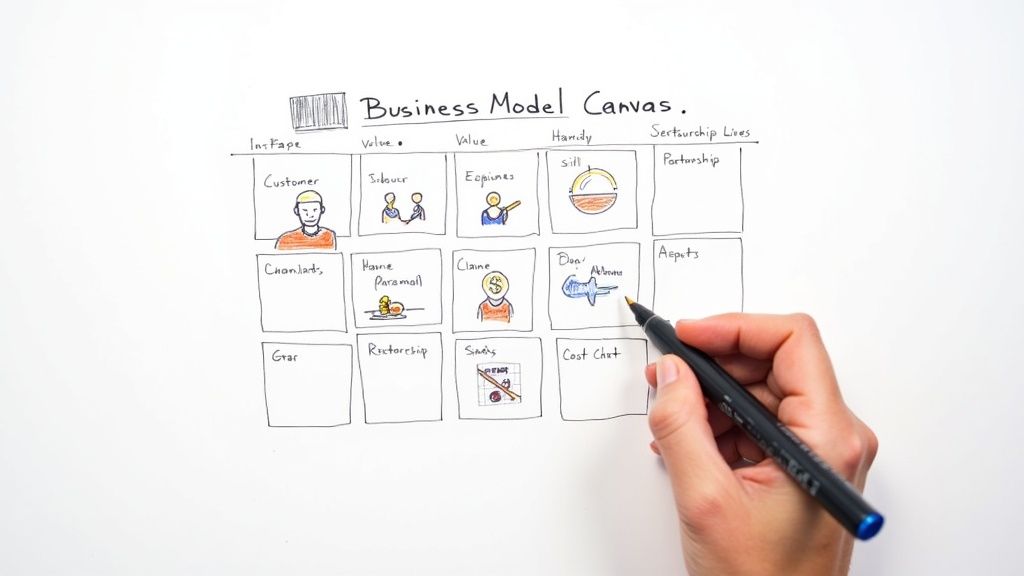
Let’s cut to the chase. The Business Model Canvas is your entire business idea, sketched out on a single page. It's a strategic shortcut, swapping a dense, 50-page business plan for nine essential building blocks. This makes it incredibly easy to see how everything connects, from who your customers are to how you'll actually make money.
Why Your Big Idea Needs a One-Page Map
Traditional business plans are where great ideas go to die. They get buried under endless paragraphs of jargon, and by the time you're done writing one, your market has already changed. They're rigid, time-consuming, and honestly, a bit of a snoozefest.
The Business Model Canvas (BMC), created by Alexander Osterwalder, is the complete opposite. Think of it less like a dusty encyclopedia and more like a road trip map for your startup.
The goal is simple: get all the critical parts of your business—who you're selling to, what you're selling, and how you'll get paid—all in one place. This visual layout helps you spot glaring holes in your logic ("Wait, who is actually going to pay for this?"), explain your vision without putting people to sleep, and quickly pivot when you realize one of your assumptions was dead wrong.
And this isn't just for scrappy startups in a garage. The BMC has become a go-to tool for massive companies and small businesses alike. In fact, research shows that over 1,300 large corporations use it for strategic planning and product development. Its visual, intuitive layout creates a shared language that gets everyone, from marketing to engineering, on the same page.
The Real Power of the Canvas
The magic here is how the canvas turns abstract ideas into a concrete, actionable plan. Instead of getting bogged down in the tiny details, it forces you to focus on the core components that actually drive the business forward.
> The Business Model Canvas is more than just a planning tool; it’s a conversation starter. It gets your entire team thinking, debating, and aligning on what truly matters for success.
To really nail this, you have to start with the people you're trying to help. That's where customer discovery comes in. It's the process of validating the most critical parts of your canvas—your customer segments and value propositions—before you pour too much time and money into a guess. It ensures you're building something people genuinely want.
For a deeper dive into sizing up your market, check out our guide on conducting a market opportunity assessment.
Breaking Down the Nine Essential Building Blocks
Alright, let’s get our hands dirty. The Business Model Canvas might look like a simple grid, but each of those nine boxes is its own little universe. To really see how they all click together, we need to pull them apart one by one.
To keep this from feeling like a boring lecture, we’re going to run with a single, slightly ridiculous example: a gourmet food truck that sells nothing but artisanal grilled cheese sandwiches. We'll call it "The Melty Monarch."
Let's build its entire business model right here, block by block.
First, take a look at this visual. It's a great cheat sheet for understanding how the different parts of your business—the problem you’re solving, the solution you offer, and your overall strategy—all fit neatly into the canvas framework.
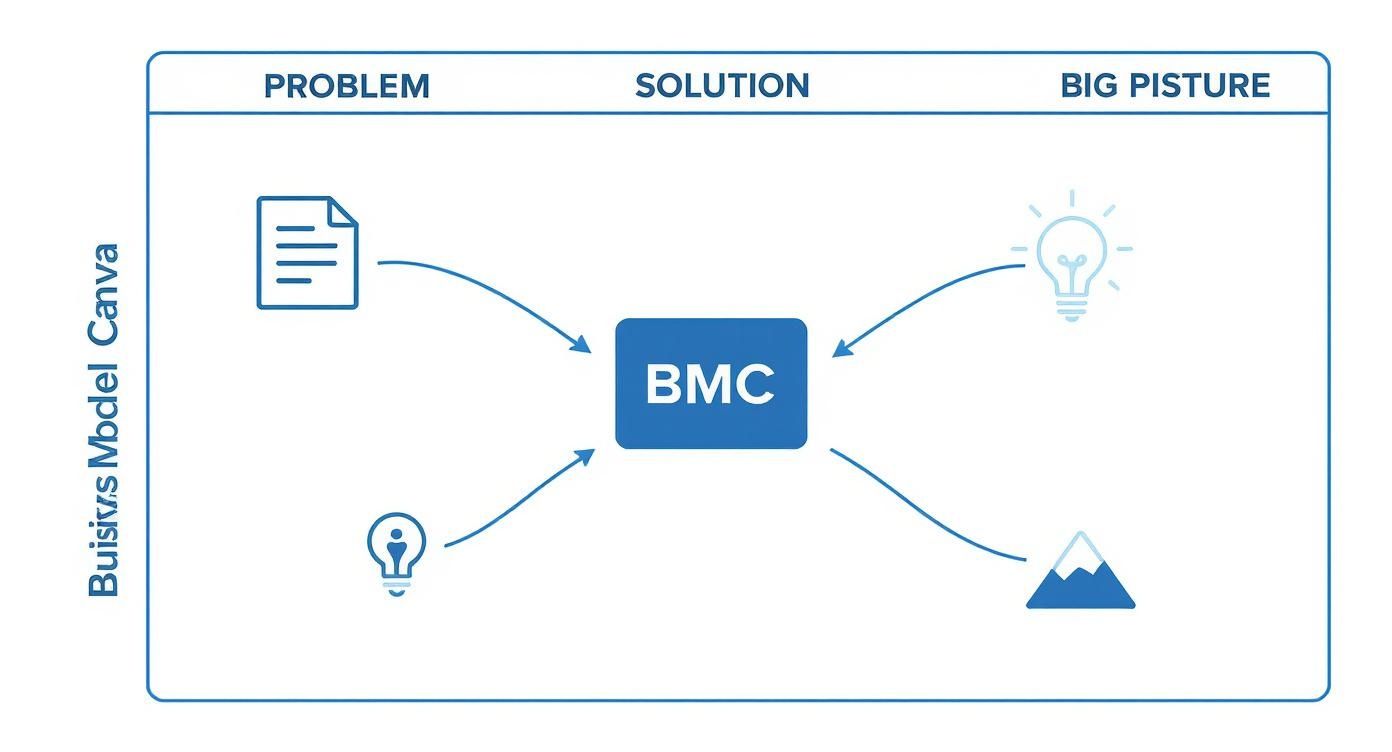
What this really shows is that a business model isn’t just a checklist. It's a story that has to make sense, connecting a real customer problem to your unique solution.
Let's start building that story for our food truck.
The 9 Blocks of the Business Model Canvas At a Glance
Before we dive deep into each component, here's a quick overview of the nine building blocks. Think of this table as your map for the journey we're about to take. It lays out what each block represents and the core question it forces you to answer.
| Building Block | What It Means (In Plain English) | The Big Question It Answers | | :--- | :--- | :--- | | 1. Customer Segments | The specific groups of people you want to sell to. | Who are our most important customers? | | 2. Value Propositions | The unique benefit or solution you offer each segment. | What value do we deliver? Why do they buy from us? | | 3. Channels | How you reach your customers and deliver your value. | How do our customers want to be reached? | | 4. Customer Relationships | The type of interaction you have with your customers. | What kind of relationship does each customer segment expect? | | 5. Revenue Streams | How your business makes money from each customer segment. | For what value are our customers really willing to pay? | | 6. Key Activities | The most important things you must do to run your business. | What key activities do our value propositions require? | | 7. Key Resources | The essential assets you need to make your business work. | What key resources do we need to operate? | | 8. Key Partnerships | The network of suppliers and partners you rely on. | Who are our key partners and suppliers? | | 9. Cost Structure | All the costs involved in operating your business model. | What are the most important costs in our business? |
This table gives you the 30,000-foot view. Now, let’s zoom in and see what these blocks look like on the ground for our favorite fictional food truck.
1. Customer Segments
This is ground zero. Before you do anything else, you have to answer one simple question: Who are you creating value for?
If your answer is "everyone," stop right there. You've already lost. You need to get specific. Think about the distinct groups of people or organizations you want to serve.
For our food truck, The Melty Monarch, we might have a few different customer segments:
- Lunchtime Office Workers: People with limited time who crave a quick, high-quality meal that isn’t another sad desk salad. They’re happy to pay a bit more for something delicious and convenient.
- Late-Night Bar Crowd: After a few drinks, nothing sounds better than a greasy, cheesy sandwich. This group is way less price-sensitive and all about instant gratification.
- Families at Weekend Farmer's Markets: Parents hunting for a kid-friendly, easy-to-eat meal while they shop for organic kale.
Figuring out who your people are is the most crucial step. If you need a deeper dive, our guide on how to identify target customers is a great place to start.
2. Value Propositions
Okay, so you know who you're serving. Now, what are you actually offering them? Your Value Proposition is the promise you make to your customers. It's the reason they'll choose you over a competitor.
This isn't just about your product; it’s about the problem you solve or the need you satisfy. What makes your thing special? Is it faster? Cheaper? A better experience?
For The Melty Monarch:
- For Office Workers: "A gourmet grilled cheese in under 5 minutes, so you can escape your cubicle without settling for fast food." The value here is speed, quality, and convenience.
- For the Late-Night Crowd: "The ultimate post-bar comfort food, made with artisanal cheese that soaks up bad decisions." The value is pure indulgence and satisfaction.
- For Families: "A wholesome, mess-free lunch that both parents and picky kids will love." The value is simplicity and family-friendliness.
> Your value proposition is the heart of your business model. It's the unique blend of product, service, and experience that makes you the obvious choice for your specific customer segments.
3. Channels
How do your customers find out about you, and how do you get your awesome product into their hands? Channels are all the touchpoints you have with your customers, from the moment they first hear about you to any post-purchase support.
This block covers your marketing, sales, and distribution all in one.
The Melty Monarch’s Channels would likely include:
- The Food Truck Itself: This is our primary point of sale. Its physical location is a channel.
- Social Media (Instagram/TikTok): Perfect for showing off those gooey cheese pulls and announcing our daily location.
- Local Food Blogs and Review Sites: Getting featured here builds credibility and brings in new customers.
- Catering Partnerships: Working directly with local offices to provide lunch for their teams.
4. Customer Relationships
This block is all about the vibe between you and your customers. Is it a white-glove, personal service, or a completely automated, self-serve experience? The relationship you build has a huge impact on customer loyalty and how people feel about your brand.
You can have all sorts of relationships:
- Personal Assistance: A real human to talk to.
- Self-Service: The customer does it all themselves (think Amazon).
- Automated Services: Personalized, but handled by software (like a Netflix queue).
- Communities: Creating a space for your customers to connect with each other.
For our cheesy empire, The Melty Monarch, we’d aim for a mix:
- A friendly, personal interaction at the truck window is a must. The owner should know regulars by name.
- A simple loyalty program, like a "buy 9 sandwiches, get the 10th free" punch card, encourages people to come back.
- Engaging with followers on social media helps build a community of fans who feel connected to the brand.
5. Revenue Streams
Now for the fun part: how do you get paid? A Revenue Stream is how a company makes money from each customer segment. This could be a one-time transaction or a recurring payment.
Don't just think about the price of your product. Think about how people pay.
The Melty Monarch’s revenue could flow from several places:
- Direct Sandwich Sales: The most obvious one. This is an asset sale.
- Catering Fees: Charging a flat rate or a per-person fee for private events. This is a service fee.
- Selling Drinks and Sides: Adding chips and sodas to an order is a classic way to increase the average ticket price.
6. Key Activities
We've covered the "front stage" of the business—the parts customers see. Now let's go behind the curtain. Key Activities are the most important things your company must do to make the whole business model work.
What are the critical actions needed to deliver your value proposition?
For The Melty Monarch, the key activities are pretty clear:
- Cooking: Making consistently amazing grilled cheese sandwiches. Every. Single. Time.
- Sourcing Ingredients: Finding the best bread, cheese, and butter. Quality is our whole brand.
- Marketing & Location Scouting: Promoting the truck and figuring out where the hungry people are each day.
- Truck Maintenance: Keeping the kitchen-on-wheels clean, safe, and running smoothly.
7. Key Resources
You can't do your key activities without the right stuff. Key Resources are the essential assets you need to deliver on your promises. These can be physical things, people, money, or even ideas.
What do you absolutely need to have?
The Melty Monarch can't exist without:
- Physical Resources: The food truck itself, all the cooking gear, and a commercial kitchen for prep.
- Human Resources: A talented cook (maybe the founder) and a friendly cashier who can handle a rush.
- Financial Resources: Cash to buy ingredients, pay for gas, and cover all the necessary permits.
- Intellectual Resources: The secret recipes for our signature sandwiches and the brand itself.
8. Key Partnerships
Very few businesses make it on their own. Key Partnerships are the network of suppliers and partners that help your business model work. You might form partnerships to get better resources, reduce risk, or find new customers.
For our food truck, key partners are vital:
- Artisanal Bakeries: To get that consistently amazing bread.
- Local Cheese Dairies: For unique, high-quality cheeses that set us apart from the competition.
- Event Organizers: Partnering with music festivals or farmer's markets to guarantee a prime spot.
- Nearby Businesses: A local brewery might let us park outside in exchange for feeding their hungry patrons.
9. Cost Structure
Last but definitely not least, where is all the money going? The Cost Structure outlines all the costs you rack up while operating your business model. This includes everything from making your product to keeping your customers happy.
Are you trying to be the low-cost leader, or are you focused on creating maximum value (and charging for it)?
The Melty Monarch's major costs would be:
- Variable Costs: Food ingredients (cheese, bread, butter). These costs go up as we sell more sandwiches.
- Fixed Costs: The truck loan payment, insurance, permit fees, and salaries. These stay the same whether we sell one sandwich or a hundred.
- Marketing & Fuel: The costs of getting the word out and actually driving the truck to its location.
The Business Model Canvas is way more than just a theoretical exercise. It's a real-world tool that startups and big companies alike use to map out new ideas and improve old ones. Since it became popular after 2009, it has largely replaced those dusty, 100-page business plans. A study even found that users were highly satisfied with the "Key Activities" and "Customer Relationships" blocks, which shows just how good it is at connecting what you do with what your customers want. You can discover more insights about its global adoption on Strategyzer.com.
How to Fill Out Your First Business Model Canvas
Alright, enough theory. It's time to grab some sticky notes and a big sheet of paper (or a digital template) and actually build this thing.
Filling out your Business Model Canvas shouldn't feel like taking a final exam. Think of it more like a brainstorming session with yourself—messy, a little chaotic, and ultimately, super insightful.
Let's get this done without the headache. The key is to follow a specific order that makes sense. You don’t just randomly fill in boxes. Instead, you tell a story, starting with your customers and ending with what it costs to serve them.
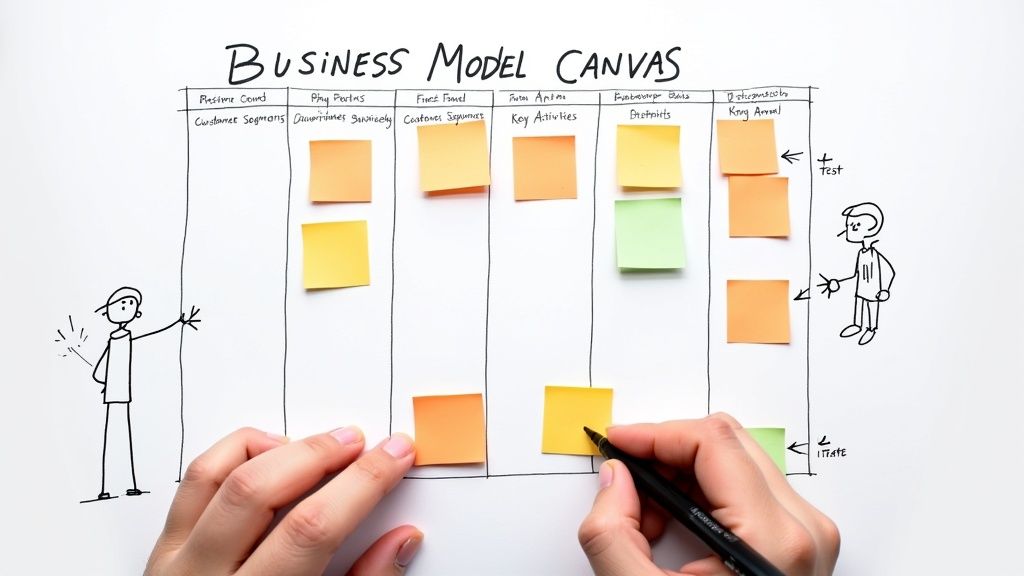
This process is designed to flow logically from the "front stage" of your business (what customers see) to the "back stage" (how you make it all happen).
The Best Order to Tackle the Blocks
To avoid staring at a blank canvas and panicking, just follow this sequence. We'll start on the right side (the customer-facing part) and work our way left to the internal stuff.
- Start with the Heart (Customer Segments & Value Propositions): These two are a package deal. Begin by clearly defining who you're serving (Customer Segments). Then, immediately ask why they should care (Value Propositions). Everything else you do will build on this foundation.
- Build the Bridge (Channels & Customer Relationships): Now, figure out how you’ll actually connect with those customers. Define your Channels (how you reach them) and the vibe of your Customer Relationships (how you interact with them).
- Show Me the Money (Revenue Streams): With the customer side mapped out, it’s time to figure out how you get paid. What are customers actually willing to pay for, and how will they pay it? This is your Revenue Streams block.
- Go Backstage (Key Activities & Key Resources): Time to shift your focus to the left side of the canvas. What do you actually need to do (Key Activities) and what do you need (Key Resources) to deliver on your value proposition?
- Assemble Your Team (Key Partnerships): Who do you need to rely on to pull this off? List the suppliers, partners, or other external players who are critical to making your business work (Key Partnerships).
- Count the Costs (Cost Structure): Finally, add it all up. Look at your resources, activities, and partnerships, and figure out what it's all going to cost you. This is your Cost Structure.
Pro Tips for a Painless Process
Filling out a canvas isn't about getting it perfect on the first try. It’s about getting ideas out of your head and onto paper where you can actually see them clearly.
Here’s how to make it easier:
- Use Sticky Notes: This is non-negotiable. Your first ideas will probably be wrong, and that's okay! Sticky notes let you move, change, and toss out ideas without having to start from scratch.
- Make It a Team Sport: Don't do this in a dark room by yourself. Grab your co-founders, advisors, or even a few trusted friends. A diverse group of people will spot weaknesses and opportunities you'd never see on your own.
- Embrace the Mess: Your first canvas should be a beautiful disaster. It's a snapshot of your current thinking, not a sacred document carved in stone. Expect it to get messy, and don't be afraid to challenge every single assumption on it.
> Your Business Model Canvas is a living document, not a historical artifact. The goal isn't to create a perfect plan but to create a set of testable hypotheses about your business.
Remember, the canvas is a tool for learning. As you talk to customers and test your assumptions in the real world, you'll come back to it again and again. You'll peel off old sticky notes and replace them with new, smarter ones.
That's not a sign of failure; it’s the sign of a business that's actually learning and growing.
Common Mistakes People Make with the Canvas
The Business Model Canvas is a fantastic tool, but like any tool, you can absolutely use it wrong. Think of it like a power drill. In the right hands, you can build a house. In the wrong hands, you’re just making a bunch of holes in your wall for no reason.
Let's walk through the classic blunders people make so you can sidestep them like a pro.
By far, the biggest mistake is treating your first canvas like a sacred, finished masterpiece. People print it out, frame it, and hang it on the wall as if it’s the final word. That completely misses the point.
> Your first Business Model Canvas isn't a business plan; it's a collection of your best guesses. Its only job is to be tested, challenged, and probably proven wrong in a dozen different ways.
Think of it as a starting hypothesis, not a final report. Its value comes from being a living document that you constantly update as you learn what works and what doesn't in the real world.
Filling It with Fantasy Instead of Facts
Another huge pitfall is what I call "wishful thinking syndrome." This is what happens when you fill out the canvas with what you want to be true instead of what you can realistically test.
You see it all the time in the Customer Segments box: "Our customers are everyone on Earth!" No, they aren't. Being wildly optimistic feels good for about five minutes, but it sets you up for a painful reality check later. Every sticky note on your canvas should be a testable guess, not a line from your startup’s imaginary fairytale.
To avoid building your strategy on pure guesswork, it's critical to validate your ideas. Understanding how to start measuring user satisfaction effectively is a great first step. A canvas built on assumptions is just paper; one validated with real feedback becomes a strategic map.
Ignoring the Red Flags
It's so easy to fall in love with your own idea. So easy, in fact, that you can become blind to the giant, flashing warning signs your canvas is practically screaming at you.
Maybe your Cost Structure box is overflowing with expensive items, while your Revenue Streams box has one lonely, unproven idea. That's a huge red flag! The canvas is specifically designed to make these mismatches painfully obvious. Don't ignore them just because you're attached to your concept.
While the canvas is hugely popular, it's not perfect. Research shows that while roughly 80% of entrepreneurs say it helps with clear communication and faster decisions, they also warn it can become too rigid if the market is changing quickly. Big companies like 3M and General Electric use it, proving its power, but its real success depends on using it as a flexible guide, not a set of rigid rules.
Using Your Canvas for Competitive Reconnaissance
Don't let your Business Model Canvas gather dust in a folder somewhere. Once you've sketched out your own grand vision, it's time to flip the script and use it to do a little ethical spying on the competition. This is where the canvas transforms from a simple planning document into a genuine strategic weapon.
Mapping out a competitor's business model is one of the sharpest moves you can make early on. It forces you to get inside their heads and take apart their entire strategy, block by block. What's their real value proposition? Who are their key partners? How are they actually making money—not just how you assume they are?
Think of it like finding a secret blueprint. When you fill in the nine blocks for a rival, you start to see the chinks in their armor. Maybe their customer relationships are transactional and weak, or perhaps they're sinking a ton of cash into a single, expensive channel. These are the openings you've been looking for.
From Educated Guesses to Hard Data
Look, you'll have to make some educated guesses at first, and that's okay. But the real power comes when you start swapping those assumptions for cold, hard data. Don't just guess which channels they use to find customers; go find out for sure.
This is where competitive intelligence tools enter the picture. The industry giants like Ahrefs or Semrush are fantastic for this kind of deep-dive work, but let's be real—they can be expensive and their price tags can be a gut punch for an early-stage startup.
That’s where more focused, accessible tools can give you a major leg up. A platform like Already.dev, for instance, lets you get a quick lay of the land without needing a massive budget. It’s designed to help you uncover what your competitors are doing to pull in customers.
Here’s a peek at how Already.dev maps out the competitive landscape, making it crystal clear who you’re really up against.
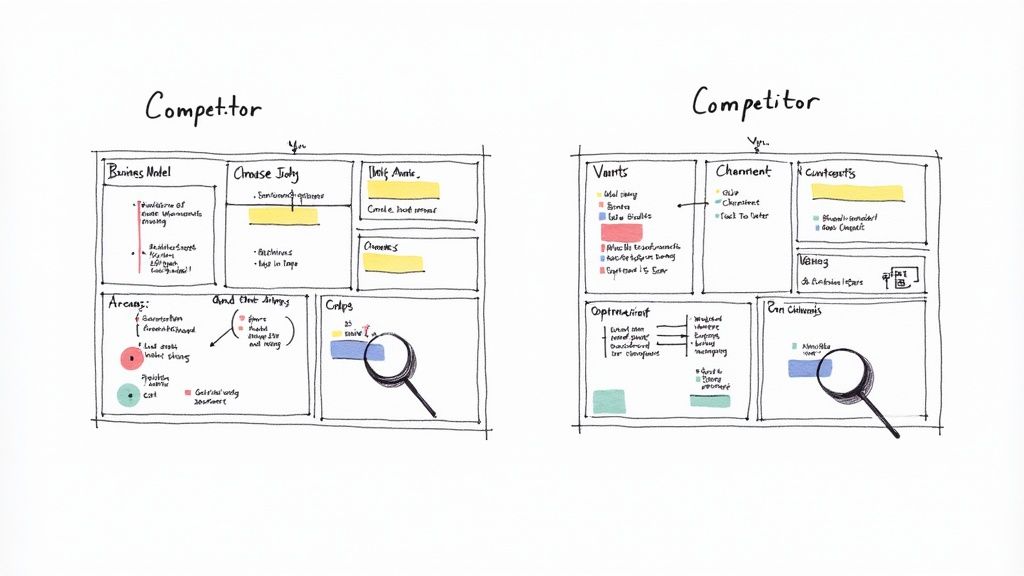
This kind of data takes your competitor's canvas from a bunch of hypotheses and turns it into a fact-based map of their entire operation.
Turning Insights Into Action
Once you've filled out a canvas for a competitor and backed it up with data, lay it side-by-side with your own. The differences will practically jump off the page, showing you a clear path forward.
> Comparing your Business Model Canvas to a competitor’s isn’t about copying them. It’s about understanding their playbook so you can write a better one.
This whole process gives you the strategic clarity to make much smarter moves. You can finally answer the big questions with confidence:
- Can we offer a better Value Proposition to an underserved Customer Segment they're totally ignoring?
- Are their Key Partnerships actually a weakness we can disrupt?
- Is their Cost Structure bloated, giving us an opening to compete on price?
By using your canvas as a competitive recon tool, you stop just planning your business and start actively positioning it to win. If you're ready to dig in, our complete guide on how to conduct competitive analysis gives you a step-by-step framework to get started. This makes the business model canvas explained not just a concept, but a living, breathing part of your growth strategy.
Got Questions? Let's Get Them Answered
We’ve covered a ton, but I know there are always a few questions that pop up when you're first getting your hands dirty with the canvas. Let's tackle them right now so you can get unstuck and move forward.
Think of this as your quick-fire FAQ session with someone who's seen it all.
Business Plan vs. Business Model Canvas: What's the Difference?
I love this question because the distinction is so important.
Imagine you’re planning a cross-country road trip. The traditional business plan is the 500-page travel diary you write before you even start the car. It’s filled with detailed turn-by-turn directions, hotel bookings, and weather predictions for a trip that’s months away. It's rigid, takes forever, and is probably wrong by the time you hit the road.
The Business Model Canvas? That’s your map. It’s a single, big-picture view showing the main highways, key cities, and how everything connects. It’s all about speed and flexibility, letting you reroute on the fly when you hit a roadblock or discover a better scenic route.
You use the canvas to figure out if the trip is even a good idea before you commit to the massive document. The canvas is for sketching and exploring; the business plan is the final blueprint you create once you know the route works.
How Often Should I Update My Canvas?
If you’ve printed your first canvas, framed it, and hung it on the wall like a piece of art, you’re missing the point entirely. The canvas isn't a static document; it's a living, breathing tool that should look a little messy.
Here’s a simple way to think about it:
- Early Days (Before You Launch): All the time. Seriously. Every customer conversation, every new piece of data, every "aha!" moment in the shower should send you running back to your canvas. Think daily or weekly tweaks.
- After Launch: Revisit it quarterly or anytime you're about to make a big move. A new competitor popping up, a shift in the market, or a game-changing product idea are all perfect triggers to pull it out and see what needs to adapt.
> The moment your canvas stops changing is the moment your business stops learning. It's a dashboard, not a history report.
Keeping it fresh ensures your strategy is grounded in reality, not just the optimistic ideas you had on day one.
Can I Use the Canvas for a Non-Profit?
Absolutely. It’s a common myth that the canvas is just for profit-driven tech startups. The tool is incredibly adaptable—you just need to shift your thinking on a few of the blocks.
For a non-profit, the core logic is the same, but the vocabulary changes a bit:
- Customer Segments become Beneficiaries (who you serve) and Donors (who funds you). You're often serving two different groups.
- Value Propositions translate to your Social Impact or mission.
- Revenue Streams are now your Funding Streams—think grants, individual donations, or fundraising campaigns.
- Profit isn't the goal. Instead, the bottom line becomes Sustainability or Surplus—the resources you generate to keep the mission going strong.
The canvas is a fantastic tool for non-profits because it forces a clear, strategic conversation about value and sustainability. It helps you map out exactly how you'll achieve your mission in a way that’s financially sound—a challenge every organization has to solve.
Ready to turn those competitive insights into your strategic advantage? Already.dev gives you the data-driven clarity you need to build a business model that wins. Stop guessing and start knowing. Uncover your market at Already.dev.