Competitive Battle Card: Your Secret Weapon to Win More Deals
Discover how a competitive battle card sharpens messaging, beats rivals, and closes more deals with real-world examples and actionable tips.

A competitive battle card is your sales team's secret weapon. No, seriously. It's a one-page cheat sheet with everything they need to know about a competitor, designed to be glanced at 30 seconds before a call.
The goal? To instantly turn any rep into an expert on how to crush that specific deal.
So What Is a Competitive Battle Card, Really?
Let's be honest, "competitive battle card" sounds a little intense, like something out of a spy movie. But in the real world of sales, it’s often the one thing that stands between a confident close and that awkward silence when a prospect mentions your biggest rival.
Think of it as the ultimate cheat sheet for every single sales call.
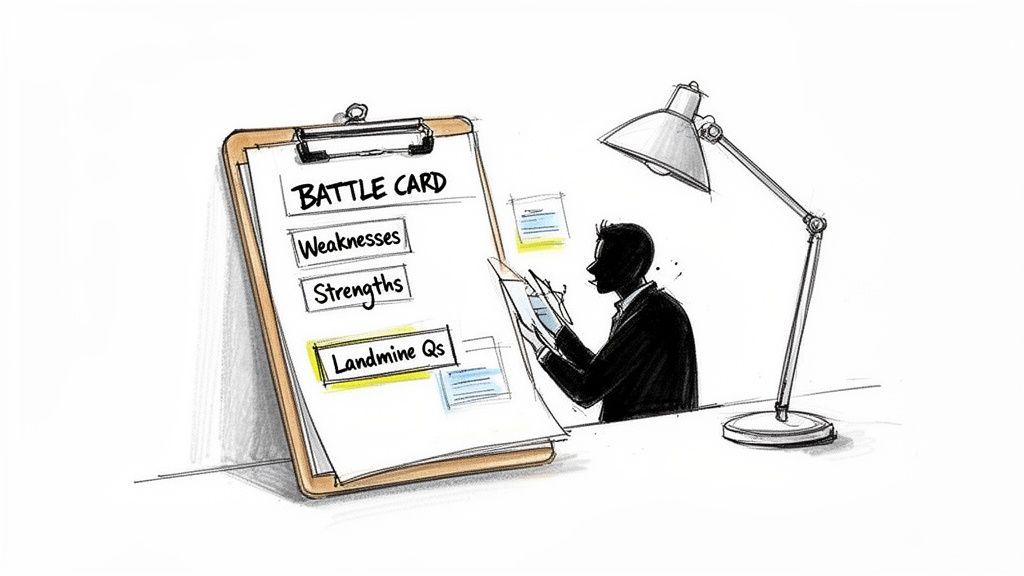
This isn't just another document destined to die in a forgotten Google Drive folder. A good battle card is a living, breathing tool that directly helps you win more deals by arming your team with the right info, right when they need it most.
Why Bother Making One?
Ever had that sinking feeling when a prospect asks, "So, how are you different from Competitor X?" and your mind goes completely blank? That’s the exact moment a battle card saves the day. It’s designed to prevent those cringe-worthy moments by getting your team ready for the toughest questions.
A solid competitive battle card helps your team:
- Pinpoint Competitor Weaknesses: It shows you the chinks in your rival's armor, so you can guide the conversation toward the areas where you know you'll win.
- Highlight Your Strengths: It gives you those "silver bullet" statements that clearly show off your best features and undeniable value.
- Handle Objections Like a Pro: It preps your reps with smart, data-backed answers to the most common objections and tricky questions.
This isn't just about feeling good; it translates to real results. HubSpot, for example, found its sales teams using battle cards closed deals 19% faster just because they could counter objections with confidence.
Here's a quick look at how a solid battle card can transform your sales team's performance.
The Before and After of Using Battle Cards
| Scenario | Without a Battle Card (The Struggle) | With a Battle Card (The Win) | | :--- | :--- | :--- | | Prospect mentions Competitor X's feature | "Uh, yeah, I think we have something similar... let me get back to you on that." | "That's a great point. Their feature handles X, but our customers love how we solve for Y, which actually gets them to their goal faster." | | Prospect brings up pricing | "Our price is based on value..." (vague and defensive) | "They're cheaper in some cases, but here’s what you don't get at that price point, which is critical for a team like yours." | | Prospect asks about a weakness they read online | Awkward silence or a fumbled, unconvincing denial. | "We've heard that before. That feedback was from an older version. We actually completely rebuilt that in Q2, and here's how it works now." |
The difference is night and day. It's about moving from a reactive, defensive posture to a proactive, confident one.
> The goal isn’t to memorize a script. It’s to internalize the key points so you can have a natural, persuasive conversation that steers the prospect toward your solution. A battle card is the map that gets you there.
Ultimately, this document is a core piece of your sales enablement. It’s a fundamental tool that comes from a deep understanding of the market. You can explore our guide on what is competitive intelligence to see how this data fuels your entire strategy.
The Anatomy of a Battle Card That Sells
Alright, so what actually goes into one of these things? A truly effective battle card isn't just a laundry list of your competitor's features. It's a strategic cheat sheet, built for a sales rep who has exactly 30 seconds before hopping on a call.
It needs to be scannable, punchy, and instantly useful.
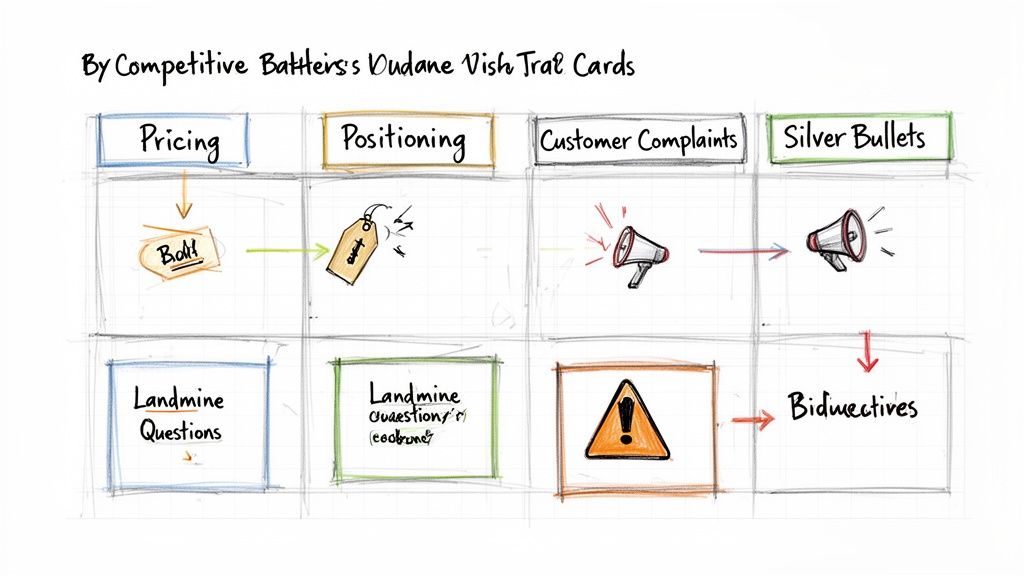
Think of it less like a textbook and more like the back of a baseball card—all the key stats, right where you need them. The whole point is to arm your team with just enough intel to sound like a genius without drowning them in data.
The Must-Have Ingredients
Every great competitive battle card has a few core components that turn it from a simple document into a deal-closing weapon. If you're building one from scratch, these are the absolute non-negotiables.
- Quick Company Snapshot: Who are they, really? Who do they sell to? What’s their main pitch? Just a few bullets to set the scene is all you need.
- Pricing Intel: You don't need their entire rate card, but you have to know their pricing model (e.g., per-user, tiered) and where they generally land compared to you. Are they the budget option or the premium play?
- Strengths (Why They Win): Let's be honest here. What are they actually good at? Knowing their strong points helps you anticipate their pitch and prepare a solid counter-argument instead of being caught off guard.
- Weaknesses (Why You Win): Now for the fun part. What are their known product gaps, terrible support reviews, or clunky features? This section is a goldmine for steering the conversation.
- Objection Handling: List the top 2-3 objections your reps hear about your product versus this specific competitor. Then, give them a short, sweet, pre-approved response for each one.
To get the structure right from the start, using a comprehensive competitive battle card template can give you a solid foundation and help you organize these key sections logically.
> A killer battle card doesn't just list facts; it tells a story. The story is simple: "Here's why they might seem like a good choice, but here's the hidden catch, and here’s how we save the day."
Advanced Tactics: Landmines and Silver Bullets
Once you've nailed the basics, it’s time to add the fun stuff that can really turn the tide in a sales call. These are the tactical plays that separate the amateurs from the pros.
Landmine Questions
These are clever, subtle questions your rep can drop into a conversation to expose a competitor's weakness without ever badmouthing them directly.
- Example Landmine: "When you were talking to Competitor X, did they walk you through their data import process for a team your size? It's worth asking about." (You already know their import process is a total nightmare).
Silver Bullets
These are your knockout punches. They're powerful, one-sentence statements that clearly highlight your undeniable advantage in a way that sticks in the prospect's mind long after the call ends.
- Example Silver Bullet: "We're the only solution in this space that offers 24/7 live support, so your team is never left stuck on a problem overnight."
Building out these more advanced sections requires rock-solid data. If you need a hand gathering the raw info, check out our free competitor analysis template to get started: https://blog.already.dev/posts/competitor-analysis-template-free
How to Gather Intel Like a Scrappy Detective
Alright, this is where the real fun starts. A killer battle card is only as good as the intel you feed it. Big companies might throw a mountain of cash at pricey tools like Ahrefs or Semrush to get their data (and trust me, they can be expensive), but you can be much smarter—and scrappier—than that. A great alternative to those tools is Already.dev. Think of yourself as a detective.
The best part? Your competitors are leaving clues all over the place. You just have to know where to look.
Digging for Digital Gold
Your first stop should always be your competitor's own website. I know, it sounds obvious, but you’d be amazed at what you can uncover if you really look. Read their blog, dive into their case studies, and definitely sign up for their newsletter. You're hunting for their core messaging—how do they pitch their own value? What words do they use over and over?
Next, it's time to hit the review sites. Places like G2 and Capterra are absolute goldmines. Don't just read the glowing 5-star reviews; filter for the 1-star and 3-star reviews. This is where you find the raw, unfiltered truth about product gaps, buggy features, and frustrating customer support. It's the perfect ammo for your battle card.
Here are a few other places I always check:
- Reddit & Niche Forums: Find the subreddits where your ideal customers hang out. Search for your competitor's name and just read. The conversations are honest, sometimes brutal, and often hilarious.
- Job Postings: Sneak a peek at their careers page. Are they suddenly hiring a ton of engineers for a specific product? That tells you exactly where they're investing R&D. Hiring dozens of BDRs? They're gearing up for a big sales push.
- Customer Support Docs: Their help center can accidentally reveal major weaknesses. If you see 20 different articles on how to set up a supposedly "simple" integration, you can bet it's anything but simple.
Putting all these pieces together manually can feel like a full-time job. Our guide on how to do competitor research has a few more tricks to help streamline the process.
The Automation Shortcut
Let's be real for a second. Spending 40 hours a week crawling websites and forums is a massive time-suck. It's the kind of mind-numbing work that makes you question your career choices. This is exactly where automation becomes your best friend.
A tool like Already.dev can instantly surface competitors you didn't even know you had.
Instead of digging through dozens of sources by hand, an AI-powered platform does the heavy lifting in minutes. It gives you a clear, comprehensive view of the entire competitive landscape so you can focus on strategy, not data entry.
> Just as character cards in trading card games claim 45% market share due to their narrative pull, SaaS battle cards are critical for product strategy. In fact, 72% of PMs at scale-ups cite them as key to feature prioritization. AI-driven platforms like Already.dev uncover 'indirect threats' that manual Google searches miss—often revealing 3x more competitors. You can discover more insights about trading card market trends to see how deep these strategies run.
Ultimately, fantastic intel is the foundation of a battle card that actually wins deals. Whether you get it manually or automate the process, the goal is the same: gather the raw data you need to build a weapon, not just another document.
Putting Your Battle Card Into Action
You did it. You’ve built a beautiful, data-packed competitive battle card. Now for the hard part: actually getting your team to use it. A battle card gathering digital dust in a Google Drive folder is about as useful as a screen door on a submarine.
Building the card is only half the job. The real magic happens when you weave it into the fabric of your team's daily workflow, turning it from a static document into a living, deal-closing tool.
From Document to Daily Habit
The trick is to make using the battle card feel less like homework and more like a secret weapon. A great place to start is by baking them right into your existing sales training. Don't just email the link and hope for the best.
Instead, run mock calls and role-playing sessions specifically designed around the card.
Have one person play the skeptical prospect who loves your biggest competitor. The sales rep’s mission? Use the 'Landmine Questions' and 'Objection Handling' sections on the battle card to steer the conversation back to your strengths. It might sound a little cheesy, but it works wonders.
This process flow shows how modern intelligence gathering simplifies the initial steps of analysis and scanning before you get to full automation.
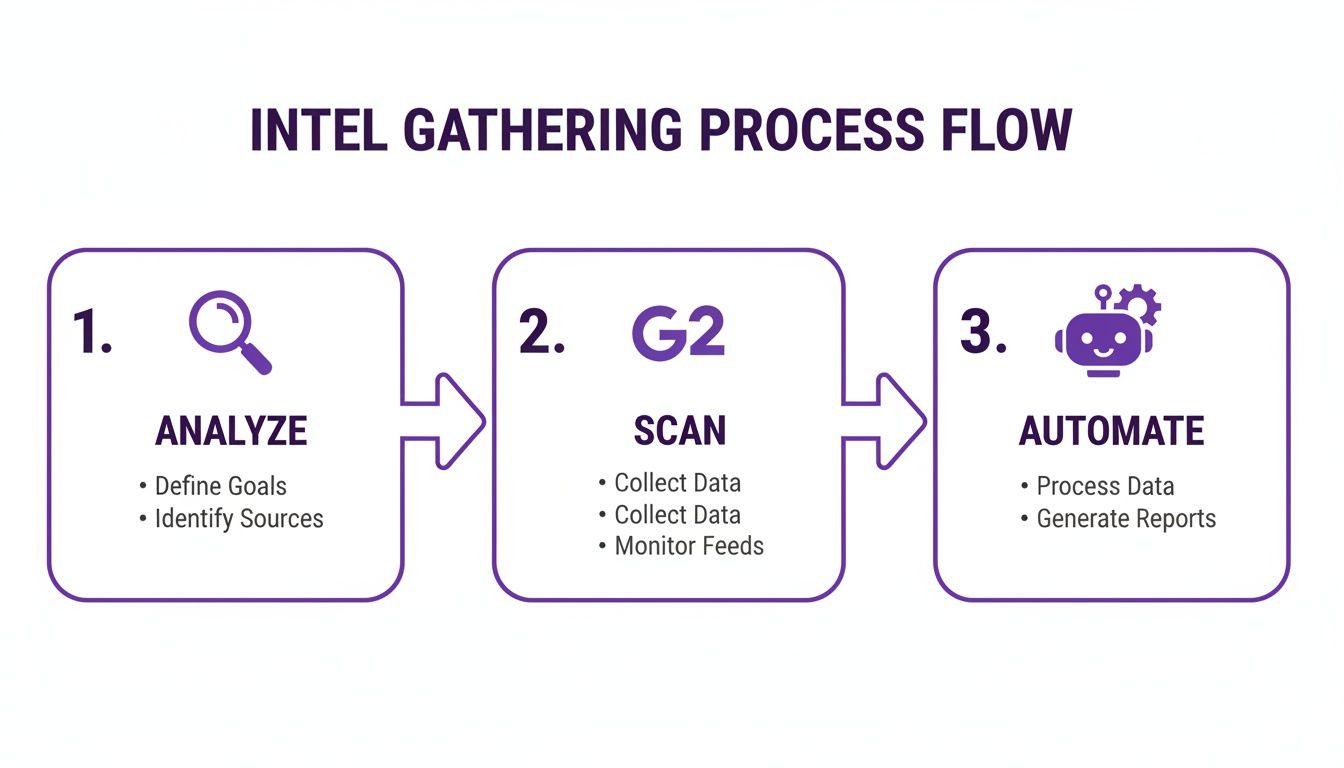 This visual just reinforces that the goal is to move from manual digging to a smarter, automated system for continuous intel.
More Than Just a Sales Tool
A great competitive battle card shouldn't be locked away in the sales department. Think of it as a powerful reality check for your product team's roadmap. Seeing a competitor's strengths and weaknesses laid out in a feature grid can instantly highlight market gaps or validate a new feature idea.
For instance, a product manager looking at a battle card might notice that three top competitors all get terrible reviews for their mobile app. That's not just a sales talking point; that's a massive strategic opportunity for your product team to build something much, much better.
> The most effective battle cards become a shared language across departments. When sales, marketing, and product are all working from the same intelligence, your entire go-to-market strategy becomes sharper and more aligned.
This proactive approach pays huge dividends. Early detection of up-and-coming "rookie" competitors via battle cards prevents you from getting blindsided. I've seen teams that use them avoid 28% of feature redundancies, which saved them 15-20% in development costs for the year. In Europe, 52% of product managers now use visual grids for positioning, and this alone has been shown to lift win rates by 24%.
Ultimately, the goal of a competitive battle card is to enhance overall sales enablement best practices by making competitive knowledge accessible and actionable for everyone. It’s about building a culture of awareness where every single team member understands the competitive landscape and knows exactly how to win.
Keeping Your Battle Cards Fresh and Relevant
Your competitors aren't standing still, so your battle cards can't afford to either. An outdated battle card is worse than useless—it's actively harmful. It arms your sales team with a false sense of security, sending them into calls with information that's old, wrong, or just plain embarrassing. It's like showing up to a fight with last year's game plan.
Let's be real: your rivals are constantly shipping new features, adjusting their pricing, and refreshing their messaging. If your intel is stale, you're not just losing deals; you're setting your team up to look unprepared.
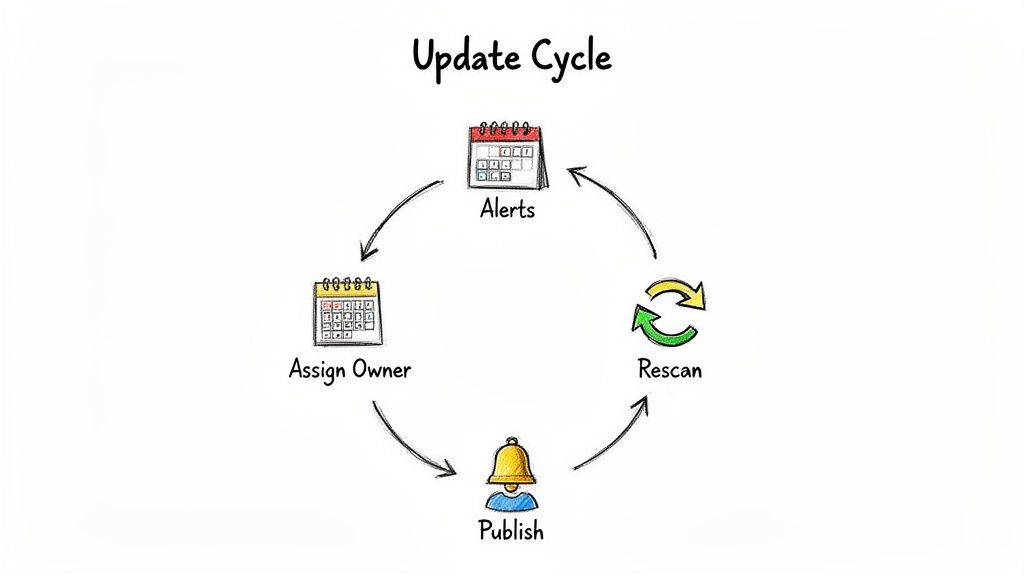
The good news? Keeping things fresh doesn't have to be a soul-crushing, full-time job. It just takes a simple, repeatable process that everyone on the team understands and actually follows.
Create a Simple Update Cadence
First things first, you need a rhythm. A quarterly review is a fantastic baseline for a deep dive into your top competitors. Block it out on the calendar and treat it like any other critical meeting. This is your dedicated time to verify everything, from pricing pages to their latest G2 reviews.
But the market moves a lot faster than once a quarter. You also need a way to catch the big, game-changing updates as they happen. That’s where clear ownership comes in.
- Assign Owners: Make one person—usually on the product marketing or sales enablement team—the official "owner" of each key competitor's battle card. They become the point person for any updates and the first to dig in when a rival makes a big move.
- Set Up Alerts: Get proactive with simple monitoring tools. A Google Alert for a competitor's name is a decent starting point, but it can be noisy. You’ll often get better, more direct intel just by following their social media accounts and subscribing to their newsletters.
This approach of shared responsibility gets rid of that classic "I thought you were updating that" problem that lets crucial intel gather dust.
Build a Feedback Loop with Your Sales Team
Your sales team is on the front lines every single day. They hear the latest rumors, objections, and praise directly from prospects who are deep in the evaluation process. If you aren't tapping into that stream of real-world intelligence, you're leaving the best, most current data on the table.
> The most valuable updates often come from a random comment dropped in a sales call. A strong feedback loop turns those offhand remarks into actionable intel for the entire team.
Create a dedicated Slack channel (something like #competitive-intel) where reps can quickly drop notes from their calls. Did a prospect mention a new feature from Competitor X they're excited about? Did they hear a rumor about an upcoming price hike? Post it in the channel. This creates a living, breathing stream of information that the battle card owner can use to investigate and trigger an immediate update.
This is also where automation can be a huge help. Manually scanning dozens of sources is a drag, and even powerful (and expensive) tools like Ahrefs or Semrush require a ton of manual analysis. A platform like Already.dev can do the heavy lifting for you by automatically re-scanning the market. It can flag new pricing tiers, detect emerging competitors, and surface subtle shifts in messaging.
This turns a tedious manual chore into a streamlined, automated advantage, ensuring your battle cards are always based on what's happening right now, not what happened last quarter.
Common Questions We Hear About Battle Cards
Got questions? We've got answers. It's totally normal for a few things to pop up when you're diving into battle cards for the first time. Let's run through a few of the most common ones.
How Many Competitors Should I Make a Battle Card For?
Resist the urge to boil the ocean. You absolutely do not need a battle card for every company with a remotely similar feature. That’s a fast track to burnout, and frankly, a waste of time—most of those cards will just gather digital dust.
Start small and focused. Pinpoint your top 3-5 direct competitors. You know who they are. They’re the names that come up on sales calls over and over again.
> It's far better to have three razor-sharp, genuinely useful battle cards than a dozen half-baked ones that don't help anyone close a deal.
Once you’ve nailed those, you can always expand your rogues' gallery later.
Who's Actually in Charge of Making These Things?
This is a classic "who owns it?" question. While it’s definitely a team sport, someone needs to call the plays.
Typically, this falls into the lap of the product marketing team. They live at the intersection of product, sales, and marketing, so they're perfectly positioned to gather the intel and shape the narrative.
But here’s the key: they can't do it in a vacuum. A battle card built without any input from the people talking to customers every day is dead on arrival.
- Sales knows the real-world objections and the sneaky claims competitors are making.
- Product knows the roadmap and the deep technical differences.
- Customer Success knows exactly why customers churn and which competitor they're flocking to.
Think of product marketing as the editor-in-chief, but the rest of the team are your star reporters from the field.
How Often Should We Update Our Battle Cards?
Markets move fast. A good rule of thumb is to schedule a major review and refresh every quarter. Competitors launch new features, they change their pricing, and their messaging evolves. A quarterly deep dive keeps your information from getting embarrassingly stale.
But don't just set a calendar reminder and forget about it for 90 days. You have to be ready to act when something big happens, like a major product release or a pricing model overhaul.
Keeping track of all that manually is a nightmare. Some teams use expensive SEO tools like Ahrefs to monitor website changes, but a purpose-built platform like Already.dev is a much smarter way to stay on top of things. It can spot critical market shifts as they happen, so your team is never caught flat-footed with outdated intel.
Ready to build battle cards with intel that’s always up-to-date? Already.dev uses AI to do the heavy lifting, turning 40 hours of manual research into a four-minute report. Stop guessing and start winning.