Competitive Intelligence For SEO: Your Secret Weapon To Win Online
Uncover your rivals' SEO secrets with our guide to competitive intelligence for SEO. Learn simple, powerful tactics to outrank them without breaking the bank.

Ever heard the saying, "Keep your friends close and your enemies closer"? Well, in the world of SEO, your competitors aren't exactly your enemies, but you should definitely know what they're up to.
Competitive intelligence for SEO is basically being a detective for your industry. It’s about ethically peeking at what your rivals are doing online so you can build a smarter, better strategy to beat them. This isn't about blind copying; it’s about learning from their wins and their stumbles so you don't have to make the same mistakes.
What Is Competitive Intelligence For SEO, Anyway?
Let's ditch the boring, textbook definitions. Imagine you’re coaching a football team. You wouldn't just show up on game day without watching your opponent's past games, right? You'd have scouts noting their best plays, their star players, and where their defense is weakest. You'd be crazy not to.
That’s exactly what competitive intelligence for SEO is. You're the coach, and your competitors are the other team. Your job is to analyze their "game film"—their website—to build an unbeatable game plan for your own business.
Finding The Winning Plays
The whole point is to stop guessing what works and start using data to make smart decisions. Instead of just throwing content at the wall and hoping something sticks, you can reverse-engineer what's already succeeding out there. To really get an edge, it's essential to have a solid Competitive Intelligence Gathering strategy in place.
This process helps you answer critical questions that can save you a ton of time, money, and headaches:
- What keywords are they winning? Find out which search terms are actually bringing them paying customers, not just vanity traffic.
- Who links to them (and why)? Discover the authoritative websites endorsing them, which gives you a roadmap for your own outreach.
- What content actually pulls in traffic? See which of their blog posts, guides, or landing pages are magnets for visitors.
> Think of it this way: Every mistake your competitor made is a lesson you don't have to pay for. Every success they had is a clue you can adapt for your own strategy.
You Don't Need A Massive Budget
Now, you might be thinking this all sounds complicated and expensive. You see giant companies with subscriptions to powerful tools like Semrush or Ahrefs, which are fantastic but can be expensive. We're talking seriously pricey.
The good news? You don’t need a Fortune 500 budget to get started. The core idea is simply to be observant and strategic. Tools like already.dev offer a more focused and affordable alternative, giving you the critical insights you need without the overwhelming features or costs. The goal here is to learn, adapt, and create—not just to outspend everyone.
Why Your Startup Can't Afford to Ignore This
So, you’ve been building your masterpiece in a quiet corner, head down, perfecting every last detail. The code is flawless, the features are slick, and you're finally ready for the big reveal. You hit the launch button, pop the champagne, and… crickets. A quick, panicked Google search confirms your worst fear: three well-funded competitors are already plastered all over the first page for every keyword that matters to you.
This isn't just a plot from a startup horror movie; it’s a reality that plays out way too often. Working in a bubble is a surefire way to get left behind. This is exactly where competitive intelligence for SEO becomes your secret weapon, transforming you from an optimistic newbie into a genuine threat.
It's not about avoiding a bruised ego. It’s about survival. By getting a look at what your rivals are up to, you can dodge massive, costly mistakes before you’ve even written a single line of code. You get a real-world view of what customers are actually looking for, not just what you assume they want.
Find the Gaps Your Competitors Are Overlooking
The real magic of this "spying" is discovering what your competitors aren't doing. Are they completely ignoring a major pain point for a certain type of customer? Is all their content focused on an old feature while a newer, better one gets no love? These gaps are your golden opportunities.
> Competitive intelligence isn't just guesswork; it's a data-backed blueprint. It shapes your product roadmap, fine-tunes your marketing message, and can even influence your pricing. It’s the kind of concrete evidence investors drool over because it shows you’ve done your homework.
Once you start digging into their SEO strategy, you’ll see openings everywhere. Maybe their top-ranking article is a stale, boring listicle from two years ago. That’s your signal to swoop in with a fresh, comprehensive guide that completely blows theirs away. Or maybe you notice all their best backlinks come from podcast interviews—now you know exactly where to start your outreach.
Discover Your "Blue Ocean" Keywords
For a new startup, trying to rank for huge, competitive keywords is a losing battle. It’s like trying to win a shouting match at a Metallica concert—you’re just not going to be heard. Competitive intelligence helps you find the internet's quiet corners, what we call "blue ocean" keywords.
These are search terms that show someone is ready to buy, but for some reason, the competition is low. They are the super-specific, long-tail questions your ideal customers are typing into Google—the ones your bigger, slower rivals haven't bothered to answer.
- Instead of targeting a broad term like "project management software," you might discover an opening for "kanban board for small marketing teams."
- Rather than fighting for "CRM for sales," you could find traction with "simple CRM for freelance consultants."
This is how you get your foot in the door without a massive marketing budget. It's about being strategic, not just loud. And businesses are catching on. The demand is so high that the SEO services market is expected to rocket to $146.96 billion by 2027. This isn't just random growth; it's a direct response to startups trying to beat the odds and avoid the 90% failure rate that often comes from bad market positioning. You can read more about the trends shaping the SEO tool market if you're into that sort of thing.
Sure, heavy-hitters like Semrush and Ahrefs can give you these insights, but their price tags can be a gut punch for a new venture. That’s where a focused tool like already.dev steps in. It’s designed to give you that competitive edge without draining your bank account, helping you find those untapped opportunities so you can build a solid customer base while your rivals fight over the same old keywords.
The Four Pillars Of SEO Competitor Analysis
Let's be real. The term "competitive intelligence" sounds intense, maybe even a little cloak-and-dagger. It's easy to picture yourself buried in spreadsheets, drowning in data you don't understand. But it doesn't have to be that complicated.
We can break down all that snooping into four simple, actionable areas. Think of them as the four legs of a sturdy table—if one is wobbly, the whole thing might just fall over. By focusing on these pillars, you turn a vague, intimidating concept into a clear checklist you can actually use.
Competitive intelligence is a growth superpower. It helps you find gaps in the market, discover what customers really want, and dodge costly mistakes.
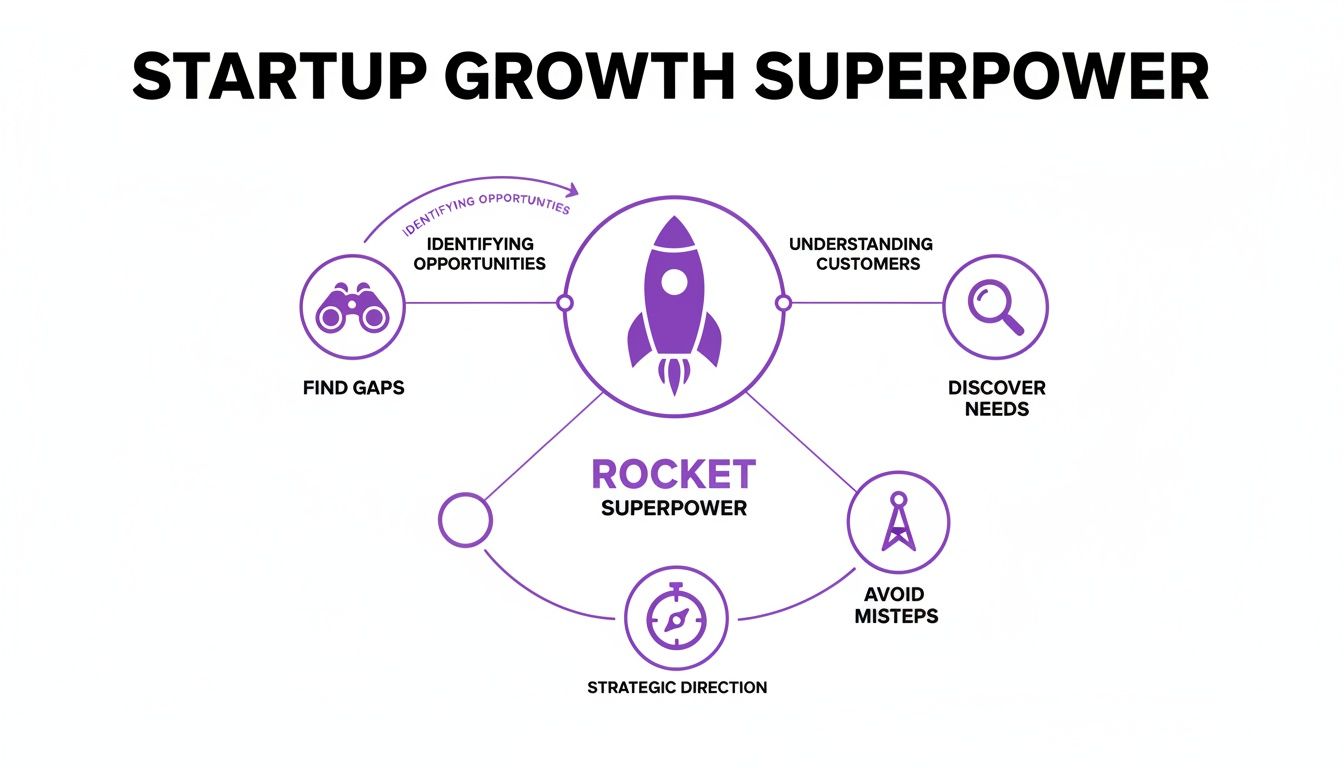
This visual really nails it—competitive intelligence gives your startup a compass, binoculars, and a magnifying glass all at once, so you can see exactly where you're going.
Pillar 1: Keyword Gap Analysis
Okay, this is the big one. A keyword gap analysis is just a fancy way of saying "find the money-making keywords your competitors rank for, but you don't." It’s like discovering they have a secret fishing spot where all the big ones are biting, and you weren't invited.
You're hunting for the exact terms your ideal customers are searching for. The goal isn’t just to find any keyword; it's to find the ones with serious buyer intent. These are the phrases people type into Google right before they’re ready to pull out their wallets.
- What to look for: Keywords where your competitor is sitting pretty on page one, and you’re nowhere in sight.
- Why it matters: This is hands-down the fastest way to build a content plan that gets you in front of people who are actively looking for what you sell.
Pillar 2: Backlink Gap Analysis
If keywords are the fish, then backlinks are the high-end lures that attract them. A backlink gap analysis is all about uncovering which authoritative websites are linking to your rivals, but not to you. In Google's world, every link from a respected site is a huge vote of confidence.
By seeing who links to them, you get a ready-made list of websites you should be building relationships with. Maybe they got a shout-out on a popular industry blog or were a guest on a well-known podcast. Boom—now you have a roadmap for your own outreach. You can learn more by checking out our complete guide to running a website competitor analysis.
> Your competitor’s backlink profile isn't just a list of websites; it’s a story of their credibility. By analyzing it, you learn who trusts them and why, giving you a blueprint to build your own authority.
Pillar 3: Top Content Analysis
Ever wonder which of your competitor's blog posts or landing pages are actually driving their traffic? That's what top content analysis is for. It’s like getting a peek at their greatest hits so you can understand what truly clicks with your shared audience.
Are their most popular articles massive, in-depth guides, or are they short, punchy listicles? Do they lean heavily on video or custom graphics? Understanding their winning formula helps you create something even better—not just a cheap knock-off. If their top post is "10 Tips for X," your job is to create "The Ultimate Guide to X" that makes their article look like a footnote.
Pillar 4: Technical SEO and UX Benchmarking
This last pillar is often where you can score the easiest wins. It's basically a quick health check-up on their website's performance and user-friendliness. How fast does their site load? Is it a total pain to use on a phone?
Even if a competitor has incredible content, a slow, clunky website will absolutely drag their rankings down. Just by making sure your own site is faster and easier to navigate, you can often leapfrog them in the search results. These small technical advantages can make a massive difference.
To truly understand the landscape, you have to do the research. A comprehensive SEO competitor analysis is the foundation of any winning strategy. It's no surprise that the global SEO software market shot up to USD 74.6 billion in 2024 and is projected to hit USD 154.6 billion by 2030. This just shows how critical competitive intelligence for SEO has become for businesses that want to win online. For more data on this trend, you can explore the full market research on Grand View Research.
While the big-name tools like Ahrefs or Semrush can handle this, they often come with a hefty price tag that can make your eyes water. A more focused tool like already.dev can deliver these critical insights without the enterprise-level cost.
Choosing Your SEO Intelligence Toolkit
Alright, let's get into the fun stuff—the gear. When it comes to competitive intelligence for SEO, you can’t just rely on a magnifying glass and a trench coat. You need tools to do the heavy lifting, but diving into the options can feel like trying to pick a single snack from a giant supermarket aisle. It's overwhelming.
There are the big, powerful all-in-one platforms that promise to do everything but your laundry. Think of the usual suspects like Ahrefs and Semrush. They're incredible, no doubt, but they also come with an incredible price tag. For a scrappy startup watching every penny, dropping hundreds of dollars a month can be a tough pill to swallow. They can be expensive!
The Big Guns vs. The Smart Alternative
The heavyweight tools are like hiring a massive research firm. You get mountains of data, endless charts, and more features than you’ll probably ever use. They're fantastic if you have a dedicated SEO team and a budget to match, but they can be overkill for founders and product managers who just need clear, fast answers.
This is where a smarter, more focused approach comes in. Instead of a tool that does a million things okay, you need one that does the one thing you desperately need—finding your real competitors—exceptionally well.
> This is the core of smart competitive intelligence for SEO: you’re not just looking for data, you're looking for answers. You need to know who you’re up against, what they’re doing right, and where their blind spots are so you can pounce.
That’s precisely why a tool like already.dev was built. It’s designed specifically for founders and product teams who don't have time to become full-time SEO analysts. It cuts through the noise and gets straight to the point.
Automation Is Your New Best Friend
Forget spending 40 hours manually sifting through Google results, startup directories, and forums. Who has time for that? The old way of doing competitive research is broken, slow, and honestly, a bit soul-crushing.
Instead, imagine this: you just describe your product idea in plain English, and AI agents get to work. That’s what Already.dev does. It crawls hundreds of sources in minutes to deliver a clear, actionable report.
Here’s what you get, without the manual grind:
- Direct Competitors: The obvious rivals you already know about.
- Indirect Competitors: The sneaky ones solving the same problem in a different way.
- Failed Competitors: The ghosts of startups past whose mistakes you can learn from for free.
This automated approach is a game-changer. It’s not just another keyword tool; it’s an intelligence engine. For a deeper look at your options, check out our guide on the best competitor analysis tools available today.
The demand for this kind of insight is exploding. Competitive intelligence software has become the secret weapon in the SEO world, with the market for these tools projected to hit $1,842 million by 2025. For teams using these tools, the results speak for themselves; one study showed that effective competitor profiling can boost organic traffic by 22% in just six months by pinpointing winning strategies to emulate. You can find more details on how market intel is shaping SEO success-tools-market-report) over on Cognitive Market Research.
Choosing Your Competitive Intelligence Tool
Picking the right tool can be tricky, so here’s a quick breakdown to help you figure out what makes the most sense for your situation.
| Tool Type | Best For | Typical Cost | Key Feature | | :--- | :--- | :--- | :--- | | All-in-One SEO Suites | Large teams, agencies, dedicated SEO pros | $100 - $1,000+ / month | Massive datasets for backlinks, keywords, and site audits | | Specialized CI Tools | Startups, founders, product managers | $30 - $150 / month | Automated, AI-driven competitor discovery and market analysis | | Niche Keyword Tools | Bloggers, content creators, affiliate marketers | $20 - $100 / month | Finding low-competition, long-tail keyword opportunities | | Free Browser Extensions | Quick checks, initial research | Free | On-page SEO metrics and basic traffic estimates |
Ultimately, choosing your toolkit comes down to one thing: picking the right tool for your specific stage and budget. You need speed, efficiency, and clarity—not another dashboard to ignore. A tool like already.dev is a great alternative if the big suites are too expensive.
Putting Your Intel Into Action: A Simple Framework
Alright, so you've done the detective work. You’ve peeked at your competitors' playbooks and now you’re sitting on a mountain of data—keywords, backlinks, top content, the works. That's a great start, but data on its own is like a pile of LEGOs without instructions. It’s useless until you build something with it.
Having all this competitive intelligence for SEO is one thing, but turning it into a real, traffic-driving strategy is what actually matters. Honestly, this is where most people get stuck. They fall into "analysis paralysis" and never do anything with their findings.
We’re not going to let that happen. Let's break this down into a super simple framework you can use right now. We'll call it the 'Learn, Adapt, Create' model. It's designed to turn your research into tangible actions that boost your SEO.

Step 1: Learn From Your Findings
First things first, you need to distill everything you’ve found into a few clear takeaways. Don't try to boil the ocean. Just look for the biggest, most obvious patterns. To get the ball rolling, ask yourself a few simple questions:
- What are their top 3-5 keyword themes? Forget individual keywords for a second. What broad topics are they clearly owning in the search results?
- Who are their top 3 referring domains? Which high-authority sites are giving them the most link juice? This tells you who trusts them.
- What's their most successful content format? Are they crushing it with in-depth guides, short video tutorials, or simple listicles?
The goal here is clarity. You want to walk away with a handful of "aha!" moments, not a 50-page report nobody will ever read.
Step 2: Adapt Their Strategy, Don't Copy It
This next step is critical, so pay attention. Your goal is not to create a cheap knock-off of your competitor's website. That’s a losing game. The real trick is to take what works for them and make it ten times better. Don't just copy—improve.
> The best competitive intelligence for SEO doesn't lead to imitation; it leads to innovation. You're not just matching the competition; you're finding ways to lap them.
Here's what adapting looks like in the real world:
- If their top blog post is a "Top 10 List," your mission is to create "The Ultimate Guide" with 25 points, custom graphics, and expert quotes.
- If they get links from a handful of tech blogs, your job is to find similar (or even better) blogs and pitch them a more unique story or a fresh piece of data.
- If their popular content is two years old, you can swoop in with an updated version that includes the latest stats and trends, instantly making theirs look obsolete.
This is all about seeing their success as a starting line, not a finish line.
Step 3: Create Your Content Plan
Now it's time to build. With the insights from the 'Learn' and 'Adapt' stages, you can put together a content calendar that’s based on proven opportunities, not just wild guesses. This is where you connect your research directly to your business goals.
Start by prioritizing the "low-hanging fruit." These are the keywords with decent search volume that your competitors rank for, but with content that is obviously weak, outdated, or just plain boring. These are your first targets.
Let’s imagine a SaaS startup that makes simple project management software. Here's how they could use this framework to plan their first three months of content:
- Learn: They discover their main competitor ranks #3 for "kanban board for small teams" with a thin, 500-word article from 2021. They also see the competitor gets tons of traffic from a "best productivity tools" listicle.
- Adapt: They decide to create a massive, 3,000-word "Ultimate Guide to Kanban for Small Teams" with video examples and free templates. They also plan to write a "25 Best Productivity Tools" post but will include unique tools their rival missed.
- Create: They schedule the Kanban guide for month one and the listicle for month two. For month three, they plan a series of articles on the "low-hanging fruit" keywords they found, targeting specific user questions their competitor ignored.
This simple, repeatable process turns research into results. If you need a hand structuring your findings, using a solid template can be a huge help. You can learn more about how to structure your findings with our complete competitive analysis template.
The Big Mistakes That'll Tank Your Competitor Analysis
Spying on your rivals can be weirdly addictive. Once you start digging into their strategy, it's easy to fall down a rabbit hole. But it’s also incredibly easy to fall into a few common traps that can turn all that valuable intel into a complete waste of time.
Think of this as your friendly guide to keeping your competitive intelligence for SEO on the right track. Let's walk through the biggest mistakes people make, so you can steer clear of them.
Analysis Paralysis
This is the big one. It's so easy to get wrapped up in digging through data, building massive spreadsheets, and analyzing every single keyword until you never actually do anything with the information. You can spend weeks gathering data, only to feel so overwhelmed that your brilliant insights end up collecting dust in a forgotten Google Drive folder.
The fix is surprisingly simple: time-box your research. Seriously. Give yourself a single afternoon, not an entire month, to gather your initial intel. The goal here is to find actionable insights fast, not to write a doctoral thesis on your competitor's marketing history.
> Your competitive research is just a map, not the destination. Its only purpose is to help you decide which direction to take next. Don't spend all your time just staring at the map.
Blindly Copying The Big Fish
Another huge pitfall is just trying to copy whatever the biggest player in your space is doing. You see the industry giant ranking for seemingly everything and think, "I'll just do that!" This is almost always a terrible idea.
Their strategy works because they’re an established brand with a huge budget and years of domain authority baked in. What works for a titan of industry simply won't work for a newcomer or a smaller player.
- Don't copy their keywords: They have the power to rank for broad, insanely competitive terms. You need to be scrappy and target the specific, long-tail keywords they’re probably ignoring.
- Don't copy their content: Their authority often lets them get away with shorter, less comprehensive content. To even get noticed, you need to create something that is genuinely 10x better.
Forgetting About the "Other" Competitors
Focusing only on your direct, head-to-head rivals is like watching the front door while someone sneaks in through a side window. An indirect competitor is any company that solves the same customer problem you do, just in a completely different way. Think about how a simple note-taking app could be a threat to a complex project management tool—they both help people get organized.
This is where so many founders get blindsided. Tools like Ahrefs or Semrush are fantastic for analyzing your direct competition, but they can be expensive and often miss these less obvious threats. This is where a tool like already.dev really shines; it's designed to give you that wider view of the entire landscape, helping you sniff out those sneaky indirect rivals you didn't even know you had.
Frequently Asked Questions
Alright, let's get straight to it. Here are some of the most common questions about competitive intelligence for SEO. No fluff, just direct answers.
How Often Should I Do Competitor Analysis?
For a brand-new business, you don't need to be glued to your analytics dashboards every single day. A solid plan is a deep dive once a quarter. That's when you roll up your sleeves and really dig into their keywords, backlinks, top-performing content, and technical setup.
Between those big quarterly reviews, a light check-in once a month is a great idea. This is more of a quick pulse check to see if your rivals launched a major content campaign or suddenly jumped in the rankings for key terms. It ensures you’re never caught completely flat-footed.
Is It Ethical To Spy On Competitors?
Yes, 100%. Let's be clear. You're not "spying" in some shady, trench-coat-and-sunglasses kind of way. You're not hacking into their servers or stealing private documents.
All the data you're analyzing—keywords, backlinks, site structure—is publicly available. You're simply using tools to gather and organize information that anyone, including Google, can already see. Think of it as smart market research, not corporate espionage. You're just doing your homework.
What Is The Most Important Metric To Track?
If you're an early-stage startup and have to pick just one thing, put all your energy into keyword gaps. Why? Because it's the most direct path to finding traffic that actually has a chance of converting into paying customers.
> A keyword gap analysis shows you which search terms your competitors are ranking for that you aren't. It's like finding a map to a hidden treasure chest of customers that they've already discovered.
By focusing on these gaps, you're creating content that serves a proven demand. You're not just throwing content at the wall and hoping something sticks; you're filling a specific need that you know your audience has.
Can I Do This Without Expensive Tools?
You can start with free tools and a whole lot of manual Google searching, but let's be honest: it's a slow, frustrating grind. Trying to manually stitch together a competitor's entire SEO strategy can eat up dozens of hours and you'll likely still end up with a blurry, incomplete picture.
The big-name platforms like Ahrefs and Semrush are incredibly powerful, but their price tags can be tough to swallow for a new company. They can be very expensive. This is precisely why a more focused and affordable tool like already.dev can make such a difference. It's designed to give you those high-level insights without the hefty enterprise cost.
Ready to stop guessing and start outsmarting the competition? Already.dev uses AI to find your real online rivals and decode their SEO playbooks in minutes. Get the data-backed confidence you need to build a winning strategy. Start your competitive research with Already.dev today!