Your Guide to Competitor Tracking Software (Without Being a Creep)
Stop guessing what your rivals are doing. Learn what competitor tracking software is, how it works, and how to use it to get ahead (without breaking the bank).

Let's be real, the term "competitor tracking software" sounds a bit creepy, right? It conjures up images of spies in trench coats, trading secrets in hushed tones. But in reality, it's less about espionage and more about smart observation.
Think of it as having a powerful set of binoculars that lets you legally and ethically keep an eye on what everyone else in your industry is up to—all from the comfort of your own office.
What Is Competitor Tracking Software, Really?

Imagine you're running a bake sale. You’d absolutely peek over at the next table to see what they’re selling. Are their cookies bigger? Did they just add fancy new frosting to their cupcakes? This intel helps you decide if you need to adjust your own prices, add some sprinkles, or maybe just start shouting "Free samples!" a little louder.
Competitor tracking software is the business equivalent of that quick peek. It automates the process of "walking by" your competitors' virtual tables to see what they’re doing online. Instead of you having to manually check their websites, social media, and pricing pages every day, these tools do all the tedious work for you.
So, What Does It Actually Do?
At its heart, this kind of software is built to gather and make sense of publicly available information about your rivals. It isn't some black-box magic; it’s just smart automation that saves you from mind-numbing manual research. The point isn’t to blindly copy what others are doing, but to deeply understand the market you're operating in.
This entire process is a huge piece of what's called marketing intelligence, which is just a fancy way of saying "using data to make better business decisions instead of just winging it."
What kind of data are we talking about? It's things like:
- Website Changes: You'll get an alert the moment a competitor tweaks their pricing, adds a new feature, or overhauls their homepage.
- Marketing Moves: See the ads they're running, the keywords they’re bidding on, and which blog posts are driving all their traffic.
- Customer Chatter: Keep tabs on what people are saying about them on social media and review sites. Are their customers thrilled or furious? That’s pure gold for you.
- Social Media Pulse: Track how often they post, which content gets the most engagement, and what their overall social strategy looks like.
Why You Can't Afford to Fly Blind
Making decisions in a vacuum is one of the riskiest things you can do in business. Without a clear picture of the competitive landscape, you're essentially just guessing. You might sink months into building a product only to find a competitor launched a better, cheaper version last week. Or you could burn through your marketing budget on keywords your rivals already own.
> Simply put, competitor tracking software transforms guesswork into a calculated strategy. It gives you the context needed to carve out your unique advantage and sidestep costly mistakes.
Of course, giant platforms like Ahrefs or Semrush are incredibly powerful for this, but their price tags can be intimidating. For startups and smaller teams, more focused and accessible tools like already.dev can deliver the same critical insights without breaking the bank. The most important thing is just to start. Because in business, what you don't know can and absolutely will hurt you.
What These Competitor Tracking Tools Actually Do
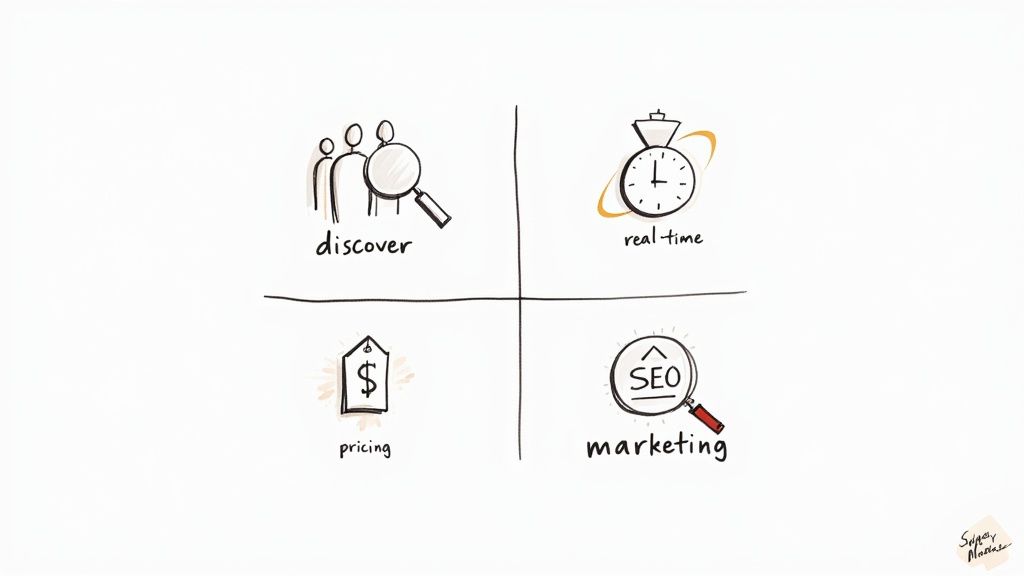
Okay, so you get the general idea. These tools are like having high-powered binoculars for your business. But what can they really do for you? Let's skip the jargon-filled feature list and talk about the actual advantages competitor tracking software gives you.
Think of it like this: these tools give you four distinct superpowers, each designed to sharpen your edge. They help you figure out who you’re truly up against, watch their every move in real-time, pick apart their product strategy, and crack the code on their marketing.
Superpower #1: Discovering Who You're Really Competing Against
You probably have a handful of competitors you keep tabs on. But what if your biggest threat isn't even on that list? It could be a brand-new startup that just launched last week or an indirect competitor solving the same customer problem in a totally different way.
This is where competitor tracking tools immediately prove their worth. They act like a radar, constantly sweeping the market to identify every single player in your arena.
- Direct Competitors: The obvious ones. They offer a very similar product to the same group of people.
- Indirect Competitors: These are sneakier. They solve the same core problem but with a different kind of solution. Think of a scooter rental company and a ride-sharing app—both get you across town.
- Emerging Competitors: The new kids on the block who could totally upend the market. Spotting them early is a huge advantage.
Trying to find all these hidden threats manually is like looking for a needle in a digital haystack. A good tool, on the other hand, gives you a complete, unbiased map of the entire battlefield.
Superpower #2: Watching Their Moves in Real-Time
Imagine getting an alert the moment your main rival slashes their prices or rolls out a game-changing new feature. That’s the magic of real-time monitoring. Checking manually means you're always playing catch-up; by the time you notice a change, the window to react has usually slammed shut.
This superpower is all about speed. The software keeps an eye on your competitors' websites, blogs, and social media 24/7, and pings you the second something important happens.
> It’s the difference between reading yesterday's newspaper and watching live breaking news. One gives you history; the other gives you a chance to act now.
This means you can counter a competitor's new pricing strategy in a matter of hours, not weeks. Or you can quickly break down a new feature they’ve just launched and decide if you need to shuffle your own product roadmap.
Superpower #3: Decoding Their Product and Pricing Strategy
Knowing what your competitors sell is just the start. The real gold is in understanding how they sell it. Competitor tracking software dissects their entire product and pricing model and lays it all out for you.
You can finally get clear answers to questions like:
- What are their most and least expensive plans?
- Which features are locked away in their premium tiers?
- How has their pricing evolved over the past year?
- Are there any gaps in their pricing that you could exploit?
This isn't about blindly copying what they do. It's about finding your unique position in the market. Maybe you can offer a must-have feature at a better price or create a new plan for a customer segment they're ignoring. For a deeper look, check out our guide on how to analyze https://blog.already.dev/posts/competitor-pricing-data to uncover these openings. These tools excel at analyzing competitive landscapes, revealing insights that old-school methods just can't see.
Superpower #4: Uncovering Their Marketing Playbook
Ever wonder how your top competitor seems to get so much traffic from Google? It’s not just luck; it’s a strategy. And competitor tracking tools let you reverse-engineer that strategy.
These platforms can show you the exact keywords your rivals rank for, the ads they're running, and the type of content that’s driving the most traffic their way. Of course, big tools like Semrush or Ahrefs can do this, but they often come with a steep price tag and a confusing interface. More focused alternatives, like already.dev, deliver that same actionable marketing intelligence without the enterprise-level overhead.
This information is a goldmine. You can spot underserved keywords they’re completely missing, see which of their ad headlines are working best, and find content ideas that are already proven to resonate with your target audience. It’s like getting a peek at their secret marketing playbook, which is the first step to writing a better one for yourself.
Why Founders and Product Managers Live and Breathe This Data
It's a common mistake to think competitor tracking is just for the marketing folks. You know, something they use to geek out over keyword rankings and ad copy. But that's selling it way short. The intelligence these tools dig up is a secret weapon for the entire company, especially for the people making the big, scary decisions.
For founders, product managers, and even the investors cutting the checks, this isn't just "marketing data." It's survival data. It’s what separates building something nobody wants from launching a product that perfectly nails a gap in the market.
Let's get into why these roles get so fired up about this stuff.
For Founders, It’s All About Dodging Bullets
Picture this: you're a founder, and you've poured your life savings and every waking hour into your new startup. You're convinced you have a world-changing idea. After nine months of grinding—coding, designing, and prepping for a huge launch—you find out a well-funded competitor launched the exact same thing six weeks ago. Ouch.
That's the kind of soul-crushing, company-killing mistake that good competitor tracking helps you avoid. For a founder, this data is your reality check.
- Spotting Real Market Gaps: Instead of just guessing, you can see what features your competitors don't have or which customer segments they're totally ignoring. That isn’t just an opening; that’s your business plan taking shape.
- Validating Your Big Idea: Seeing a few competitors in a space is actually a good thing—it proves a market exists! The software helps you figure out if the market is a bloodbath or if there's still room for a new, better solution to win.
- Nailing the Investor Pitch: When you talk to VCs, saying "we're the only ones doing this" is a giant red flag. Saying "here are our three main competitors, and here's exactly how we're going to beat them" shows you’ve done your homework and you're living in the real world.
> A founder’s job is to de-risk the business at every single turn. Competitor data is one of the most powerful risk-reduction tools you have. It turns blind faith into a calculated strategy.
For Product Managers, It's the Roadmap to Winning
If a founder sets the destination, the Product Manager (PM) is the one drawing the map to get there. A PM's life is a constant tug-of-war over priorities. Should we build Feature X or improve Feature Y? Do our users care more about raw speed or a beautiful interface?
Without outside context, these decisions are just educated guesses. With competitor data, they become strategic moves. A PM uses competitor tracking software to get answers to the tough questions:
- "Did our rival just launch something brilliant?" Getting real-time alerts on new feature launches means you're never caught off guard. You can analyze their release, watch how customers react, and decide if—and how—you need to respond.
- "What are the 'table stakes' features?" By looking at the top players, you can quickly see the baseline features customers expect in your category. This keeps you from launching a product that feels half-baked.
- "Where can we build a much better experience?" Tracking customer reviews of competing products is an absolute goldmine. If everyone complains that your competitor’s onboarding is a nightmare, you know exactly where to focus your energy to create a product people will love.
And Yes, Investors Are Watching Too
So what about the people with the money? Investors use this data to see if a company actually understands the world it operates in. They want to back a team that has a real, sustainable advantage—not just a cool idea that can be copied in a weekend. This isn't some niche hobby anymore; the global market for competitive intelligence tools was around USD 50.9 billion and is projected to more than double. That shows just how critical this data has become for making smart investments. You can explore more on the software market's rapid growth to see for yourself.
At the end of the day, from the C-suite to the product team, competitive intelligence is a team sport. While big, complex tools like Ahrefs or Semrush have their place, their expensive price tags can make them overkill. A more focused tool like already.dev can cut through the noise, giving the whole team the clarity they need to build, market, and sell a product that wins.
How To Pick The Right Tool For Your Budget
Let's be honest, shopping for competitor tracking software can feel like a total minefield. The market is absolutely packed with tools, and it's easy to get lost. You've got the heavy hitters like Ahrefs and Semrush, which are incredibly powerful but come with a price tag that can make a startup founder's eyes water.
So, how do you find the right tool without accidentally blowing your entire budget? You need a game plan. It’s time to ignore the slick sales demos and zero in on what your business actually needs. The goal is to find that sweet spot between powerful features and a price you can stomach.
This is where a simple scorecard becomes your best friend. It’s a straightforward, no-fluff way to size up any tool you're looking at.
A Simple Scorecard for Choosing Competitor Tracking Software
Use this checklist to quickly evaluate and compare different tools based on what really matters.
| Evaluation Criteria | What to Look For (The Simple Version) | Red Flag to Watch Out For | | :--- | :--- | :--- | | Data Accuracy | Is the info reliable and up-to-date? Look for real-time or daily updates on keywords, pricing, and features. | The tool is vague about its data sources or update frequency. Stale data is useless data. | | Ease of Use | Can you get meaningful insights in minutes, not weeks? An intuitive interface is key. | You need to read a 200-page manual just to find the dashboard. Complexity kills adoption. | | Pricing Transparency | Are the pricing tiers clear and easy to understand? You want a tool that scales with you. | Confusing pricing models with hidden fees or long-term contracts designed to trap you. |
This scorecard cuts through the noise. If a tool can't score well on these three basic points, it's probably not the right fit, no matter how many bells and whistles it has.
The whole point of this data is to make better decisions. Whether you're a founder looking for a market opening, a product manager prioritizing the next feature, or an investor doing due diligence, you need clear, actionable intel.

As you can see, the need for good data runs deep across the business. Everyone is trying to answer a different question, but the source of truth is the same.
Finding the Right Fit Without the Enterprise Price Tag
Here’s the good news: you don't have to choose between getting great insights and paying your team. The software market is enormous—estimated between USD 730–824 billion—and this growth has fueled a wave of specialized tools like SimilarWeb, SpyFu, and BuiltWith that serve millions.
> The secret is to find a tool that delivers 80% of the value for 20% of the cost. You don't need every feature imaginable; you just need the ones that directly lead to smarter, faster decisions.
This is exactly why tools like already.dev were created. They're built from the ground up to give founders and product teams the high-impact intelligence they need—on things like pricing changes, feature launches, and marketing shifts—without the bloat and complexity of the legacy platforms.
If you want to dig deeper, this guide on the best competitive intelligence software is a great resource. For a more focused list, check out our own breakdown of the https://blog.already.dev/posts/best-competitor-analysis-tools specifically for startups.
At the end of the day, the best tool is the one you’ll actually use. It should feel less like a chore and more like a secret weapon. So, use this scorecard, stay focused on what you really need, and remember that world-class insights are well within reach, even on a startup budget.
A Simple Three-Step Workflow to Get Started
Okay, so you’ve waded through the options and picked your competitor tracking software. High five! But now comes the part where most people get stuck: actually using the thing. It’s easy to get overwhelmed by a sea of dashboards, charts, and what feels like a tidal wave of data.
Forget all that for a second. We’re going to build a dead-simple, three-step workflow that you can start using today. This isn't about becoming a competitive intelligence ninja overnight. It's about building a small, consistent habit that keeps you informed without eating up your entire week.
Step 1: Identify Your "Top 3" Rivals
First things first, you have to resist the urge to track every single company in your space. That’s a one-way ticket to analysis paralysis, and you’ll end up drowning in notifications you don't care about.
Instead, pick just three competitors to start with.
- Your Arch-Nemesis: The company you go head-to-head with most often for new deals.
- The Big Kahuna: The established market leader everyone looks up to (and secretly wants to beat).
- The Scrappy Underdog: The new, interesting startup that’s trying something different and making some noise.
By narrowing your focus, you make sure the data you get is actually relevant and not just noise. You can always swap these out later, but starting small makes the whole process feel manageable.
Step 2: Set Up Smart, Automated Alerts
This is where the real magic happens. The whole point of this software is to let it do the heavy lifting for you. Instead of manually checking a dozen websites every day, you’ll have the most important updates sent right to your inbox or Slack.
Set up automated alerts for the high-impact stuff. Don’t track every little blog post. Focus on the game-changers:
- Pricing Changes: Get a notification the second they adjust their pricing tiers or introduce a new plan.
- New Feature Launches: Know immediately when they roll out a new product or a killer feature.
- Homepage Messaging Shifts: See how they tweak their core value proposition to win over customers.
> Think of this as your personal smoke alarm for the competitive market. You don’t need to watch the house 24/7; you just need to know when something is actually on fire.
Modern tools make this incredibly easy. The industry has really shifted toward cloud-based, AI-enhanced platforms where automated alerts and real-time monitoring are just expected. You can discover more about this industry shift and see how AI is changing the game.
Step 3: Schedule a Weekly 15-Minute "Competitor Check-in"
Finally, and this might be the most important step, put it on your calendar. Seriously. Schedule a recurring 15-minute meeting with yourself every week—maybe Friday morning with your coffee. This is your dedicated time to review the alerts your competitor tracking software has collected.
During this quick check-in, just ask yourself two simple questions:
- Did anything major happen this week that requires an immediate response from our team?
- Are there any interesting patterns starting to emerge over time?
That's it. This simple routine turns competitor tracking from a daunting research project into a quick, repeatable habit. It’s why a focused tool like already.dev can be a great alternative to bigger platforms like Semrush that can feel overwhelming because they're so expensive and complicated. A purpose-built tool helps you stick to this simple workflow without getting lost in endless data.
Common Mistakes to Avoid
So, you've got your hands on some powerful competitor tracking software. It feels like you've unlocked a secret level in the business game, right? But hold on. With great power comes the great potential to mess things up spectacularly. Let's walk through the classic blunders I see all the time so you can sidestep them.
The biggest and most common pitfall is what I call "Copycat Syndrome." You see your main rival launch a new feature, and your gut reaction is to hit the panic button and tell your team, "Build that! Now!" This is almost always a terrible idea. Blindly copying your competitors means you’re always playing catch-up, and you slowly erase what makes your own product special in the first place.
Analysis Paralysis: The Data Hoarder's Trap
Another classic mistake is "Analysis Paralysis." This is where you become a data hoarder. Your software is pulling in mountains of information—pricing changes, keyword rankings, new ad campaigns—and you spend all your time organizing it into beautiful spreadsheets and dashboards.
The problem? You never actually do anything with it. You're so busy collecting and admiring the data that you forget its entire purpose is to help you make a decision.
> Remember, the goal isn't to have the prettiest charts. It's to find one or two key insights that help you make a smarter move this week.
Data is just noise until it inspires action. If you find you're spending more than 30 minutes a week just looking at dashboards without making a single decision, you’ve fallen into the trap.
Obsession Overload: Focusing on the Wrong Company
Finally, there’s what I like to call "Obsession Overload." This happens when you spend more time watching your competitors than you do talking to your own customers and, you know, actually building your business. It's surprisingly easy to get sucked into the drama of what everyone else is doing, but it's a massive distraction.
Your competitor's every move isn't some secret message meant just for you. Most of the time, they’re just trying stuff out, same as you are. Getting bogged down in their day-to-day tactics is a surefire way to lose sight of your own long-term vision.
To keep yourself from falling into these traps, stick to a few simple rules:
- Use competitor data for inspiration, not imitation. Try to figure out why they made a certain move, not just what they did.
- Set a time limit. Block out a specific, short amount of time each week to review the intel, then get back to your own work.
- Focus on your customers first, always. Their feedback is infinitely more valuable than your competitor's latest press release.
Big, all-in-one tools like Ahrefs or Semrush can be expensive firehoses of data, making these mistakes even easier to fall into. A more focused tool like already.dev is designed to help you zero in on the important signals, so you can stay informed without getting completely derailed.
Got Questions? We've Got Answers
If you've still got a few questions bouncing around in your head, you're not alone. Let's tackle some of the most common ones we hear about competitor tracking software.
Is This Stuff Legal and Ethical?
Yes, 100%—as long as we're talking about public information. Good competitor tracking tools aren't doing anything shady. They simply automate the process of collecting data that’s already out there for anyone to see.
Think of it this way: instead of you manually checking a competitor's website, pricing page, or social media every day, the software does it for you. It's not corporate espionage; it's just smart, automated market research.
How Often Should I Actually Check This Data?
This is a great question. You want to be informed, not obsessed. For most folks, a quick 15-20 minute review once a week is the perfect rhythm.
> The goal is to spot meaningful trends over time, not to react to every tiny change your competitor makes. A weekly check-in keeps you ahead of the curve without turning into a second job.
A good trick is to set up automated alerts for the really big moves—like a major price cut or a new product launch. That way, you get a heads-up on game-changing events without drowning in the daily noise.
Do I Really Need a Pricey, Complicated Tool?
Nope. While massive platforms like Semrush or Ahrefs are incredibly powerful, they're often overkill for startups, founders, or product managers. They come with a hefty price tag and a learning curve that can feel like climbing a mountain.
You can get all the actionable intelligence you need from a more focused and affordable tool. The key is finding a platform that gives you the core insights—like pricing and feature updates—without the enterprise-level cost.
That's exactly why we built already.dev. It’s designed to deliver that critical intelligence without the complexity, so you can spend your time building your product, not trying to figure out a dashboard.
Ready to stop guessing and start knowing? already.dev uses AI to uncover your competitors' strategies in minutes, not weeks. Get the clarity you need to build a winning product. Start your free trial today!