How to Calculate Share of Voice (Without a PhD in Math)
Learn how to calculate share of voice and measure your brand's visibility against competitors. Quick steps, tools, and insights to dominate your niche.

At its core, calculating Share of Voice is just figuring out your brand’s slice of the conversation pie compared to your rivals. Think of it this way: for every 100 people talking about your industry, how many are talking about you? The math is simple: divide your brand’s mentions by the total market mentions, then multiply by 100 to get a percentage.
This one number tells you if you're a market leader or just whispering in the wind.
What Is Share of Voice and Why Bother?
Let's be real, "Share of Voice" (SOV) sounds like another piece of marketing jargon destined for a PowerPoint slide nobody reads. But what if I told you it’s the closest thing you have to a scoreboard in the game of brand awareness? It’s a brutally honest look at how much of the relevant online conversation you actually own.
Ignoring SOV is like driving blind. Sure, you’re moving, but are you winning? Losing? Just going in circles? This metric cuts through the fluff and tells you exactly where you stand.
Beyond a Buzzword
So, what does this actually mean for your day-to-day? Measuring your Share of Voice helps you:
- Benchmark against reality: See how you really stack up against the competitors you’re trying to beat, not just how you think you’re doing.
- Spot the gaps: A low SOV on a specific channel, like organic search, might reveal a massive, untapped opportunity your competitors are overlooking.
- Defend your budget: Nothing tells a story like data. Showing a direct lift in SOV after a big campaign launch is a powerful way to prove your marketing dollars are actually working (and not just funding the office Nespresso machine).
It’s easy to mix up SOV with its cousin, share of market. They’re definitely related, but they measure very different things. If you're curious about the specifics, our guide on Share of Market vs. Share of Voice breaks it down nicely.
> Share of Voice isn’t just a data point for geeks; it’s a gut-check for any marketer who wants to crush the competition. It tells you whether your message is actually landing or just getting lost in the static.
Ultimately, knowing how to calculate share of voice gives you a real competitive edge. It turns fuzzy goals like "increase brand awareness" into a number you can actually track and improve. For a deeper dive into quantifying your brand's presence across different channels, check out a practical guide to Share of Voice measurement. It’s less about vanity and all about strategic clarity.
Your Pre-Calculation Game Plan
Diving headfirst into calculating share of voice without a solid plan is a recipe for a massive headache and a spreadsheet full of garbage data. Trust me, I've seen it happen.
Think of this as your pre-flight checklist. Getting these few things right upfront makes the actual math a thousand times easier and, more importantly, actually useful.
Who Is Actually in the Ring with You?
First things first: you need to know who you're really up against. It's so tempting to list giants like Amazon or Google as your competitors, but let's be real—unless you're playing in that same billion-dollar sandbox, it's a useless comparison.
Your real competitors are the ones fighting for the same customer attention, the same keywords, and the same dollars. Forget the big names you see on TV for a second. Your true competitors are the brands that consistently show up right next to you in search results or get mentioned in the same articles.
The goal here isn't to create an exhaustive list of every company in your industry. Instead, aim to pinpoint 3-5 direct competitors that are genuinely vying for your audience. These are the brands whose marketing moves directly impact your own. Keeping the list tight and focused makes your SOV calculation sharp and actionable, not a blurry mess of irrelevant data.
> A common mistake I see is a neighborhood boutique comparing itself to a national chain. This gives you data that’s completely useless. The key is to measure your voice against rivals who are actually in the same weight class.
Once you have your roster of rivals, the next crucial step is defining what "market" you're even talking about. This is where a lot of people go wrong, so don't skip this part.
Defining Your Battlefield
"The market" is a dangerously vague term. Are you measuring the conversation around your brand name? A specific product category like "vegan protein powder"? Or a broader industry topic like "sustainable fitness"? Each of these represents a completely different battlefield.
Getting this crystal clear is non-negotiable.
- Brand-Level SOV: This tracks mentions of your specific brand name ("Acme Co") versus your competitors' brand names ("Globex Corp"). It’s great for gauging overall brand awareness.
- Category-Level SOV: This looks at a product or service category (e.g., "CRM software for small business"). It tells you who is winning the conversation on a specific solution.
- Topic-Level SOV: This is the broadest view, focusing on an industry theme (e.g., "remote work productivity"). This helps you see who is seen as a thought leader in the space.
Choose the one that aligns with your current business goals. If you just launched a new product, category-level SOV is your best bet. If you're trying to build your company's reputation, topic-level is the way to go.
This simple infographic breaks down the basic flow from your brand's efforts to analyzing the market to finally calculating your Share of Voice.
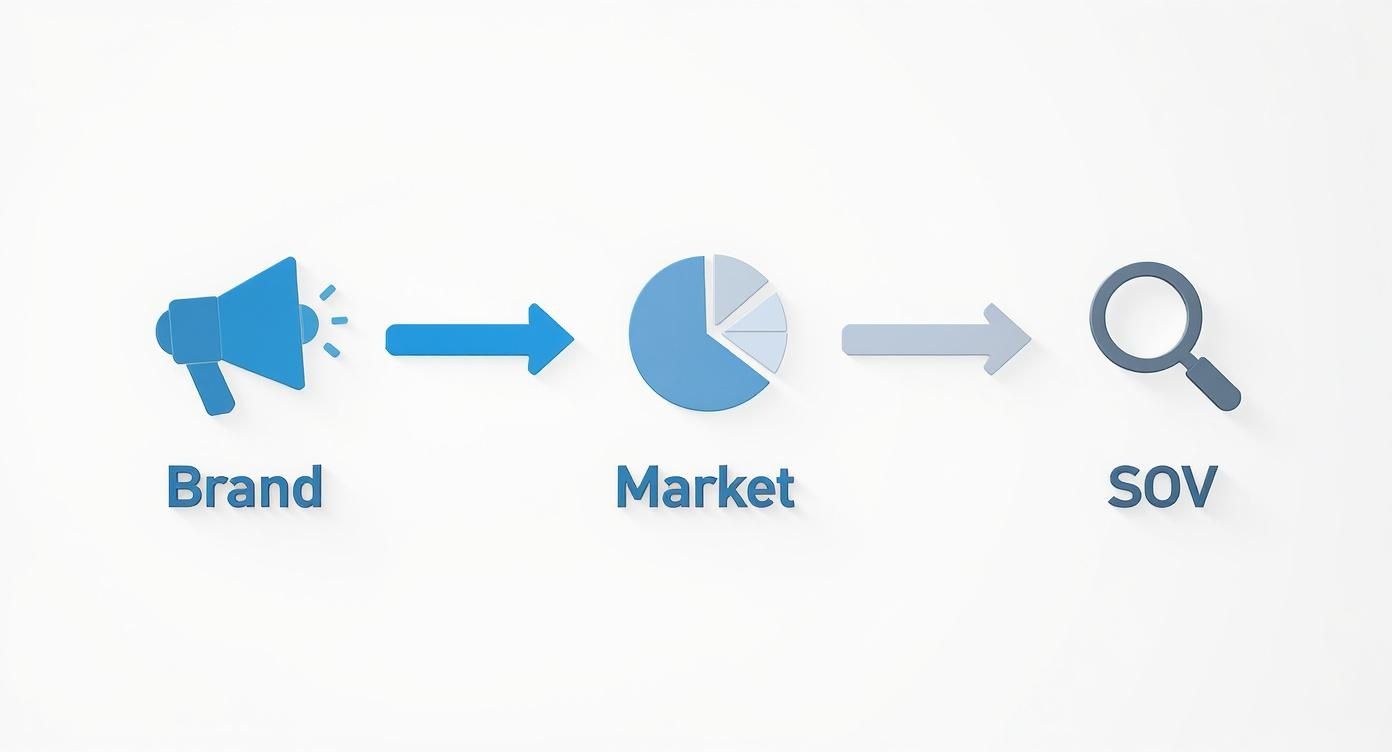
It visualizes the journey from your brand's voice (the megaphone) to the total market conversation (the pie chart), which is then analyzed to determine your specific share (the magnifying glass).
Picking Your Tools Without Breaking the Bank
Finally, let's talk about the gear you'll need. To get the data for your calculation, you'll need some tools. You’ve probably heard of the big players like Ahrefs or Semrush, which are incredibly powerful but can also be incredibly expensive, often costing hundreds of dollars every month.
For many, that's a tough pill to swallow.
While those tools are fantastic, they aren't your only option. For gathering essential keyword visibility and competitor data without emptying your wallet, a more accessible alternative like already.dev can give you the insights you need to get started. It’s built to deliver clear competitive intelligence quickly.
Now, with your competitors identified, your market defined, and your tools ready, you’re officially prepped to start calculating.
Calculate Your SOV in Organic Search
Alright, let's get our hands dirty with the channel that can truly make or break a brand: organic search.
When someone types a question into Google, you want to be the one with the answer. Your SEO Share of Voice tells you exactly how often that's happening for you versus everyone else you're up against.
Think of it like this: Is your store the one everyone’s flocking to on the busiest street online, or are they all piling into your competitor’s shop next door? This isn't just about stroking your ego by ranking #1 for your brand name; it's about owning the real conversations that actually lead people to buy something.
The Formula Isn't as Scary as It Looks
Let's break down how to actually calculate this stuff. The basic formula can look a little intimidating at first glance, but I promise it's simpler than it seems.
> Your SEO SOV = (Your Visibility Score / Total Market Visibility Score) x 100
Don't let the term "Visibility Score" throw you. It’s just a clever way of blending two key metrics: your search rankings and the monthly search volume for those keywords.
It just makes sense, right? Ranking #1 for a keyword with 10,000 searches a month is a way bigger deal than ranking #1 for a term only a handful of people search for. This combined score gives you a much more realistic picture of your actual presence.
A solid website competitive analysis depends on this—understanding not just if you rank, but how much that ranking is truly worth in potential eyeballs.
So, where does this data come from? You could try to piece it all together manually from Google Search Console and a separate keyword tool, but trust me, you’ll regret it. The big players like Ahrefs or Semrush are fantastic but their price tags can be a tough pill to swallow. A more focused tool like already.dev can get you the visibility data you need without the massive bill.
A Real-World Example: The Craft Brewery Showdown
Let's put this into practice. Imagine you run a local craft brewery, "Hop Revolution." You're duking it out with a huge national brand ("MegaBrew Inc.") and another popular local spot ("Artisan Ales").
First, you nail down your 5 most important, money-making keywords:
- 'craft beer near me' (5,000 monthly searches)
- 'local IPA' (2,000 monthly searches)
- 'best brewery downtown' (1,500 monthly searches)
- 'hazy IPA delivery' (800 monthly searches)
- 'brewery with patio' (500 monthly searches)
Using your SEO tool, you pull the current rankings and their estimated click-through rates (CTR) to figure out a visibility score. The higher you rank, the bigger slice of the click pie you get.
| Keyword | Search Volume | Hop Revolution (Rank/CTR) | MegaBrew Inc. (Rank/CTR) | Artisan Ales (Rank/CTR) | | :--- | :---: | :---: | :---: | :---: | | craft beer near me | 5,000 | #3 (12%) | #1 (28%) | #5 (6%) | | local IPA | 2,000 | #2 (15%) | #10 (2%) | #1 (28%) | | best brewery downtown | 1,500 | #1 (28%) | Not Ranked | #2 (15%) | | hazy IPA delivery | 800 | #4 (8%) | #2 (15%) | Not Ranked | | brewery with patio | 500 | #1 (28%) | #6 (4%) | #3 (12%) |
Now for the math. You calculate the visibility score for each brand by multiplying the search volume by the CTR for every keyword they rank for, then add it all up.
- Hop Revolution's Visibility: (5000*0.12) + (2000*0.15) + (1500*0.28) + (800*0.08) + (500*0.28) = 1,524
- MegaBrew's Visibility: (5000*0.28) + (2000*0.02) + (800*0.15) + (500*0.04) = 1,580
- Artisan Ales' Visibility: (5000*0.06) + (2000*0.28) + (1500*0.15) + (500*0.12) = 1,145
The Total Market Visibility Score is just the sum of all three: 1,524 + 1,580 + 1,145 = 4,249.
Finally, we plug those numbers back into our SOV formula:
- Hop Revolution SOV: (1,524 / 4,249) x 100 = 35.9%
- MegaBrew Inc. SOV: (1,580 / 4,249) x 100 = 37.2%
- Artisan Ales SOV: (1,145 / 4,249) x 100 = 26.9%
And just like that, you have a scoreboard. You're going toe-to-toe with the national giant and are pulling ahead of your local rival.
More importantly, you see exactly where the battle is being fought. You're owning high-intent local terms like 'best brewery downtown,' but MegaBrew is cleaning up on the massive 'craft beer near me' keyword.
As search evolves, keeping an eye on new features with a Google AI Overviews Visibility Tracker becomes even more critical to protecting this turf. This data isn't just a bunch of numbers; it's the blueprint for your next marketing move.
Own the Ad Space with Impression Share

When you're putting real money on the line for ads, "visibility" stops being a fuzzy marketing term and becomes the only thing that matters. If your ads aren't being seen, you’re basically just lighting your budget on fire. This is where Share of Voice for paid media comes in, and the good news is, it's a lot less complicated than its organic search counterpart.
You can forget about messy formulas and third-party data scraping. For platforms like Google Ads, there’s a built-in metric that does all the work for you: Impression Share.
Put simply, Impression Share tells you what percentage of the time your ad was actually shown compared to all the times it could have been shown. Google literally gives you this number on a platter. If your Impression Share is 30%, Google is politely telling you that you're missing out on 70% of your potential audience. Ouch.
Finding and Using Your Impression Share
Getting this data is the easy part. Just head into your Google Ads account, go to your campaigns, and modify your columns to add "Impression share" from the "Competitive metrics" section.
But the number itself isn't the prize. The real magic is using it to make smarter decisions that don’t always involve just throwing more money at the campaign.
> Think of Impression Share as your paid media scoreboard. A low score isn't just a sign to "spend more." It's a prompt to get smarter—refine your keywords, sharpen your ad copy, or get strategic with your bidding.
A low Impression Share should immediately make you ask a few key questions:
- Is our budget just too low? Sometimes, the answer really is that simple. If you're constantly being outbid, you might need to allocate more funds to compete.
- Is our ad quality terrible? Google rewards relevance. A low Ad Quality Score will sink your Impression Share, no matter how much you're willing to spend.
- Are our bids too timid? You could be bidding too low to win the most valuable auctions, especially during peak times for your industry.
A Real-World Scenario: The Course Creator vs. The Goliath
Let's picture an online course creator—we'll call her "Creative U"—trying to go up against a giant like MasterClass. Creative U can't possibly match their ad spend, so they have to out-think them.
They check their Google Ads dashboard and see their main campaign has a measly 15% Impression Share. Panic starts to set in. But instead of just cranking up the budget, they dig a little deeper.
They find two crucial things:
- For broad keywords like "online writing courses," their Impression Share is practically zero. MasterClass completely owns that space.
- But for a niche, long-tail keyword like "online course for fiction editing," their Impression Share is a much healthier 60%.
That's the lightbulb moment. Instead of burning cash in a battle they can't win, they can double down where they’re already strong. They can shift their budget to absolutely dominate that niche, rewrite their ad copy to speak directly to aspiring fiction editors, and become the big fish in a smaller, more profitable pond.
This is a much savvier move than just blindly upping the budget. While comprehensive tools like Semrush or Ahrefs offer deep dives into competitor ad strategies (for a pretty penny), you can get this core, actionable data right from the source. Of course, for a more holistic view of the competitive landscape beyond just ads, exploring a list of the best competitor analysis tools can round out your strategy.
Ultimately, Impression Share is the go-to method for calculating SOV in paid search. It's the percentage of potential impressions your ads receive compared to the total eligible impressions. For instance, if your ads show up in 40% of eligible searches for your target keywords, your SOV is 40%.
Research on top US retailers revealed that brands with an Impression Share above 50% saw a 25% jump in click-through rates. You can discover more insights about these findings on llmrefs.com. This proves that a higher SOV in paid media isn't just about being seen more often—it translates directly to better engagement.
Tracking Your Buzz in PR and Earned Media
We've talked about the digital turf you pay for and the organic search results you fight for. Now, let’s get into the buzz you earn. This is the world of Public Relations and earned media—when blogs, news sites, podcasts, and influencers are talking about you because they genuinely want to, not because there's a check involved.

Figuring out your Share of Voice here can feel a little like trying to catch smoke. How can you possibly track every single mention across the entire internet?
It’s not as messy as it sounds, I promise. The goal is pretty straightforward: count how many times you’re mentioned in relevant places compared to your competitors. This isn't just an ego boost; it's how you find out if your PR efforts are actually making a dent.
What Actually Counts as a Mention?
First things first, you need to decide what's even worth counting. A random tweet from an account with two followers doesn't carry the same weight as a feature in Forbes. Defining what a "quality mention" looks like is the most important first step.
As a rule of thumb, I always tell my clients to focus on mentions that come from:
- Reputable sources: These are the industry blogs, news outlets, and publications your target audience actually reads and trusts.
- Contextually relevant content: The mention should be part of an article or discussion that’s actually about your industry or the problems you solve.
- Positive or neutral sentiment: You absolutely have to track how people are talking about you. A glowing review is gold; a scathing takedown is something else entirely.
Tracking sentiment—the good, the bad, and the ugly—is non-negotiable. A high number of mentions means nothing if they're all from angry customers. It adds a crucial layer of context to your SOV numbers.
A Fintech Story: Putting It Into Practice
Let's imagine a scrappy fintech startup called "FinFast" that just launched a new budgeting app. Their main competitor is an established player, "MoneyMogul." FinFast's big launch included a massive PR push to get their name into top-tier tech publications.
To see if their push actually worked, they decided to track their earned media SOV for the quarter. They identified their target publications (think major tech news sites, popular personal finance blogs) and started counting.
Here’s a simplified look at what they found.
PR Share of Voice Calculation Example (Q1)
| Brand | Number of Media Mentions | Percentage of Total Mentions (SOV) | | :--- | :---: | :---: | | FinFast (You) | 210 | 42% | | MoneyMogul | 290 | 58% | | Total Mentions | 500 | 100% |
Even as the new kid on the block, the data shows FinFast captured a whopping 42% of the conversation. MoneyMogul still has the lead, but FinFast’s campaign clearly cut through the noise. This is the kind of data that proves to the board that their strategy is working.
In public relations, your SOV is calculated by dividing your earned media coverage by the total coverage for all competitors in your space. One recent analysis of global PR campaigns showed that brands with a higher SOV in earned media saw a 30% increase in brand recall and a 20% boost in customer trust. If you're a data nerd, you can explore the full PR metrics study on prowly.com.
Tools That Do the Dirty Work for You
Let’s be real: manually Googling your brand and your competitors every day is a one-way ticket to burnout. Thankfully, there are tools that can do all this for you.
> Automating your PR and media monitoring is a game-changer. It frees you from the endless grind of searching for mentions and lets you focus on what the data actually means for your strategy.
Platforms like Meltwater or Brandwatch are the heavyweights in this arena, offering deep analytics, sentiment analysis, and real-time alerts. They can be pretty pricey, though, which is often a barrier for smaller teams. For a more accessible way to keep an eye on brand chatter and competitor moves, already.dev can help you monitor the conversation without the enterprise-level price tag.
By tracking your earned media, you get a clear, unfiltered view of how the world really sees your brand. It’s the ultimate reality check for whether your story is truly hitting home.
Common SOV Traps and How to Dodge Them
Calculating Share of Voice can feel like a marketing superpower, but even superheroes have their kryptonite. Diving into the numbers without knowing the common pitfalls is like trying to assemble IKEA furniture in the dark—it’s frustrating, and you’ll probably end up with something that looks nothing like the picture.
Let's walk through the most common traps I've seen people fall into and, more importantly, how you can sidestep them.
The Vanity Metrics Mirage
First up, the classic blunder: chasing pure vanity metrics. Simply counting every single brand mention you can find is a rookie move. It feels good, but it doesn't mean much.
Think about it: a thoughtful mention in a high-authority publication that your customers actually read is worth a thousand random tweets from bot accounts. They're not even in the same league.
- Don't: Treat all mentions as equal.
- Do: Zero in on quality mentions from relevant sources. Learn to tell the difference between a feature in a major industry blog and a fleeting comment on an obscure forum.
Picking the Wrong Enemies
I see this one all the time. You end up choosing the wrong competitors to measure yourself against. If you're a neighborhood coffee shop, comparing your SOV to Starbucks is going to give you data that’s completely useless and, let's be honest, a little depressing.
Your Share of Voice is only as good as the competitive set you define.
- Don't: Compare your brand to global giants unless you’re genuinely in their weight class.
- Do: Handpick 3-5 direct competitors. These are the brands actually fighting you for the same customers and the same keywords. This keeps your data sharp, relevant, and actionable.
The Inconsistency Quicksand
This one’s a silent killer for SOV tracking. One month you track keywords in Ahrefs, the next you’re using Semrush, and the month after you're just eyeballing results in Google. While these are fantastic tools, they can be pricey, and switching between them constantly will completely wreck your data's integrity.
You simply can’t track progress if the goalposts keep moving every time you pull a report.
- Don't: Hop between different tools and methodologies.
- Do: Choose a consistent set of tools and metrics and stick with them. If you’re looking for a powerful and more accessible alternative to the big (and expensive) names, a tool like already.dev can give you the consistency you need without eating up your entire budget.
> The biggest mistake you can make with Share of Voice is treating the number as the finish line. It’s not. The number is just the starting gun that tells you where to run next.
Forgetting the "So What?" Factor
This might be the most dangerous trap of all: getting a number and doing absolutely nothing with it. A 22% SOV is just a statistic on a slide. It’s utterly pointless unless it answers the "so what?" question.
What does that 22% really tell you about your SEO strategy? Your ad spend? The impact of your latest PR campaign?
- Don't: Just report the number and move on to the next task.
- Do: Use the data to ask tough questions and make smarter marketing decisions. A low SOV isn't a sign of failure; it's a roadmap showing you exactly where you need to focus your efforts next.
Lingering Questions About Share of Voice
Once you start getting your hands dirty with Share of Voice calculations, a few common questions always seem to pop up. Let's run through some of the big ones.
How Often Should I Be Running These Numbers?
For most brands, hitting this quarterly is the perfect cadence. This gives you enough time to see real trends take shape without getting bogged down by the daily noise.
That said, if you’re in the middle of a major campaign—like a huge product launch or a Black Friday blitz—you’ll want to check in more often. For paid and social channels, looking at your SOV weekly or even daily during these intense periods can tell you if your efforts are actually moving the needle.
Is It a Good Idea to Mash Everything into One Big SOV Score?
I get the appeal, but honestly, it’s a bad idea. While a single "blended" SOV score seems neat and tidy, it usually masks more than it reveals. Think about it: a 15% SOV in organic search is a massive achievement, while 15% on social media might be a sign you’re getting crushed.
> Keeping your SOV metrics separate for each channel is far more powerful. It gives you a clear picture of where you're strong and, more importantly, where you need to focus your efforts.
Okay, I Ran the Numbers and My SOV Is... Awful. Now What?
First off, take a breath. A low SOV isn't a failure—it's just your starting point. Now you have a benchmark.
Instead of trying to fight everywhere at once, get specific. Where are you the weakest, but see the most potential? Maybe a competitor is ranking for a bunch of long-tail keywords you could realistically steal. Or perhaps they’re all over TikTok, but completely ignoring a niche LinkedIn community where your ideal customers gather.
Find one area where you can make a real impact and go all-in. It’s always better to own one small piece of the market than to be invisible across the entire thing.
Ready to stop guessing and start knowing where you really stand? Already.dev uses AI to uncover your true competitors and map out the entire market landscape in minutes, giving you the data-driven confidence you need. Find your real competitors today.