How to Find Competitor Websites Without Losing Your Mind
Tired of guessing who you're really up against? Learn how to find competitor websites with simple methods that actually work. No fluff, just results.

Finding your competitor's websites is way easier than you think. It starts with a few smart Google searches using your main keywords. The real trick is to look past the usual suspects and use a few search tricks to find the rivals who are really stealing your lunch money. This simple shift turns a dumb search into a powerful spy mission.
Your Competitors Are Hiding in Plain Sight
Ever feel like you’re competing against ghosts? You know they’re out there, but you can’t quite put a name to the website. The good news is, finding who you’re really up against isn't about expensive spy tools—it’s about knowing where to look and how to look.
Most people hear "competitor" and immediately picture the giants in their industry. But the battlefield is much wider than that. You’re not just fighting the Goliaths; you're also up against:
- Direct Competitors: The obvious ones. They sell the same thing to the same people. If you sell project management software, so do they. Yawn.
- Indirect Competitors: The sneaky ones. They solve the same problem with a totally different solution. If you sell project management software, they might sell fancy spreadsheets or even productivity coaching services.
Your Best Free Tool? Google. Obviously.
The most powerful weapon in your arsenal is the one you use every day: Google. It's the ultimate source of truth for who's getting in front of your potential customers.
Think about it—if someone is looking for a solution like yours, their journey almost certainly begins with a Google search. So the clowns showing up on page one are your direct competition.
The whole process is pretty straightforward. You figure out what you're looking for, use Google to gather the raw data, and then analyze the results to build your hit list.
Turning a Simple Search Into an Investigation
Don't just type your product name into the search bar. That's amateur hour. You need to think like your customers and use a few tricks to turn that search into a laser-focused investigation. This is your digital detective kit for uncovering the competition that's been flying under your radar.
> The first page of Google is the most valuable real estate on the internet. The companies that own it for your key search terms are, by definition, your top digital competitors.
Every query you run reveals Google's prioritized list of who its algorithm thinks is most relevant to your audience. To do this better, use a few search operator tricks to narrow the field.
Quick Google Tricks for Finding Competitors
Here are a few of my favorite search operator combos to quickly pinpoint competitors you might otherwise miss.
| Search Operator Trick | What It Uncovers | Real-World Example |
| :--- | :--- | :--- |
| "keyword" + "alternative" | Finds pages where people are explicitly looking for substitutes for a known product or service. | "Salesforce alternative" |
| related:[competitor.com] | Shows websites Google considers similar to a known competitor's site. A goldmine. | related:asana.com |
| "keyword" + inurl:blog | Uncovers competitors who are winning with content marketing and thought leadership in your niche. | "email marketing tips" inurl:blog |
These simple commands are a great starting point.
For a more automated approach, check out this practical guide on how to scrape Google Search results, which can show you how to pull this data at scale. This lets you quickly see who consistently shows up for your most important keywords, turning your guesswork into a data-backed understanding of your competitive world.
Using SEO Tools Without Breaking the Bank
Alright, your Google deep-dive has probably given you a decent starting list. But now it’s time to bring in the big guns—without, you know, having to sell a kidney to pay for them. SEO platforms are basically cheat codes for competitor discovery, doing the heavy lifting to uncover rivals you’d never find on your own.
They sift through mountains of search data to see who’s ranking for the keywords that your customers are typing into Google. Think of them as your personal digital spies, reporting back with a detailed list of everyone trying to poach your audience.

The Powerhouse Platforms (and Their Price Tags)
When you talk about SEO tools, two names pretty much own the conversation: Ahrefs and Semrush. These platforms are the industry gold standard for a reason—they are unbelievably powerful. You can find out just about anything you’d ever want to know about a competitor's online game plan.
But all that power comes with a hefty price tag. Plans for these tools can be super expensive, which can be a tough pill to swallow if you're a startup or running on a tight budget. They’re fantastic, but not always practical for everyone.
The good news? You don't need a sledgehammer to crack a nut. For the core job of just identifying competitors, there are much more focused and accessible options. Platforms like already.dev are built to deliver the crucial competitive data you need, minus the overwhelming feature set and painful subscription fee.
Finding Competitors with a Keyword Gap Analysis
One of the slickest features inside these tools is the Keyword Gap (or Content Gap) analysis. It sounds super technical, but the concept is brilliantly simple: you plug in your website and a competitor’s, and the tool spits out a list of all the valuable keywords they rank for that you don't.
Let's say your competitor is a coffee shop called "The Daily Grind," and you run "Espresso Yourself."
- A gap analysis might show they rank for "best pour-over coffee near me," a term you totally overlooked.
- You could discover they pull in tons of traffic from "quiet cafes to work from," revealing a whole new customer profile.
- Just like that, you have a data-backed roadmap of content to create and keywords to target.
This isn't just about finding random keywords; it’s about finding competitors who are having conversations with your audience that you're not even a part of yet. Every "gap" highlights a blind spot in your strategy that a competitor is happily taking advantage of.
Uncovering Hidden Rivals Through Backlink Analysis
Here’s another sneaky-smart tactic for finding competitors: see who’s linking to them. A backlink is just a link from one website to another. To Google, these links are like votes of confidence or letters of recommendation.
If a major industry blog, a popular influencer, or a trusted news site links to a website, that's a massive signal that the site is a serious player.
> By looking at a known competitor's backlinks, you can uncover a whole network of other relevant sites in your space. If a top "Best SaaS Tools of 2024" article links to your main rival, you can bet it also links to three or four of your other competitors, too.
It’s like checking out your rival’s friend list to see who else runs in their circles. This is often how you find the up-and-comers—the ones who haven't hit page one of Google yet but are busy building real authority behind the scenes.
And of course, if you want to dive in without opening your wallet, you might want to check out our guide on the best free competitor analysis tools available right now.
Putting It All Together
Tools like Ahrefs and Semrush are the heavyweights, and they can be amazing if you've got the cash. But for a more focused and affordable approach, you should check out already.dev.
Ultimately, using these tools isn't about getting lost in spreadsheets. It’s about being strategic. Pick one known competitor, find the keywords they own, see who links to them, and you’ll quickly build a highly accurate, targeted list of your true digital rivals.
Playing Traffic Detective on a Budget
Let's be real: ranking on Google is a massive win, but it’s not the whole story. You can know every keyword a competitor ranks for, but that doesn't tell you where their actual customers are coming from. Time to put on your detective hat and follow the digital breadcrumbs.
This is where traffic analysis tools change the game. They give you a backstage pass to any website's performance, showing you not just how many visitors they get, but how they get them. Are they crushing it on social? Is there a secret referral partner sending them a firehose of leads? This is how you find out.
The Not-So-Secret Weapon: SimilarWeb
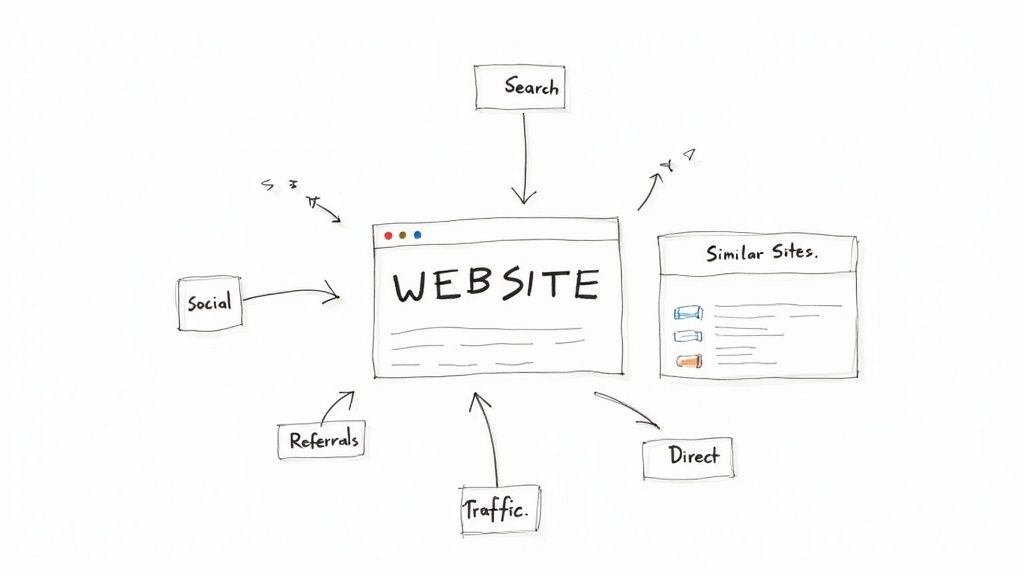
One of the go-to tools for this kind of sleuthing is SimilarWeb. Think of it as a powerful set of binoculars for peeking into anyone's web traffic. Just pop in a URL, and you'll get a surprisingly accurate estimate of their total visitors and where those people are coming from—whether it's organic search, social media, direct visits, or referrals from other sites.
Here's the official logo, so you know what to look for.
But the real magic for our purposes? The "Similar Sites" feature. This thing is pure gold. You can plug in your own site or a known competitor, and its algorithm will spit out a list of other websites it considers related. This is often how I stumble upon those under-the-radar players and niche competitors that bigger SEO tools sometimes miss entirely.
Look Beyond the Raw Traffic Numbers
Getting a list of sites is a great first step, but you need to know if they're a genuine threat. This is where engagement metrics come in, and they tell a much deeper story.
Keep an eye on these data points:
- Bounce Rate: What percentage of people bail after seeing just one page? A super high bounce rate might mean their traffic isn't a great fit for what they offer.
- Pages per Visit: How many pages does the average visitor click through? More pages usually signal higher engagement and genuine interest.
- Average Visit Duration: Are people sticking around for 30 seconds or 5 minutes? The longer, the better—it tells you the content is actually connecting with them.
These numbers help you separate the contenders from the pretenders. A site with a million visitors but a 90% bounce rate is probably less of a threat than one with 100,000 visitors who stick around to read four or five pages. This context is absolutely critical when you perform a complete website competitive analysis and try to understand the full picture.
> This kind of analysis helps you move beyond just chasing keywords. You start building a more realistic map of your competitive world, understanding who is truly capturing your audience's attention, not just their search queries.
While the free version of SimilarWeb is fantastic, the more advanced features can get expensive fast. For a more budget-friendly and AI-powered way to uncover competitors using traffic signals and other data, a platform like already.dev can automate this whole discovery process for you. For other options, it's worth checking out the top competitor analysis tools available from Storychief.
Finding Competitors in Their Natural Habitat
Data from tools is great, but it only tells part of the story. The real, sometimes messy, truth is that your competitors are active in the same online spaces your customers are. It's time to roll up your sleeves and find them "in the wild."
This isn't about running another complex report. It’s about listening. By tuning into the unfiltered conversations people are having about the problems you solve, you'll uncover a completely different class of competitors, from scrappy up-and-comers to established names that just weren't on your radar.
Social Media Stakeouts
Think of platforms like LinkedIn, X (formerly Twitter), and niche Facebook groups as the digital water coolers for your industry. This is where your ideal customers vent, ask for help, and share what’s working for them. And you can bet your competitors are right there in the mix.
Start by digging into relevant hashtags. If you sell accounting software for freelancers, you should be living in conversations tagged with #freelancelife, #bookkeeping, or #solopreneur. Look for the tools and services that pop up again and again when someone asks for a recommendation. It’s a goldmine.
Another pro move is to follow the key influencers in your space. Who are the big voices everyone listens to? See which companies they partner with, what products they’re reviewing, and who they casually mention. These people are tastemakers, and their endorsements are a shortcut to finding the players with real clout.
Lurking in Forums and Q&A Sites
If social media is the water cooler, then forums like Reddit and Quora are the late-night brainstorming sessions. This is where people go for brutally honest advice, often sharing what they really think, thanks to a bit of anonymity.
These sites are absolute treasure troves for discovering competitors that solve hyper-specific problems. Niche subreddits (like r/smallbusiness or r/SaaS) are filled with threads like, "What's the best tool for X?" or "Has anyone found a good alternative to Y?"
> The answers in these threads are a direct pipeline into the minds of your potential customers. They'll tell you not only who the competitors are but why people choose them—or why they hate them. This is priceless qualitative data you can't get from a spreadsheet.
Searching for threads where people complain about the problems your business solves will reveal a host of solutions you never even considered. You’ll see everything from simple spreadsheet templates to complex enterprise software recommended right next to each other.
How to Systematically Track Community Mentions
Diving into these rabbit holes is insightful, but you need a simple system to keep track of what you find. A basic spreadsheet is perfect for this.
To get a clearer picture of where to look, think of these platforms as different discovery hotspots.
Community Discovery Hotspots
| Platform | What to Look For | Pro Tip | | :--- | :--- | :--- | | LinkedIn/X | Hashtag searches around a core problem. Follow industry influencers to see who they mention. | Set up keyword alerts for your product category. You’ll get notified of new conversations automatically. | | Reddit/Quora | Search for "alternative to [known competitor]" or "[your service] recommendations." | Pay close attention to upvoted or "best" answers. They signal which solutions have the most social proof. | | Facebook Groups | Join groups where your target audience hangs out. Look for recommendation threads. | Don't just lurk—engage. Answering questions builds your authority and gives you a better feel for the community's needs. |
This hands-on approach adds a much-needed human layer to your competitive analysis. While powerful (and expensive) SEO platforms like Ahrefs or Semrush give you the "what," this manual digging gives you the crucial "why." If you want a more focused tool, check out already.dev.
You won't just know who your competitors are; you'll understand how they're actually perceived by real people.
Peeking Under the Hood: Finding Rivals Through Tech and Marketplaces
Alright, let's get a little more tactical. Sometimes, the fastest way to find a competitor's website isn't by looking at keywords, but by looking at their code and where they do business. You can uncover a surprising number of rivals by peeking under the hood of their website or seeing where they’ve set up shop online.
Think of these methods as finding a secret back entrance to your competitor’s strategy session. They’re powerful, often overlooked, and can reveal players that traditional SEO and traffic analysis might miss entirely.
Follow the Technology Fingerprints
Ever stumbled upon a slick website and wondered what software they're using to run it? There are tools for that, and they're goldmines for competitor discovery. A service like BuiltWith can scan any URL and instantly show you its entire technology stack—from the e-commerce platform it’s built on to the email marketing service it uses to send newsletters.
So, why is this so useful? Because technology choices are like digital fingerprints. If you’re a Shopify store that uses Klaviyo for email and Gorgias for customer support, finding another site with that exact same tech combo is a massive clue. They probably aren’t selling antique teacups; they're likely another e-commerce brand operating in a similar way to you.
This technique is especially brilliant for finding digitally savvy rivals.
- Spot shared platforms: Are you built on Webflow? Look for other top-tier Webflow sites in your space.
- Identify specialized tools: Do you use a niche analytics tool like Mixpanel? Seeing who else uses it can point you directly to other product-led companies.
It’s a simple but incredibly effective way to find businesses that not only sell what you sell but also think how you think when it comes to their online operations.
> Think of a website's tech stack as its DNA. By comparing that DNA to your own, you can quickly identify close relatives in the market—the ones who are solving similar problems with a similar toolkit.
Beyond just finding them, you can also keep an eye on how their sites evolve. For instance, you can automate web captures for visual tracking by exploring resources like Mastering the Screenshot API: A Quick Guide to Visual Testing.
Scour Digital Marketplaces and App Stores
If you sell a digital product or service, your competitors are almost certainly hanging out in plain sight on marketplaces and app stores. This isn't just a good idea; it’s an absolute must-do. These platforms are curated ecosystems where your ideal customers are actively shopping for solutions.
For a SaaS company, this means diving headfirst into places like:
- The Shopify App Store
- The Salesforce AppExchange
- The Chrome Web Store
- Atlassian Marketplace
Don't just plug in your main keyword and call it a day. Get creative. Use the category filters to see who’s listed alongside you. And definitely pay close attention to the "similar apps" or "customers also installed" sections—these are algorithmic goldmines for finding direct competition.
This isn’t just for SaaS, either. If you’re a creative professional, marketplaces like Etsy, Envato, or Behance are your true battlegrounds. If you're an author, the Amazon Kindle store is your competitive landscape.
The key is to put yourself in your customer’s shoes on that specific platform. What categories would they browse? What search terms would they use? The companies that pop up are the ones you’re fighting against for that audience’s attention and money.
While the big, pricey SEO tools like Ahrefs or Semrush are fantastic for broad analysis, they can sometimes miss these niche platform players. For a more focused and automated approach to this kind of tech-stack and marketplace discovery, a tool like already.dev can be a great alternative, digging into these specific sources to build your competitor list for you.
Turning Your Competitor List into a Real Strategy
Okay, deep breath. You’ve put on your detective hat, done the legwork, and now you're staring at a massive, probably messy, list of potential competitors. That's a great start. But let's be real—a list is just a list until you do something with it. A spreadsheet with 100 names is just 100 ways to feel overwhelmed.
This is the part where we turn that raw data into an actual, actionable strategy. The goal isn't to track every single move of every company you found. Honestly, that’s a one-way ticket to burnout. Instead, it’s about figuring out who really matters and focusing your energy where it counts.
Your new best friend for this task? A simple spreadsheet. Seriously, no need for fancy software just yet. A Google Sheet or Excel file is perfect for organizing your findings and creating a competitive map you can actually use.
Organizing Your Intel
For each competitor you’ve identified, you'll want to track a few key data points. The trick is to keep it simple. You're not writing a PhD thesis on them; you just need the highlights to make smart decisions.
Start by creating these columns in your spreadsheet:
- Competitor Name & Website: Just the basics.
- Key Products/Services: What do they actually sell? Be specific here.
- Primary Marketing Channels: Where do they seem to be most active? Think SEO, social media, PPC, etc.
- Notes: This is a catch-all for your gut feelings, interesting pricing models, or a killer feature you noticed that made you say, "huh."
This simple structure immediately turns your chaotic list into an organized dashboard. Suddenly, you have an at-a-glance view of the entire market.
Prioritizing Who to Watch
Now for the most important part. Not all competitors are created equal, and trying to monitor everyone is a fool's errand. You need to sort them into buckets so you know who deserves your daily attention and who just needs a casual check-in now and then.
> A common mistake is treating every competitor as a five-alarm fire. In reality, you probably have 2-3 who are a real threat, a dozen who are on the radar, and a bunch who are just background noise. Your job is to tell them apart.
We can use a simple framework to sort this out. Breaking down your findings is a core part of building a solid competition analysis framework that you can rely on for the long haul.
Here’s a practical way to group them:
- Tier 1: The Heavyweights. These are your direct rivals. They target the exact same customers with a very similar product. You should be watching these folks daily or, at the very least, weekly.
- Tier 2: The Contenders. They might offer a slightly different product or target a different segment of your audience, but there's significant overlap. Keep an eye on them—maybe check in monthly.
- Tier 3: The Up-and-Comers. These are the new kids on the block. They might not be a threat today, but they could be a huge problem in a year. A quarterly check-in is usually enough for this group.
This simple act of prioritizing transforms your list from a source of anxiety into a powerful strategic tool. You’ll know exactly where to focus, ensuring you spend your time reacting to real market shifts, not just chasing ghosts.
Finding and categorizing competitors is a huge step, but it can be incredibly time-consuming. If you'd rather spend less time digging and more time building, Already.dev uses AI to automate this entire process—from discovery to analysis—delivering a comprehensive competitive map in minutes, not weeks. Check it out at https://already.dev.