How to Find Competitors Websites (Without Losing Your Mind)
Tired of guessing? Learn how to find competitors websites with simple, clever tricks. Ditch the boring stuff and find who you're really up against.
Stop guessing. The fastest way to find your competitors' websites is to master a few clever Google searches. Using special commands called search operators, you can instantly uncover websites targeting your exact audience and keywords, giving you a clear picture of who you're really up against.
Stop Guessing and Start Finding Your Real Competitors
Let's be real. You probably have a mental list of the two or three competitors you always bring up in meetings. They're the big names, the ones you see everywhere. But what if the companies quietly eating your lunch aren't even on that list?
The internet is a massive, chaotic place. Your true rivals might be startups you've never heard of or established players from a neighboring industry dipping their toes in your pond.
Finding them isn’t about aimlessly scrolling through search results. It’s about being a digital detective and knowing which clues to follow. Your first mission is to stop thinking like a business owner and start thinking like your customer.
What words would they type into Google to fix the problem you solve? Forget your branded jargon; it’s all about their real-world pain points. This is the foundation for everything that follows and a core part of building what's known as competitive intelligence.
The Different Flavors of Competitors
Before you start digging, you need to know that not all competitors are created equal. Lumping them all into one big list is a recipe for confusion. You need to know who to watch, who to learn from, and who to safely ignore for now.
They generally fall into three buckets:
-
Direct Competitors: These are the obvious ones. They offer the same product or service to the same audience. If you sell project management software for small businesses, another company doing the exact same thing is your direct competitor. It's a straight-up cage match.
-
Indirect Competitors: This is where things get interesting. These companies solve the same problem but with a totally different solution. For our project management software example, an indirect competitor could be a simple spreadsheet template, a shared calendar, or even a company that sells physical whiteboards. They're all competing for the same "get organized" budget.
-
Aspirational (or Tertiary) Competitors: These are the titans of a related industry that you admire but don't directly compete with (at least, not yet). Think of a huge brand known for amazing customer service or incredible marketing. You can learn from their strategies without worrying about them stealing your customers tomorrow.
> By categorizing your competitors from the get-go, you can focus your energy where it matters most: on the direct and indirect players who are actively vying for your customers' attention and money.
Understanding these distinctions turns a messy, overwhelming list into a clear strategic map. It helps you prioritize your research and decide who poses an immediate threat versus who just offers a learning opportunity.
Now that you know who you’re looking for, it's time to actually find them.
Your First Five-Minute Competitor Hunt
Let's get some quick wins. These Google search "recipes" are my go-to for a fast first look at the competitive space. Just swap in your own keywords and see who pops up.
| Search Recipe | What It Finds | Example |
| :--- | :--- | :--- |
| "your primary keyword" alternatives | Finds lists and articles comparing different solutions in your niche. | "project management software" alternatives |
| related:competitor.com | Shows websites Google sees as similar to a known competitor. | related:asana.com |
| intitle:"top 10" "your industry" | Uncovers "best of" listicles ranking players in your space. | intitle:"top 10" "saas tools for startups" |
This simple exercise can often reveal 80% of your most active competitors in under five minutes. It's a powerful start before you dive into more advanced techniques.
Uncovering Competitors in Places You Never Thought to Look

So you've nailed the fancy Google searches. Awesome. But let's be real—the sneakiest competitors, the ones who could really eat your lunch, aren't always waving a flag on page one of Google.
They're hiding in plain sight, leaving breadcrumbs all over the web. You just have to know where to look. This is where you swap your marketer hat for a detective's trench coat. Your rivals are already talking to your future customers; you just need to find those digital hangouts.
Dig Where Your Customers Live
For a minute, stop thinking about your business and start thinking like a member of your industry's community. Every niche has its own digital watering holes where professionals, hobbyists, and potential buyers gather. This is your treasure map.
If you're launching a new SaaS tool, for instance, your competitors are practically shouting from the rooftops on software review sites. These platforms are absolute gold because customers leave brutally honest reviews, giving you a direct pipeline into what your rivals do well and—even better—where they're dropping the ball.
So, where do you start digging?
- For SaaS & Software: Dive deep into platforms like G2, Capterra, and Product Hunt. Just search for your product category and see who pops up. Don't forget to check out the "Alternatives to" sections; they literally do half the work for you.
- For Ecommerce & Physical Products: Your battlefield is the major marketplaces. Search for your product type on Amazon, Etsy, or the Shopify App Store—whatever platform is dominant in your space. Who are the top sellers? Who's drowning in five-star reviews?
- For Mobile Apps: The Apple App Store and Google Play Store are ground zero. A quick search for your app's main function will instantly show you who you're fighting for screen real estate.
These sites aren't just static lists; they're living, breathing ecosystems. Seeing who ranks high and figuring out why is a huge part of understanding not just who your competitors are, but what their entire market strategy looks like.
> Think of it this way: your competitors are already paying to acquire customers on these platforms. By snooping around, you get to learn from their marketing spend for free. It’s like getting a free lesson in what works (and what doesn't) in your specific market.
The Unconventional Hunting Grounds
Alright, now for the really fun part. The best intel often comes from places most people never think to check. We’re talking about the internet's back alleys and community forums where the real conversations are happening.
These spots are way less polished, but that's what makes them so revealing.
Industry Forums and Reddit Communities
Go find the subreddits where your target audience complains. I'm serious. Search for threads with titles like, "Anyone know a tool that does X?" or "I'm so frustrated with [Competitor Brand]."
The replies will be a goldmine—a laundry list of every solution people have tried. You won't just find direct competitors; you'll get a masterclass on the exact pain points that push customers to seek out alternatives in the first place.
Job Listings Are a Crystal Ball
This is one of my favorite under-the-radar tricks. Head over to LinkedIn or other job boards and search for roles related to your product or industry.
A company hiring a "Senior Product Manager for our new AI-powered chatbot" just handed you their product roadmap for the next 12 months on a silver platter. It's a powerful, forward-looking way to not only find competitors but also see their next move before they make it. It tells you exactly where they're investing their money and what they believe the future holds.
Using SEO Tools Without Breaking the Bank
Manual sleuthing is a solid start, but let's be real—it's a grind. When you’re ready to bring in some firepower to automate your search for competitor websites, SEO tools are your new best friend. They can tear through mountains of data in minutes, showing you exactly who you’re fighting for the same eyeballs online.
You’ve probably heard of the big players like Ahrefs and Semrush. These platforms are incredible; they're like having a super-powered spy drone for the internet. The catch? They can be wildly expensive, often running hundreds of dollars a month, which is a tough pill to swallow if you're a startup or a smaller business.
But don’t worry, you don’t need to remortgage your house to get these insights.
Finding Your True Keyword Competitors
The most powerful thing these tools do is uncover your keyword competitors. This is a total game-changer. It’s not about who you think your competitors are; it’s about who Google thinks they are.
A keyword competitor is any website that ranks for the same search terms you’re trying to own. If you sell "organic dog food," anyone else showing up on the first page for that phrase is a keyword competitor—even if it's just a popular blog and not another e-commerce store.
Why does this matter so much? Because these are the sites you’re directly battling for customer attention in the search results. Finding them is the first step to outranking them.
Big, expensive tools like Ahrefs or Semrush make this dead simple. You pop in your domain, and they spit out a "Competing Domains" report. It’s a beautiful, clean list of websites that share a high percentage of keywords with you. Honestly, it's the fastest way to get a data-backed list of rivals.
How to Find Competitors on a Lean Budget
So, what if the fancy, expensive tools are out of reach? You can actually get a shocking amount of the same data without emptying your wallet. This is where you get scrappy and smart.
A fantastic alternative is already.dev, which is built to automate this kind of deep research without the enterprise-level cost. It goes beyond just keywords to find direct, indirect, and even failed competitors, giving you a much richer picture of the market.
Besides specialized platforms, you can also piece together a solid strategy with more accessible options. For a great rundown of no-cost options, check out our guide on the best free competitor analysis tools. It’s packed with ways to get started right away.
Here are a few ways to replicate that "keyword competitor" discovery process yourself:
- Google Keyword Planner: It's free with a Google account. You can plug in a competitor's URL and see the keywords they rank for. It’s not as slick as the paid tools, but it absolutely gets the job done.
- Free Backlink Checkers: Many SEO companies offer free versions of their backlink tools. By seeing who links to your known competitors, you can often stumble upon other players in your space you hadn't even considered.
- SERP Analysis: It's old-school but effective. Simply Google your top 5-10 most important keywords. Systematically note down every single domain that appears on the first page. It's time-consuming, but it costs nothing.
> The goal isn't just to find a list of names. It’s to understand the digital battlefield. Who is consistently showing up? Who is dominating the most valuable keywords? That's the intel you can actually use.
Turning a Flood of Data Into an Actionable List
Once you start using these tools, you’ll get a flood of domains. Don't get overwhelmed. Your mission is to sift through the noise and pinpoint the real threats. In my experience, most businesses initially identify between 5-15 direct competitors. After some filtering, this list usually shrinks down to 2-8 core competitors who truly matter.
Here’s a scary stat: 82% of marketers find that their top 3 competitors control a massive 35-45% of their target market’s organic search traffic. This really drives home how critical it is to identify those key players accurately. You can dig into more competitor research findings like this from The CMO.
Here’s a simple process to refine your list:
- The Quick Scan: Visit each website. Do they sell something similar? Are they talking to the same audience? If it’s a clear "no," cross them off.
- Check Their Authority: Use a free domain authority checker. Are they a massive, untouchable brand or a smaller site you can realistically go up against?
- Look at Their Content Game: Do they have a blog? Are they actively publishing content around your core topics? This shows they’re serious about SEO.
By the end of this, you’ll have a focused, high-quality list of competitor websites you found with data, not just guesswork. This list is the foundation for every strategic decision you make next, from your content plan to your product roadmap.
Spying on Their Ads and Social Media Game
Alright, let's get into the fun stuff—a little corporate espionage. If you really want to know what makes a competitor tick, you need to see where they're spending their money. Their ads are a direct pipeline into their marketing brain, showing you exactly what they’re pushing, what messaging they think resonates, and who they’re trying to reach.
This isn't just about finding another competitor's website. It’s about reverse-engineering their entire sales funnel, from that first ad impression all the way to the checkout page. Forget guesswork. You can literally see the ads your rivals are running right now, and the best tools are completely free.
The Ad Library Is Your Secret Weapon
One of the best-kept secrets in competitive research is the Meta (Facebook) Ad Library. It's a free, fully searchable database of every single ad running on Facebook and Instagram. I'm not kidding. You can see their exact ad creative, the copy they’re testing, and even the landing pages where they're sending traffic.
It’s like someone handed you their marketing playbook. Are they A/B testing two different headlines? You'll see both. Targeting a specific demographic with a unique offer? It’s all out in the open.
Here's a quick look at what you’d find if you searched for a company like Asana.
You can instantly see the different formats they're testing—from simple images to slick video testimonials—which gives you a pretty clear picture of where their marketing focus is at the moment.
The Google Ads Transparency Center offers a similar peek behind the curtain. While it's a bit less visual than Meta's library, it's just as powerful for seeing who's bidding on your core keywords and what their primary message is.
Decode Their Social Media Strategy
Paid ads are just one piece of the puzzle. A competitor's organic social media presence is a goldmine of strategic clues, but you have to know what to look for. Don't just glance at their follower count and move on.
Analyzing their social channels shows you what they believe is most important to their brand and their customers. Are they constantly posting about a new feature on LinkedIn? That’s probably their big focus for the quarter. Running a huge giveaway on Instagram? They're likely in a big push for brand awareness.
> A competitor's social feed isn't just a collection of posts; it's a public declaration of their business priorities. If you learn to read between the lines, they’ll tell you everything you need to know about their next move.
When you're doing these deep dives, you'll often need to gather a lot of data. It's worth learning more about how to use Proxies for Web Scraping Data to make the process smoother and avoid getting blocked.
What to Look for on Their Socials
Don't just scroll through their feed aimlessly. Put on your detective hat and look for specific clues that give away their strategy. Here's a quick checklist of what to zero in on:
- Content Themes: What are the recurring topics? Are they all-in on educational content, behind-the-scenes culture posts, or hard product sells? This tells you how they’re positioning themselves in the market.
- Engagement Levels: Forget vanity metrics like 'likes'. Look at which types of posts get the most genuine comments and shares. That's a direct signal of what their audience actually finds valuable—and a great source of ideas for your own content.
- Influencer Partnerships: Are they working with certain influencers? This is a massive shortcut to understanding the exact audience segment they're trying to win over.
- Community Interaction: How do they talk to their followers? Is the tone formal and corporate, or casual and funny? This reveals a ton about the brand personality they're trying to build.
By combining what you learn from their paid ads and their organic social media, you stop just collecting a list of competitor URLs. You start building a detailed profile of their entire marketing engine, which is a massive strategic advantage.
Building Your Competitor Tracking System
Alright, you've done the detective work and now you're sitting on a solid list of competitor websites—from the big players to the scrappy startups. High five! But here's the reality check: that list is just a snapshot. It'll be stale news faster than you can say "pivot" if you don't have a system to keep it fresh.
Finding your competitors is step one. The real trick is keeping tabs on them without it turning into a full-time, soul-crushing job. We're not talking about building some ridiculously complex dashboard that only a data scientist could love. It’s all about creating a simple, repeatable process to watch what they're up to.
Let's be real, you're not going to check all their websites every single day. The goal is to build a lightweight "competitive intelligence" machine that works for you in the background, flagging the important stuff without drowning you in noise.
Your Competitor Tracking Command Center
First things first, you need a central spot to dump all this juicy info. Forget the fancy, expensive software for now. All you need is a simple spreadsheet.
Seriously. A Google Sheet or an Excel file is the perfect place to start. The key is to keep it organized and focused on what actually matters, because a messy spreadsheet is just a digital junk drawer. To get you rolling, we've put together a template you can swipe and adapt.
Grab our free competitive landscape analysis template to skip the setup and get right to the good stuff.
At a minimum, your sheet should track these key details for each competitor:
- Company Name & URL: The basics.
- Competitor Type: Are they Direct, Indirect, or Aspirational? This little label is huge for prioritizing your attention.
- Key Offerings: A quick one-liner on their main products or services.
- Pricing Model: Jot down their pricing page URL and their basic tiers (e.g., Freemium, $49/mo, Enterprise).
- Social Links: Grab links to their main profiles on LinkedIn, X, Instagram, etc.
- Notes: This is your catch-all column for raw intel. "Just launched a new AI feature," or "Their blog content is killing it."
This simple setup turns your raw list of websites into an organized database you can actually use to make smarter decisions.
Putting Your Tracking on Autopilot
Manually checking dozens of websites every week is a terrible use of your time. This is where a little bit of automation goes a very long way. While the big-name monitoring tools can get pricey, you can rig up a surprisingly powerful system for free.
Your first move? Set up Google Alerts. It’s old-school but it works. Create an alert for each competitor's brand name, and you'll get an email whenever they pop up in the news, drop a press release, or get featured in a blog post. It's like having your own free PR spy.
Another pro-level move is keeping a visual record of their key web pages. For a more robust system, it's worth exploring methods for automating web page screenshots to see exactly how their homepage or pricing page evolves over time.
This quick flow shows how spying on their ads and social media feeds directly into your bigger-picture strategy.
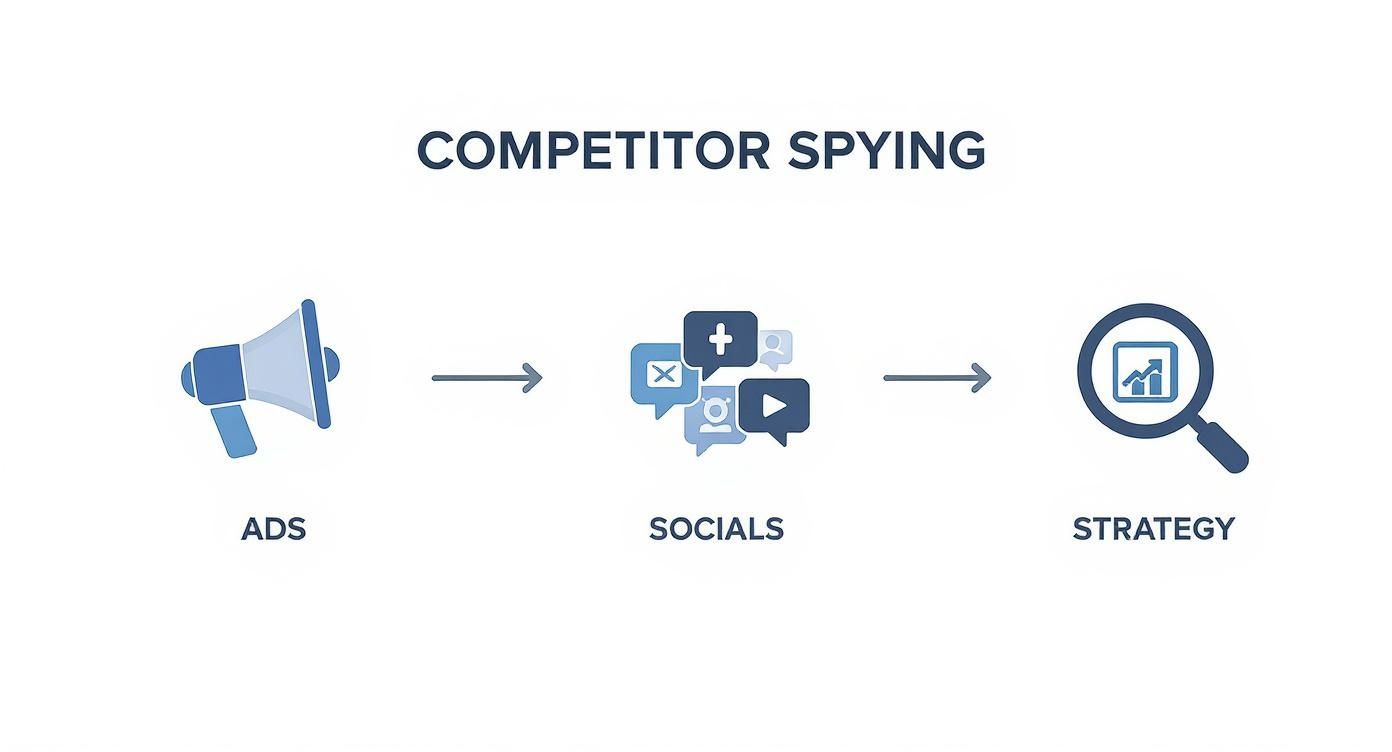
As you can see, monitoring what they're doing with ads and on social media creates a feedback loop of insights that directly informs your next strategic move.
Why Automation Is a Game Changer
Switching from manual spot-checks to an automated system is huge. I've seen organizations using automated monitoring spot competitor pricing changes in just 2-4 hours—a massive leap from the old-school method which could take up to two weeks. It's no wonder that 65% of large companies now use some form of automated tracking.
> The real power of a tracking system isn't just knowing what your competitors did yesterday. It's about spotting patterns over time that signal their next big move, giving you a chance to react before it's too late.
If you want to take things a step further without the Ahrefs or Semrush price tag, a tool like already.dev can automate the discovery and initial analysis part of this process. It feeds your tracking system with fresh data so you can focus on strategy, not just data entry.
Frequently Asked Questions
Alright, so you've done the hard work, your spreadsheets are full, and you've got a list of competitors that could rival a phone book. Fantastic. But let's be honest, that's usually when the real questions start popping up.
Let's run through some of the most common "what now?" moments you'll hit after uncovering your competition. Think of this as the rapid-fire round to clear up any lingering doubts.
How Often Should I Be Doing This Research?
Look, this isn't a "one and done" deal. Think of it like checking the weather—you don't need a new forecast every five minutes, but you also don't want to get caught in a downpour wearing flip-flops.
For most businesses, a quarterly deep-dive is a great rhythm. That means doing a full-blown refresh of your competitor list every three months. For everything in between, a lightweight weekly check-in is all you need. That could be as simple as:
- A 5-minute scan of Google Alerts: See if any major news dropped about your top 3-5 rivals.
- A quick scroll through their socials: What are they pushing? What are people saying?
This keeps you aware without making you paranoid. The goal is consistent insight, not constant surveillance.
What If I Find a Super Strong Competitor I Never Knew Existed?
First things first: breathe. Don't panic. It’s easy to feel like you've been asleep at the wheel, but what you’ve actually done is uncover a massive strategic blind spot before it could cause real harm. That's a huge win.
Your immediate next step is a quick "threat assessment." Dive into their website with a few key questions:
- Who are they really talking to? Is their messaging and branding a direct hit on your ideal customer profile?
- What's their secret weapon? Do they have a killer feature, unbelievably low pricing, or content that’s just on another level? Pinpoint what makes them a contender.
- How long have they been around? Are they a fresh-faced startup or an established player you somehow missed?
> Finding a new, formidable competitor isn't a sign you failed. It's a gift of market intelligence you didn't have yesterday. Use it to sharpen your own value proposition and double down on what makes you unique.
Once you understand why they're so effective, you can start making smart decisions—whether that means adapting your product, tweaking your marketing, or just leaning harder into what makes you different.
How Can I Tell a Real Threat from a Minor Player?
This is a critical skill to develop. You simply don't have the time or energy to track every single website that sells something vaguely related to your business. You need to focus on the rivals who can actually move the needle on your bottom line.
A real threat usually ticks several of these boxes:
- They show up for your "money" keywords: We're talking about the high-intent search terms that people use when they're ready to buy.
- Their audience is your audience: They are fishing in the exact same pond.
- They're actively marketing: You see their ads, their social media is buzzing with activity, and they’re consistently publishing new content.
- People love them: They've got great reviews, positive shout-outs on social media, and are frequently mentioned by industry leaders.
A minor player, on the other hand, might just be a niche blog that happens to rank for a keyword or two, or a company with a product that only slightly overlaps with yours. Keep an eye on them, but don't lose sleep over them.
This kind of disciplined monitoring really works. Companies that stay on top of competitor traffic sources uncover an average of 3-4 new content opportunities every single month. The field has gotten so important that 73% of larger companies now treat it as a major budget priority. You can dig into more insights on how analyzing competitor traffic leads to fresh opportunities.
Ready to stop guessing and start winning? already.dev uses AI to automate this entire discovery process, uncovering direct, indirect, and even failed competitors in minutes, not weeks. Get the data-driven confidence you need to build a better business. Start your free trial at already.dev today!