How to Find Website Competitors Without Going Broke
Learn how to find website competitors with practical, real-world methods. Discover smart search tricks, affordable tools, and how to analyze rivals effectively.

A simple Google search for your main product or service is the obvious first step, but the real gems are found when you dig deeper into forums, social media, and specialized SEO tools. This is where you uncover the rivals hiding just beyond page one—and these less obvious competitors often reveal crucial market gaps and customer pain points.
Your Real Competitors Aren't on Page One
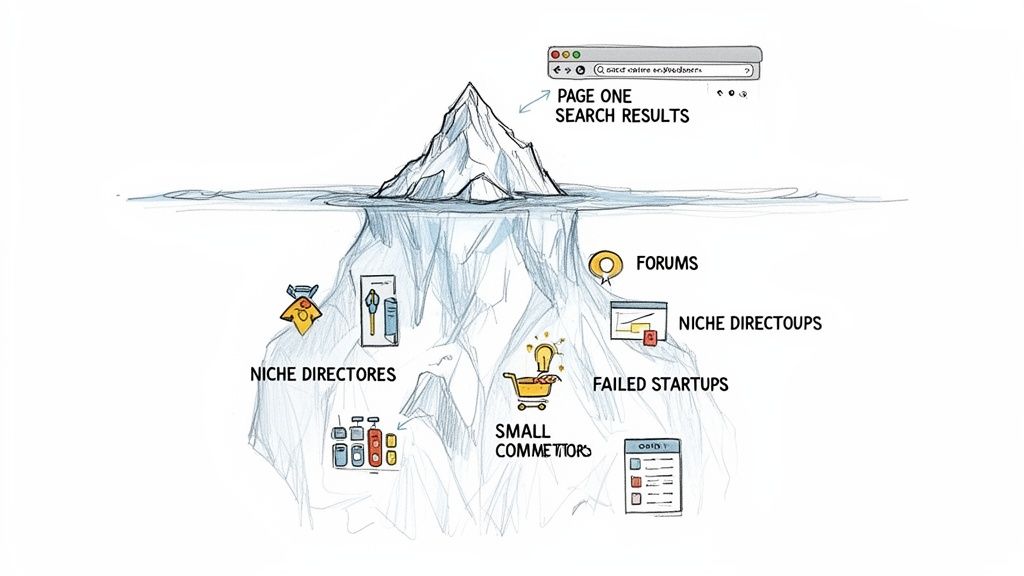
So, you Googled your brilliant idea, saw a couple of similar sites, and breathed a sigh of relief. "Not much competition," you thought. "This is going to be easy."
I hate to be the one to burst that bubble, but relying on a simple search is like seeing the tip of an iceberg and assuming that's the whole thing.
Your most dangerous rivals are often lurking just beneath the surface, completely invisible to a casual search. These aren't just the big, obvious players; they're the scrappy startups, the niche forum favorites, and even the ghosts of failed ventures whose stories hold some of the most valuable lessons.
The Three Flavors of Competitors
Thinking about "how to find website competitors" means looking far beyond simple clones of your idea. You've got to hunt for three distinct types, because they all want a piece of your customer's wallet.
- Direct Competitors: These are the most obvious ones. They sell a similar product to the same audience. Think Lyft vs. Uber. You're fighting for the exact same customer.
- Indirect Competitors: These guys solve the same core problem but with a totally different solution. For a project management tool like Asana, an indirect competitor could be a simple spreadsheet template or even a physical whiteboard. They're stealing customers you didn't even know you were losing.
- Tertiary Competitors: These are the wildcards. They offer something tangentially related that competes for your audience's time, attention, and budget. A company selling online courses on productivity is a tertiary competitor to that same project management tool.
Ignoring the last two is a rookie mistake. It creates a massive blind spot in your strategy, leaving you vulnerable to threats you never saw coming.
> The biggest mistake in competitor research is stopping at the first page of Google. True insights come from understanding the entire ecosystem—direct, indirect, and even the ones who tried and failed.
Why Your Search Is Just the Beginning
A quick search only tells you who’s good at SEO, not necessarily who’s best at solving your customer’s problem. The real conversations, the authentic recommendations, and the unfiltered complaints are happening elsewhere.
They're buried in Reddit threads, niche Slack communities, and industry-specific forums where people ask for genuine advice. This is where you find the under-the-radar tools that people actually love and recommend. These are often the competitors that big, pricey SEO suites like Ahrefs or Semrush can sometimes miss entirely because they can be super expensive. A more focused tool like Already.dev can help automate some of this deeper discovery, but the mindset shift is what really matters.
Ultimately, your goal isn't just to compile a list of URLs. It's to understand the landscape so you don't spend months building something for a problem that’s already been solved—or worse, solved better by someone you never knew existed. Consider this your reality check.
Become a Digital Detective with Smart Search Tricks
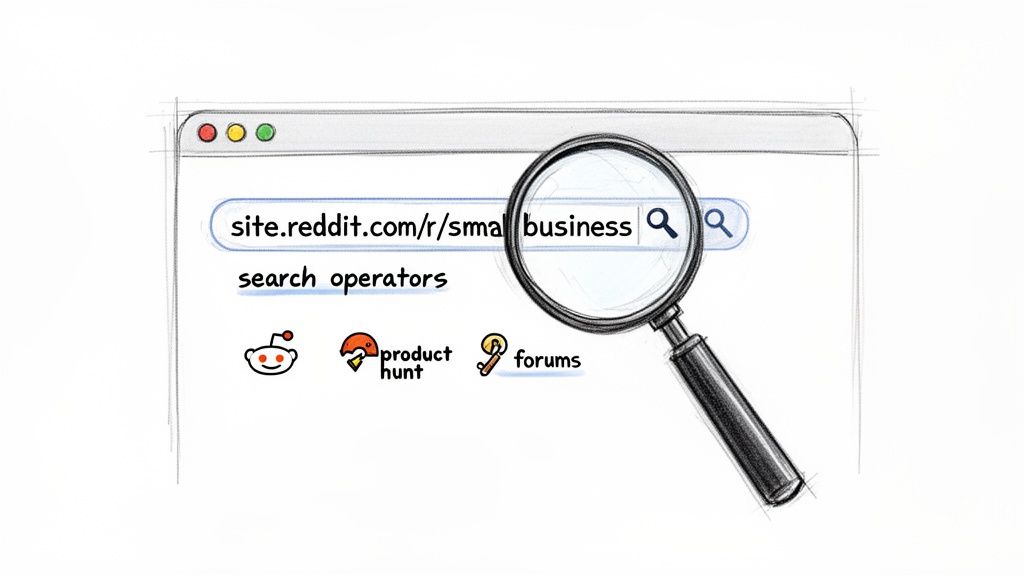
Alright, time to put on your trench coat. Just typing your main keywords into Google is the amateur move—it’s like trying to solve a mystery by only talking to the first person you see on the street. You'll get an answer, but it's rarely the right one.
The real gold is buried where your customers actually talk: niche forums, specific subreddits, and little-known industry directories. To dig up those competitors, you have to learn to speak Google's language.
Mastering Google's Secret Handshakes
Google has a set of "advanced search operators" that are basically secret handshakes for getting exactly what you want. They look a bit nerdy, I'll admit, but they are incredibly powerful for finding competitors that fly under the radar.
Here are the essentials for your detective toolkit:
site:This is your secret weapon. It forces Google to search only within one specific website, letting you eavesdrop on conversations in places like Reddit or a particular industry forum." "(Quotation Marks): Puts Google on a tight leash. It has to search for that exact phrase, with no room for its own creative interpretations.*(Asterisk): This is your wildcard. It acts as a placeholder for any word or phrase, which is amazing for finding different ways people ask the same question.-(Minus Sign): The "get this out of my face" operator. If you're tired of seeing a big-name player in every search, just subtract them. A search likeproject management tool -asanawill clear the noise.
Think of these operators as ingredients. You can mix and match them to create some seriously effective search recipes.
Practical Recipes for Finding Hidden Competitors
Let's move past the theory and get our hands dirty. The goal here is to find raw, unfiltered recommendations from real people solving real problems.
Here are a few copy-and-paste recipes to get you going. Just swap out the bracketed text with terms from your own world.
Recipe 1: The Reddit Recon
- The Query:
site:reddit.com/r/[relevant_subreddit] "anyone know a tool for *" - Why it Works: This query zones in on a specific subreddit (think
/r/smallbusinessor/r/SaaS) and finds posts where people are literally asking for tool recommendations. The replies are a treasure map to your direct and indirect competitors. - Example in Action:
site:reddit.com/r/podcasting "anyone know a tool for editing audio"
Recipe 2: The Alternative Hunter
- The Query:
"[your_competitor] alternatives" - Why it Works: It's simple, but it's a classic for a reason. This search digs up articles, blog posts, and forum threads where people are actively looking to switch from a known competitor. You'll often find entire lists of rivals in a single click.
- Example in Action:
"Mailchimp alternatives"
Recipe 3: The Community Infiltrator
- The Query:
site:[industry_forum.com] "recommend a * for [your_task]" - Why it Works: Every niche has its watering holes—forums or online communities where the pros hang out. This search lets you listen in as they give their honest takes on the best tools for a specific job.
> The most honest competitor insights don't come from a company's homepage. They come from a random forum thread at 2 AM where a user says, "Forget Tool X, I switched to Tool Y last month and it changed everything."
This hands-on approach is so critical because it gives you context. You don't just get a company name; you find out why people are flocking to them.
As you get deeper into this, you might find that to scale up your data collection, you'll need to leverage proxies for web scraping. But for now, these manual searches are your most potent starting point. They force you to think like a customer, not just a founder.
I know this process feels like a grind, but it's worth it. Did you know that relying on the first page of Google can cause you to miss up to 70% of your real competition? The obvious players are just the tip of the iceberg. The real threats are lurking in the exact kinds of forums and directories these searches uncover. This is where you find the opportunities everyone else is missing.
Use SEO Tools Without the Hefty Price Tag
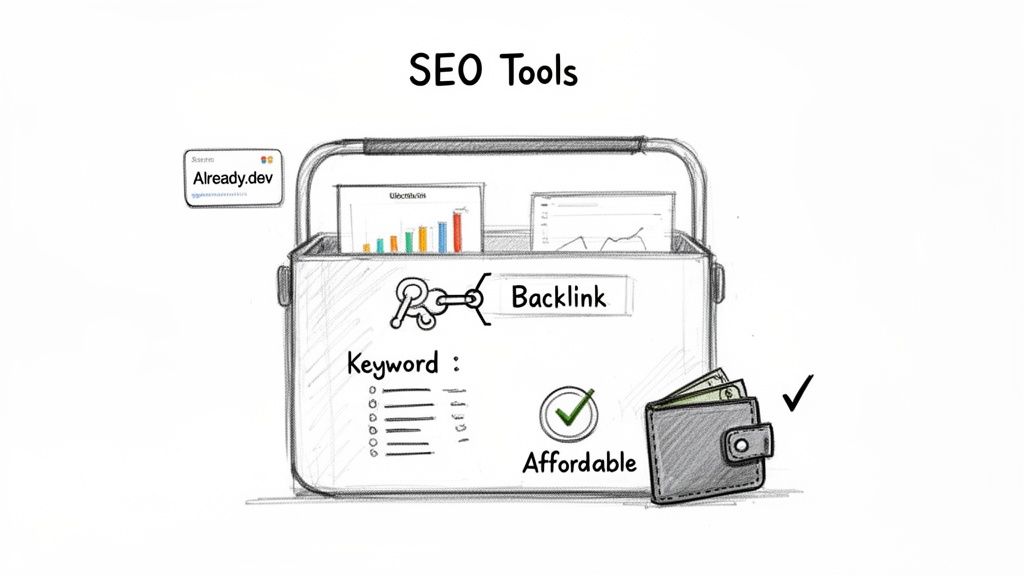
Manual searching is a fantastic start, but let's be honest, it's a grind. To really scale up your competitor discovery, you need to bring in the power tools. SEO platforms are incredible for this because they see the internet as a giant, interconnected map of keywords and links, not just a series of disconnected pages.
But there’s a catch, and it’s a big one. The industry giants like Ahrefs and Semrush are built for marketing agencies with deep pockets. Their monthly subscriptions can be eye-wateringly expensive, easily running into hundreds of dollars. For a founder on a ramen budget, that's often a non-starter.
The good news? You don't need their entire, complicated dashboard. You just need to understand the core concepts they use to unearth competitors and then find smarter, more affordable ways to get that same intel, like Already.dev.
SEO Jargon for Competitor Hunting, Simplified
Let's cut through the buzzwords. When it comes to finding competitors, there are really only two big ideas you need to grasp. These concepts are the bedrock of how SEO tools work their magic.
-
Keyword Gap Analysis: This sounds complex, but it's dead simple. It’s all about finding keywords your competitors rank for, but you don't. Imagine your rival gets tons of traffic from the phrase "automated invoicing for freelancers." If you're not even on the radar for that term, that's a gap in your strategy and a massive clue about their customer focus.
-
Backlink Profile Analysis: This is just a fancy way of asking, "Who is linking to my competitor?" Every link from another website is like a vote of confidence. By looking at who "votes" for your rivals, you can discover key industry blogs, directories, and review sites central to your niche—and you'll almost certainly find other competitors mentioned on those same sites.
These two pieces of data alone can reveal a treasure trove of competitors you would have never found through manual searching. They show you who is actually fighting for the same audience in the search results, which is often a more accurate measure than just looking at who has a similar product.
> The real power of SEO tools isn't in their endless charts and graphs. It's in their ability to answer one simple question: "Who is winning the attention of my target customer on Google?"
A Quick Look at Competitor Discovery Tools
Navigating the sea of competitor research tools can be overwhelming. Some are built for deep SEO analysis, while others focus on specific intel like tech stacks or ad campaigns. Here's a quick breakdown to help you choose the right tool for the job.
| Tool | What It's Great For | Typical Monthly Cost | Best For | | :--- | :--- | :--- | :--- | | Ahrefs/Semrush | Deep-dive SEO, backlink analysis, keyword gaps | $129+ (can be expensive) | Marketing agencies, established companies | | Already.dev | Automated discovery, reports for founders | $29+ | Startups, product teams needing quick insights | | BuzzSumo | Content strategy, finding popular topics | $199+ (can be expensive) | Content marketers, PR teams | | BuiltWith | Uncovering a competitor's tech stack | $0 - $495+ | Sales, product teams, market researchers |
This isn't an exhaustive list, but it gives you a good sense of the landscape. Your goal isn't to use every tool, but to pick the one that gives you the most actionable information for your budget.
Getting the Goods on a Startup Budget
Okay, so the big-name tools are pricey. How do you get this crucial competitive data without selling a kidney? You get strategic. You don't need to pay for a dozen features you'll never use.
Instead of getting overwhelmed, focus on tools designed for clarity and affordability. This is exactly why we built Already.dev. It's designed for founders who need comprehensive competitor reports in minutes, not another complicated dashboard that takes weeks to master. It automates the discovery process, giving you critical insights—like keyword gaps and positioning—without the enterprise price tag.
Beyond specialized platforms, you can also piece together a great strategy using more focused, and often free, tools. Looking for a rundown of your options? You might be interested in our guide on the https://blog.already.dev/posts/best-free-competitor-analysis-tools to get started.
Uncovering Hidden Edges with Smarter Tools
It's not just about who ranks for what; it's also about how they do it. Some tools go beyond keywords to look at a competitor's technology and content strategy, exposing their hidden advantages.
For example, uncovering tech stacks with a tool like BuiltWith or analyzing content with BuzzSumo can show you exactly what makes a rival tick. Research shows that 58% of websites use niche technologies or ad platforms that can drive up to 35% more targeted traffic. This kind of intelligence is a huge advantage. To understand the various capabilities a specialized tool can offer in competitor research, consider exploring copycat247's features for competitor analysis.
Think about a product team that missed a rival's use of a specific payment gateway popular in European markets, costing them 22% of potential conversions. A quick tech stack scan could have prevented that entirely.
Ultimately, the goal is to use technology to save your most valuable resource: time. Whether you choose an all-in-one solution like Already.dev or a mix of smaller tools, the objective is the same: find out who you're really up against, fast. This way, you can spend less time researching and more time building something better.
Turn Your Competitor List into a Winning Strategy
Alright, you’ve done the detective work. You have a list of websites, maybe in a spreadsheet or scribbled on a napkin. It's tempting to pat yourself on the back and call it a day, but let's be real: a list of competitors is completely useless.
It's just a bunch of names. It doesn't tell you what to do.
This is where we turn that raw data into an actual strategy. This isn’t about creating another boring spreadsheet that collects digital dust. It’s about figuring out your competitor's game plan so you can find the holes and build your own. We're going to dive into their positioning, features, and pricing to spot the golden opportunities they've missed.
Reading Between the Lines of Their Website
A competitor's homepage is basically a billboard for their entire strategy. They are telling you, loud and clear, who they think their ideal customer is and what problem they believe they solve better than anyone else. Your job is to listen, but with a healthy dose of skepticism.
Start by dissecting their core marketing message. What are the first five words you see? Are they screaming "easy," "powerful," "cheap," or "premium"? This language is no accident; it’s a carefully crafted signal about their position in the market.
For example, imagine every rival's website is plastered with jargon and case studies from Fortune 500 companies. They're all fighting over the same enterprise giants. That’s not a dead end for you—it’s a massive green light. What if you became the go-to solution for small businesses, freelancers, or non-profits?
> A competitor's weakness isn't usually a missing feature. It's a customer segment they've chosen to ignore. Your entire business can be built in the space they've left behind.
Mapping Out Features and Pricing
Now let's get into the nitty-gritty. It's time to compare what they offer and what they charge for it. This is where you can find some of the most glaring opportunities.
Create a simple comparison grid. It doesn't have to be fancy. Just list your top 3-5 competitors and map out a few key things:
- Core Features: What are the non-negotiable features in your space? Every competitor will have these.
- "Wow" Features: What is the one cool, unique thing each one offers? This often reveals their secret sauce.
- Pricing Tiers: How do they structure their plans? Is it based on users, features, or usage?
- Free Trial / Freemium: Do they let users try before they buy? If so, what are the limitations?
Let’s say you’re building a new email marketing tool. You might find that Competitor A charges per subscriber, Competitor B charges per email sent, and Competitor C offers a free plan but slaps their ugly branding on everything.
This analysis immediately sparks strategic questions for your business. Could you offer a more generous free plan? Could you create a simpler, flat-rate pricing model that cuts through the confusion? If every competitor's pricing is a complex maze, your winning strategy might just be radical simplicity.
To keep all this information organized and actionable, you'll want to use a structured approach. You can find a great framework in our competitive analysis template which helps you lay out these comparisons clearly.
The Goldmine of Customer Reviews
Want to know a competitor's biggest weakness? Don't ask them. Ask their customers.
Customer reviews on sites like G2, Capterra, or even in Reddit threads are an absolute goldmine. People are brutally honest when they're frustrated. Look for patterns in their complaints.
Are users constantly griping about terrible customer support? That’s your opening. Make outstanding, human-powered support your core selling point.
Do a dozen reviews mention a specific missing feature that would "make this tool perfect"? You just found a feature for your MVP. Pay special attention to 3-star reviews; they're often the most insightful, pointing out what's good but also what's painfully missing.
This isn’t just about finding flaws. It’s about understanding the emotional triggers in your market. What frustrates people enough to go online and write a lengthy complaint? Solving that one thing can be more powerful than adding ten new features.
This whole process—analyzing positioning, mapping features, and digging through reviews—is about turning a passive list into an active game plan. You’re not just finding out who your competitors are; you’re discovering exactly how to beat them. This is how you find your unique edge and build a business that doesn't just compete, but wins.
Create a Simple Competitor Research System That Works
Alright, let's land this plane. We’ve covered a ton of ground, from playing digital detective with Google tricks to wading through the sometimes-murky waters of SEO tools. But information without a system is just noise. It’s like buying all the ingredients for a gourmet meal and then just staring at them on the counter.
The goal isn't to do competitor research once, create a beautiful spreadsheet, and then let it collect digital dust in your Google Drive. The real pros know that finding website competitors is an ongoing habit, not a one-time project. Markets change, new players pop up, and old rivals pivot. Your research needs to be a living, breathing thing.
The good news? It doesn’t have to be a soul-crushing, 40-hour-a-week job. You can build a simple, repeatable system that keeps you sharp without driving you crazy.
Your Five-Point Competitor Check-Up
Think of this as your recurring tune-up. Whether you do it monthly or quarterly, this simple checklist will keep you from getting blindsided. It’s a loop that ensures you’re always making decisions based on what’s happening now, not what was true six months ago.
Here’s a straightforward process you can follow:
-
Run Your Search Recipes: Revisit the smart search tricks we talked about earlier. Spend 30 minutes running queries like
site:reddit.com/r/[your_niche] "looking for a tool for *"to see if any new names are getting recommended in community discussions. -
Check Your Tool's Report: If you're using a tool, now's the time to run a fresh report. For expensive tools like Ahrefs or Semrush, this might be a pain. But with a more focused platform like Already.dev, you can get an updated, comprehensive report in about four minutes. It does the heavy lifting of scanning hundreds of sources automatically.
-
Spot the New Faces: Compare your new findings with your old list. Who’s new? Who disappeared? A new competitor might signal a new market angle you hadn't considered.
-
Analyze One Big Thing: Don't try to analyze everything every time. This quarter, maybe you focus solely on your top three rivals' pricing pages. Next quarter, you can do a deep dive into their customer reviews on G2 or Capterra.
-
Note One Key Takeaway: End the session by writing down one single, actionable insight. It could be "Competitor X just launched a free tier; we need to re-evaluate ours" or "Everyone is complaining about Competitor Y's customer service—this is our chance to shine."
> Competitor analysis paralysis is real. The solution isn't more data; it's a better, simpler routine. Make it a habit, and you'll always be one step ahead without the burnout.
This quick-hit process keeps you informed without swallowing your entire week. The most important part is consistency. Doing a little bit often is far more valuable than doing a massive deep dive once a year.
This flow chart visualizes the core strategy of analyzing the market, finding opportunities, and then acting on them.
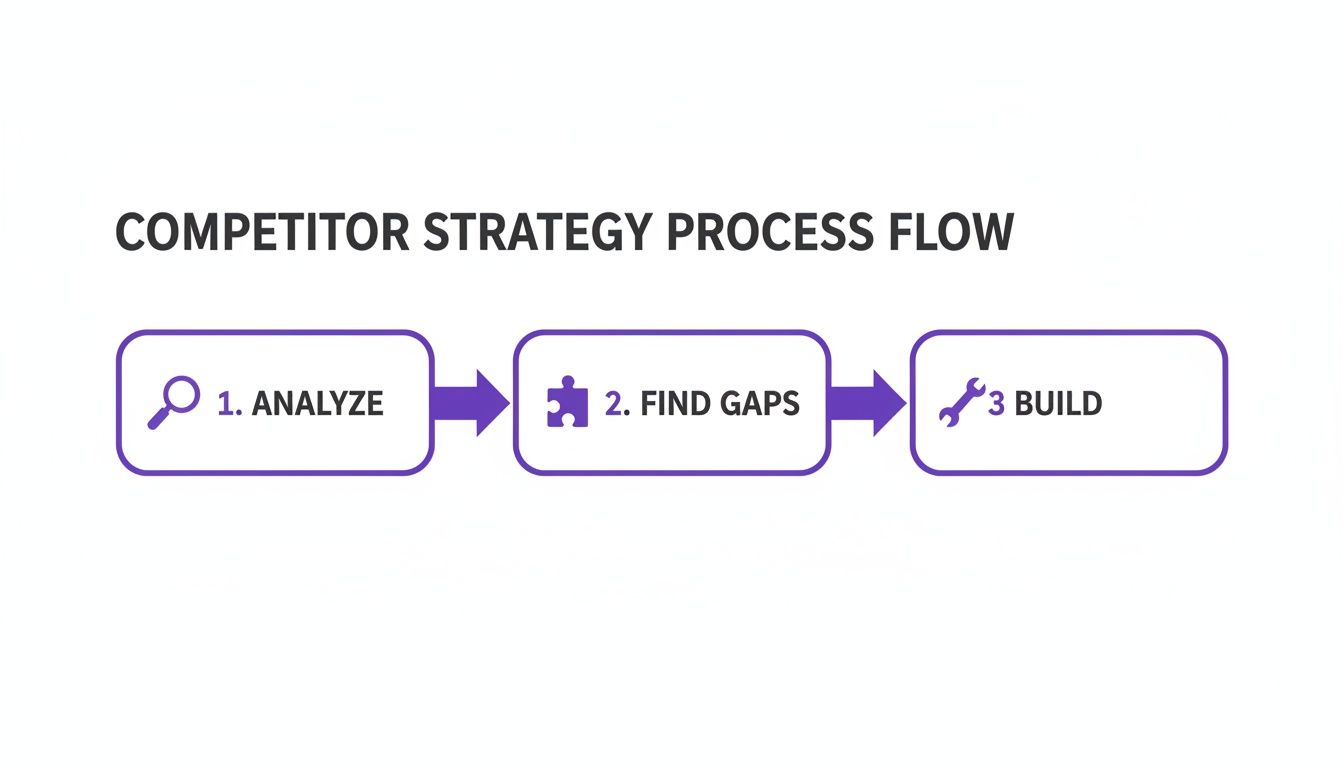
This process emphasizes that the goal isn't just to gather data but to find a gap in the market that your product can fill.
Tying It All Together for the Win
So, how do you find website competitors? You start by understanding that your real rivals are rarely the obvious ones. You become a digital detective, using smart search tricks to listen in on real customer conversations. You bring in power tools—but you choose them wisely, opting for affordable, focused solutions like Already.dev over bloated, expensive platforms.
Then, you turn that list of names into a real strategy by dissecting their positioning, features, pricing, and customer feedback to find your unique opening. And finally, you wrap it all up in a simple, repeatable system that keeps you ahead of the curve.
This isn't about being paranoid or obsessing over every move your rivals make. It's about being informed. It's about having the data-driven confidence to know when to pivot, when to persevere, and when to perfect your idea before you write a single line of code.
By creating a system, you turn research from a daunting task into a strategic advantage. For an even more structured approach, you can learn more by checking out our framework of competitive analysis to build your own robust system.
Remember, the goal is to spend less time worrying about the competition and more time building something your customers truly love. A solid system gets you there faster.
Frequently Asked Questions
Alright, you've made it this far, which means you're serious about figuring out who you're really up against. Let's tackle a few common questions that always seem to pop up when founders start digging into the competitive landscape.
How Often Should I Actually Do Competitor Research?
Think of it like a dental check-up, not a root canal. You don't want to be doing it constantly, but ignoring it completely will lead to some painful surprises down the road.
Before you write a single line of code, a deep-dive analysis is non-negotiable. Once you're live, a quick health check every quarter is usually a good rhythm. This cadence is perfect for spotting new players, noticing if a rival suddenly changed direction, or seeing if they've rolled out a feature that's getting a ton of buzz.
If you’re in a ridiculously fast-moving space like AI or crypto, you might even want to peek around monthly. The real goal is to build a light, ongoing habit, not to scramble in a panic when a new competitor’s ad suddenly pops up in your feed.
What’s the Single Biggest Mistake People Make?
Oh, this one’s easy. The biggest mistake, by far, is stopping at the first page of Google and only looking for direct, feature-for-feature clones of your idea. It’s like thinking the only other restaurants in town are the ones on your street selling the exact same sandwich.
> This tunnel vision creates a massive blind spot for indirect and alternative competitors—the ones solving the same customer pain point, just in a totally different way.
A simple spreadsheet template, for instance, can be a brutal competitor to a shiny new project management app. That's precisely why you have to get out of Google and dig into niche communities, forums, and app stores. You need to see the whole picture, not just who has the best SEO for the obvious keywords.
Are Those Super Expensive SEO Tools Worth It for This?
For a solo founder or a small team just getting started? Honestly, probably not.
Don't get me wrong, powerhouse tools like Ahrefs or Semrush are incredible pieces of software, but they're built for big SEO agencies and in-house teams. They come with a steep price tag (often $100+ per month) and a learning curve that feels like you’re trying to fly a 747 just to get to the grocery store. They can be really expensive.
They're usually total overkill when all you need is quick, clear validation of your idea. A focused, affordable alternative like Already.dev gives you the crucial insights you need—who you're up against, what they're doing right, and where the gaps are—without the complexity and cost.
Ready to stop guessing and start knowing? Already.dev turns what used to be a 40-hour research headache into a clear, actionable report in just four minutes. Describe your idea and let our AI agents uncover every competitor, so you can build with confidence. Get your first competitor report.