Your Guide to Price Analysis Software
Discover how price analysis software helps you beat competitors and boost profits. Get the insights you need to set the perfect prices for your products.
Let's be real, setting prices often feels like throwing darts in a dark room. You hope you hit the board, but you're probably just putting a hole in the wall. Price analysis software is the light switch. It's like having a nerdy-but-cool analyst who does nothing but watch your competitors, the market, and your customers, then tells you exactly what to charge. It's about swapping gut feelings for cold, hard cash.
So What Is Price Analysis Software Anyway?
Imagine you had a live feed of the entire market for your stuff. That’s pretty much what this software does. It automates the soul-crushing job of manually checking dozens of competitor sites, scraping prices, and trying to make sense of it all in a spreadsheet that would make your eyes bleed.
This isn't just for giants like Amazon. Businesses of every size, from scrappy e-commerce startups to brands that have been around forever, use these tools to make sure they’re not accidentally giving away money. At the end of the day, the software answers one simple, yet multi-million dollar question: "Is this the right price?"
It’s More Than Just a Price Checker
At its core, price analysis software is a specialized form of competitive intelligence. It doesn't just tell you a competitor's price; it gives you the context to understand why that price matters and how you should react (or if you should just ignore them). You can dive deeper into this concept in our guide on what is competitive intelligence.
This data-first approach isn't a "nice-to-have" anymore. The global market for this kind of software is blowing up and is expected to reach USD 1.82 billion by 2025. Here in North America, the market is projected to grow by roughly 16.1% every year for the next few years, which just shows how vital smart pricing has become. You can check out the full breakdown in this price optimization market growth report.
The Real-World Advantage
So what does this look like in practice? Here’s how these tools give you a serious edge:
- Stop Underselling Yourself: The software can instantly spot where you're priced way below the market average. This is the lowest of low-hanging fruit—an immediate chance to boost your profit margins without losing a single customer.
- React in Real-Time: Did a major competitor just launch a flash sale? You'll get an alert before the ink is even dry on their announcement. This lets you make a calculated decision: match their price, hold your ground, or maybe offer something even better.
- Make Data-Backed Decisions: Your internal meetings change completely. Instead of, "I feel like we should drop the price," it becomes, "The data shows our top three competitors cut prices by 10% and demand is trending down. Let's adjust."
While general market intelligence tools like Ahrefs or Semrush are powerful, they aren't built specifically for product pricing and, let's be honest, can be crazy expensive. A dedicated tool like already.dev gives you focused, actionable pricing insights without the enterprise-level cost. It helps turn pricing from a stressful, reactive chore into a proactive, profit-driving machine for your business.
The Core Features That Actually Matter
Alright, let's cut through the marketing B.S. A lot of price analysis software is bloated with features that look cool on a sales page but that you'll probably never touch. When you're picking a tool, you need to focus on the core engines that actually do the work.
Think of it less like a Swiss Army knife with a thousand tiny, useless tools and more like a powerful drill—it does one job, and it does it exceptionally well.
Here are the four features that really move the needle. If a tool doesn't nail these, keep looking.
This infographic breaks down how price analysis software connects the dots between your competitors, market trends, and your own customers.
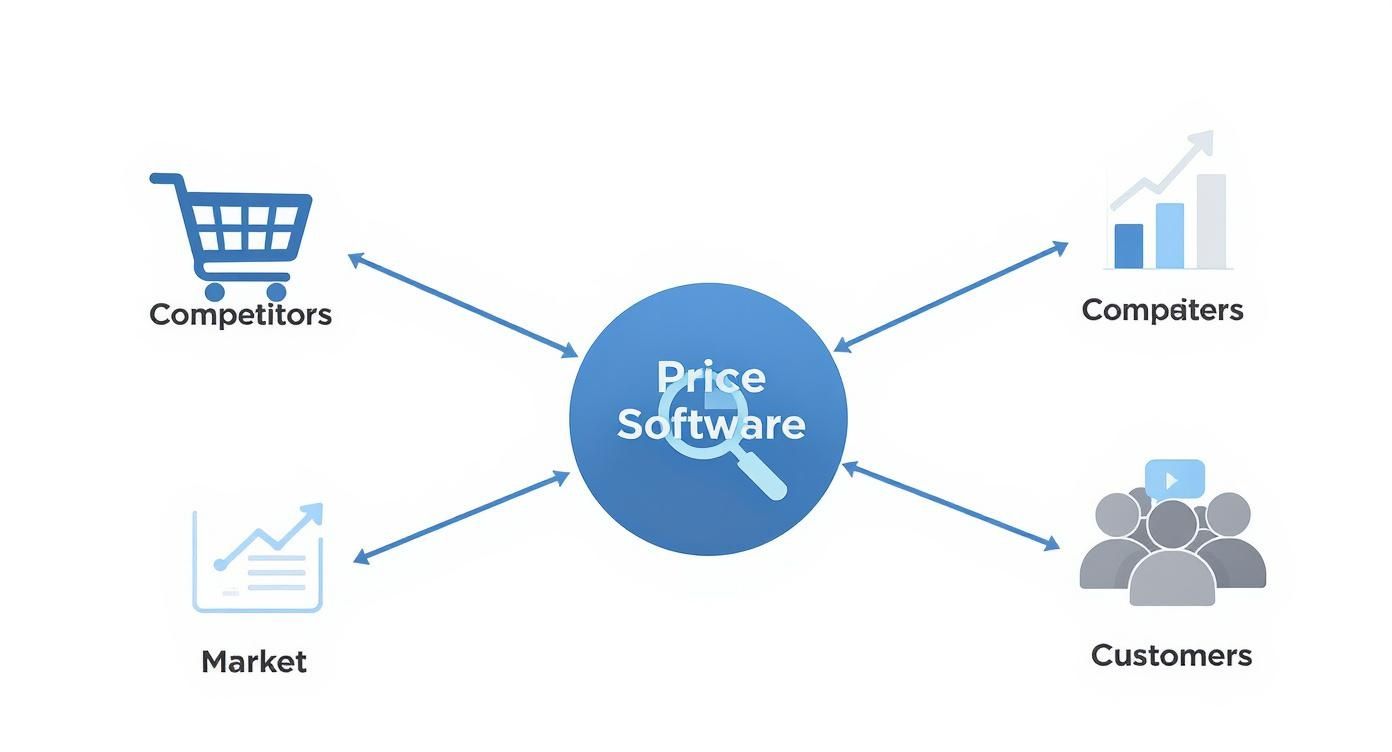
As you can see, the software acts as a central hub. It pulls in critical data from multiple sources to give you a complete picture of your pricing environment so you can make smarter decisions.
1. Competitor Price Monitoring
This is the absolute foundation of any decent pricing tool. It’s your digital spy network, automatically keeping tabs on what everyone else is charging for similar products. Forget wasting hours manually checking websites—this feature does it for you, 24/7.
A good monitoring tool will let you:
- Track specific products or entire categories: You can zero in on your biggest rivals for your most important items.
- Get real-time alerts: Receive a notification the second a competitor launches a sale or hikes their prices. This lets you react instantly, not days later.
- View historical pricing data: See how a competitor's prices have shifted over time. Are they constantly discounting, or do they hold firm? This context is pure gold.
2. Dynamic Pricing Engines
Think of a dynamic pricing engine as a smart thermostat for your prices. Instead of setting a price and forgetting it, this feature automatically adjusts it based on pre-set rules and real-world triggers. It’s all about staying nimble.
For example, you could set a rule to automatically price-match your top competitor on a popular TV. But for an exclusive accessory that only you sell, you could set a different rule to maintain a 30% margin, no matter what. It’s all about maximizing profit where you can and staying competitive where you must. A fundamental part of this process is the ability to accurately extract data from invoices, which provides the raw numbers these engines need to operate.
3. Demand Forecasting
This is where things get a little "crystal ball." Using AI and your own historical sales data, demand forecasting helps you predict how a price change might affect your sales volume. It answers the million-dollar question: "If I raise the price by $5, how many fewer units will I actually sell?"
This is incredibly useful for planning promotions or testing new price points without flying blind. You can simulate a price change and see the likely impact on revenue and profit before you commit to it. This feature is a big reason why the price optimization software market is set to more than double, from around USD 1.68 billion in 2025 to a projected USD 3.59 billion by 2030.
4. Analytics and Reporting Dashboards
Data is useless if you can't understand it. A great dashboard turns mountains of raw numbers into simple, clean charts and graphs that even your non-techie boss can understand. At a glance, you should be able to see your current market position, pricing opportunities, and the performance of your strategies.
> The goal isn't more data; it's more clarity. A good dashboard shouldn't require a data science degree to understand. It should tell you a story: where you’re winning, where you’re losing, and what you should do next.
While big, all-in-one marketing platforms like Ahrefs or Semrush offer some analytics, they can be overkill and very expensive. For pricing, you need focused insights. A tool like already.dev gives you the clean, actionable dashboards you need without the hefty price tag.
Putting This Software to Work in the Real World
Alright, enough with the theory. Let's talk about what actually happens when you start using price analysis software day-to-day. No jargon, no high-level concepts—just a practical look at how this kind of tool becomes part of your weekly routine to help you make more money.
Imagine "Jenna," who runs an online store selling high-end coffee gear. She’s sharp and knows her products, but she isn't a data scientist. More importantly, she doesn't have hours to waste manually checking what her competitors are up to.
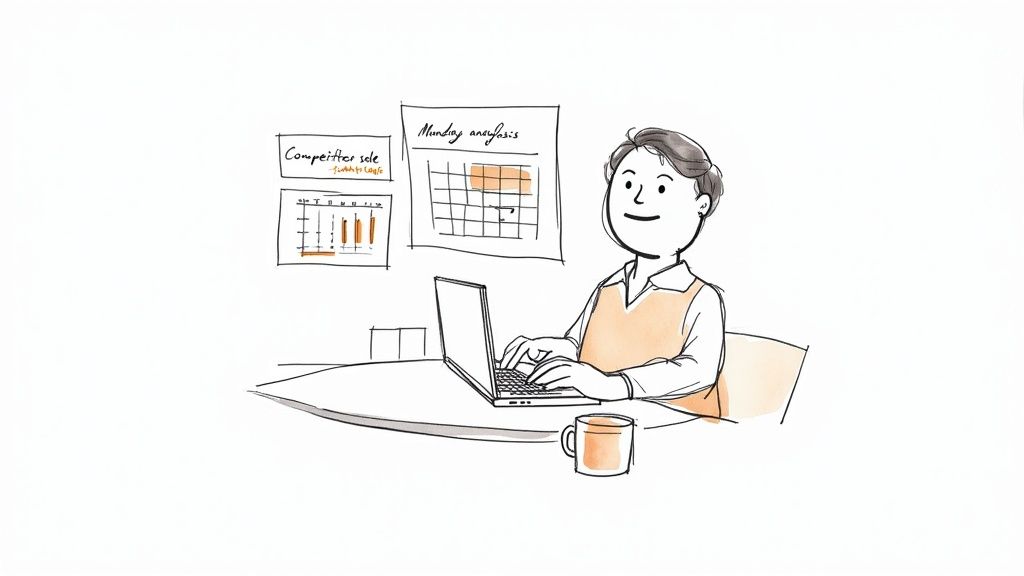
Monday Morning: The Proactive Setup
Jenna’s week doesn’t start with a mad dash. Instead, she logs into her price analysis software and spends about 15 minutes setting things up. Her first move? Creating a smart alert.
She picks her top three competitors and tells the software to watch their prices for a popular premium espresso machine. Then, she sets a trigger: "Ping me the instant any of these guys drop their price by more than 5%."
Just like that, her entire strategy shifts from reactive to proactive. She's no longer finding out about a sale two days late; she's ready to make a move the moment it happens.
Wednesday Afternoon: The Alert and the Opportunity
On Wednesday, an email alert lands in Jenna's inbox. Her biggest competitor just dropped that exact espresso machine by 10% in a surprise sale. The old Jenna might have panicked, maybe even slashed her own prices in a race to the bottom that would’ve tanked her margins.
But the new Jenna just opens her dashboard. The software shows her something much more interesting. While the espresso machine is a hot item, another product—a niche, single-origin coffee bean—has been collecting dust on her virtual shelves. It’s great coffee, but it just isn't moving.
The software suggests a promotional bundle. Instead of blindly matching the discount, it recommends a weekend flash sale: "Buy the espresso machine at full price, and get a bag of our single-origin beans for 50% off."
> This is where good price analysis software really shines. It doesn’t just report what competitors are doing; it digs into your own data to help you find a smarter, more profitable response. It’s about playing chess, not checkers.
The Weekend Flash Sale
Jenna quickly builds the flash sale in her Shopify store. It's a killer offer that doesn't devalue her main product, protecting her brand's premium feel. At the same time, she’s solving a second problem by clearing out that slow-moving inventory.
The sale runs from Friday to Sunday. She can actually relax and enjoy her weekend because the strategy was built on solid data, not just a gut feeling. That kind of confidence is what makes these tools so valuable. If you want to dig deeper into gathering this kind of intel, our guide on leveraging competitor pricing data is a great next step.
The Following Monday: The Results
Come Monday morning, Jenna logs in to check the numbers. The results are in, and they speak for themselves:
- Espresso Machine Sales: She sold nearly as many units as she would have by price-matching, but she did it at full price, keeping her profit margin intact.
- Slow-Moving Inventory: She moved 70% of that stagnant coffee bean stock, turning a potential write-off into a win.
- New Customer Acquisition: Her analytics show that 20% of the flash sale buyers were brand new to her store, pulled in by the unique bundle.
This entire workflow didn't add hours to her week; it actually saved her time and a whole lot of stress. While big, complex tools like Ahrefs or Semrush offer broad market data, they're often expensive and aren't built for this kind of specific, profit-focused work. A dedicated tool like already.dev, on the other hand, gives you the focused power you need to turn market shifts into money-making opportunities that fit right into your routine.
Who Really Wins with Price Analysis
When you hear price analysis software, it’s easy to picture giant corporations with entire floors of people staring at spreadsheets. But that’s not the whole story. While the big players absolutely rely on these tools, the ones who see a game-changing difference are the underdogs who need every advantage they can get: startups and investors.
For these groups, this isn't just another subscription. It's a force multiplier. It's the secret weapon that lets them punch way above their weight class. Let's break down exactly how.
The Startup Superpower: Leveling the Playing Field
Launching a startup is like building a plane while it's already in the air. Your fuel (cash) is limited, your crew is small, and you’re flying against commercial airlines. Price analysis software is like getting an advanced radar system installed mid-flight.
Suddenly, you can go toe-to-toe with the big dogs without needing a massive analytics team. You don't have to throw a dart at a board to pick your launch price; the data points you to the sweet spot. And those razor-thin margins you live and die by? This software helps you guard them like a hawk.
Here’s how it actually plays out in the trenches for a startup:
- Compete on Smarts, Not Size: You’ll never outspend the giants, but you can definitely outsmart them. Good software lets you spot market gaps and pricing opportunities they've completely missed, helping you stay nimble and strategic.
- Find Product-Market-Price Fit: Everyone talks about product-market fit, but what about the price? A tool that scans the market helps you land on a price that customers will actually pay and that keeps your lights on.
- Avoid the Race to the Bottom: When a huge competitor runs a sale, a startup's first instinct is to panic and slash prices. This software gives you the confidence to make a better move, like offering a clever bundle or highlighting a unique feature instead of just torching your profit margins.
The Investor’s Crystal Ball
Now, let's flip the coin and look at this from an investor’s or VC's point of view. Their entire job is to place smart bets on promising companies, and that means due diligence is everything. Price analysis software is their superpower for cutting through the hype.
Imagine you're a VC looking at a $2 million seed round for a hot new SaaS company. The pitch deck is slick, but you need to know if the business model is built on solid ground or just wishful thinking.
> This software is what takes an investor from, "I hope their pricing strategy works," to, "I've analyzed their pricing against the top five competitors and see a clear path to profitability." It turns a gut feeling into a data-driven conviction.
This kind of deep dive answers the questions that keep investors up at night:
- Is this pricing sustainable? It's easy to attract users by charging almost nothing. This software shows whether a company's prices are realistic for long-term growth or just a short-term gimmick.
- How vulnerable are they? The tool can quickly reveal if a startup is one price war away from disaster. If their main competitor could drop prices by 20% and wipe them out, that's a massive red flag.
- Where's the real market opportunity? By analyzing the competitive landscape, an investor can see if the startup is walking into a crowded, commoditized market or if they've found a genuine niche where they can command a premium.
While broad-spectrum tools like Ahrefs or Semrush can offer some market context, they’re often brutally expensive and just aren't built for this kind of specific, product-level pricing analysis. A focused platform like already.dev gives both startups and investors the deep, actionable insights they need to build and back winning companies—without the enterprise-level price tag. It's a game-changer for anyone who’s serious about making smart, data-backed decisions.
How to Choose the Right Pricing Tool
Okay, so you're convinced you need a pricing tool. Great. Now for the tricky part: actually picking one. The market for price analysis software is absolutely flooded, and trying to choose can feel like wading through a sea of buzzwords and slick sales pitches. How do you find a tool that will actually make you money instead of just costing you a fortune?
Consider this your no-fluff buyer's guide. We're going to cut through the noise and focus on what really matters when you're kicking the tires on a new pricing platform.
Don't Get Seduced by the Big Names
First off, let's talk about the price tag. You're going to stumble upon massive, all-in-one platforms that tack on some pricing and market analysis features. They're undeniably powerful, but they are also incredibly expensive—we're talking hundreds, if not thousands, of dollars every single month. For most businesses, that’s like buying a Formula 1 car just to do a grocery run.
A much smarter move is to find a focused tool that does one thing exceptionally well. A platform like already.dev, for instance, is built from the ground up for deep competitive and pricing insights. It delivers the actionable data you need without the eye-watering enterprise price, making it a far better fit for startups and growing businesses. You can check out more specialized options in our guide to the best competitive intelligence tools.
Core Criteria for Your Shortlist
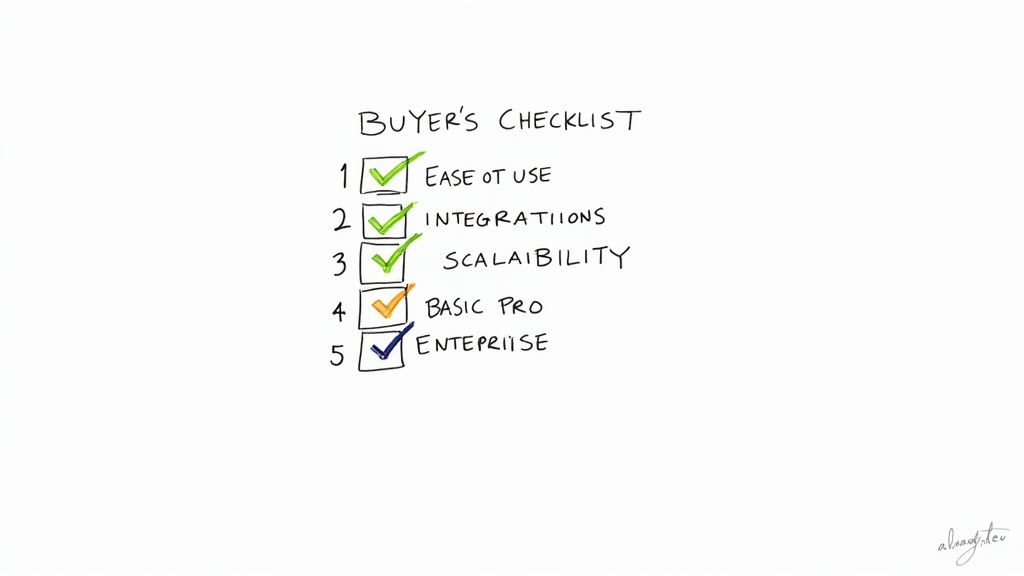
As you start comparing tools, try not to get distracted by a laundry list of 50 different features. Instead, zero in on these three critical areas:
- Ease of Use: Is the dashboard clean and intuitive, or does it look like the cockpit of a 747? If you need a degree in data science just to understand the reports, it’s the wrong tool. It should save you time, not create a new full-time job.
- Key Integrations: Does the software actually connect with the tools you already rely on? For an e-commerce shop, a smooth Shopify or BigCommerce integration is a must-have. For a SaaS company, it might be Stripe. Make sure it slots into your existing workflow without a headache.
- Scalability: The tool you pick today needs to be able to grow with you. Can it handle tracking more competitors or products as your business expands? You don't want to go through this whole song and dance again in a year.
Your Demo Day Checklist
Never, ever pull out a credit card before you've seen a live demo. This is your chance to ask the tough questions and see the software in action. Here’s a simple checklist to run through with the sales rep:
- Can you show me how to track my top three competitors, right now?
- How are pricing alerts set up, and what do they look like when I get one?
- What does the historical pricing data for a single product actually look like?
- Realistically, how long does the initial setup and integration process take?
- What kind of support is available if I get stuck?
> A good demo should feel less like a sales pitch and more like a strategy session. If they can't give you clear, direct answers, that's a huge red flag.
The market for this kind of software is only getting bigger. In fact, it's projected to explode from just under USD 1.98 billion in 2025 to nearly USD 5.94 billion by 2032. This incredible growth just goes to show how essential these tools are becoming. When you're making your choice, it pays to look around, even using a dedicated comparison platform for specific products to get a full view of the landscape. Getting familiar with these price optimization software market trends will help you stay ahead of the curve.
Frequently Asked Questions
Got questions? You're not the only one. Here are a few of the most common things people ask about price analysis software, answered in plain English. No corporate jargon, we promise.
Is Price Analysis Software Hard to Use?
Honestly, the best ones are built for business owners, not data wizards. If you can handle your Shopify dashboard, you can definitely handle this. Modern platforms like already.dev have clean interfaces that tell you what's happening without making you squint at a million numbers.
The initial setup might take a few minutes, sure. You'll need to connect your products and tell the software which competitors you want to keep an eye on. But after that, the software pretty much runs itself, doing the heavy lifting automatically. Its whole purpose is to make your life easier, not give you another complicated thing to learn.
How Quickly Will I See a Return on Investment?
It can happen way faster than you might think. Seriously, just finding one or two popular products that you've been accidentally underpricing can pay for the software subscription for months. A simple 5% price bump on a bestseller, backed by data showing you're still competitive, can dramatically boost your profit margin overnight.
> The ROI isn't just about making more money on each sale, though. It's also about getting your time back. Think of all the hours you won't spend manually checking ten different competitor websites every single day. That's a huge win.
Plus, you save money by avoiding costly mistakes. Instead of launching a promotion based on a gut feeling and hoping for the best, you’re making a strategic move based on real market data. That kind of smart decision-making pays for itself almost immediately.
Will Changing My Prices Annoy Customers?
That’s a totally fair question. Nobody likes seeing a price suddenly double for no reason. But this isn't about random, sneaky price hikes. Good price analysis software is about finding the right price, not just the highest possible price.
It’s all about being smart and strategic. Think about how airlines or Uber adjust prices based on demand—that's dynamic pricing in action. Your software will help you set rules to avoid massive, jarring price swings. The goal is to find that sweet spot where the price reflects the product's value and aligns with what customers are happy to pay. You're not trying to squeeze every last penny out of them; you're just making sure you're not leaving money on the table.
Ready to stop guessing and start knowing what your products are really worth? Already.dev gives you the competitive insights you need to price with confidence.