A Guide to Competitor Keywords Research
Unlock your SEO edge with our guide to competitor keywords research. Learn a simple workflow to find the terms driving your rivals' traffic and boost your own.
You could spend months throwing keywords at the wall, hoping something sticks. Or, you could just peek at your competition's homework. Competitor keyword research is the ultimate cheat sheet for figuring out your market, discovering what your audience actually searches for, and spotting the strategic gaps your rivals left wide open.
Stop Guessing and Start Winning
Let's be real: we're not trying to copy our competitors word-for-word. That’s how you become a follower, not a leader. Think of this more like smart reconnaissance. It’s about ethically peeking at their playbook to understand the game they're playing—so you can find a better way to win it.
This whole process is like getting the answers to the test before you even sit down. By seeing which terms are already sending them traffic, you get insights that would otherwise take months of painful trial and error to figure out.
This quick visual breaks down the flow, from seeing the big picture to finding those specific gaps you can pounce on.
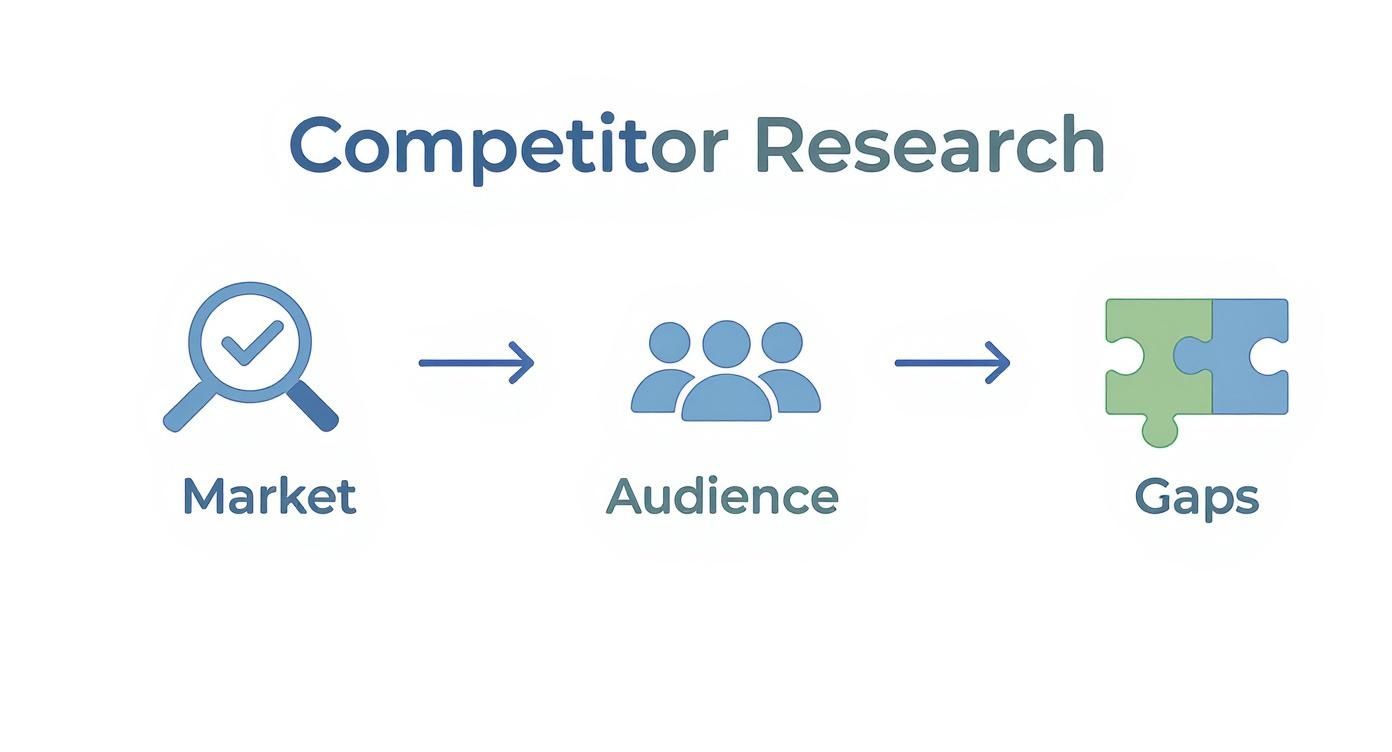
As you can see, this isn't just about grabbing a list of keywords. It's a strategic process of market analysis, getting to know your audience, and pinpointing real opportunities.
Why This Isn't Just "Spying"
Forget the sneaky vibes. Good competitor keyword research is really about gathering market intelligence. It helps you dodge costly mistakes by learning from what others have already tried—both their wins and their hilarious fails. You're not just looking at keywords; you're deciphering their entire content strategy. What topics do they own? Where are they weak? Are they completely ignoring a customer segment you could swoop in and serve?
> The goal isn't to imitate. It's to find the blueprint of what works and then build something much, much better. You’re using their hard work to fast-track your own growth.
For instance, you might find a competitor ranks for "best accounting software for freelancers," but their article is from two years ago. That's not a keyword to copy—it's a golden ticket to create a superior, up-to-date resource and steal that traffic right from under them.
The Tools for the Job
To pull this off right, you’ll need some help. The big players like Ahrefs or Semrush are incredibly powerful but come with a hefty price tag, often running hundreds of dollars a month. They can show you pretty much every keyword a competitor ranks for.
For a more budget-friendly approach, tools like already.dev offer similar competitive insights without making your wallet cry, which is perfect for startups and smaller teams. To make sure your efforts fit into a solid plan, it's always a good idea to review general keyword research best practices.
This guide will walk you through a practical, repeatable workflow to find the exact terms that will drive real traffic and results.
Finding Competitors You Never Knew You Had

You probably have a neat list of your main rivals—the ones you glare at during industry events and secretly check their website every week. But what if I told you your biggest SEO competitor isn't the company you think it is?
The real battlefield for traffic is packed with players you've likely never even heard of. These are your keyword competitors, and they're quietly siphoning off potential customers before you even get a chance.
A keyword competitor is just any website that ranks for the terms you want to rank for, even if they don't sell the same stuff you do. This could be a niche blog, an industry magazine, a popular forum, or even a review site. They're all competing for eyeballs, and in the world of SEO, eyeballs are everything.
Direct vs. Indirect Competitors
Let's break it down. If you sell high-end coffee makers, another company selling similar coffee makers is a direct competitor. You're both fighting for the same customer's wallet. Simple enough.
But what about that popular coffee blog that wrote "The 10 Best Espresso Machines Under $500"? They don't sell any machines, but they absolutely rank for keywords your customers are searching for. This is an indirect competitor. They're not after the final sale, but they're capturing the attention and trust of your audience way before you can.
You have to pay attention to both. Direct competitors show you what’s working in your specific market, while indirect competitors are a goldmine for content ideas and understanding what your audience really wants to know. For a deeper dive, check out our guide on https://blog.already.dev/posts/how-to-find-competitors.
> You're not just competing against other products; you're competing against every piece of content that answers your customer's questions. Ignoring indirect competitors is like leaving the side door of your house wide open.
Uncovering Your Hidden Rivals
So, how do you find these digital ghosts? The big, expensive tools like Ahrefs or Semrush are fantastic for this. You can plug in a keyword and they’ll spit out a list of every single site that ranks for it. They're incredibly powerful, but they can also cost a small fortune.
A more affordable alternative like already.dev can give you similar competitive intelligence without making your accountant cry. The goal here is to build a list that goes way beyond the usual suspects.
Once you have a list, here’s a practical way to categorize them:
- Primary Competitors: These are your head-to-head rivals. You sell the same stuff to the same people. Monitor them closely.
- Secondary Competitors: They might sell a high-end or low-end version of your product, or they might serve a slightly different market. Keep an eye on them.
- Indirect/Content Competitors: These are the blogs, magazines, and affiliate sites. Don't obsess over them, but definitely borrow (ahem, "get inspired by") their content strategies.
This simple categorization helps you focus your energy. You need to know who to watch like a hawk and who you can just learn from. Understanding this landscape is crucial because every industry is different. For example, one study found the Local Services industry has 93 easy keyword opportunities for every difficult one, making it great for newcomers. In contrast, Finance and SaaS are brutal battlegrounds with a nearly 1-to-1 ratio of easy-to-hard keywords. This data proves why digging deep into competitor research is so important—it's how you find realistic opportunities.
How to Ethically Steal Their Best Keywords
Alright, let's get down to business. It's time to figure out exactly what's working for your competitors so you can do it even better. We're going to pull off a little digital reconnaissance to see which keywords are actually driving them traffic and making them money.
This isn't about blind guesswork. It's about using real data to build a master list of topics that are already proven to attract the right audience. Think of it as letting your competitors do all the expensive trial and error for you.
Choosing Your Tools for the Job
To do this right, you need the proper gear. The big platforms like Ahrefs and Semrush are the gold standard for a reason—they have incredible data and powerful filtering capabilities. The only catch? They are very expensive, often running hundreds of dollars a month.
Luckily, you don't need a massive budget to get the job done. More affordable tools like already.dev can deliver the competitive intelligence you need without emptying your wallet. We break down even more options in our guide on the best competitor analysis tools here: https://blog.already.dev/posts/best-competitor-analysis-tools
No matter which tool you pick, the fundamental process is the same: you plug in a competitor’s domain and start digging.
To give you a clearer picture, here’s a quick rundown of some popular tools.
Comparing Popular Keyword Research Tools
This table offers a quick look at some go-to SEO tools, what they're best at, and what you can expect to pay.
| Tool | Best For | Typical Cost | |---------------|---------------------------------------------------------------------------|----------------------| | Ahrefs | Deep-dive backlink analysis and comprehensive keyword/content exploration | Expensive (starts ~$99/mo) | | Semrush | All-in-one marketing suite, from SEO to PPC and social media analysis | Expensive (starts ~$129/mo)| | already.dev | Affordable and focused competitor keyword analysis for startups | Varies, much lower cost | | Ubersuggest | Great for beginners and those on a tight budget, with a free tier | Free to ~$29/month |
Ultimately, the best tool is the one that fits your budget and gives you the data you need to make smart decisions.
Pinpointing Their "Money Pages"
Every website has a handful of pages that do all the heavy lifting—the ones pulling in the lion's share of valuable, organic traffic. These are their "money pages," and your first mission is to find them.
Just pop a competitor's domain into your tool of choice and look for a "Top Pages" or "Best by Links" report. This will instantly show you which of their URLs are getting the most love from Google.
Take a good look at what you find. Are they long-form blog posts? Simple product pages? Detailed landing pages? This one step alone gives you a massive clue about what kind of content connects with your shared audience. If their top performers are all "how-to" guides, you know what you need to start creating.
> Don't just look at the keywords; look at the pages that rank for them. A keyword is just a query, but a top-ranking page is a complete solution that Google has already validated as being valuable to searchers.
Once you have these pages identified, you can drill down even further to see every single keyword that specific page ranks for. This is how you go from a vague idea to a concrete list of terms to target.
Hunting for the Low-Hanging Fruit
Now for the really fun part: spotting their weaknesses. Just because a competitor shows up for a keyword doesn’t mean they own it. This is where you find your openings.
The trick is to apply a few simple filters to their keyword list. Here’s a setup I use all the time:
- Positions 5-20: This is the sweet spot. It flags keywords where your competitor is visible but hasn't locked down a top spot. They've proven the term has value, but they’ve left the door wide open for you to create something better.
- Lower Keyword Difficulty (KD): Most tools have a difficulty score. Filter for keywords with a lower KD. Trying to rank for a KD 80 term right out of the gate is a recipe for disappointment. Sticking to keywords under 30 gives you a real fighting chance.
- Informational Keywords: Look for queries that include words like "how," "what," "why," or "best." These informational searches are often much easier to rank for with a solid blog post than the super-competitive commercial terms.
This filtering turns a massive, overwhelming spreadsheet into a focused hit list of your best opportunities. A recent survey found that 78% of SEO professionals regularly use tools like these to find these exact kinds of strategic gaps. You're specifically looking for places where they're vulnerable—where you can create a more helpful, in-depth, or up-to-date piece of content and jump right past them in the search results.
As you uncover these keywords, you can weave them into a broader SEO plan. For more on that, check out these 10 SEO tips for SaaS companies. This entire workflow is repeatable, allowing you to systematically build out your content strategy based on what’s already winning in your industry.
Turning a Messy List into a Goldmine
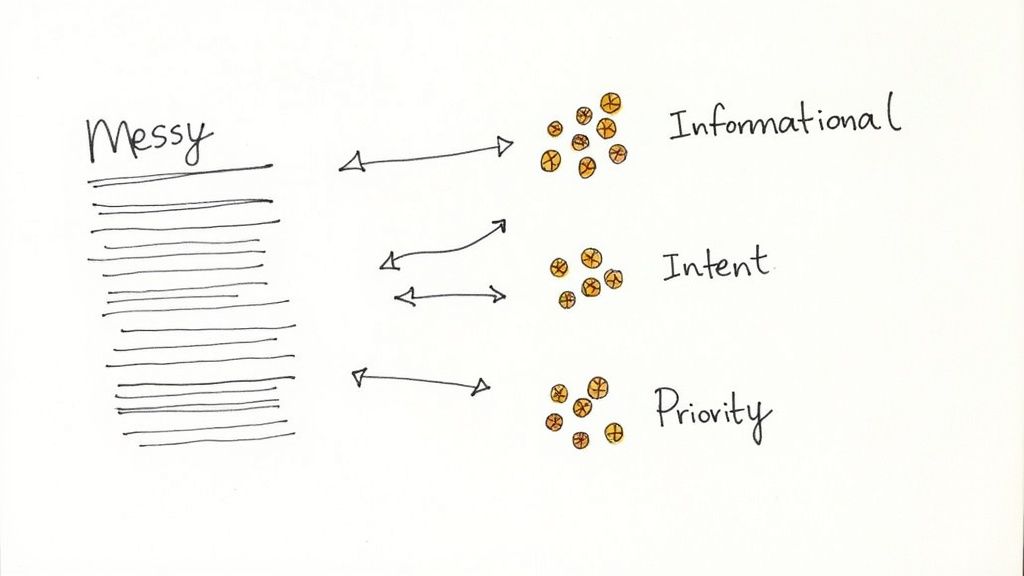
Alright, you did it. You spied on your competitors, scraped all the data, and now you’re the proud owner of a spreadsheet with thousands of keywords. It’s a beautiful, slightly terrifying mess, isn't it?
Before you get overwhelmed and close the laptop, take a breath. This digital chaos is actually a goldmine, and we’re about to start digging. This is where we transform that raw data into a clean, actionable content plan. And the best part? You don't need to be a spreadsheet wizard. This is all about simple, logical sorting.
Cleaning Up the Junk Drawer
First things first: we need to throw out the garbage. Your raw keyword export is definitely full of junk that’s completely irrelevant to your business. The most common culprit is a competitor's branded keywords.
If your rival is "SuperPants Inc.," your list is probably littered with terms like "SuperPants login," "SuperPants pricing," or "is SuperPants a scam?" Unless you're specifically writing reviews about them, these keywords are useless. Filter them out. Just use your spreadsheet's search function for their brand name and delete those rows without mercy.
You'll also find tons of duplicates or near-duplicates. Think "how to fix leaky faucet" and "how to fix a leaky faucet"—they're the same search. Pick one, ditch the other. A little manual cleanup now will save you a world of headaches later on.
> Think of this step like cleaning out your garage. You have to toss the old paint cans and broken lawn chairs before you can find the tools you actually need to build something cool.
Grouping Keywords into Topic Clusters
With the junk gone, it's time to start grouping. This is the secret to turning a random list of terms into a real content strategy. The goal is to group similar keywords into topic clusters. It’s just a fancy way of saying "a bunch of keywords that are all about the same thing."
For instance, you might see keywords like these:
- "best running shoes for beginners"
- "how to choose running shoes"
- "what to look for in running shoes"
- "running shoe guide"
Instead of treating these as four separate content ideas, you can see they all fall under one big topic: choosing running shoes. This becomes one powerhouse article, not four flimsy ones. This approach is killer for building topical authority, which Google absolutely loves.
The Secret Sauce: Understanding User Intent
This is easily the most important part of the whole process. User intent is the why behind a search. It’s the difference between someone just browsing and someone with their wallet out, ready to buy. Nailing this is what separates an SEO strategy that just gets traffic from one that actually gets customers.
I find it easiest to sort intent into three simple buckets:
- Informational: The searcher wants to learn something. These are your "how," "what," "why," and "best" queries. An example would be, "how to fix a leaky faucet."
- Commercial: They're a step closer to buying and are now investigating options or comparing products. Think "best kitchen faucet brands."
- Transactional: They are ready to buy. These searches often include words like "buy," "price," or "discount." A classic example is "buy new kitchen faucet online."
Go through your clustered list and tag each group with one of these intents. This simple act instantly turns your spreadsheet into a strategic document. Now you know which keywords are perfect for top-of-funnel blog posts (Informational) and which are destined for bottom-of-funnel landing pages (Transactional).
This level of detail is how you uncover the real wins. In fact, deep competitor analysis can reveal massive content gaps. I once saw a company discover their competitors were ranking for over 200 long-tail keywords for a niche financial product they had completely overlooked. By targeting these, they boosted their organic traffic by 35% in just six months.
Once everything is cleaned, clustered, and tagged, you’re ready for the final step: prioritization. To make this whole process smoother, grab our free competitor analysis template to keep all your findings organized. Your messy list is now a powerful, structured roadmap for exactly what to create next.
Creating Your Content Attack Plan
Alright, let's get down to business. You've wrangled that beast of a spreadsheet into a clean, organized list of keyword clusters, all tagged up with user intent. That’s a huge win, so give yourself a pat on the back.
But here’s the reality check: unless you have a content team the size of a small army and an unlimited budget, you simply can't target everything at once.
For the rest of us, prioritization is everything. This is the moment we shift from dreaming about possibilities to actually making a plan. We need a straightforward way to decide which keywords to go after first—the ones that will give us the most bang for our buck. This is how you transform a "what if" document into a "what's next" action plan for your content calendar.
The Holy Trinity of Keyword Prioritization
Forget about overly complex formulas and spreadsheets with fifty columns. To make smart, strategic bets, you really only need to zero in on three things for each keyword cluster. Think of it as a simple balancing act that will help you quickly separate the real gold from the glitter.
Here's what you need to look at:
-
Relevance: How badly do you want this customer? On a scale of 1-10, how perfectly does this keyword align with your core product or service? A keyword like "buy [your product]" is a solid 10. A vaguely related "how-to" topic might be a 3. Be brutally honest with yourself here.
-
Search Volume: Is anyone actually looking for this? A keyword with a million monthly searches sounds amazing, but it’s probably way too broad to be useful. On the flip side, a term with only 10 searches a month likely isn't worth the effort. You're looking for that sweet spot in the middle.
-
Difficulty: Let's be real—can you actually win? This is your gut-check moment. If the first page of Google is dominated by massive, authoritative brands, your chances of ranking as a smaller player are slim to none. Look for keywords where you actually have a fighting chance.
These three pillars are the foundation of a solid content attack plan. They’ll keep you from wasting time and money chasing keywords you can't rank for or that will never lead to a sale.
> Prioritization isn't about finding the 'best' keywords in a vacuum. It's about finding the best keywords for you, right now. It’s the difference between having a list and having a strategy.
Finding Your Sweet Spot
The perfect keyword opportunity lives right at the intersection of these three factors. What you're really hunting for are terms with high relevance, decent search volume, and low-to-medium difficulty. This is your low-hanging fruit—the keywords that can deliver quick wins and build some much-needed momentum for your SEO.
The big, expensive tools like Semrush and Ahrefs will give you a "Keyword Difficulty" score, and that's a great place to start. But even if you’re using a more affordable tool like already.dev, you can get a good feel for the competition just by Googling the term yourself.
Take a hard look at the search results. What do you see?
- A wall of massive, well-known companies? (Hard)
- A few smaller blogs or forum discussions? (Easier)
- A bunch of outdated or low-quality articles? (Jackpot!)
This quick manual check gives you a real-world sense of the competitive landscape that a simple number can't always capture. It helps you spot the gaps where you can slide in and offer a much better answer than what's currently ranking.
A Simple Scoring System to Rule Them All
Now, let's make this ridiculously easy.
Hop back into your spreadsheet and add three new columns: Relevance (1-10), Volume (1-10), and Difficulty (1-10). Just be sure to flip the difficulty score, so 1 is the hardest and 10 is the easiest. Then, score each of your keyword clusters.
Finally, add one last column called "Priority Score" and use this simple formula: (Relevance + Volume + Difficulty).
And just like that, you've got your marching orders. Sort the spreadsheet by this new score from highest to lowest. The clusters with the highest scores are your top priorities. They represent the best possible combination of business value, audience size, and winnability. This simple system makes the best targets bubble right to the top, giving you a clear, data-driven roadmap for what to create next.
Got Questions? We've Got Answers
Alright, you've got the playbook, but a few questions are probably still rattling around in your head. That's a good thing. It means you're thinking critically about how to apply all this. Competitor keyword research can feel a bit like peeling an onion—there are always more layers.
Let's clear up some of the most common head-scratchers I hear all the time.
How Often Should I Actually Do This?
Think of this process less like a one-time project and more like a routine check-up. The digital space moves way too fast for a "set it and forget it" approach.
I recommend a full, deep-dive analysis once a quarter. This is your chance to zoom out and spot the bigger picture: Has a new competitor entered the scene? Did an old rival just pivot their entire content strategy? This quarterly rhythm keeps your strategy from getting stale.
For your main competitors—the ones you’re constantly bumping up against—a quick monthly look-see is smart. You're not redoing the whole project, just scanning for immediate changes. This helps you catch things like:
- New product or feature launches they're targeting with keywords.
- A specific blog post that's suddenly taking off.
- A new content cluster they’re building out to claim a new topic.
> The point isn't to get obsessed with every little move they make. It's about gathering intelligence to spot trends and opportunities. Constant mirroring leads to reactive, uninspired marketing, not a winning strategy.
What If My Competitor Is a Goliathan Brand?
Okay, so your main competitor is a household name with a marketing budget that could buy a small island. First off, don't panic. Trying to go head-to-head with them on their turf is a fool's errand. You can't out-Amazon Amazon.
Chasing their broad, high-volume keywords like "running shoes" is like trying to win a shouting match at a rock concert. You just won't be heard. As a smaller, nimbler business, your advantage lies in being specific.
This is where you have to get scrappy and lean into long-tail keywords. Think about the hyper-specific queries the big players ignore because they’re too busy chasing massive volume.
For instance, a corporate giant might own the keyword "running shoes," but they’re probably not creating in-depth content for "best waterproof trail running shoes for wide feet." That's your opening. You can use their massive keyword profile to find these little pockets of opportunity where you can deliver real, specialized value that a huge corporation simply can't.
Is It Cool to Target the Exact Same Keywords?
Yes, absolutely! In fact, you pretty much have to. But—and this is a huge "but"—you can't just slap together a carbon copy of their content. That’s a fast track to being completely ignored by both search engines and actual humans.
The real goal is to see what's already resonating with the audience and then create something that's 10 times better. Brian Dean famously coined this the "Skyscraper Technique." If their top-ranking article is "10 Tips for Better SEO," your job is to come out with something like, "The Ultimate Guide to SEO in 2025: 25 Actionable Tips with Examples and a Free Checklist."
When you find a keyword where they're ranking well, put on your analyst hat and really dissect their page. Ask yourself:
- Is this information getting a little stale or incomplete?
- Are they missing key data, examples, or visuals?
- Is the page itself kind of clunky or hard to read?
- Could this be way more engaging with video, an interactive tool, or better design?
Your mission is to find their weak spots and pounce. You're using their success as a proven concept, then raising the bar so high that your version becomes the definitive resource on the topic.
Ready to stop guessing and start finding those competitor keyword gaps? already.dev uses AI to do the heavy lifting, uncovering every competitor and the keywords they rank for in minutes, not days. Get the data-driven confidence you need to build a winning content strategy.
Find out more at https://already.dev