10 Differentiation Strategy Examples to Stand Out (and Not Be Boring)
Stop blending in. Steal these 10 powerful differentiation strategy examples to carve out your market niche and leave competitors wondering what happened.
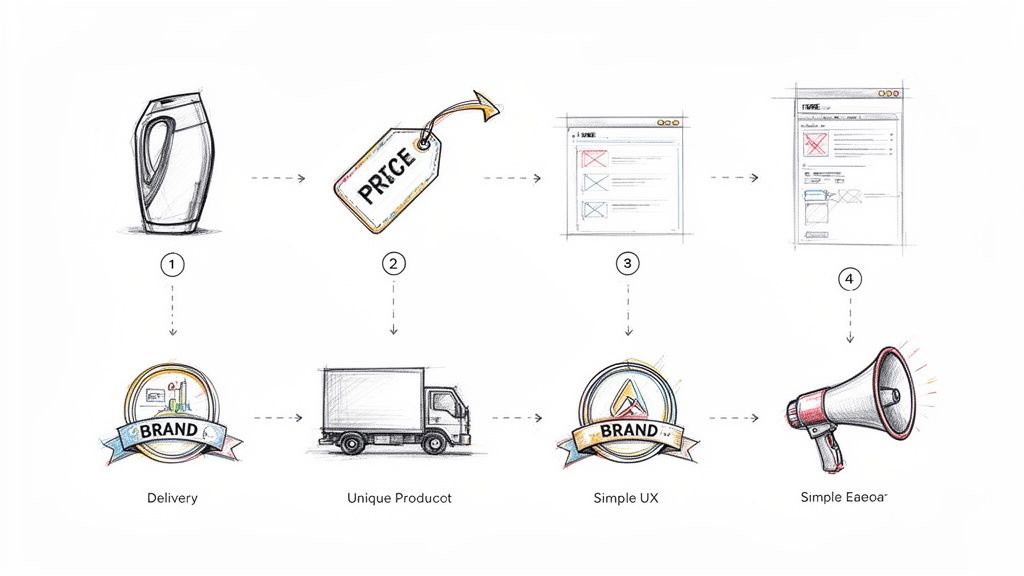
Look, the world doesn't need another generic SaaS tool or a carbon-copy ecommerce store. Seriously. What it needs is your business, but the version that isn't just shouting into the void trying to be heard over the noise. Being different isn't about having a wacky logo or using a weird font. It's about making a deliberate choice to be the only logical choice for a specific type of customer. But how do you actually do that without a massive marketing budget or a team of branding gurus?
You need a game plan. Forget the dense MBA-speak and theories that put you to sleep. This article is your practical playbook. We’re going to break down 10 real-world, no-fluff differentiation strategy examples you can actually use, covering everything from product features to how you price your stuff.
For each example, we'll dive into a mini case study, explaining exactly why the strategy worked. More importantly, we'll give you a step-by-step guide on how you can steal these ideas for your own business. We'll also tell you what to measure so you know if your efforts are actually working.
Think of this as your cheat sheet for building a brand that doesn't suck. Ready to stop competing on price and start dominating your little corner of the world? Let's get to it.
1. Feature-Based Differentiation
This is the classic "my thing does something your thing can't" strategy. It’s all about building a product with unique features that make competitors look like they're from the Stone Age. You’re not just building another mousetrap; you're building one with laser targeting and a slick mobile app.
This is a super direct way to be different because it gives customers a concrete reason to choose you. When a user can point to a specific feature and say, "I need that," you've pretty much won. Think of Figma's real-time collaboration. Before Figma, designers were emailing ".psd" files back and forth like it was 1999. Figma introduced a feature that let teams work on the same file, at the same time. Game-changer.
Why It Works & How to Implement It
This works because it solves a specific, often painful, problem. The trick is making sure customers actually care about the feature you're building.
How to get it right:
- Find Feature Gaps: Don't guess what to build. Use tools to see what your competitors are missing. Tools like Ahrefs or Semrush can help with research, but they can be crazy expensive. A more focused alternative like Already.dev can automatically find competitor feature gaps, saving you a ton of time and money.
- Focus, Don't Bloat: Instead of building a Swiss Army knife with a million mediocre features, build one razor-sharp scalpel. Focus on 2-3 core features that deliver massive value. Notion did this perfectly with its all-in-one "blocks" system, creating a uniquely flexible workspace.
- Create a Moat: Build features that get better as more people use them (network effects) or that make it hard for customers to leave (switching costs). Tesla's Supercharger network is a perfect example; the more stations they build, the more valuable a Tesla becomes.
2. Price and Pricing Model Differentiation
This isn't just about being the cheapest. That's a race to the bottom. Price differentiation is about how you charge and the value you signal with your price. You can be the no-frills, low-cost leader like Southwest Airlines or the fancy, premium option.
The real magic, though, is in the pricing model. Instead of a boring monthly fee, you can get creative with usage-based, freemium, or other models that actually make sense for your customers. Think of Stripe's pay-as-you-go model. They only make money when their customers make money. This created perfect alignment and fueled their growth. This is a powerful differentiation strategy example because it can make your product a no-brainer to buy compared to competitors.
Why It Works & How to Implement It
A smart pricing model makes it easier for people to start using your product and ties your success directly to theirs. This builds trust and makes your competitors' rigid subscriptions look dumb.
How to get it right:
- Benchmark Your Competitors: You can’t set a price in a vacuum. You need to know what everyone else is charging. Manually tracking this is a total pain. Tools like Already.dev can automatically benchmark your pricing against competitors. You can find more detail in this guide to competitor price comparison.
- Align Price with Value: Don't just pull a number out of thin air. Tie your price to the main value customers get. For HubSpot, it’s the number of contacts. For AWS, it's the computing power used. This makes the cost feel fair.
- Offer a "No-Brainer" Entry Point: A freemium or usage-based model is awesome for getting users in the door. Mailchimp's famous free plan let millions of small businesses get started, creating a huge funnel for their paid plans. Just make sure you don't go broke giving everything away for free.
3. Quality-Based Differentiation
This strategy is about being the "best in class." Not by having the most features, but by being the most reliable, durable, and well-made. You're not building the cheapest car; you're building the Mercedes-Benz that runs flawlessly for 20 years.
This approach is powerful because it builds deep customer trust and lets you charge more. When customers know your product just works and will last, they'll pay to avoid the headaches of cheaper junk. Think of Apple's crazy design and manufacturing standards. An iPhone feels solid because every part is chosen for quality, creating an experience that's hard to copy.
Why It Works & How to Implement It
This works because it taps into a basic human desire: peace of mind. Quality builds loyalty and creates fans who will tell everyone how great your product is. The key is to measure quality with real numbers, not just fluffy marketing claims.
How to get it right:
- Pinpoint Competitor Quality Gaps: Your definition of "quality" has to solve a real problem. Sifting through reviews to find complaints about competitors is a soul-crushing task. A tool like Already.dev can instantly analyze customer reviews to show you exactly where competitors are failing on quality, giving you a clear roadmap.
- Measure Everything: Don't just say you're high-quality; prove it. Track real metrics like platform uptime (aim for 99.99%), bug rates, customer support response times, and Net Promoter Score (NPS). Make these numbers a core part of your company's dashboard.
- Communicate Your Superiority: Use your quality stats in your marketing. Patagonia does this by showing off the durability of its gear and backing it with an Ironclad Guarantee. Use case studies and testimonials to show customers you’re not just all talk.
4. Brand-Based Differentiation
This is the "people don't buy what you do, they buy why you do it" strategy. Brand-based differentiation is more than just logos and colors; it's about crafting a powerful story that makes customers feel like they're part of a tribe. You’re not just selling a product; you're selling an identity.
This is one of the most lasting ways to be different because a strong brand is super hard to copy. Anyone can copy a feature, but they can't copy your reputation. Think of Patagonia. People don't just buy a jacket; they buy into a mission of environmental activism. That connection is priceless.
Why It Works & How to Implement It
This works because humans are emotional creatures. A good brand story connects with our values, turning a simple purchase into a meaningful choice. The key is being authentic; customers can spot a fake a mile away.
How to get it right:
- Define Your "Why": Start with your mission. Why does your company exist beyond making money? Dollar Shave Club’s funny, anti-establishment brand was built on the simple story of taking on overpriced razor giants.
- Find Your Voice: Figure out your brand's personality. Are you the expert guide, the rebellious outlaw, or the trusted friend? Use a tool like Already.dev to analyze competitor brand positioning and find a unique voice. This helps you build a solid foundation with a clear marketing positioning matrix.
- Live Your Brand: Consistency is everything. Your brand promise must show up in your product, your marketing, and your customer support. To really stand out, you can also draw inspiration from incredible examples of branded content that grab attention and build recognition.
5. Customer Service and Experience Differentiation
This strategy is less about what your product does and more about how it feels to use it. It’s about creating an experience so smooth and helpful that customers wouldn't dream of leaving. You're not just selling software; you're selling a partnership.
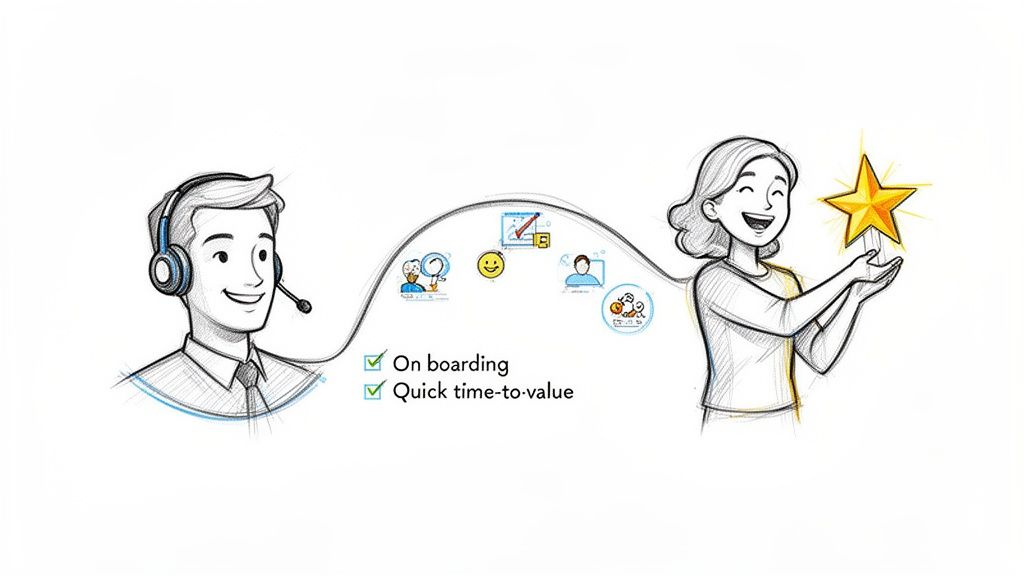
This is one of the most powerful differentiation strategy examples because it’s so hard for competitors to copy. You can replicate a feature overnight, but you can't easily replicate a world-class culture of customer obsession. Think of Zappos' legendary service, where reps are encouraged to stay on the phone as long as it takes to make a customer happy. That's a real competitive advantage.
Why It Works & How to Implement It
This strategy works because people buy from people they like and trust. A great experience builds deep loyalty that goes beyond price or features. It turns customers into your best salespeople.
How to get it right:
- Find Friction Points: Don't just guess where your customers are struggling. Map their entire journey. Use tools like Already.dev to analyze customer reviews and support tickets for your competitors, pinpointing their service gaps. Their weakness is your opportunity.
- Invest in Success Early: Don't treat customer support as a cost center. Hire a customer success team before you think you need one. Their job isn't just to answer tickets but to make sure customers are actually winning with your product.
- Arm Your Team: Give your team the tools and power to solve problems without asking a manager for permission every five minutes. Stripe's excellent developer documentation is a form of customer service; it helps users help themselves, which builds trust.
6. Technology and Innovation Differentiation
This is the "we built something nobody else can" strategy. It’s about creating a massive advantage through proprietary tech, patents, or unique algorithms. You're not just making a better version of something; you're fundamentally changing how the problem is solved.
This is a monster of a differentiation strategy because it creates a true competitive moat. When your core tech is years ahead of everyone else, it's almost impossible for them to catch up. Think of Stripe's API-first approach to payments. While others offered clunky old systems, Stripe built simple, elegant tech that revolutionized online payments.
Why It Works & How to Implement It
This works because it builds high barriers to entry, making your market position super defensible. The key is making sure your tech breakthrough solves a real, painful problem and isn't just a science project.
How to get it right:
- Solve a Real Problem: Don't build tech in a vacuum. Start with a customer pain point that your innovation can uniquely solve. Your R&D should be focused on creating value, not just cool demos.
- Build a Technical Moat: Your innovation needs to be hard to copy. This could be through patents, a deep well of data for an AI model, or a system that's just way more efficient. Tesla’s lead in battery tech and self-driving data is a perfect example.
- Translate Tech to Value: Don't just sell the technology; sell the result. Explain how your fancy tech translates into real benefits like speed, cost savings, or better outcomes. Already.dev doesn't just talk about its AI; it promises to turn 40 hours of boring competitor research into 4 minutes.
7. Niche and Vertical Specialization
Instead of trying to be everything to everyone, this strategy is about becoming the undisputed master of one specific thing. It means targeting a specific customer segment or industry with a solution that’s tailor-made for them. You’re not just building a generic CRM; you’re building the CRM for dentists.

This is a killer strategy because it turns you from a "nice-to-have" into a "must-have" for your chosen audience. While general tools offer a 6/10 solution for everyone, you offer a 10/10 solution for a specific group. Think of Toast, which dominates the restaurant industry with a point-of-sale system built specifically for the chaos of food service.
Why It Works & How to Implement It
This works because it creates intense customer loyalty. When you deeply understand an industry's workflows and language, the big generic players look clueless. The key is to pick the right niche and go all-in.
How to get it right:
- Find an Underserved Vertical: Don't just pick a niche out of a hat. You need to do a market opportunity assessment to find a segment with real problems and money to spend. Use a tool like Already.dev to see which verticals competitors are ignoring.
- Become an Expert: Get obsessed with your niche. Talk to customers constantly, go to their industry events, and read their trade magazines. Your product and marketing must scream, "We get you."
- Build an Ecosystem, Not Just a Product: Dominate your niche by integrating with the other tools your customers already use. Veeva Systems did this in the life sciences space, creating a cloud ecosystem that became the industry standard.
8. Speed to Market and Agility Differentiation
This strategy is for the speed demons. It's not about having the most features or the lowest price; it's about being relentlessly fast. You ship new features, respond to feedback, and fix bugs before your competitors have even finished their morning coffee.
This is one of the best strategies for startups because it turns their small size into a weapon. While big, slow companies are stuck in meetings, you're already shipping. Think of Slack's early days. They iterated on user feedback at a dizzying pace, constantly shipping small improvements that made the product stickier and left rivals in the dust.
Why It Works & How to Implement It
This works because customers love momentum. Seeing a product constantly improve builds trust and excitement. In a fast-moving market, the company that learns and adapts the quickest wins. The trick is to build a culture that prioritizes speed without shipping garbage.
How to get it right:
- Build a Shipping Machine: Set up modern development practices like CI/CD and automated testing. This lets your engineers deploy code safely and often, making releases a non-event.
- Create Direct Feedback Loops: Don't let customer insights get lost in a game of telephone. Funnel feedback from support, social media, and sales calls directly to your product teams so they can react instantly.
- Monitor and Respond Instantly: You can't be fast if you're flying blind. You need to know what competitors are shipping and what customers want right now. Manual research can take 40+ hours, but a tool like Already.dev can deliver these competitive insights in minutes, letting you react faster than anyone else.
9. Distribution and Partnership Differentiation
This strategy is about showing up in places your competitors aren't. Instead of just selling directly, you build a web of strategic partnerships and integrations that give you exclusive access to customers. It’s less about what your product does and more about where people can find it.
This is a powerful way to create a network effect. When your product plugs seamlessly into the tools your customers already use, it becomes the default choice. Think of Stripe. It’s not just a payment processor; it's the payment engine embedded inside Shopify, Squarespace, and thousands of other platforms. This makes it incredibly hard for a competitor to kick them out.
Why It Works & How to Implement It
This works because it leverages the audience and trust of established partners. You’re not just acquiring customers one by one; you’re tapping into entire ecosystems. The key is to create true win-win relationships.
How to get it right:
- Map Your Ecosystem: Identify other tools your target customers use. You want partners that add value to your product, not direct competitors. Tools like Already.dev can help you find partnership and distribution gaps that your rivals have missed.
- Build an Open API: Make it dead simple for other developers to build on top of your platform. A well-documented API is the foundation of a good partnership program. Slack’s success was supercharged by its massive app store, all built on an open platform.
- Create a Partner Program: Don't just hope for integrations; actively recruit partners. Build a formal program with clear benefits like revenue sharing, co-marketing, and dedicated support. HubSpot’s legendary partner program turned thousands of marketing agencies into a powerful sales channel.
10. Data and Insights Differentiation
This strategy is about becoming the source for information no one else has. You compete by providing proprietary data or analytics that customers can't get anywhere else. You aren't just selling a tool; you're selling exclusive knowledge that gives your users an edge.
This is a powerful strategy because data creates a deep moat. Think about Google's search data. They know what the world is thinking about, which gives them an insane advantage. Similarly, companies like Apollo.io and Crunchbase built their businesses on organizing hard-to-get B2B data, making them indispensable for sales and investment pros.
Why It Works & How to Implement It
This works because it turns your product from a "nice-to-have" into an essential intelligence hub. When your data becomes the basis for your customers' critical decisions, they'll never leave. The key is to find and present data in a uniquely valuable way.
How to get it right:
- Find Unique Data Sources: Don't just scrape the same public websites as everyone else. Find data that's hard to get. This could mean building a community that generates unique data or creating a tool that captures it.
- Generate Proprietary Insights: Raw data isn't enough; you need to turn it into useful intelligence. To truly leverage data for differentiation, mastering customer feedback analysis is critical. Use machine learning to find trends and benchmarks that offer a unique perspective.
- Build an Intelligence Pipeline: Start early. Develop a system for collecting and cleaning data from day one. Companies like Already.dev do this by pulling from over 100 sources to provide unique competitive intelligence, a much more focused and affordable approach than trying to use expensive tools like Semrush or Ahrefs.
10 Differentiation Strategies Comparison
| Strategy | Implementation (🔄 Complexity) | Resources (⚡ Requirements) | Outcomes (⭐ Expected quality) | Use cases (💡 Ideal use cases) | Key advantages (📊 Impact) | |---|---|---:|---|---|---| | Feature-Based Differentiation | 🔄 Moderate → High (engineering & continuous R&D) | ⚡ High (dev, testing, maintenance) | ⭐ Clear product moat; enables premium pricing | 💡 Products where unique capabilities win early adopters | 📊 Measurable performance gains; easy marketing message | | Price & Pricing Model Differentiation | 🔄 Low → Moderate (experimentation, billing systems) | ⚡ Low → Moderate (billing, analytics) | ⭐ Rapid acquisition potential; margin sensitivity | 💡 Commoditized markets; price‑sensitive segments | 📊 Fast share capture; simple A/B testability | | Quality-Based Differentiation | 🔄 Moderate → High (processes, QA, culture) | ⚡ High (ops, talent, QA tools) | ⭐ Strong loyalty, lower churn, premium positioning | 💡 Enterprise, reliability‑critical products | 📊 Long-term retention and referral growth | | Brand-Based Differentiation | 🔄 Moderate (strategy + consistent execution over time) | ⚡ Moderate (marketing, content, PR sustained) | ⭐ Emotional loyalty and pricing power | 💡 Crowded markets needing emotional resonance | 📊 Defensible recognition; organic acquisition | | Customer Service & Experience | 🔄 Moderate (process design, training) | ⚡ High ongoing (support teams, CS programs) | ⭐ Reduced churn; higher lifetime value | 💡 Subscription services; high‑touch B2B offerings | 📊 Word‑of‑mouth growth; expansion revenue | | Technology & Innovation Differentiation | 🔄 High (patents, R&D, complex engineering) | ⚡ Very high (top talent, capital) | ⭐ Defensible moat; potential category leadership | 💡 Deep‑tech products and platform plays | 📊 Hard to replicate; attracts partnerships & talent | | Niche & Vertical Specialization | 🔄 Moderate (domain expertise, tailored workflows) | ⚡ Moderate (specialized hiring, integrations) | ⭐ High product‑market fit; strong retention | 💡 Underserved industries or regulated verticals | 📊 Easier acquisition; premium pricing for fit | | Speed to Market & Agility | 🔄 Moderate (CI/CD, team autonomy, processes) | ⚡ Low → Moderate (automation/tools) | ⭐ Fast validation; first‑mover advantages | 💡 Fast‑changing markets; early‑stage startups | 📊 Rapid learning; lower risk via iterations | | Distribution & Partnership Differentiation | 🔄 Moderate (partner ops, integrations, contracts) | ⚡ Moderate (partner management, API work) | ⭐ Faster reach; lower CAC via channels | 💡 Platform businesses; geographic expansion | 📊 Network effects; credibility from partners | | Data & Insights Differentiation | 🔄 High (data pipelines, compliance, ML) | ⚡ High (infrastructure, scale, privacy controls) | ⭐ Sticky product with unique, monetizable insights | 💡 Decision‑support, benchmarking, analytics tools | 📊 Value increases with scale; strong switching costs |
Your Turn: Stop Blending In and Start Winning
We've just covered a ton of differentiation strategy examples. The big takeaway should be this: differentiation isn't about being the absolute best at everything. That's a great way to go broke.
The real goal is to be meaningfully different on the one or two things your ideal customer actually cares about. It's about being the obvious choice for a specific group of people, not a mediocre option for everyone. The examples we covered aren't myths; they're stories of people who got obsessed with finding a gap nobody else was serving.
The Big Takeaways: Your Differentiation Cheat Sheet
Let's boil it all down. Forget the jargon. Winning with differentiation comes down to a few core ideas:
- Solve a Specific Pain, Not a General Problem: Superhuman didn't build a better "email client." They built the "fastest email experience ever made" for executives who value time above all else. They found a high-value pain point for a niche audience.
- Turn a Weakness into a Strength: Everyone else was racing to add more features. Basecamp did the opposite, focusing on simplicity. They made "lack of complexity" their core feature, which was a huge differentiator in a bloated market.
- Your Brand Is More Than a Logo: Liquid Death isn't just water; it's a punk rock attitude in a can. They sell an identity. Their brand is so strong that the product itself is almost secondary.
- Experience is a Product: Zappos didn't invent shoes, but they basically invented amazing online customer service. Their 365-day return policy wasn't just a "feature"; it was the core experience that built an empire.
From "What If?" to "What's Next?"
So, where do you start? Don't just pick a strategy from this list and hope for the best. The secret is figuring out the sweet spot between what you're good at, what your competitors suck at, and what your customers desperately want.
This is where most people get stuck. They spend weeks manually Googling competitors, reading reviews, and trying to piece everything together. Or they shell out a fortune for expensive tools like Ahrefs or Semrush, only to get buried in data that doesn't tell them where the real opportunities are. It’s slow, painful, and often leads to bad guesses.
The smartest founders shortcut this process. They use data to pinpoint the exact cracks in the market. They don’t guess which features to build; they find the ones customers are begging for that competitors have ignored. They don't guess on pricing; they analyze the whole industry to find a unique angle.
Mastering the differentiation strategy examples we’ve explored is your ticket out of the "sea of sameness." It’s how you stop competing on price and start building a brand people love. Don't build another commodity. Find your unique angle, own it, and build something people can't help but talk about.
Tired of manually digging for competitor weaknesses and market gaps? Already.dev automates the entire competitive analysis process, giving you a crystal-clear roadmap for differentiation in minutes, not weeks. Stop guessing and start building a winning strategy with data-backed confidence at Already.dev.