How to Find Niche Markets That Actually Make Money
Tired of the competition? Learn how to find niche markets with our guide. We share practical steps to uncover and validate profitable ideas.

Finding a niche market is about carving out your own space. You start with a big market you care about, zoom in on a smaller, obsessed slice of that audience, and then find a specific problem they have that you can solve better than anyone else. Simple, right?
Stop Competing with Giants and Find Your Niche
Let’s be honest. Going toe-to-toe with giants like Amazon or Walmart is a fantastic way to set your money on fire. You’ll burn through your runway and your sanity before you even make a dent. The key to winning isn't to fight their fight; it's to find a totally different battleground—one they’ve completely ignored.
A niche market is your own little corner of the world where you can actually be the big fish. This isn't about selling some weird, obscure trinket. It’s about deeply serving a smaller, more passionate group of people who are desperate for what you’re offering. Forget shouting into the void of a saturated market where nobody can hear you.
Why Small Is the New Big
When you go niche, you’re not just chasing sales; you’re building a real community. Your customers become fans because they feel like you get them. That kind of loyalty means you can become the go-to expert in your space without needing a nine-figure marketing budget.
> The whole idea is beautifully simple: You're not just selling a product; you're solving a very specific problem for a very specific group of people. This laser-focused approach makes your marketing insanely effective, builds fierce customer loyalty, and often lets you charge a premium because you’re not just another generic option.
The process of narrowing down your focus is actually pretty straightforward, as this visual breaks down.
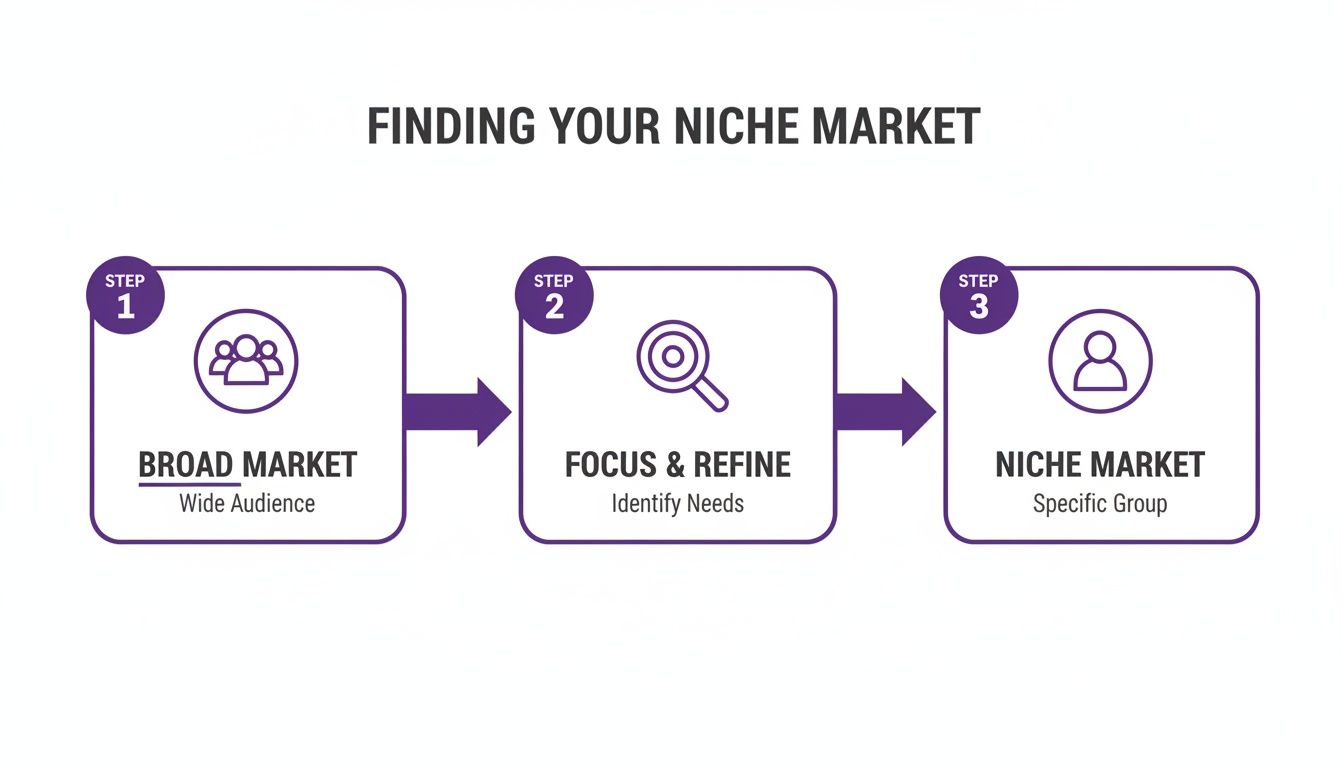
It’s a great reminder that success isn't about trying to please everyone. It's about making a meaningful connection with the right people who truly need what you’ve built.
To help you see just how powerful this is, here's a quick look at the core benefits of focusing on a niche market versus trying to tackle a broad one.
Why Going Niche is a Startup Superpower
| Benefit | The Niche Market Approach | The Broad Market Nightmare | | :--- | :--- | :--- | | Competition | You have fewer, if any, direct competitors. You can become the market leader. | You're up against giants with massive budgets and brand recognition. It’s a constant uphill battle. | | Marketing | Your message is hyper-targeted, making campaigns cheaper and more effective. You speak their language. | You have to shout to be heard. Marketing is expensive, and your message gets diluted. | | Customer Loyalty | You build a tribe of die-hard fans who feel understood. They become your best advocates. | Customers are fickle and price-sensitive. They have a million other options. | | Profit Margins | You can often charge premium prices for specialized solutions and expertise. | It's a race to the bottom on price. Margins are razor-thin. |
Ultimately, choosing a niche gives you an unfair advantage. It's about being a big deal to a small, passionate group instead of being invisible to everyone.
This whole strategy is about working smarter, not harder. By serving a dedicated audience, you can create a sustainable, profitable business that truly thrives.
If you want to go even deeper, check out a comprehensive guide on how to find your niche. Now, let’s get into the nitty-gritty of how you can find these hidden gems.
Uncover Niche Ideas Hidden in Plain Sight
You're probably sitting on a goldmine of niche ideas and don't even know it. Seriously. Forget trying to dream up the next big thing out of thin air and just look at your own life. The best, most genuine ideas almost always come from your personal headaches, hobbies, and weird obsessions.

Think about it this way: building a business is a marathon. If you aren't genuinely fired up about the problem you're solving, you’ll burn out fast. Kicking things off with something you know and care about gives you a massive, unfair advantage.
Mine Your Own Life for Problems
The very first place to dig for niche market ideas is your own experience. We all have those moments where we grumble, "Why doesn't this exist?" or "There has to be a better way to do this." Those little flashes of frustration? That's pure gold.
Get a notebook or open a doc and just start listing things. Don't filter, just write.
- Your Job: What tasks do you secretly dread? What software makes you want to chuck your laptop out the window? What's that one recurring complaint you and your coworkers always bond over?
- Your Hobbies: What piece of gear is always breaking? Is there a tool that would make your hobby 10x easier? What do you and other enthusiasts constantly complain about in your group chats?
- Your Daily Routine: What tiny annoyance trips you up every single day? Is there a product you own that just doesn't quite work for your specific needs?
This is exactly how great niche businesses are born. Someone gets fed up with the terrible selection of durable gear for left-handed gardeners, or they can't find a project management tool that doesn't feel like it was designed in 1998. So, they decide to fix it themselves.
> The most powerful business ideas come from scratching your own itch. When you solve a problem you personally have, you get a built-in understanding of the customer that no amount of market research can ever replicate.
This isn't just about spotting annoyances; it's about finding gaps that you are uniquely qualified to fill.
Look for Passionate Online Communities
Okay, once you have a few ideas pulled from your own life, it's time to see if you're the only one with this particular problem. The internet is perfect for this, since it neatly organizes people into hyper-specific communities. This is where your future customers are already hanging out.
Go dive into these digital watering holes:
- Reddit: Find subreddits related to your profession or hobbies. Look for posts where people are begging for recommendations, complaining about products, or sharing their DIY workarounds. The exact language they use is a cheat sheet for how to market to them later.
- Facebook Groups: Search for groups dedicated to specific interests—anything from "Vegan Keto Recipes" to "Vintage Motorcycle Restoration." Pay close attention to the recurring questions and frustrations that pop up over and over.
- Niche Forums: Trust me, every hobby has them. Whether it's a forum for audiophiles, saltwater aquarium keepers, or FPV drone pilots, these are the places where passionate people get into the nitty-gritty details.
Your job here is to be a fly on the wall. Listen to their pain points. What do they wish they could buy? What are they trying to hack together on their own? This is how you confirm that your personal problem is actually a shared market need.
This whole process isn't just about finding niche markets; it's about finding your market. By starting with authentic problems from your own life and then validating them within these passionate online communities, you lay the foundation for a business you’ll actually enjoy building for the long haul.
Validate Your Niche with Smart Research
Okay, you’ve mined your own experiences and lurked in passionate online communities. By now, you should have a shortlist of niche ideas that actually get you excited. That's a huge step. But before you start sketching logos or buying domain names, we need to find out if anyone will actually pay for what you're thinking of building.
This is the validation stage. It’s where your gut feeling gets a much-needed reality check with cold, hard data. Don't worry, we're not talking about complex financial models or MBA-level spreadsheets. This is about smart, scrappy research to see if you're really onto something.

Think of yourself as a digital anthropologist. Your job is to observe and listen to what people are complaining about, asking for, and—most importantly—searching for. This is where you find real demand.
Become a Digital Eavesdropper
The best place to start is where your potential customers are already gathered. Head back to those subreddits, Quora threads, and niche forums you found earlier. This time, you’re not just browsing; you're hunting for specific patterns.
You’re looking for recurring complaints and repeated requests. Are people constantly asking for a product recommendation that no one seems to have a good answer for? Are they sharing clunky DIY workarounds because an off-the-shelf solution just doesn't cut it? These are the clues you’re after.
Keep an eye out for phrases like these:
- "Does anyone know a tool for..." This is a goldmine. It’s a direct signal of an unmet need from someone actively trying to find a solution.
- "I'm so frustrated with..." Frustration is a powerful motivator for a purchase. When people are genuinely annoyed, they are primed to find something better.
- "I wish there was a..." This is your target audience literally handing you a product idea on a silver platter. Pay very close attention to these moments.
This kind of qualitative research is so important because it gives you the human story behind the search numbers and trend lines you'll look at next. For a much deeper dive into this process, check out our complete guide on market research for entrepreneurs.
Use Free Tools to Spot Trends
Once you’ve got a feel for the problems people are talking about, it's time to see if the interest is actually growing. This is how you confirm your niche is a rising tide and not just a passing fad.
Google Trends is your new best friend. It’s incredibly simple to use but surprisingly powerful. Just plug in a keyword related to your niche idea—think "vegan leather bags" or "home cold plunge tub"—and see what the search interest has been doing over the past few years.
> Is the trend line going up, staying flat, or slowly dying? An upward trend is a fantastic sign that you’re catching a wave. A flat line isn't a deal-breaker if the search volume is high, but a declining line is a massive red flag.
Seriously, this five-minute check can save you from building an entire business around a dying trend. It’s one of the highest-leverage things you can do at this stage.
Dig into Search Data Without Breaking the Bank
Now it's time to get a bit more granular and look at what people are actively typing into search engines. This is your quantitative validation—using real numbers to measure how many people are looking for a solution.
Sure, powerful SEO tools like Ahrefs or Semrush offer incredibly detailed keyword data. But let's be honest, they can be really expensive, especially when you're just exploring an idea. You don't need to spend hundreds of dollars a month just to get started.
A more accessible tool like already.dev can give you the search data you need without the hefty price tag. At this stage, you’re just trying to answer two simple questions:
- Are people searching for solutions to the problem you've identified?
- And if so, roughly how many of them are there?
Focus on finding "long-tail keywords." These are longer, more specific search phrases that reveal true intent. A search for "shoes" is impossibly broad, but a search for "waterproof hiking shoes for wide feet" is a niche customer practically shouting their exact needs at Google. Finding these specific queries is proof that a dedicated group is already looking for what you want to build.
Good quantitative validation means looking for measurable signals of demand before you invest significant time and money. Experienced analysts often hunt for micro-niches—like AI tools for hobbyists or premium pet consumables—that show sustained organic search growth of 20–80% year-over-year. When you find that kind of growth combined with low competition, you've hit a sweet spot of rising interest and a cost-effective way to find your first customers.
By mixing human insights from online communities with hard data from search trends, you're building a solid case for your niche. This isn't about finding a "sure thing" or eliminating all risk. It’s about making an educated bet and moving from "I think this is a good idea" to "I have evidence that people are actively looking for this."
Make Sure Your Niche Can Actually Pay the Bills
Passion is an incredible engine. It's what gets you out of bed in the morning and pushes you through the inevitable hurdles of starting something new. But let’s get real for a second: passion doesn’t pay the rent. A business with three die-hard fans is a fantastic hobby, not a viable company.
Now that you've landed on a niche idea that genuinely excites you, it's time to put on your business hat. We need to figure out if there's enough financial juice in this market to be worth the squeeze. This is the critical moment where we separate the fun side projects from the ideas that could actually become your full-time thing.
Don't sweat it—you don't need a degree in economics for this part. We're just doing some 'back-of-the-napkin' math to see if your idea is big enough to matter, but not so massive that you’d be picking a fight with a Fortune 500 company right out of the gate.
Sizing Up Your Pond
First things first, we need to get a ballpark idea of how many people are actually in your potential market. The goal here is to find that sweet spot: a market small enough to be overlooked by the big players but large enough to support your business and give it room to grow.
A simple way to think about this is in layers:
- Total Addressable Market (TAM): This is the entire universe of potential customers. If you were selling custom keyboards, the TAM would be everyone on the planet who uses a computer keyboard. It's a huge, intimidating number that's mostly useless for our purposes.
- Serviceable Available Market (SAM): Now we're getting warmer. This is the slice of that universe you can realistically reach. For your keyboard business, maybe that’s English-speaking mechanical keyboard enthusiasts who are active on Reddit and YouTube. Better, but still a little fuzzy.
- Serviceable Obtainable Market (SOM): This is the money shot. It’s the portion of the SAM you can realistically capture in the near future. As a new brand, maybe you can snag 1-2% of that market in your first couple of years.
> This isn't about finding a perfect, to-the-penny number. It's about understanding the scale of your playground. Is it a small puddle, a decent-sized lake, or a vast ocean? You’re looking for the lake—big enough to swim around in, but not so big you’ll get eaten by sharks.
This framework is used everywhere. Take the massive global wellness industry, for instance. A niche entrepreneur might look at the TAM for something like personalized nutrition kits. From there, they’d estimate their SOM by applying a realistic adoption rate. Many successful niche businesses aim to capture just 1–5% of their TAM in the early years, which can still translate to millions in revenue. You can find more insights on wellness trends on McKinsey.com.
The Simple Profitability Check
Once you have a rough sense of your market size, it's time to ask the most important question: can you actually make money here?
Here’s a dead-simple formula to get you started:
(Potential Customers in SOM) x (Average Price You Can Charge) = Potential Revenue
Let’s run a quick example. Say you’ve identified a niche of 10,000 potential customers (your SOM). If you think you can sell them a product or service for $75, that’s a total potential market of $750,000. If you capture just 5% of that in your first year, you’re looking at $37,500 in revenue. Is that enough to keep the lights on and grow? That depends on your goals, but now you have a real number to work with.
This quick calculation forces you to think about two critical things: how many people are truly out there, and what are they willing to pay?
If your initial numbers look terrifyingly small, don't panic. It doesn’t mean the idea is dead. It might just be a sign that you need to charge more, which is often possible in a niche where you’re offering a specialized solution. You can dive deeper into how to run a full market opportunity assessment in our other guide.
Of course, reaching those customers is key. A well-defined content strategy is essential for attracting and retaining customers within your niche, ensuring long-term financial viability. For more on that, check out this great Guide to Building a Winning Small Business Content Marketing Strategy.
This financial gut-check is a crucial step. It grounds your passion in reality, ensuring you’re building something that can not only fulfill you but also sustain you.
Test Your Niche Idea Without Going Broke
Alright, let's get out of the spreadsheets and into the real world. You’ve done the research, you've mapped out the landscape, and you’ve got a niche that feels right. But a gut feeling doesn't pay the bills.
Before you go all-in, you need to find out if real people will actually open their wallets for what you're selling. This is where we get scrappy. We're talking cheap, fast experiments designed to get one thing: proof of demand. Forget building a perfect product for now. We’re hunting for clicks, emails, and—the holy grail—pre-orders.
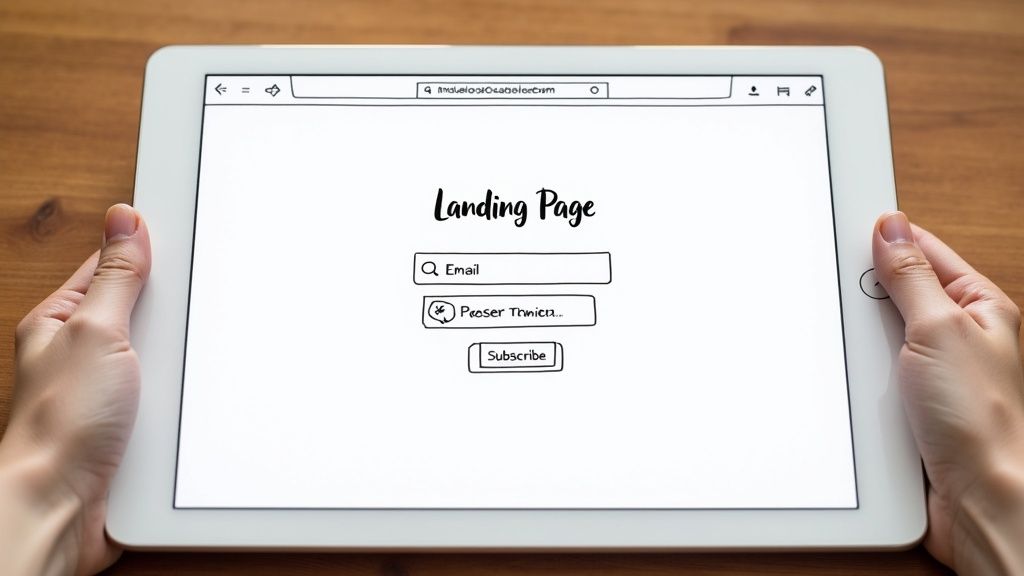
This is the moment of truth. This is what tells you whether to hit the gas, pivot slightly, or head back to the whiteboard.
The Landing Page Litmus Test
One of the most effective, low-effort ways to test the waters is a simple landing page. Think of it as a digital storefront for a product that doesn't exist yet. The only goal here is to see if your idea is compelling enough for someone to hand over their email address.
This doesn't need to be a masterpiece. Using a tool like Carrd or Webflow, you can get a page live in a single afternoon. Just make sure it clearly covers three things:
- The Problem: Hit them with the pain point you identified. Make it resonate.
- Your Solution: Frame your idea as the perfect answer to that specific problem.
- The Ask: A clear, can't-miss call to action button. Think "Get Early Access" or "Join the VIP List."
The number of sign-ups you get is your first tangible piece of data. A slow trickle is a yellow flag. A sudden rush of emails? That’s the green light you’re looking for.
Run a Tiny, Targeted Ad Campaign
Once the page is live, you need to get it in front of the right people. This doesn't require a big marketing budget. A small, strategically targeted ad campaign can give you a ton of insight.
You already know your audience from your research, right? You know where they hang out online and what they care about. Use that intel to run hyper-focused ads on platforms like Facebook, Instagram, or even a specific subreddit.
> You can get incredibly valuable data for as little as $50 to $100. You're not buying sales; you're buying information. The two metrics that matter most are click-through rate (CTR) and cost per email sign-up. A high CTR tells you your message is hitting home. A low cost per sign-up shows people are genuinely intrigued by your offer.
This small spend gives you hard numbers on whether you can actually reach your audience and if they care about what you're saying.
The Ultimate Validation: The Smoke Test
Ready to turn up the heat? The smoke test is my favorite validation trick because it cuts through the noise. It takes the landing page idea one step further by adding a "Pre-Order Now" or "Buy Now" button.
When a visitor clicks it, they don't go to a checkout page. Instead, they land on a simple page explaining the product isn't quite ready yet. From there, you can offer them a spot on an exclusive waitlist or a special discount for being one of the first believers.
This test measures the single most important thing: purchase intent. It's one thing for someone to give you an email address; it's another thing entirely for them to try and give you their credit card number. This is how you separate the window shoppers from the buyers who desperately need your solution.
Think of these validation experiments as your safety net. They're the fastest and cheapest ways to know for sure if you've struck gold or just have a cool idea. It’s how you find those winning niche markets without betting the farm.
A Few Lingering Questions About Niche Markets
Alright, you’ve made it this far. You've dug into your own life for ideas, maybe even done some quick math on a napkin. But let's be real—committing to a niche can feel like a leap of faith. It's totally normal to have some last-minute doubts and questions bouncing around in your head.
So, let's tackle them head-on. I've heard these same "what ifs" and "how-tos" from countless founders over the years. Think of this as your final gut-check before you dive into the deep end.
Can a Niche Actually Be Too Small?
Yes, absolutely. This is probably the biggest risk of them all. A niche with only a few hundred potential customers isn’t a business; it’s a hobby, and probably an expensive one at that.
This is precisely why we harped on market sizing and validation earlier. Those steps are your safety net, designed to stop you from pouring your heart and soul into something that’s dead on arrival.
You're looking for that sweet spot—a market small enough that the big players ignore it, but big enough to actually sustain you.
> Here's a simple gut-check I always use: Can you realistically capture just 5% of this market? If the revenue from that tiny slice can't cover your costs and pay you a decent salary, you’ve got two choices. Either figure out how to charge a lot more, or it's time to find a bigger pond.
Don't let the fear of being "too niche" paralyze you, but don't ignore the numbers, either. Treat data like your co-pilot.
What if Someone Steals My Amazing Niche Idea?
First, take a breath. Ideas are a dime a dozen. It’s all about the execution. If your idea is genuinely good, competition isn't just possible—it's guaranteed. Honestly, it’s a good sign! It's validation that there's money to be made.
Your best defense isn't keeping your idea under wraps. It's building a brand that people actually care about.
Here’s how you build a moat around your business that competitors can't cross:
- Have a Real Personality: Ditch the corporate jargon. Talk to your customers like a human being. Your unique voice is something no one can replicate.
- Build a Community: Start a newsletter, a Facebook group, or a Discord server. Give your fans a place to hang out and connect. Make them feel like they're part of an insider's club.
- Offer Insanely Good Service: When a customer has an issue, be the one who solves it faster and with more empathy than anyone else. People never forget that.
By the time the copycats inevitably show up, you should be so far ahead in building trust and loyalty that they can't touch you. They might rip off your product, but they can't steal the relationship you have with your customers.
How Can I Market to a Niche Audience Without a Big Budget?
This is where having a niche becomes your superpower. You don’t need a Super Bowl ad. You don't need a billboard in Times Square. Your audience is small and hangs out in predictable places, so you just need to show up there.
Think about it. You're not trying to reach "everyone." You're just trying to reach your people. That makes your marketing incredibly efficient and cheap.
Here are a few scrappy, low-budget tactics that punch way above their weight for niche businesses:
- Be Genuinely Helpful: Find the subreddits, forums, and Facebook groups where your people live. Don't just drop links to your site—that’s a rookie move. Instead, answer questions and offer real advice. Become a trusted expert, not a salesperson.
- Create Hyper-Specific Content: Start a blog or a TikTok account that laser-focuses on your niche's biggest headaches. If you're selling "sustainable pet products for city apartment dwellers," create content like "The 5 Best Compostable Dog Toys That Won't Stink Up Your Studio."
- Team Up with Micro-Influencers: Forget the huge names. Find small creators who your audience already knows and trusts. Their engagement is often through the roof, and they're much more affordable (and authentic) to partner with.
Because your audience is so focused, every dollar you spend and every minute you invest goes so much further. It’s the ultimate marketing cheat code.
Ready to stop guessing and start validating your niche with real data? already.dev uses AI to do the heavy lifting, uncovering competitors and market insights in minutes, not weeks. Ditch the expensive tools and endless manual research—find your strategic advantage today at https://already.dev.