A Founder's Guide to Pricing Strategy for New Products
Stop guessing and create a pricing strategy for new products that works. Learn how to research competitors, find your value metric, and launch with confidence.
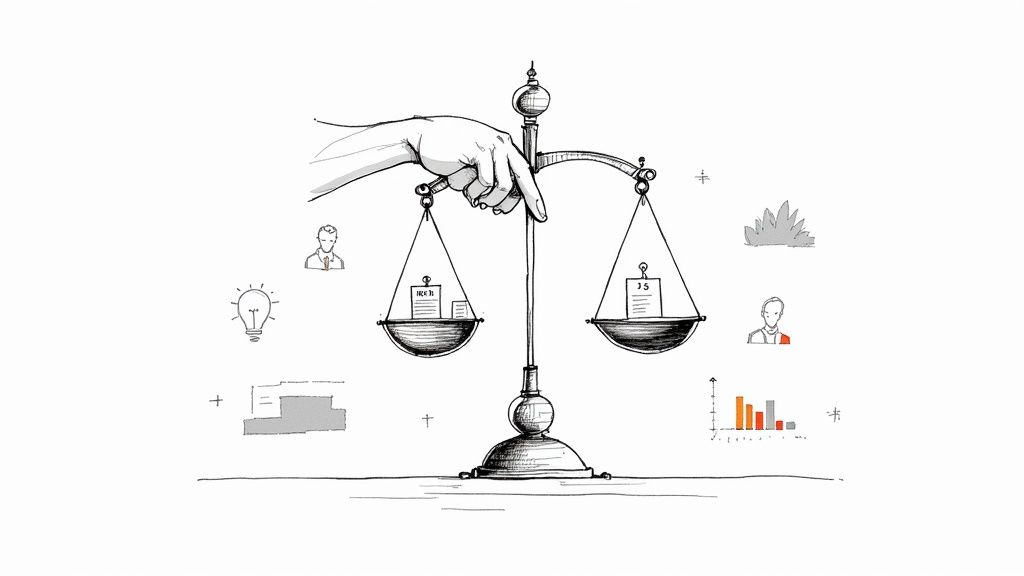
Picking a price for your new product can feel like throwing a dart in a dark room. You just hope you hit something that isn't your foot. A proper pricing strategy for new products is what turns that wild guess into a confident, data-backed decision that keeps the lights on and your customers happy. It’s less about dusty MBA theories and more about a practical plan for survival and not eating ramen for the rest of your life.
Why Your Gut Feeling on Price Is Probably Wrong
Let’s be real for a second. That number you have in your head for your new product? It’s probably a guess. Maybe you based it on your costs, what a competitor is charging, or just what feels right. The problem is, your gut has no idea what your customer's budget is or how much they'd truly pay to have their problem solved. Your gut is great for telling you when you're hungry, not for pricing a SaaS product.
Guessing is tempting because it’s fast. But it's also the quickest way to sink an otherwise great product. Price is the loudest signal you send about your product’s value. Go too low, and you scream "cheap and low-quality." Go too high, and you scare off potential buyers before they even kick the tires. A solid pricing strategy moves you from a place of fear to a position of strength.
It’s about moving from random guesswork to a strategic approach that actually fuels growth.
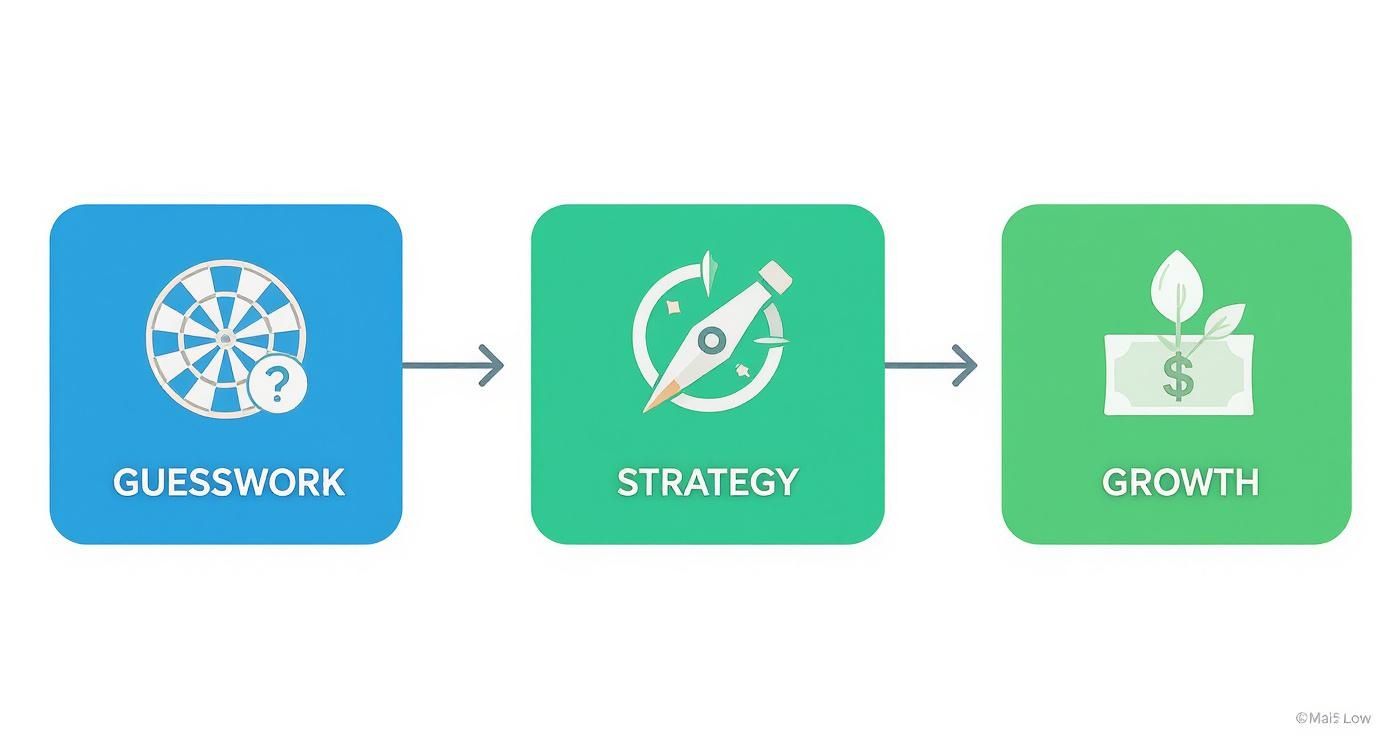
This path makes it clear: sustainable growth comes from a deliberate strategy, not a lucky shot with a dartboard.
Moving From Guesswork to a Real Strategy
So, how do you ditch the dartboard for good? It all starts with listening to the market instead of the voice in your head. You have to get out of the building (or, you know, open a new browser tab) and dig into what real people are actually willing to pay.
Before you can even dream of putting a number on your product, you have to do your homework. Understanding the competitive landscape is completely non-negotiable. For a deeper look at this, check out our guide on how to conduct effective market research for new products.
> Your price is a story you tell customers about your product’s worth. If you don't believe the story, neither will they. Pricing isn’t just a number—it’s the ultimate reflection of the value you provide.
Ultimately, building a solid strategy boils down to a few key mindset shifts:
- Stop thinking about cost, start thinking about value. Your costs are your problem, not your customer's. They only care about what your product does for them.
- Embrace research over instinct. Hard data from competitors and potential customers will always be your best friend here.
- Treat pricing as an ongoing experiment. Your first price will almost certainly not be your last. You have to be ready to test, learn, and adapt as you go.
How to Ethically Spy on Your Competitors
Before you slap a price tag on your masterpiece, you need to get the lay of the land. Think of it as casing the joint, but, you know, legally. Competitor research isn't just about peeking at their prices; it's about understanding the story their pricing tells.

This initial peek is your baseline. It's the starting point for figuring out where you fit into the market and how you can frame your own value.
Decoding Their Pricing Page
A pricing page is so much more than a list of numbers—it’s a masterclass in positioning. Your first mission is to dissect what your rivals are doing. Don't just glance; get your magnifying glass out and look for clues.
What are they really selling?
- Feature Gates: Which features do they lock away in their priciest plans? This tells you exactly what they believe their most valuable assets are.
- Value Language: Pay close attention to the words they use. Are they selling "more users," "advanced analytics," or "peace of mind"? Their language reveals the specific customer pain point they’re targeting.
- The Decoy Plan: Ever notice a middle plan that just looks like the best deal? That’s almost always intentional. It’s designed to make the decision easier for most buyers.
For example, a project management tool might offer unlimited projects only on its top-tier plan. This signals that their power users are agencies or large teams juggling tons of work, and that’s a feature worth paying a premium for. This kind of intel is absolute gold when you're crafting your own pricing strategy.
The Real Goldmine: Price History
Knowing what a competitor charges today is useful. But knowing what they charged last year? That’s where the real juicy intel is.
Big companies use expensive tools like Ahrefs or Semrush to track this stuff, but you don't have to break the bank. You can find out more about how to track competitor pricing data without the enterprise-level invoice, and tools like already.dev are a much more accessible alternative.
Historical data tells a story about their confidence and market position. Are their prices steadily climbing year over year? That's a huge green flag. It suggests the market is healthy, demand is strong, and customers are willing to pay more for the value they receive. If you're coming in as a competitor, that's great news—it means there's room for you to price confidently.
> Key Takeaway: A competitor's price changes reveal far more than their current numbers. A history of increases signals market health, while frequent discounts might hint at desperation.
On the flip side, what if their prices are all over the place or constantly dropping? That could be a red flag. It might mean they’re struggling to prove their value or are locked in a race to the bottom with other players. Understanding this dynamic is crucial.
Analyzing your competitors' price history is a core part of a strong competitive pricing strategy, helping you decide whether to price below, at, or above the market rate. When rivals show consistent price hikes, it often points to stable demand where customers accept higher costs. Conversely, see-sawing prices can signal profitability issues or weak demand. This research helps you avoid pricing your product in a way the market has already rejected.
Finding the Right Way to Charge Your Customers
You've sized up the competition. Now for the fun part: deciding how you’re actually going to get paid.
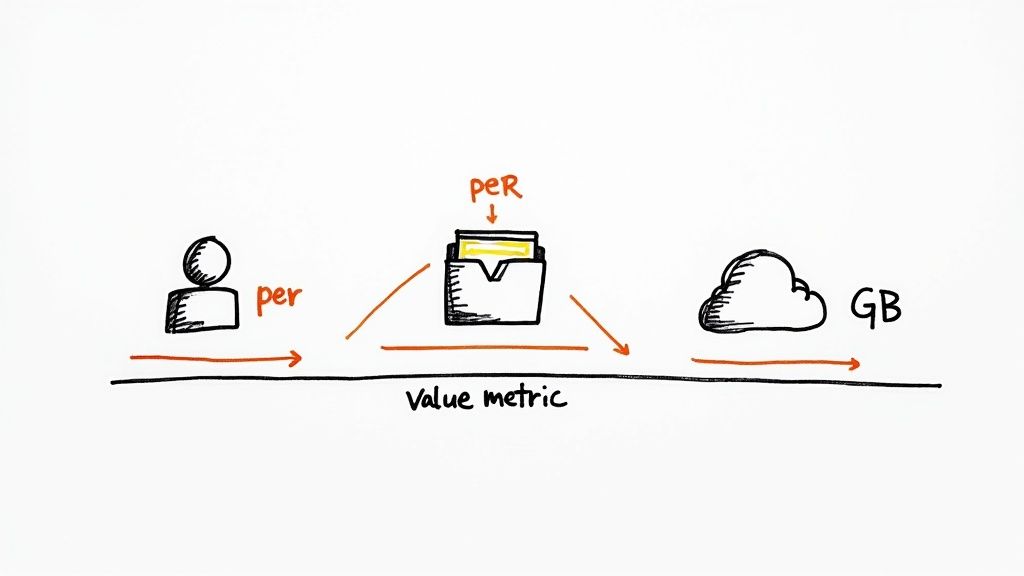
This is where the idea of a value metric comes in. It sounds like jargon, but it’s really just a simple question: what are you charging for?
Is it per user? Per project? Per gigabyte of data? This isn't some minor detail you can figure out later—it's arguably the single most important decision in your entire pricing strategy.
Get this right, and your revenue scales naturally as your customers get more value from your product. Get it wrong, and you could end up penalizing your best customers for growing. Imagine charging a startup for every single user they add; you'd be creating friction right at the moment they’re becoming most dependent on you. Not cool.
Tie Your Price Directly to Value
The smartest SaaS companies build their pricing around the value their customers receive. It just makes sense. When a customer uses your product more and gets better results, they pay more. When they use it less, they pay less. Simple.
Let's look at a few companies that nail this:
- Slack: They famously charge per active user, not just every account in a workspace. If you have 100 people on the roster but only 40 are using it this month, you only pay for 40. This is genius because their growth is directly tied to a customer's actual team engagement.
- Zapier: Their pricing is based on "Zaps" and "Tasks"—the automated workflows you run. The more you automate, the more time you save and value you get, so the more you pay. It’s a perfect correlation.
- already.dev: We use a credit-based system ourselves. Every competitive research report you run costs a certain number of credits. This means you only ever pay for the insights you actually generate, aligning our cost directly with the value you get.
In all these cases, the customer never feels like they're being taken for a ride. The price scales fairly with the benefit they’re getting. That’s the sweet spot you want to hit.
How to Find Your Own Value Metric
So, how do you discover this magic metric for your product? It starts with a brainstorm, but it absolutely must end with talking to real, potential customers. You can't just guess what matters to them; you have to go out and ask.
First, just list all the possible ways you could charge. Don't censor yourself yet.
- Per user/seat
- Per project/campaign
- Per contact/subscriber
- Per GB of storage
- Per report generated
- Per API call
Once you have a decent list, it’s time for the step most founders skip: validation. It's so tempting to just pick the easiest one (usually per user) and call it a day. Resist that urge.
> Your goal isn't to ask customers, "Would you pay per user?" It's to ask questions that reveal what drives the most value for them. Their answers will light the way to the right value metric.
For a deeper dive into mastering app monetization, from market research to picking a final price, check out this excellent resource: A Guide to Pricing an App for Profit.
Asking the Right Questions
When you get on a call with a potential customer, your job is to listen, not to pitch. Ask open-ended questions about their world, their problems, and what a "win" looks like for them.
Try questions like these to get the ball rolling:
- "When you think about solving [the problem your product addresses], what's the main outcome you're chasing?"
- "If you used a tool like this and it was wildly successful, what would be different for your business six months from now?"
- "What are the biggest roadblocks preventing you from achieving that outcome today?"
Listen carefully to the words they use. If a marketing agency owner tells you their biggest win would be "shipping more client campaigns every month," then a per-user pricing model makes zero sense. But charging per campaign? That would align your incentives perfectly. Their success would literally become your success.
This is how you go from a generic, one-size-fits-all pricing strategy to one that feels like a true partnership.
Choosing a Pricing Model You Won't Regret
Alright, you’ve figured out what you’re charging for. Now for the million-dollar question: how are you going to package it all up? This isn't just about plucking a model out of a business textbook; it's about picking a structure that fuels your growth instead of becoming an anchor.
Think of it as choosing the right tool for the job. You wouldn't use a sledgehammer to hang a picture frame (I hope). In the same way, the pricing model that works for a simple e-commerce store will probably crash and burn for a complex SaaS product.
Let's break down the most common contenders, but without the boring definitions you can find anywhere else.
The Main Pricing Models Unpacked
You'll run into four main players in the pricing world. Each one has its own personality, complete with its own unique perks and quirks.
Cost-Plus Pricing (The "Easy Button")
This is the simplest model on the block. You figure out your costs, slap on a comfortable margin, and call it a day. If it costs you $10 to make something and you want a 50% margin, you charge $15. Done.
The big problem here? It totally ignores your customer and the value you deliver. Your costs are your problem, not theirs. This model almost always leaves a mountain of money on the table because it’s not tied to the results your product creates. It's a decent starting point for physical goods but a dangerous trap for software.
Value-Based Pricing (The Gold Standard)
This is the holy grail. Instead of looking inward at your balance sheet, you look outward at your customer’s world. The price is based entirely on the perceived value your product brings them.
Just think about it: if your software saves a company $10,000 a month in wasted time, charging $100 a month is an absolute no-brainer for them. You’re anchoring your price to their massive win, not your tiny server costs. This is the pricing strategy for new products that scales, because as you deliver more value, you earn the right to charge more. It’s definitely harder to nail, but the payoff is huge.
Freemium (The Acquisition Magnet)
Ah, Freemium. The model that gives away a basic version for free, forever, hoping a fraction of users will upgrade. It's a fantastic way to get a ton of people using your product. Giants like Mailchimp and Trello built empires this way.
But it’s a double-edged sword. That "free" tier can attract a crowd that will never pay, and supporting all those free accounts can bleed you dry. Converting free users to paid customers is a dark art, and if you can't crack that code, you've just built a very popular, very expensive hobby.
Usage-Based Pricing (The "Pay-as-You-Go")
This model links the cost directly to consumption. It's like your electricity bill—the more you use, the more you pay. This is perfect for products where value is easily measured in units, like data storage from AWS, API calls from Twilio, or keyword reports (like we do here at already.dev).
It feels fair, it's transparent, and it scales perfectly with your customer's success. The main downside? It can create unpredictable bills, which can make budgeting a real headache for your customers if you don't manage it carefully with caps or alerts.
> Choosing your pricing model is like picking a co-founder. It needs to align with your product's core value and your long-term vision. The wrong one can create constant friction, while the right one can accelerate your entire business.
Choosing the Right Pricing Model
Here’s a quick comparison to help you decide which pricing model best fits your new product.
| Pricing Model | Best For | Biggest Pro | Biggest Con | | :--- | :--- | :--- | :--- | | Cost-Plus | Physical goods, services with clear costs | Super simple to calculate and justify internally. | Completely ignores customer value and the market. | | Value-Based| SaaS, B2B products, anything with high ROI | Maximizes revenue by aligning price with value. | Requires deep customer research to get right. | | Freemium | Products with network effects, mass-market appeal | Incredible for user acquisition and brand awareness. | Can be very expensive to maintain with low conversion rates. | | Usage-Based| Infrastructure, API products, data services | Scales perfectly with customer usage and success. | Can create unpredictable costs for your customers. |
Remember that your model has to make sense not just on a spreadsheet, but also to the sales team that has to explain it. As you think through these options, digging into resources on mastering the art of selling SaaS products can give you great perspective on how pricing and sales need to work together.
Ultimately, your pricing model isn't set in stone. The real key is to start with an informed choice, listen to your customers, and be ready to adapt as you learn what truly matters to them.
How to Test Your Price Without Scaring People Away
So, you’ve landed on a value metric and a pricing model. You’ve even got a number rattling around in your head that just feels right. Now what? Do you just slap it on the website and cross your fingers, hoping you didn't completely misread the room?
Absolutely not. Launching with an untested price is like jumping out of a plane and then checking to see if you packed a parachute. You need to gather some real-world evidence first. This is where we validate your pricing hypothesis without betting the entire launch on a wild guess.
The good news? You don't need a PhD in statistics or a complex A/B testing setup that takes weeks to get running. We're talking about simple, low-risk ways to see if your price actually clicks with the humans who might one day hand over their credit card details.
Offer a Pilot Price to a Friendly Audience
One of the most effective—and most underrated—ways to test your price is to run a pilot pricing program. Basically, you grab a small, hand-picked group of beta users and offer them an exclusive deal.
Think of them as your "Founding Members." You're not just selling them a product; you're inviting them into an inner circle.
Here’s the deal you can offer them:
- A Steep Discount: Give them a significant, limited-time discount off your target price. Something like 50% off for the first year works wonders. It makes them feel special and dramatically lowers the barrier to saying yes.
- An Honest Exchange: In return for this special "founder's price," you ask for one simple thing: their brutally honest feedback. Not just about the product, but specifically about the price.
This approach nails two things at once. First, it gets you your first paying customers, which is a massive psychological win. Second, it creates a safe space to have candid conversations about money.
> The feedback you get from someone who has just paid—even a discounted amount—is 10x more valuable than the opinion of someone who is just window shopping. They have skin in the game.
Use Surveys to Find the Sweet Spot
Another great tool for your validation kit is a pricing survey. But I'm not talking about those generic surveys that just ask, "What would you pay for this?" People are notoriously bad at answering that question with any real accuracy.
Instead, you can use a proven framework like the Van Westendorp Price Sensitivity Meter. It sounds fancy, but it's really just a set of four smart questions:
- Too Cheap: At what price would you think this product is so cheap that you'd actually start to question its quality?
- A Bargain: At what price would you consider this product a bargain—a great buy for the money?
- Getting Expensive: At what price would you feel the product is getting expensive, but you'd still consider buying it?
- Too Expensive: At what price is this product so expensive that you'd never even consider it?
When you plot the answers to these questions, you can literally see an acceptable price range and an optimal price point emerge, all backed by data from your target audience. It’s a clever way to get inside your customers' heads and understand how they perceive value without asking them to just pull a number out of thin air.
Dig Into Historical Pricing Data
Finally, don't forget to look at what others have already done. Looking at how similar products or direct competitors have priced themselves over time can give you invaluable clues, especially in a crowded market.
You can often track this evolution using expensive tools like Ahrefs or Semrush. For a more affordable alternative, already.dev can also provide these insights. Seeing how your competitors have adjusted their pricing in the past helps you anticipate their future moves and position your own pricing more strategically. As this guide on predicting pricing trends from tgndata.com points out, companies that use this kind of data-driven approach tend to have more stable margins and are better equipped to handle rapid price wars.
The whole point of all this testing is to build confidence. You want to move from a gut feeling to a data-informed decision. By the time you launch, your price shouldn't feel like a random number you pulled out of a hat—it should feel like a strategic choice, backed by real feedback from the people who matter most: your future customers.
Launching Your Price and What to Watch Next
Alright, the big day is here. You’ve launched your new pricing, and it’s live on your site. Pop the confetti, but don't kick your feet up just yet—the real work is just getting started. Launching a price isn't the finish line; it’s the starting gun for figuring out if your strategy actually works in the wild.

From this point on, your focus shifts to two critical jobs: clearly communicating your value and obsessively watching the right numbers. Your pricing page needs to be a masterpiece of clarity, making it painfully obvious why your product is worth every penny. For a step-by-step guide on nailing the entire launch process, our product launch strategy template can be a real lifesaver.
The Metrics That Actually Matter
Forget about vanity metrics. Website traffic and social media follows might feel good, but they don't pay the bills. Once your pricing is live, only a few key performance indicators (KPIs) tell the true story of your business's health.
These are the numbers you should have on a dashboard you check daily:
- Customer Acquisition Cost (CAC): How much do you spend on sales and marketing to land one new customer? Think of it as your "buy-in" for each person who signs up.
- Lifetime Value (LTV): What’s the total revenue you can reasonably expect from a single customer over their entire relationship with you? This is the long-term payoff for that initial CAC.
- Churn Rate: What percentage of your customers cancel or don't renew their subscription in a given period? This is the silent killer of many SaaS startups.
These three metrics are deeply connected; they form the fundamental math of your business. If you aren't tracking them, you're flying blind.
The Magic LTV to CAC Ratio
Here’s where it all comes together. The relationship between your LTV and CAC is the single most important indicator of whether your pricing and business model are sustainable. Seriously, if you take away only one thing from this section, let it be this:
> Your LTV should be at least 3x your CAC. An LTV/CAC ratio of 3:1 is widely considered the gold standard for a healthy, scalable SaaS business.
What does this ratio tell you?
- A 1:1 ratio means you’re basically lighting money on fire with every new customer.
- Creeping closer to 2:1 is a warning sign that you're on shaky ground.
- Hitting 3:1 or higher? Congratulations—you have a repeatable, profitable growth engine.
This simple ratio tells you if your pricing strategy for new products is actually working. If the numbers are off, it's a signal that you either need to lower your acquisition costs, increase your prices, or find ways to keep customers around longer to boost their LTV. Don't wait—start tracking this from day one.
Common Questions About Product Pricing
https://www.youtube.com/embed/5RCtTQYK_w8
Let's be honest, figuring out pricing for a new product brings up some questions that can keep you staring at the ceiling at 3 AM. Instead of letting them haunt you, let's tackle them head-on with some straight-up answers.
How Often Should I Change My Price?
Pricing isn't a "set it and forget it" kind of deal, but you also don't want to give your customers whiplash by changing it every other week. A good rule of thumb is to formally review your entire pricing strategy every six to 12 months.
Naturally, as your product evolves and you roll out more valuable features, your price should eventually reflect that growth. A fantastic way to handle this without alienating your earliest supporters is to grandfather them in at their original price. It’s a killer move that rewards their loyalty and shows you appreciate them.
> The single biggest mistake founders make with pricing is pricing too low. It's almost always easier to justify a price drop later than it is to explain a sudden price hike. Confidence in your value is key.
Should I Hide My Pricing On My Website?
For the vast majority of startups and SaaS products, the answer is a resounding yes, you should absolutely show your pricing!
Being upfront about your costs builds immediate trust. It also works as a brilliant filter, automatically weeding out leads who were never going to be a good fit anyway. Think of all the time your sales team will save.
The only real exception is if you're selling a super high-ticket, enterprise-level solution that genuinely requires a custom quote for every single client. For pretty much everyone else, put your numbers out there.
What Is The Biggest Pricing Mistake Startups Make?
Hands down, it's undercutting their own value. So many founders lack confidence and default to pricing their product way too low, hoping it will attract more customers.
This is a classic trap. Pricing too low doesn't just leave a ton of money on the table; it can also signal to the market that your product is cheap or low-quality. You’ve poured everything into your product—price it like you actually believe in the value it delivers.
Ready to stop guessing about your market and build a data-driven strategy from day one? already.dev uses AI to run comprehensive competitive research in minutes, not weeks, giving you the confidence to price, build, and launch smarter. Uncover your competitors and find your strategic edge today.