what is product differentiation: a ridiculously simple guide
what is product differentiation? Learn practical strategies to make your product stand out, build a stronger brand, and attract loyal customers.
Product differentiation is why you'll happily pay $5 for one coffee but scoff at paying $2 for another, even if they're both just hot bean water. It’s what makes your product the only choice in a customer’s mind, not just another option on the shelf.
It’s about being memorable, not a commodity.
So What Is Product Differentiation Anyway?
Let’s skip the dry, textbook definition that sounds like it was written by a robot.

Picture two coffee shops sitting side-by-side. Both sell a decent latte for around the same price. One is just a generic cafe. The other has cozy armchairs, super-fast Wi-Fi, and baristas who actually remember your name and don't judge you for your complicated order.
Which one do you keep going back to? The one with the great vibe, of course.
That’s differentiation in a nutshell. It’s all the little (and big) things that make your product the clear winner for a specific group of people. It’s less about cramming in a million features and more about carving out a unique identity that people connect with.
Why You Can’t Afford to Be a Copycat
In a crowded market, blending in is the fastest way to become invisible. If your product is a carbon copy of everyone else's, you're left to compete on just one thing: price. That’s a race to the bottom, and trust me, you don't want to win that game.
Differentiation is your ticket out of the bargain bin.
Here's a quick summary of what it actually means for your business.
Why You Should Care About Differentiation
| Key Area | Without Differentiation (The Forgettable Zone) | With Differentiation (The 'Must-Have' Zone) | | :--- | :--- | :--- | | Pricing Power | You're stuck in price wars, constantly dropping prices to compete. Welcome to the gutter. | You can command a premium price because your value is unique. | | Customer Loyalty | Customers are fickle and will switch to a cheaper alternative in a heartbeat. Bye-bye. | You build a loyal tribe that sticks with you through thick and thin. | | Market Position | You're just another commodity, easily replaceable. | You become a category leader with a strong, defensible "moat." | | Marketing | Your message is generic and gets lost in the noise. "We're... a company!" | Your marketing is sharp, targeted, and resonates deeply with your audience. |
Ultimately, differentiation gives you a story to tell and a reason for customers to listen.
> The goal of product differentiation is to ensure your stuff has a unique identity in the minds of your customers. It answers the question, "Why should I buy from you instead of the other guy?"
The journey to finding your unique angle starts with a deep dive into the competitive landscape. Understanding what is competitive intelligence is the first, crucial step toward figuring out where you can plant your flag and stand out. It’s all about spotting the gaps your rivals are completely missing.
The Three Main Flavors of Differentiation
Product differentiation isn't some mystical marketing voodoo. Think of it more like choosing your character in a video game—you can't be the strongest, fastest, and smartest all at once. You have to pick your specialty. In the business world, these specialties usually fall into three main flavors.
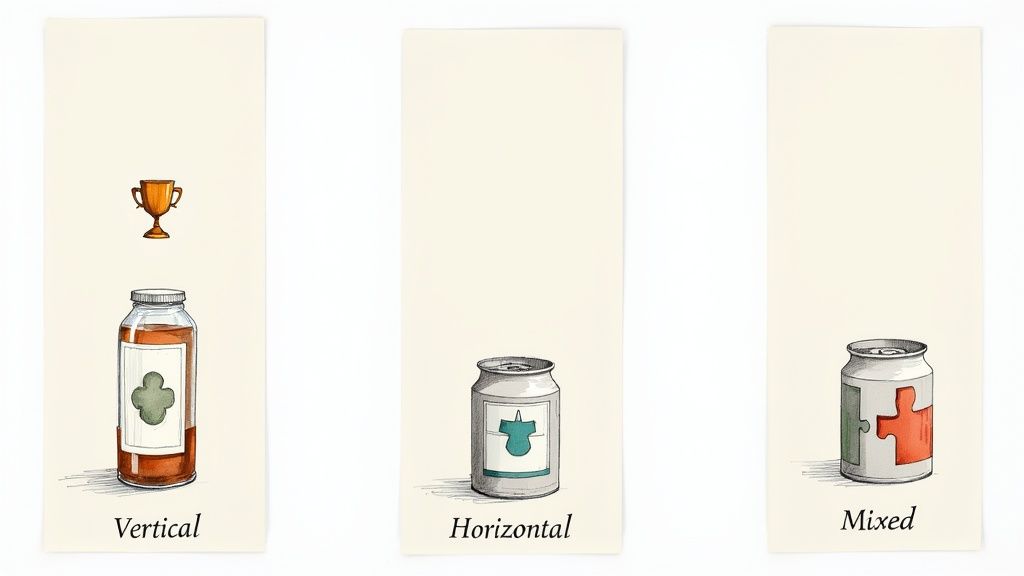
Understanding these types is like having a secret decoder ring for your market. You can suddenly see why your competitors are making certain moves and, more importantly, where the undefended territory is.
Let’s break them down.
Vertical Differentiation: The "Better or Worse" Game
This is the one we all get intuitively. Vertical differentiation is all about a clear hierarchy of quality and price. If everyone agrees that one product is objectively "better" than another, you're looking at vertical differentiation. It’s a ladder—some products sit on the top rung, and some are on the bottom.
Project management tools are a perfect SaaS example of this in action.
- Trello: Simple, visual, and often free. It's on a lower rung, perfect for individuals or small teams who just need a basic Kanban board.
- Jira: Complex, powerful, and pricey. It's on the top rung, built for massive enterprise teams with sophisticated software development workflows.
Neither is trying to be the other. Jira isn't for your weekend DIY project, and Trello isn't going to manage a mission to Mars. They've picked different spots on the quality and feature ladder, and it works.
> The core idea here is that if two products were the same price, everyone would choose the "better" one. The only reason to buy the "worse" one is because it's cheaper.
Horizontal Differentiation: The "Coke vs. Pepsi" Debate
Now for the fun one. Horizontal differentiation is about personal taste, style, or preference. There's no objective "best" choice; it just comes down to what an individual customer wants. Price and quality are roughly the same, but the products appeal to entirely different sensibilities.
This is the classic Coke vs. Pepsi, Nike vs. Adidas, or Mac vs. PC battleground.
In the SaaS world, just look at email marketing platforms.
- Mailchimp: It’s known for its friendly, almost playful branding and a super-simple interface. It’s perfect for creators and small businesses who want something that just works without a steep learning curve.
- ConvertKit: It brands itself as being "for creators, by creators." Its features and messaging are laser-focused on bloggers, podcasters, and people selling online courses.
Both tools send emails effectively and are in a similar price bracket. But they feel completely different. One feels like a creative studio; the other feels like a powerful workshop. Choosing between them is purely a matter of which brand's vibe you connect with more.
Mixed Differentiation: The Reality of Most Markets
Let's be real: most products don't fit neatly into one box. Mixed differentiation is the messy, real-world combination of both vertical and horizontal factors. A product might be slightly better (vertical) but also appeal to a different style (horizontal).
Cars are a classic example. A BMW is objectively a higher-performance vehicle than a Honda (vertical), but they also have vastly different brand images that appeal to very different types of people (horizontal).
This strategy is incredibly effective because it lets companies justify a higher price while also building a loyal brand tribe. Getting this right has a massive impact. In fact, research analyzing over 1,200 companies found that those with strong differentiation strategies grew their market share by 3.2% annually, compared to just 0.8% for undifferentiated products. This happens because customers become less sensitive to price when they feel a product is truly unique. You can learn more about how differentiation fuels market growth and gives you a real competitive edge.
Real-World Examples That Don't Put You to Sleep
Theory is great, but let's be honest, it's a bit like assembling IKEA furniture with the instructions—you get the general idea, but seeing the finished product is way more helpful. To really get what product differentiation looks like, we need to see it in the wild.
And we're going to skip the usual suspects. Yes, we know Apple is a design god and Tesla made electric cars cool. Snooze. Let's look at some genuinely clever SaaS companies that stared down a crowded market and came out on top.
This isn't just a list of cool products. It's a strategic breakdown of the why. Pay close attention to how they didn't just add a feature; they completely changed the conversation.
Notion: The Lego Blocks of Productivity
Remember when your productivity "stack" was a chaotic mess of Google Docs, Evernote, Trello, and a dozen other single-purpose apps? It was a nightmare. The market was packed with tools that did one thing reasonably well, forcing you to constantly jump between them.
Then Notion waltzed in.
Instead of being another note-taking app or another project manager, Notion differentiated itself by being a flexible, all-in-one workspace. Its killer move was using a feature differentiation strategy, but not in the way you'd think.
- The "Lego Block" Concept: Notion’s core idea is that every piece of content—a heading, a to-do list, an image, a database—is a "block." You can arrange these blocks any way you want.
- Ultimate Customization: This gave users the power to build their own tools. Need a simple to-do list? Done. Want a complex CRM for your freelance business? You can build that too, without writing a single line of code.
By focusing on flexibility over a rigid set of features, Notion became the go-to tool for people who were tired of being forced into someone else's workflow. It stood out by handing the keys to the user, creating a cult-like following in the process.
Slack: The Email Killer with a Personality
Before Slack, team communication was basically a relentless flood of "Reply All" emails and clunky instant messengers. It was inefficient, impersonal, and just plain soul-crushing. Slack saw this and realized the problem wasn't the need to communicate, but the tool everyone was using.
Slack's genius was its sharp focus on user experience (UX) and brand differentiation. It didn't just create a chat app; it created a better way to work.
> Slack fundamentally changed how teams collaborate by making communication real-time, organized, and—dare I say—fun. It beat email by being a superior experience, not just a different one.
Here’s how they pulled it off:
- Channel-Based Organization: Instead of messy email chains, conversations were neatly organized into public or private channels. This simple structural change made information instantly easier to find.
- A Playful Brand: From its friendly notifications to its quirky loading messages, Slack had personality. In a world of boring, corporate software, this friendly and informal tone made it a tool people actually enjoyed using.
- Integrations Galore: Slack became the central hub for work by integrating with hundreds of other tools, from Google Drive to Trello, turning it into a command center for any project.
Slack's success proves that how a product feels to use can be one of the most powerful forms of differentiation out there.
Figma: The Collaborative Design Tool
For years, designing user interfaces meant using desktop-based software like Sketch or Adobe XD. It worked, but it was a lonely process. Designers would work on a file, save it, and then email it to a teammate for feedback, creating a slow, version-control mess.
Figma crashed this party by doing something radically different: it put the entire design process in the browser and made it collaborative from the ground up.
Figma's victory was a masterclass in distribution and service differentiation.
- Browser-Based and Platform-Agnostic: By living in the browser, Figma was instantly accessible to anyone, anywhere, on any operating system. No downloads, no licenses to manage. This removed a massive point of friction.
- Real-Time Collaboration: This was the game-changer. Multiple designers, developers, and product managers could be in the same file at the same time, leaving comments and making edits live. It was like Google Docs for design.
This approach was so effective because it didn't just change the tool; it changed the entire design workflow. Figma understood that design is a team sport, and they built the stadium for it.
This power of brand perception isn't just for software, either. A 2016 study found that established national brands can charge 20-30% more than store brands for similar quality products, simply because their differentiation creates a powerful brand image. You can explore more about how branding influences pricing and market share in the full study.
Finding Your Product's Unique Superpower
Alright, enough theory. We've talked about the what, the why, and admired how other clever SaaS companies have pulled it off. Now, it's your turn. This is where we roll up our sleeves and figure out what makes your product the hero of its own story, not just a background character in someone else’s.
Finding your product’s unique superpower is less about a magical "aha!" moment and more about good old-fashioned detective work. You have to become a private eye for your own market, dust for fingerprints, and follow the clues to find what makes you different.
The first step? You've got to understand the competitive landscape you’re playing in. This isn’t about obsessively stalking your rivals, but about strategically mapping the entire neighborhood to find that one empty lot where you can build your castle.
Step 1: Stalk Your Competitors (But in a Smart Way)
Competitive research sounds intimidating, but it doesn't have to be. Sure, you could drop a small fortune on enterprise-level tools like Ahrefs or Semrush. They're powerful, no doubt, but they can be expensive. Using them when you're just starting can feel like using a bazooka to open a tin can—and their price tags can be eye-watering.
For most teams, a more focused approach is all you really need. An AI-powered platform like already.dev can do the heavy lifting for you as a great alternative, digging through hundreds of sources to find direct competitors, indirect threats, and even companies that tried and failed. It’s like having a full research team without the full-team payroll.
To get the lay of the land, you need a solid framework. Learning how to conduct competitive analysis is a crucial first step, as it reveals what everyone else offers and, more importantly, where the real opportunities for unique value are hiding.
Step 2: Map the Battlefield With a Feature Matrix
Once you’ve identified your key competitors, it’s time to get tactical. The goal here is to visually compare everyone’s arsenal. The simplest and most effective way to do this is with a feature comparison matrix.
Think of it as a fancy spreadsheet. You list your competitors along the top row and all the possible features your product (and theirs) could have down the first column. Then, you just go through and check off who has what.
- List Core Features: These are the absolute must-haves, the table stakes for playing in your category.
- Add Secondary Features: Note the nice-to-haves that some, but not all, competitors offer.
- Include "Wow" Features: These are the unique, innovative things that only one or two players have.
- Don't Forget Pricing and Support: Sometimes, the biggest differentiator isn't a feature at all.
This simple exercise is incredibly revealing. You'll quickly see where the market is crowded (everyone has Feature X) and, more importantly, where the gaps are.
Here’s an example of what this kind of competitor analysis can look like when visualized, helping you spot patterns and gaps almost instantly.

A visual matrix like this immediately shows where feature sets overlap and where unique opportunities might be hiding in plain sight.
> Key Takeaway: The goal isn't to build every feature your competitors don't have. It's to find the meaningful gap that a specific group of customers is desperate for you to fill.
Step 3: Find Your Spot With a Positioning Map
A feature matrix tells you what everyone is building. A positioning map, on the other hand, tells you who they're building it for and how they're selling it. This is where you move from features to market perception.
A positioning map is just a simple two-axis graph. You pick two key attributes that matter to customers in your market and plot where your competitors fall on the map.
Common axes include:
- Price (Low Cost vs. Premium)
- Quality (Basic vs. High-End)
- Target Audience (For Individuals vs. For Enterprise)
- Ease of Use (Simple vs. Complex)
- Brand Vibe (Playful vs. Corporate)
Let's say you're building a new project management tool. You might choose "Ease of Use" for one axis and "Target Audience (Small Teams vs. Enterprise)" for the other. You'd then place Trello in the "Easy to Use / For Small Teams" quadrant and Jira in the "Complex / For Enterprise" quadrant.
Suddenly, you can see the open spaces on the map. Is there an empty spot for a tool that's super easy to use but built for enterprise-level security? Or a complex tool designed specifically for solo freelancers? This visual helps you understand not just your competitors' products, but their entire market strategy. To go deeper, you can also explore how to use a marketing positioning matrix to sharpen your brand's unique place in the market.
This infographic shows a simplified flow of how distinct SaaS companies carved out their unique space.
Each company identified a different axis of differentiation—flexibility, user experience, or distribution—to win in a crowded market.
Your Differentiation Discovery Checklist
Feeling overwhelmed? Don't be. Here's a simple, actionable checklist to guide you from confusion to clarity.
- Identify 5-10 Competitors: Use a tool like already.dev to find both direct and indirect rivals.
- Create a Feature Matrix: Map out what they offer. Be brutally honest about where they win and where they're weak.
- Build 2-3 Positioning Maps: Use different axes to explore the market from multiple angles.
- Pinpoint the Gaps: Look for the empty spaces on your maps. Where is the unmet need?
- Talk to Real Humans: Find people who fit the profile of your "gap" customer. Ask them about their frustrations. What do they wish existed?
- Brainstorm Your Angle: Based on the gaps and customer feedback, what is the one thing you can do better than anyone else for this specific group?
- Write Your Differentiation Statement: Fill in the blanks: "For [target customer], our product is the only [category] that [unique benefit] because [reason to believe]."
Following these steps will transform "product differentiation" from a vague concept into a concrete battle plan. It’s your roadmap to creating a product that isn't just different, but indispensable.
Common Differentiation Disasters to Avoid
Trying to be different can go spectacularly wrong. It’s a bit like trying to cook a gourmet meal by just chucking a bunch of expensive, random ingredients into a pot. You’ll probably just end up with a confusing, inedible mess.
The road to product oblivion is paved with good intentions and terrible differentiation strategies. This is the hall of shame for differentiation mistakes. Read it, memorize it, and for the love of your company, don't do it.
The "Feature Stuffing" Fiasco
This is easily the most common trap, especially in the SaaS world. It’s born from a place of deep insecurity. You peek over at your competitors, see they have a feature you don't, and your team immediately spirals into a panic-fueled coding frenzy to build your own version.
Do that a dozen times, and congratulations—you've built a Frankenstein's monster. Your product is now bloated, confusing, and a nightmare to maintain. And the worst part? You're not different anymore. You're just a clunkier, less-focused version of everyone else.
> The Brutal Truth: More features do not equal more value. Differentiation isn't about having everything; it's about being the absolute best at something that a specific audience desperately needs.
Creating a Solution in Search of a Problem
This one is the ambitious cousin of feature stuffing. It’s what happens when a team falls head over heels in love with a cool idea or a clever piece of tech and builds a "unique" feature that precisely zero customers ever asked for. The team is convinced they’ve created a game-changer, but in reality, they’ve just solved a problem that doesn't exist.
This is the classic sign of a team that has stopped talking to its customers and started listening only to the echo chamber in their own office. You get so wrapped up in being different that you completely forget to be useful.
The Unnoticeable Improvement
In a crowded market, making a tiny, barely perceptible improvement is a surefire way to be ignored. Being 5% better at something your competitor already does well isn't a differentiation strategy; it's a rounding error. Your potential customers are busy people. They aren't going to uproot their entire workflow for a trivial upgrade.
For a difference to truly matter, it has to be big enough for people to actually notice and care about. The stakes are high for just being "slightly better." Just look at the hyper-competitive pharmaceutical industry, where drugs that are only marginally better than existing treatments struggle to grab more than 10-15% of the market. You can learn more about the challenges of subtle differentiation in high-stakes markets to see why you need to take bigger swings.
Playing the Price War Game
Unless you have the massive, world-dominating scale of a Walmart or an Amazon, competing on price is a death wish. It’s a race to the bottom where the only prize is razor-thin margins and a customer base that will ditch you the second someone else dangles a 10% discount.
When you make your product the cheapest, you’re telling the world it's the least valuable. That's a reputation that's incredibly hard to shake. Instead of attracting loyal fans who love what you do, you attract bargain hunters who have zero loyalty to your brand. Real differentiation lets you escape this trap and charge based on the unique value you provide—not just because you’re the cheapest option on the list.
Your Simple Product Differentiation Action Plan
Okay, enough with the theory. You get the what, why, and how of product differentiation. Now it's time to roll up your sleeves and actually put this knowledge to work.
This isn't just a summary; think of it as your practical, no-fluff checklist. Let’s turn that "differentiation" buzzword into your most powerful weapon.
Step 1: Know Thy Enemy (And Thyself)
You can't be different if you don't know what you're being different from. It's that simple. The first move is always to take a good, hard look at the competitive landscape.
Who are you really up against? What are they great at? And, most importantly, where are they dropping the ball?
You could go all-in on expensive, complex tools like Ahrefs or Semrush, but honestly, they can be overkill and very expensive. A more focused tool like already.dev is a great alternative that gives you the intel you need without the hefty enterprise price tag. The goal here is just to get a clear map of the battlefield.
To get started on the right foot, grab our free competitor analysis template. It'll walk you through it.
Step 2: Find the Golden Gap
Once you have that map, start looking for the empty spaces. This is where your unique superpower is hiding. The "gap" isn't always a missing feature—it could be an underserved audience, a clumsy user experience everyone else overlooks, or a brand voice that doesn't sound like a corporate robot.
> Your goal isn't to be different for the sake of being different. It's to be uniquely useful to a specific group of people who are being ignored by everyone else.
This is the most crucial part of the process. It’s where you stop looking over your shoulder at competitors and start listening—really listening—to what customers are complaining about.
Step 3: Craft Your Story and Stick to It
Found your gap? Perfect. Now, boil it down into a simple, compelling story. This becomes your Unique Selling Proposition (USP), and it needs to be so clear that anyone on your team could recite it in their sleep.
Here’s a quick framework to help you nail it:
- Who is it for? Get specific. Not "businesses," but "small, non-technical marketing teams."
- What problem does it solve? Zero in on the core pain point you discovered.
- How are you unique? This is your differentiator. Is it your dead-simple design? Your fanatical customer support? Your pricing model?
Once you've got this story, weave it into everything. Your website, your sales calls, your support emails, and even your product’s design. Consistency is what turns a good idea into a brand people can't forget. Now go make some noise.
Frequently Asked Questions
Alright, let's clear up a few common questions that pop up when we talk about product differentiation. Think of this as the quick-and-dirty guide to the tricky parts.
What’s The Difference Between Product Differentiation And Market Segmentation?
This is a great one. They’re two sides of the same coin, but they are definitely not the same.
Here's a simple way to think about it: market segmentation is about splitting the entire market into smaller, manageable groups. It’s like a baker realizing they can't sell one type of cake to everyone, so they identify different customer groups: wedding parties, kids' birthdays, and office events.
Product differentiation is what you do next. It's creating a specific cake that’s perfect for one of those groups—a stunning, multi-tiered cake for the wedding crowd, a colorful, character-themed cake for the kids, or easy-to-serve cupcakes for the office.
Segmentation is about who you're selling to. Differentiation is what you're selling that makes you the obvious choice for them.
Can A Company Have Too Much Product Differentiation?
You bet. It's surprisingly easy to overdo it, especially when you start differentiating in ways that your customers just don't care about. This is how you end up with a "solution in search of a problem."
Imagine a project management tool adding a feature that lets you customize the app's font to Comic Sans. Sure, it's a unique feature—no one else has it! But does it solve a real problem for project managers? Nope. The goal isn't just to be different; it’s to be meaningfully different.
How Often Should I Review My Differentiation Strategy?
Your differentiation strategy has a shelf life. It’s not something you figure out once and then frame on the wall. The market is constantly in motion.
A good rule of thumb is to give it a thorough review at least once a year. But—and this is a big but—you need to hit the reset button immediately if something major changes. That could be a huge new competitor entering the scene, a shift in technology, or a change in how your customers work. Staying different means staying vigilant.
Ready to stop guessing what your competitors are doing and find your unique place in the market? Already.dev uses AI to do the heavy lifting, delivering deep competitive insights in minutes, not weeks. Get started for free.