What Is Product Strategy? A No-Nonsense Guide
What is product strategy? Get a simple, practical guide on how to build a winning strategy and create products customers actually want to buy.
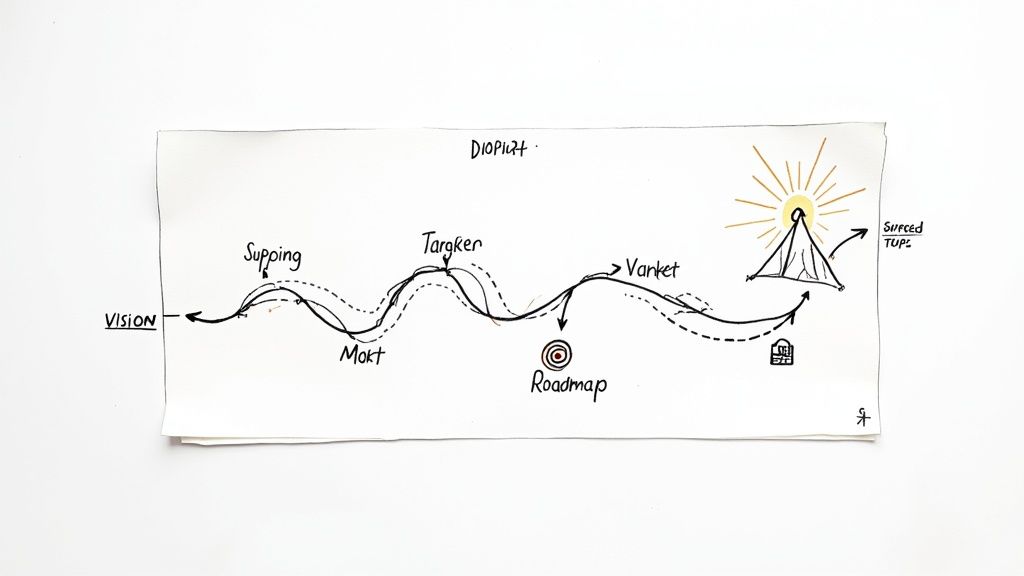
Let's cut right to it. A product strategy is your product's game plan. It’s the high-level script that connects your company's big, hairy, audacious goals to the actual, nitty-gritty work your team does every day.
Think of it as the ultimate cheat sheet for the big 'why' questions: Why are we even building this thing? Who are we building it for? And most importantly, how are we going to crush the competition?
So What Exactly Is Product Strategy Anyway?
Imagine you’re planning an epic cross-country road trip. You wouldn't just jump in the car and start driving, hoping for the best, right? Of course not. You'd have a destination in mind (let's say San Diego), a reason for going (escaping a brutal winter), and a rough idea of how you'll get there (sticking to major highways, not some random dirt roads).
That's your product strategy in a nutshell. It’s not the detailed, turn-by-turn directions—that’s your product roadmap. The strategy is the overarching plan that makes sure everyone on the team is driving in the same direction, for the same reasons.
Without a solid strategy, you get chaos. Your team builds features that sound cool in a meeting but don't solve a real customer problem or move the business forward. It’s like taking a random exit because you saw a flashy billboard, only to find yourself completely lost.

Why It's More Than Just a Document
A great product strategy isn't some 50-page document that gets written once and then gathers digital dust in a forgotten Google Drive folder. It's a living, breathing guide for making tough decisions.
When a salesperson begs for a new feature to close one big deal, or an engineer has a brilliant but totally off-track idea, the strategy is what you point to. It gives you the clarity to say "no" to the merely good ideas, so you have room to execute on the great ones.
> A product strategy is a clear framework for making choices. It helps prioritize features, align teams, and ensures every effort pushes the product closer to its goals.
At its core, it links what your team is building to the real-world needs of your customers and the mission of your business. That alignment is the secret sauce separating products that thrive from those that just... exist. If you want to dig deeper, this comprehensive guide on what a product strategy entails does a great job breaking things down.
The Building Blocks of a Great Strategy
Every solid product strategy rests on a few core pillars. Getting these right isn't just important; it's everything.
- Your Market and Customers: Who are you actually building this for? What specific, nagging problem are you solving for them? This requires serious digging, and our guide to market analysis for startups is a great place to start.
- Your Differentiators: What makes your product the obvious choice? Why should a customer pick you over the dozen other options screaming for their attention? This could be your killer design, a cheaper price, or world-class customer service.
- Your Business Goals: How does this product help the company win? Maybe it's hitting a revenue target, capturing market share, or just making existing customers happier so they stick around.
To make this crystal clear, here’s a quick breakdown of how these pieces fit together.
The Core Components of a Product Strategy
This table offers a quick glance at the essential pillars of any solid product strategy, explaining the 'what' and 'why' for each component.
| Component | What It Is | The Big Question It Answers | | :--- | :--- | :--- | | Vision | The ultimate, long-term impact you want your product to have on the world. | Where are we ultimately going? | | Target Audience | A clearly defined group of people or businesses you're building for. | Who are our customers? | | Market Needs | The specific problems or desires your target audience has. | What problem are we solving? | | Key Differentiators | The unique features or qualities that set you apart from competitors. | How will we win? | | Business Goals | The measurable outcomes the product needs to achieve for the company. | What does success look like? |
Nailing these components ensures your strategy is a powerful tool for building a successful product.
The Three Pillars of a Winning Strategy
So, we've established that a product strategy is your destination—the big "why" that guides every single thing you build. But what actually keeps the car on the road? Every solid strategy is held up by three unshakeable pillars. Get these right, and you’ve built a foundation for success. Get them wrong, and you’re just building a product that’s going nowhere fast.
Think of it like building a ridiculously cool three-legged stool. If one leg is wobbly or missing, the whole thing comes crashing down, probably spilling your expensive coffee everywhere. These pillars aren't just corporate buzzwords; they are the practical, tough questions you absolutely must answer.
Pillar 1: Your Target Market
First up is the "who." Who are you really building this for? It's tempting to say "everyone," but that’s a recipe for disaster. "Everyone" doesn't have a specific problem you can solve. A real target market does.
This pillar is all about getting borderline obsessed with your ideal customer. It means knowing more than just their age and location. What keeps them up at night? What are their biggest frustrations at work? What do they secretly wish existed to make their lives easier?
> Answering these questions forces you to move beyond assumptions and into genuine customer empathy. Your goal isn't just to define a demographic; it's to understand a person's problems so deeply that your product feels like it was built just for them.
Don't just imagine this person—go find them. Talk to them, survey them, and observe them in their natural habitat. The insights you gain here are pure gold.
Pillar 2: Your Value Proposition
This brings us to the second pillar: the "what and why." Specifically, what pain are you solving, and why is your solution the best one? Your value proposition is your unique promise to the customer. It's the clear, simple statement that explains the benefit you provide.
A weak value proposition sounds something like, "We're a collaborative platform with AI features." Yawn. A strong one sounds like, "We cut your team's meeting time in half by automatically summarizing every call." See the difference? One is a feature list; the other is a life-changing outcome.
To nail this, you need to be brutally honest about what makes you different.
- Unique Features: Is there something your product does that no one else can?
- Superior Design: Is your product just ridiculously easier or more enjoyable to use?
- Unbeatable Price: Are you the most affordable option for a specific level of quality?
- Incredible Service: Do you offer support so good people tweet about it?
This isn’t about being the best at everything. It’s about being the undeniable best at something that your target market truly cares about. You need a sharp, compelling answer to the question: "Why should I choose you?"
Pillar 3: Your Go-to-Market Plan
The final pillar is the "how." How will you get your amazing product into your customers' hands and convince them to care? A brilliant product that nobody knows about is just a hobby. A go-to-market (GTM) plan is your strategy for reaching, acquiring, and retaining customers.
This plan connects your product to the market. It covers everything from your pricing model and marketing channels to your sales process. Are you going to find customers through social media ads, content marketing, or direct sales? Will your product be a cheap monthly subscription or a high-ticket enterprise purchase?
Figuring this out is crucial. Today's market is fiercely competitive. A recent report from Deloitte highlights that product innovation is a top priority for 95% of executives. They aren't just building new things; they're strategically investing to ensure those products succeed.
Your GTM plan ensures your product doesn't just launch; it launches with a purpose and a clear path to the people who need it most. Together, these three pillars—Target Market, Value Proposition, and Go-to-Market—form a powerful system that turns a vague idea into a winning product strategy.
How to Build Your Product Strategy Step by Step
Alright, enough with the theory. Let's get our hands dirty and actually build this thing. Crafting a product strategy isn't about getting a fancy MBA or creating a 100-slide PowerPoint deck that puts everyone to sleep. It’s about making a series of smart, connected choices.
This is your practical, no-fluff guide to building a product strategy from the ground up.
Step 1: Start with Your Vision
Before you write a single line of code, you need a vision. This isn't some fluffy mission statement you hang on the wall. Your product vision is the ultimate "why" behind what you're building. What change do you want to see in the world because your product exists?
Think big. Be a little bold.
- Slack’s vision: "To make work life simpler, more pleasant, and more productive."
- LinkedIn’s vision: "To create economic opportunity for every member of the global workforce."
Notice they don't list a single feature? They talk about outcomes. Your vision is your North Star—it should be aspirational but clear enough to guide you when you're lost.
Step 2: Get Obsessed with Customer Problems
This is where so many products go off the rails. Founders fall in love with their cool solution. Don't be that person. Fall in love with your customer's problem. Get deeply, uncomfortably obsessed with it.
You need to understand the pain points and unmet needs of your target audience better than they do.
> Stop building what you think people want and start building what they desperately need. The best product strategies are born from genuine empathy, not from a brilliant idea you had in the shower.
So, how do you do this? Talk to people. Run surveys. Lurk in forums. Watch them try to solve their problems with existing tools (or, more likely, with duct tape and spreadsheets). The goal is to find a nagging pain that isn't being addressed well enough by anyone else.
This flow diagram shows how a deep understanding of the market is the foundation for a strong value proposition and go-to-market plan.
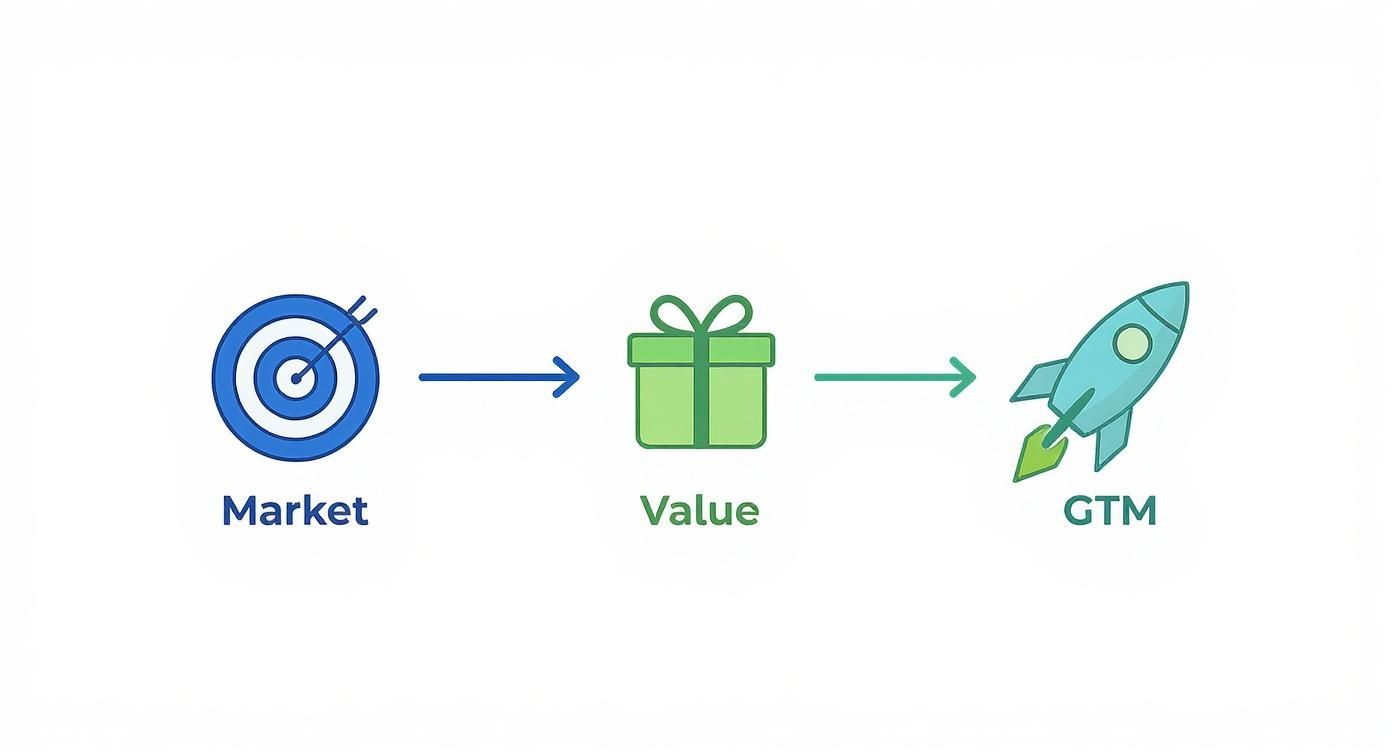
It makes it clear that strategy isn't a random collection of ideas but a logical progression from understanding a market to delivering value.
Step 3: Snoop on Your Competition (Smartly)
Once you've identified the problem you’re solving, it’s time to see who else is trying to fix it. Competitive analysis isn't about copying features; it’s about finding the gaps. Where are your competitors dropping the ball? What are their customers constantly complaining about in reviews?
This is your chance to carve out a unique space for yourself. Maybe your competitors are too expensive, too complicated, or focused on a slightly different user.
Now, doing this research manually is a total grind. Big tools like Ahrefs or Semrush are powerful, but they can be seriously expensive, especially when you're just starting out. A more focused alternative like Already.dev can give you deep competitive insights without making your wallet cry. It helps you find not just the obvious rivals, but also the indirect threats and failed attempts—which are often just as educational.
Step 4: Define Clear, Measurable Goals
With a vision and a deep understanding of the market, it’s time to get specific. What does success actually look like? "Making a great product" is a wish, not a goal. You need measurable targets that tell you if your strategy is actually working.
The SMART goals framework is perfect for this:
- Specific: What exactly do you want to achieve? (e.g., Increase user activation rate).
- Measurable: How will you track progress? (e.g., By 20%).
- Achievable: Is this realistic given your resources?
- Relevant: Does this goal line up with your vision?
- Time-bound: When will you achieve this by? (e.g., By the end of Q3).
A solid goal sounds like this: "Increase our trial-to-paid conversion rate from 3% to 5% within the next six months." See the difference? Now that's a target you can actually work toward.
Step 5: Craft Your High-Level Roadmap
Finally, we can start thinking about the "how." A product roadmap is a high-level visual summary of your plan to achieve your goals over time. I have to stress—it’s not a list of features with strict deadlines.
Instead, think of it in themes or horizons:
- Now: What are we focused on right now to hit our immediate goals? (e.g., "Simplify the new user onboarding flow").
- Next: What’s coming up after that? (e.g., "Introduce team collaboration features").
- Later: What are the bigger ideas for the future? (e.g., "Explore enterprise-level integrations").
This approach keeps everyone aligned on the strategy without getting bogged down in a rigid, instantly outdated plan. It gives you direction while leaving room to learn and adapt—the perfect balance for turning a great product strategy into reality.
Useful Frameworks Without the Fluff
The world of product management is drowning in frameworks and acronyms that all promise to be the one. Let's be honest: most are just corporate buzzwords dressed up to look smart. They might look impressive in a slide deck, but they often crumble when they hit the real world.
But don't tune out just yet. A couple of these frameworks are genuinely useful—think of them less like rigid rulebooks and more like mental models to help you organize your thoughts. You don't need a certification to use them; you can start tomorrow.
Let’s cut through the noise and look at a couple of the greatest hits that actually work.
The Lean Canvas: Sketch Your Plan on a Napkin
Ever feel like your business plan is a 50-page monster that no one, not even you, wants to read? The Lean Canvas is the perfect cure. It’s a brilliant one-page template that forces you to be brutally honest and concise about what really matters.
Imagine your entire business plan on a single sheet of paper. It’s broken down into nine boxes covering the most critical pieces of your strategy:
- Problem: What are the top 1-3 problems your customers are desperate to solve?
- Customer Segments: Who are you really building this for? Get specific.
- Unique Value Proposition: What's your clear, compelling message that grabs someone's attention?
- Solution: What are the core features that directly address those problems?
- Channels: How are you actually going to reach your customers?
- Revenue Streams: How will this thing make money?
- Cost Structure: What are your biggest expenses going to be?
- Key Metrics: What numbers will tell you if you're winning or just busy?
- Unfair Advantage: What do you have that can’t be easily copied or bought by a competitor?
The real magic of the Lean Canvas is its speed. You can sketch one out in an afternoon, hash it out with your team, and instantly spot the holes in your thinking. It’s a lifesaver for startups and new product ideas.
Jobs-to-be-Done: Hire Your Product for a Job
This one is less of a rigid framework and more of a fundamental shift in how you see your product. The Jobs-to-be-Done (JTBD) theory makes a simple but powerful argument: customers don't buy products, they hire them to get a specific job done.
Think about it. Nobody wakes up excited to buy a quarter-inch drill bit. They want to hang a picture on their wall. The drill bit is just the tool they hire for that job.
> By focusing on the "job" instead of customer demographics, you get to the real "why" behind their purchase. This moves you from building features to delivering actual outcomes.
For instance, people didn't hire Dropbox to "store files in the cloud." They hired it to "access my work from any device without having to email myself attachments." Getting that "job" right is what let Dropbox build a dead-simple solution that completely took over a crowded market.
Understanding the job your customers are hiring you for is the bedrock of a solid product strategy. You can even visualize these jobs and see where the big opportunities are by building a Product-Market Grid that maps out what people need against potential solutions.
This shift in focus—from who people are to what they're trying to accomplish—is more important than ever. With 5.56 billion internet users today, your strategy has to think globally and digitally. As you can discover more about global product trends, the vast majority are on their phones, making a mobile-first approach a non-negotiable. Frameworks like these help you focus on the universal "jobs" people need done, no matter who or where they are.
Common Mistakes That Derail Product Strategies
It’s a great feeling to finally have a product strategy on paper. You’ve got a clear vision, a solid plan, and the team is fired up. But a strategy document is one thing; making it work in the real world is another.
Plenty of promising strategies go off the rails, often due to a few classic, almost comical, blunders. The good news? Once you know what these traps look like, you can see them coming a mile away and steer clear.
Falling in Love with Your Solution
This is the big one, the cardinal sin of product development. It starts with a brilliant idea for an app or some slick software. The tech is cool, the design is elegant, and you just know everyone will want it.
The problem? You've fallen head-over-heels for your solution before truly understanding the customer’s problem. It’s like spending a year crafting the perfect hammer, only to find out your customers desperately needed a screwdriver.
> A product strategy should be obsessed with the customer’s problem, not the cleverness of your solution. The moment your team gets more excited about a feature than the pain it solves, alarm bells should be ringing.
Always, always start with the "who" and the "why." Who are we building this for? Why is their current situation so frustrating? Only after you've nailed that should you even begin to think about the "what."
Chasing Shiny Feature Requests
Here’s another classic strategy-killer: shiny object syndrome. A huge potential client says, "We’ll sign the contract tomorrow if you just add this one little feature." Or maybe the sales team is convinced that an AI-powered widget is the secret to market domination.
Next thing you know, your well-thought-out roadmap is in the bin. Chasing every shiny new request turns your strategy into a reactive, chaotic mess. You end up with a product that's a mile wide and an inch deep—a Swiss Army knife with 100 tools that are all mediocre at best.
Your strategy needs to be your shield. Every new idea or request has to pass a simple test: "Does this move us closer to our core vision and goals?" If the answer is no, you have to find the discipline to say so, even when it’s tough.
Trusting Vanity Metrics
The last major trap is getting seduced by vanity metrics. These are the numbers that look amazing in a PowerPoint deck but tell you absolutely nothing meaningful about the health of your product or business.
They're the junk food of data. Some of the biggest offenders include:
- Total sign-ups: This number looks impressive, but how many of those people are actually using your product?
- Social media likes: It feels great to be popular, but does that popularity translate into revenue?
- App downloads: A huge download count is awesome, but what's your churn rate a week later?
A solid product strategy is built on actionable metrics—the numbers that reflect real user behavior and connect to business outcomes. Think user activation rates, customer lifetime value (CLV), and retention cohorts. They might not be as flashy, but they tell you the truth about whether your strategy is actually working.
Keeping Your Strategy Alive with AI
Let's be honest. A product strategy isn't a "set it and forget it" document. If you're not pulling it up to guide decisions every week, it's just gathering digital dust. It's meant to be a living guide—a co-pilot for your team that needs constant attention to stay on course.
But keeping it "alive" in today's market is about more than just a quarterly check-in. This is where AI completely changes the game. It's not some far-off concept; AI is quickly becoming a go-to tool for product managers. Think of it as your always-on analyst, tirelessly scanning the market for subtle shifts you might otherwise miss.

Suddenly, your static plan becomes a dynamic system that can adapt in near real-time. Instead of just reacting to a competitor's surprise launch, you can actually start to anticipate it.
AI as Your Strategic Co-Pilot
AI-powered tools are automating the most tedious parts of strategic planning, freeing you up to focus on the big-picture thinking. They can dissect competitor moves, sift through thousands of customer reviews to spot emerging trends, and hand you data-backed insights so you’re not just relying on gut feelings.
This shift is happening fast. A recent Airtable report found that 76% of product leaders are planning to invest more in AI to sharpen their product strategy. It's not really an option anymore—it’s a competitive necessity.
To get the most out of this, it helps to understand what Artificial Intelligence in business truly entails. It’s not about magic. It’s about letting machines do what they do best—process insane amounts of information—so you can do what you do best: make smart, strategic decisions.
Making AI Practical for Your Strategy
You don't need a PhD in data science to start using AI. The trick is to weave it right into your regular strategy workflow.
- Automated Competitive Research: Instead of sinking hours into manually checking competitor websites, a tool like already.dev can monitor their feature launches, pricing changes, and marketing shifts for you.
- Real-Time Market Signals: Set up alerts that track what the market is saying and how customer sentiment is changing. This turns your strategy from a fixed document into a responsive guide.
- Data-Driven Roadmapping: Use AI to analyze which potential features actually line up with market gaps and real customer needs. It helps you prioritize with solid evidence, not just opinions.
When you start using these approaches, your strategy becomes less of a fixed plan and more of a continuous loop of learning and adapting. If you want to go deeper, our guide on AI-powered market research has some practical first steps you can take.
Product Strategy FAQs
Alright, let's tackle some of the most common questions that pop up when talking about product strategy. I'll give you the straight-up answers, no fluff.
What Is the Difference Between a Product Strategy and a Product Roadmap?
Think about planning a big road trip. Your product strategy is deciding your destination and the whole point of the trip. It’s the "We're driving to the Grand Canyon to experience something epic." It’s the vision—the 'what' and the 'why'.
The product roadmap, on the other hand, is your turn-by-turn navigation. It's the "First, we'll drive to Denver, then head through Utah." The roadmap details the major steps ('how') and sequence ('when') to reach your destination. Your strategy should stay fairly consistent, but your roadmap will definitely change if a better route pops up.
How Often Should I Revisit My Product Strategy?
Your product strategy isn't something you can "set and forget." While the core vision should have staying power, the strategy itself needs regular check-ins. You should plan a deep-dive review with your leadership team at least once a year.
> That said, you should be informally stress-testing it every single quarter. Keep a close eye on your competitors, listen to what the market is telling you, and constantly ask, "Is our plan still the right one?" If a major market shift happens—like a key competitor getting bought out—don't wait. Review it immediately.
Can a Small Startup Have a Product Strategy?
Not only can you have one, you absolutely must. For a small, resource-strapped team, a clear strategy is even more critical. It's not about writing some long, formal document. It’s about achieving ruthless focus.
For a founder, something as simple as a one-page Lean Canvas can serve as an incredibly effective strategy document. It forces you to nail down the toughest questions right from the start—like "who are our customers?" and "how are we actually going to win?" That kind of clarity is your secret weapon against bigger, slower competitors.
Stop guessing and start winning. Already.dev gives you the competitive intelligence you need to build a smarter product strategy in minutes, not weeks. Uncover your market's hidden opportunities today.