What Is Strategic Positioning? A Simple Guide to Standing Out and Winning
Discover what is strategic positioning and how to define your unique value to beat rivals and fuel growth.

Let's cut the crap. Strategic positioning isn't some fancy MBA term you can ignore. It’s the answer to one simple question: Why the heck should anyone pick you over everyone else?
It’s about making your company the only real choice for a specific group of people, not just being a slightly cheaper or shinier version of your competitors.
So What Is Strategic Positioning, Really?
Imagine you're at a super crowded beach. Everyone has a boring blue or white towel. If you have the same towel, you're invisible. But if your towel is neon pink with sparkly unicorns on it, people notice. You’ve claimed your spot.

That's positioning. It's the art of deliberately carving out a unique space in the market where your brand becomes the no-brainer answer to a specific problem. It's kinda like the deliberate, strategic process of personal branding for executives, but for your whole company.
This isn’t just fluffy marketing talk. It’s the foundation for any business that actually wants to stick around.
Why This Isn't Just Corporate Gibberish
Great positioning isn't about a slick tagline or a clever ad. It’s a core business strategy that makes everything else—marketing, sales, product development—suddenly click into place.
> "Strategic positioning gives you space in the marketplace to command the attention of your best prospects."
When you get it right, your marketing practically writes itself. Your product team knows exactly what to build (and what to ignore). Best of all, your ideal customers start finding you. You stop being a forgettable jack-of-all-trades and become a sought-after specialist.
Take GPS technology. The market was valued at a massive USD 110.76 billion and is now projected to hit an insane USD 440.91 billion by 2033. That kind of growth happens when a technology perfectly positions itself to solve a huge need, becoming something people can't live without.
Good Positioning vs. Bad Positioning at a Glance
The difference between a company that nails its positioning and one that face-plants is night and day. One becomes famous for something, while the other gets lost trying to be everything to everyone. It's the difference between a winner and a wannabe.
Here’s a quick table to show you what I mean.
| Characteristic | Good Positioning (The Winner) | Bad Positioning (The Wannabe) | | :--- | :--- | :--- | | Clarity | So simple a 10-year-old gets it. | Vague and stuffed with buzzwords. | | Target | Obsessed with a specific niche audience. | Tries to be "for everyone." Yawn. | | Difference | Stands for something truly unique. | Just another "me-too" copycat. | | Decisions | Says "no" to things that don't fit. | Chases every shiny new object. | | Result | Becomes the go-to choice for their tribe. | Fights on price and eventually fades away. |
Without a clear position, you’re just another voice in a sea of noise. You're forced to spend more and shout louder just to get a sliver of attention. A strong strategic position isn’t just an advantage; it's your cheat code to winning the game.
The Four Pillars of Unbeatable Positioning
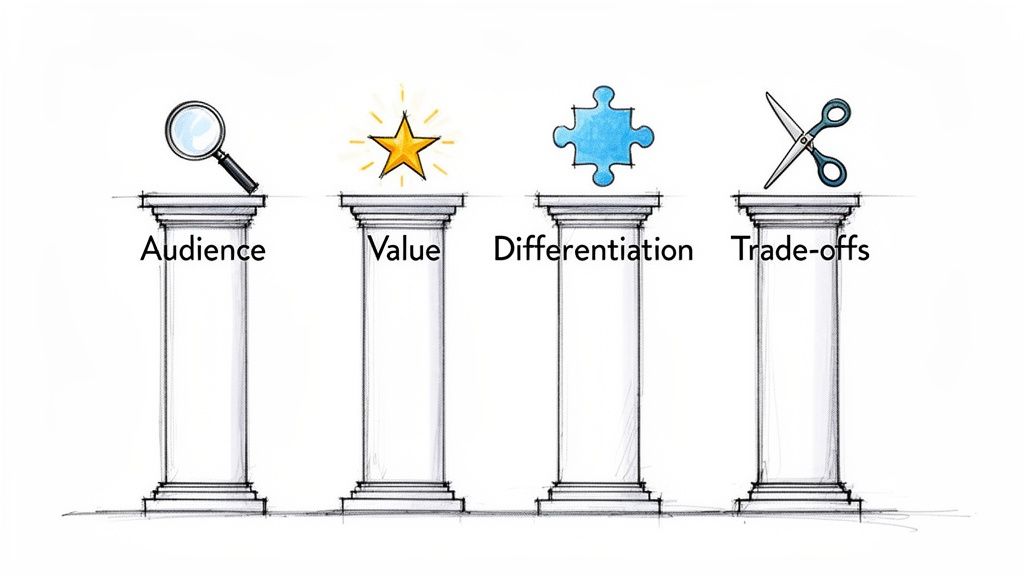
So, you get the big idea—carve out your own spot. But how do you actually find and claim that space without getting lost? It really boils down to four fundamental pillars.
Nail these, and you’ll stop competing on price and start winning on value.
Pillar 1: Know Your Audience (No, Really Know Them)
This is way more than "males, 18-35." That’s useless, surface-level stuff. Real positioning starts with an almost creepy obsession with a specific group of people who share a painful, nagging problem.
You need to know their secret frustrations—the stuff they vent about to friends but would never post on LinkedIn. What keeps them up at night? What are they really trying to do? Your mission is to become the world's leading expert on their problem, not just on your solution.
This is where you spot the gaps. You can use keyword research tools to see what people are searching for. Big tools like Ahrefs or Semrush are super powerful, but they can be expensive. A tool like Already.dev is a great alternative that can give you a shortcut by showing you how other companies are already tackling similar problems for specific audiences.
Pillar 2: Nail Your Value Proposition
Once you're inside your audience's head, your value proposition is your clear, simple promise to make their pain go away. It’s the "what's in it for me?" question answered so well that a five-year-old would get it.
A value prop is not a list of features. Honestly, nobody cares about your "synergistic AI-powered widgets." They care about what those widgets do for them—save them an hour every day, make them look like a genius to their boss, or kill that one annoying task forever.
> Your value proposition is the clear, tangible outcome you deliver. It's the "after" picture for your customer's "before" state.
Think about it like this:
- Weak Value Prop: "We offer a cutting-edge project management platform." (So does everyone else.)
- Strong Value Prop: "We help scattered remote teams finish projects on time, without the chaos." (Okay, now I'm listening!)
Pillar 3: Create Real Differentiation
Differentiation is your secret sauce. It’s that one thing you do that your competitors either can't or won't copy. And for the love of all that is holy, don't say it's "better customer service" or "higher quality." Everyone claims that. It's boring and nobody believes you.
True differentiation is baked into your business. It might be:
- Your Business Model: You offer a subscription in an industry that only sells one-off products.
- Your Unique Process: You have a secret method that gets results faster than anyone else.
- Your Brand's Personality: You're the funny, irreverent choice in a sea of boring corporate clones (think Dollar Shave Club).
The key is to be different in a way your ideal audience actually cares about. Being the only company that makes purple widgets is different, sure, but if nobody wants purple widgets, it's a useless distinction. A great way to visualize this is by using a marketing positioning matrix to see where you stand.
Pillar 4: Make Gutsy Trade-Offs
This is the hardest pillar for most people, but it's the most powerful. Strategic positioning is just as much about what you don’t do as what you do. It’s about having the guts to say "no."
You have to be willing to actively annoy some customers to become an absolute hero to your ideal ones.
When you try to be everything to everyone, you end up being nothing special to anyone. The moment you declare, "We don't serve that market," or "We don't offer that feature," you instantly strengthen your appeal to the people who are a perfect fit. IKEA happily trades off in-store service and pre-assembly for stylish, cheap furniture. They made a choice, and they own it.
These four pillars—Audience, Value Proposition, Differentiation, and Trade-offs—aren't just business school theories. They are the building blocks for a business that doesn't just survive, but thrives by becoming the only logical choice for the right customer.
Real-World Examples from Companies You Know
Theory is fine, but seeing this stuff work in the wild is where it really clicks. Let's look at how a few companies used these exact principles to carve out their own space and win big.
Think of this as a playbook, not a history lesson. We'll see how the four pillars—Audience, Value Proposition, Differentiation, and Trade-offs—come together to create an unstoppable market position.
The Streaming Giant vs. The Dinosaur
Remember Blockbuster? If you're under 25, maybe not. It was the go-to spot for Friday night movies. You'd roam the aisles, fight with your family, and hope the new release wasn't sold out. Blockbuster’s whole position was built on selection and immediacy.
Then Netflix showed up with its little red envelopes. Their first move wasn't about getting you a movie right now. It was about something completely different.
Let's break down their brilliant strategy:
- Audience: They targeted movie lovers who were sick of late fees and driving back to the store. Their ideal customer planned their movie nights, not the impulse renter.
- Value Proposition: "Never pay a late fee again." Simple, powerful, and a direct shot at Blockbuster's most hated feature.
- Differentiation: Convenience. Movies came right to your mailbox, and you could keep them for as long as you wanted. A totally new model.
- Trade-offs: This was genius. Netflix gave up immediacy. You couldn't just grab a movie; you had to wait. They intentionally said "no" to the instant gratification crowd to become the perfect solution for the patient viewer.
By making that trade-off, Netflix created a niche where Blockbuster couldn't follow without destroying its own business model. And we all know how that story ended.
A Scrappy SaaS Startup Finds Its Niche
Let's look at a modern example. The project management software market is a war zone, full of giants that promise to do everything from track your tasks to launch a rocket. A new startup, let's call them "Briefly," enters the scene.
Instead of trying to out-feature the big players, Briefly got smart.
- Audience: They ignored the "all project managers" crowd and focused on a super-specific group: small, remote creative agencies (5-15 people) who felt the big tools were bloated and complicated.
- Value Proposition: "The simplest way for creative agencies to manage client feedback." Notice they didn't say "manage projects." They zeroed in on one specific, painful part of the workflow.
- Differentiation: Simplicity and an obsession with client collaboration. While competitors added more charts, Briefly focused on making it incredibly easy to share a design and get comments on it.
- Trade-offs: They said "no" to enterprise features, Gantt charts, complex reporting, and a hundred other things the big guys offered. They were actively unappealing to customers who wanted an all-in-one monster tool.
This is what sharp positioning looks like. Briefly made itself the no-brainer choice for its tiny slice of the market. Keeping tabs on competitor moves like this is vital, and tools like Already.dev can help automate that discovery, saving you from weeks of boring manual digging.
In hyper-competitive markets, this is non-negotiable. The payoff is huge. One analysis found that top-positioned companies saw a revenue CAGR of 10% and a market cap CAGR of 16%. You can dive deeper into McKinsey's analysis on how this positioning drives massive returns.
How To Build and Test Your Strategic Position
Alright, enough theory. It's time to actually build something. Crafting your strategic position isn't some mystical art. It’s about making a few tough choices and then having the guts to see if you were right.
Let's get our hands dirty. This is where we turn abstract strategy into a market-tested weapon.
Your Strategic Positioning Mad Libs
The best way to start is by forcing yourself to be concise. No buzzwords, no fluff. Just a simple, clear statement that anyone—from your grandma to an investor—can understand.
Think of it like Mad Libs for your business. I've used this simple fill-in-the-blanks template for years to cut through the noise.
| Component | Your Answer | Example | | :--- | :--- | :--- | | For... (Your Target Audience) | | For early-stage SaaS founders... | | Who struggle with... (The Core Problem) | | ...who are struggling to find product-market fit... | | [Your Company Name] is a... (Your Category) | | ...Already is a competitive intelligence platform... | | That provides... (Your Key Benefit/Value Prop) | | ...that provides a real-time view of their market... | | Unlike... (Your Main Competitors) | | ...unlike manual research or clunky enterprise tools... | | We are the only ones who... (Your Unique Differentiator) | | ...we are the only ones who instantly map the entire competitive landscape. |
Filling this out forces you to make the hard trade-offs we talked about. It crystallizes exactly where you fit in the market and, just as importantly, where you don't.
Stop Guessing And Start Testing
Once you've got a draft, your job is to try and break it. A strategy that only exists in a Google Doc is worthless. You have to expose it to the market to see if it holds up.
This diagram shows the core components you’ll be testing. It’s a simple flow, but it’s the foundation of everything.
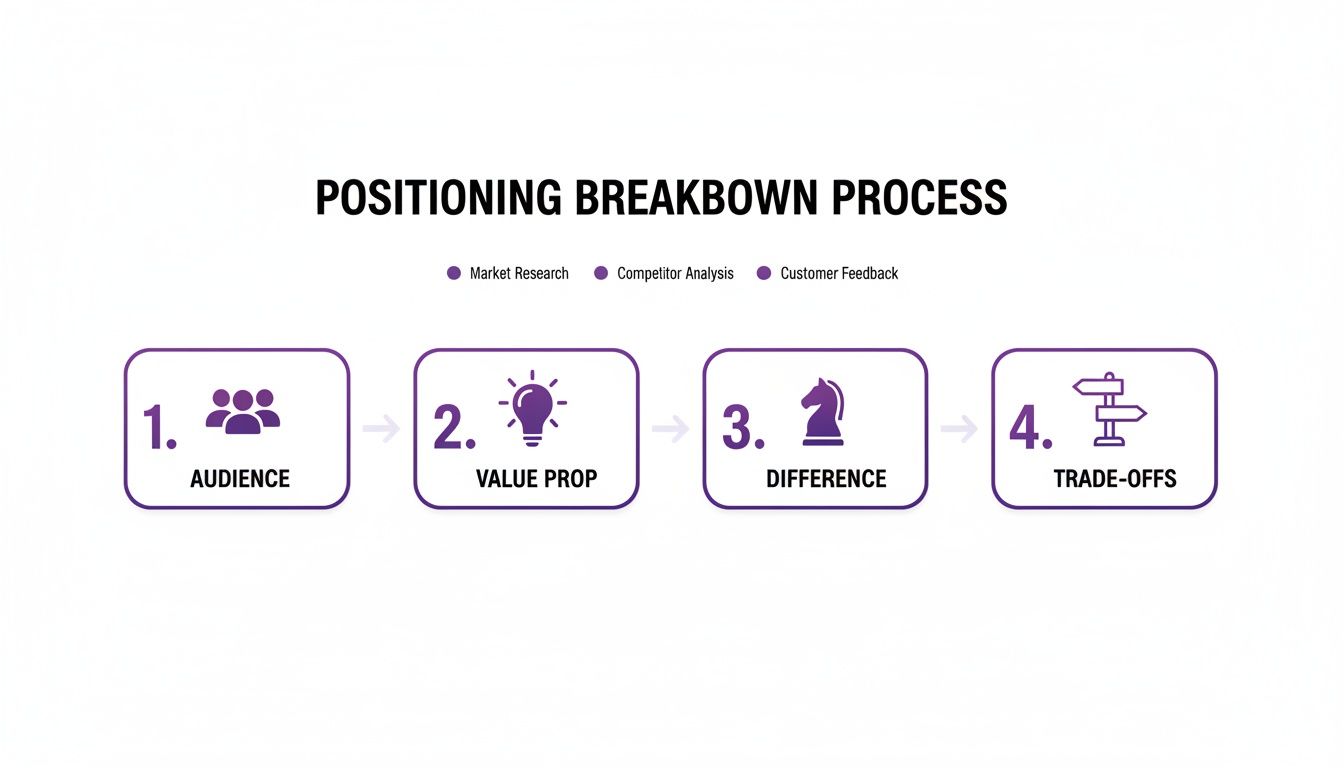
Each choice—your audience, value prop, difference, and trade-offs—builds on the last to create a rock-solid position.
Here are a few cheap and fast ways to validate your ideas:
- Run Micro Ad Campaigns: Spend $100 on LinkedIn or Facebook ads. Create two or three ad variations, each testing a different positioning angle. The one that gets the clicks is a huge clue.
- Conduct "Problem" Interviews: Don't ask, "Would you buy my product?" It’s a useless question. Instead, have real conversations about the problem you think you solve. Ask how they're dealing with it now. If they don't seem that bothered, you might be selling a vitamin when you need to be selling a painkiller.
- Analyze Competitor Language: Manually sifting through competitor websites and reviews takes forever. A full competitive landscape analysis framework is the best way to do this, and a platform like Already.dev can supercharge this, giving you a clear view of your competitors' positioning so you can find your unique gap in minutes, not weeks.
Validating Your Value Proposition
At the end of the day, it's all about delivering superior value. For B2B companies, getting this right can mean gaining 10-25% more market share each year. Research shows that top firms with a strong position hold an average market share of 35%, compared to just 12% for the laggards. That's a huge difference.
> The goal of testing isn't to be proven right. It's to find the truth as quickly as possible, even if it's not the truth you wanted.
When you're testing, you need ways to make sure your offer actually connects. Using proven Product Market Fit strategies like targeted surveys can give you the hard data to back up what you're hearing in interviews. This combo of listening and measuring is how you turn a good guess into a winning strategy.
Common Positioning Mistakes and How to Dodge Them
Alright, let's talk about the fun part—learning from everyone else's expensive mistakes. Getting your positioning right is awesome. Getting it wrong is a fast track to becoming another forgotten startup.
The good news is that most failures stumble into the same few traps. If you know what they look like, you can sidestep them like a pro.
Mistake 1: The "We're for Everyone" Trap
This is the deadliest mistake, born from a fear of missing out. You think, "If I target everyone, I'll have more customers!" The reality? When you're for everyone, you're for no one. Your message becomes so generic it's just noise.
-
Uh-Oh Signal: Your marketing copy is full of vague promises like "high-quality solutions." You describe your target market as "small businesses." That's not a niche; that's half the economy.
-
Do This Instead: Get ridiculously specific. Pick one small, underserved niche and become their hero. It's better to have 100 die-hard fans than 10,000 users who barely remember your name.
Mistake 2: The "Me-Too" Blunder
You see a competitor crushing it and think, "I'll just do what they're doing, but cheaper!" This is a race to the bottom you will lose. Copying a competitor means you're always one step behind, fighting over their scraps. You're telling customers, "We're just like them, but not as good."
> Being a copycat is the fastest way to become invisible. You give up your greatest asset—your uniqueness—for the comfort of following someone else's playbook.
-
Uh-Oh Signal: Your homepage looks and sounds almost identical to your top three competitors. Your only selling point is your price.
-
Do This Instead: Find your weird. What's the one unconventional opinion you hold about your industry? Lean into that. Use a tool like Already.dev to see how all your competitors are positioned so you can find that empty lane and own it.
Mistake 3: The "Feature Overload" Fallacy
This is super tempting for tech companies. It's the belief that the company with the most features wins. So you keep adding more and more, creating a bloated, confusing product that does a hundred things poorly instead of one thing brilliantly.
Remember, customers don't buy features; they buy solutions. More features just mean more complexity and a steeper learning curve, which pushes people away.
-
Uh-Oh Signal: Your product roadmap is a massive list of feature requests from every type of user. Your sales deck is 30 slides long, and each one explains a different button.
-
Do This Instead: Be a ruthless editor. Focus on the one core job your product needs to do exceptionally well for your specific audience. Be famous for solving one problem better than anyone else on the planet.
Your Positioning Is Never Finished
So, you think you’re done? Nailed the perfect statement and high-fived the team? I’ve got news for you: you’re never really finished.
Strategic positioning isn't a task you check off a to-do list. It's a living, breathing part of your business that needs constant attention. Think of it like a garden, not a statue. You can't just build it and walk away. You have to tend to it.
Markets shift, customer needs evolve, and sneaky new competitors pop up overnight. What made you unique last year might make you irrelevant next year. Stay paranoid—in a good way.
Your Quarterly Positioning Health Check
To stay sharp, you need a simple, repeatable process. Once a quarter, get your team together and run through a quick health check.
Here’s a simple checklist:
- Competitor Creep: Have any new players shown up? Are the old ones changing their message? A quick scan can reveal if someone is trying to eat your lunch.
- Customer Chatter: Are customers asking for things that don't align with your core value? This could mean their needs are changing, or you're attracting the wrong people.
- Message Resonance: Does your message still land? Check ad click-through rates and listen to sales calls. If you hear, "I don't get what you do," that’s a massive red flag.
- Team Alignment: Ask a few people from different departments to explain what the company does and for whom. If you get wildly different answers, your internal positioning is broken.
This proactive approach is what separates good companies from great ones. You can learn more about keeping a pulse on these things by exploring what marketing intelligence is and how it helps you stay ahead.
Getting your positioning right—and keeping it right—is the single biggest lever you can pull to win. It’s not just a marketing exercise; it’s the core of your strategy.
Frequently Asked Questions
You've made it this far, so let's hit a few of the most common questions I hear all the time. This is the rapid-fire round.
Isn't Positioning Just a Fancy Word for Marketing?
Nope. It’s the number one mix-up people make. Think of it like building a house.
- Strategic Positioning is the blueprint. It’s the thinking that happens before you build. It decides what kind of house you're building, for whom, and where. It’s the core strategy.
- Branding & Marketing are the construction crew and the real estate agent putting the "For Sale" sign out front. They bring the blueprint to life and tell the world about it.
Positioning is the strategy; marketing is the execution. Without a solid position, your marketing is just shouting into the void.
How Can a Tiny Startup Beat a Huge Corporation?
Ah, the classic David vs. Goliath. This is where positioning shines. A huge corporation is a massive cruise ship—it’s powerful, but it turns slowly and can’t go into shallow water. They have to appeal to everyone, which makes them kind of bland.
You, as a startup, are a speedboat. You can zip into tiny coves the cruise ship can't dream of approaching.
By focusing on a hyper-specific niche—a small group with a very particular, painful problem—you can become the absolute best solution for them. The big guys might not even see that niche as profitable enough to care about. You win by being more relevant to a select few, not by trying to out-spend the giants.
How Often Should I Revisit My Positioning?
Great question. This is not a "set it and forget it" deal. The market is always moving.
As a general rule, do a light health check every quarter. This isn't a huge project, just a quick look to make sure your core assumptions still hold up.
But you'll want to do a much deeper review when certain things happen:
- A major market shift: A new technology emerges or your customers' behavior takes a sharp turn.
- A scary new competitor enters the ring: Don't ignore them. Figure out where they stand and how it affects you.
- Your growth stalls: This is a huge red flag. It’s often the clearest sign that your position has gone stale.
Keeping an eye on this stuff doesn’t have to be a full-time job. Sure, tools like Ahrefs or Semrush are great for monitoring the market, but they can be expensive. A more focused alternative like already.dev is built specifically for mapping the competitive landscape, making it way easier to spot these shifts before they become big problems.
Ready to stop guessing and start winning? Already.dev gives you the competitive intelligence you need to find your unique spot in the market and build a business that stands out. Get a full view of your competitors in minutes, not weeks.