10 Blue Ocean Strategy Examples To Inspire You in 2025
Tired of competing? Dive into our deep analysis of 10 brilliant blue ocean strategy examples and learn how to create your own uncontested market space.
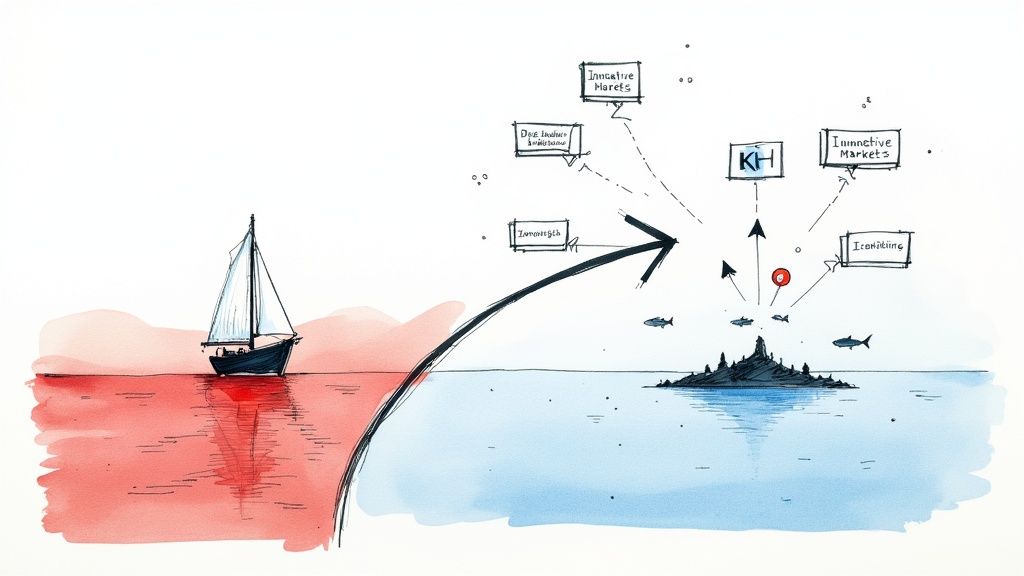
Ever feel like your market is a bloody shark tank? You're not alone. Most businesses are stuck in a "red ocean," fighting tooth and nail over the same customers, constantly trying to out-maneuver and undercut the competition. It's exhausting, expensive, and often a race to the bottom. But what if you could just... leave? That's the core idea behind Blue Ocean Strategy. It’s not about out-competing everyone; it's about making the competition irrelevant.
This isn't some abstract business school theory. It’s a practical framework for creating new market space and unlocking massive, uncontested demand. To make this real, we’re going to dissect 10 powerful blue ocean strategy examples, from circus acts and airlines to SaaS disruptors and meal-kit pioneers. We'll show you exactly how they did it, step-by-step.
Before we dive in, let's get one thing straight. It’s easy to confuse big-picture thinking with day-to-day actions, so it's helpful to distinguish between strategy and tactics to fully grasp how these companies created entirely new value curves. This list isn't just about telling success stories; it's about providing a blueprint. For each example, we’ll break down:
- The Red Ocean: What the crowded market looked like before.
- The Strategic Move: The specific actions they took to create a new market.
- The Outcome: The measurable results of their blue ocean shift.
- Actionable Takeaways: Concrete lessons you can apply to your own startup or product today.
Forget the jargon and fluff. Let's get into the real stories and practical steps you can actually use to find your own blue ocean.
1. Cirque du Soleil - Entertainment Without Stars
Back in the day, the circus industry was a pretty grim, zero-sum game. Ringling Bros. and Barnum & Bailey were the titans, locked in a brutal fight over a shrinking audience of families with kids. Their strategy was simple: get the biggest stars, the most exotic animals, and shove as many acts as possible into three rings. It was a race to the bottom on price and a race to the top on costs.
Cirque du Soleil looked at this bloody red ocean and said, "Nah, we're good." Instead of competing, they created an entirely new market space, a perfect blue ocean strategy example that blended the circus with the sophistication of theater.
The Strategic Shift: From Circus to "Cirque"
Cirque du Soleil used the Four Actions Framework to completely reinvent the experience.
- Eliminate: They got rid of the most expensive and controversial elements: star performers and animal acts. No more lion tamers or prima donna trapeze artists demanding huge salaries.
- Reduce: They downplayed the traditional "three-ring" chaos and cheap humor. The focus shifted away from individual, disconnected acts.
- Raise: They elevated the entire production value. This included a single, unifying theme, sophisticated music, high-end choreography, and artistic lighting, creating a much more refined atmosphere.
- Create: They introduced elements never seen in a traditional circus. This included a cohesive storyline, intricate costumes, and a theatrical, awe-inspiring experience designed to captivate adult audiences willing to pay premium, theater-level prices.
Shows like 'O' and KÀ in Las Vegas aren't just circuses; they are immersive theatrical events that created a new category of entertainment.
Actionable Takeaways for Founders
- Redefine Your Audience: Don't just fight for existing customers. Cirque targeted adults and corporate clients, a segment the traditional circus had completely ignored. A proper market opportunity assessment can help you find these untapped audiences.
- Create, Don't Compete: Instead of trying to be a "better" circus, Cirque became something entirely different. Ask yourself: what can I eliminate from my industry's standard offering to lower costs, and what can I create to offer unprecedented value?
- Build a Brand, Not Just a Product: Cirque du Soleil is synonymous with artistic, high-end performance. They built a powerful brand around their unique value proposition, allowing them to charge a premium and build a loyal global following.
2. Netflix - Home Entertainment Disruption
Before Netflix, renting a movie was a universally annoying experience. You’d drive to Blockbuster, wander the aisles hoping they had the new release you wanted (they didn’t), and then rush to return it in a day or two to avoid those dreaded late fees. The video rental industry, led by giants like Blockbuster, competed on store locations and inventory depth, a red ocean of logistical nightmares and customer frustration.
Netflix saw this pain point and decided to torpedo the entire model. They didn't just build a better video store; they created a completely new market for home entertainment. This classic blue ocean strategy example shows how they moved from competing in the physical world to dominating a new digital one.
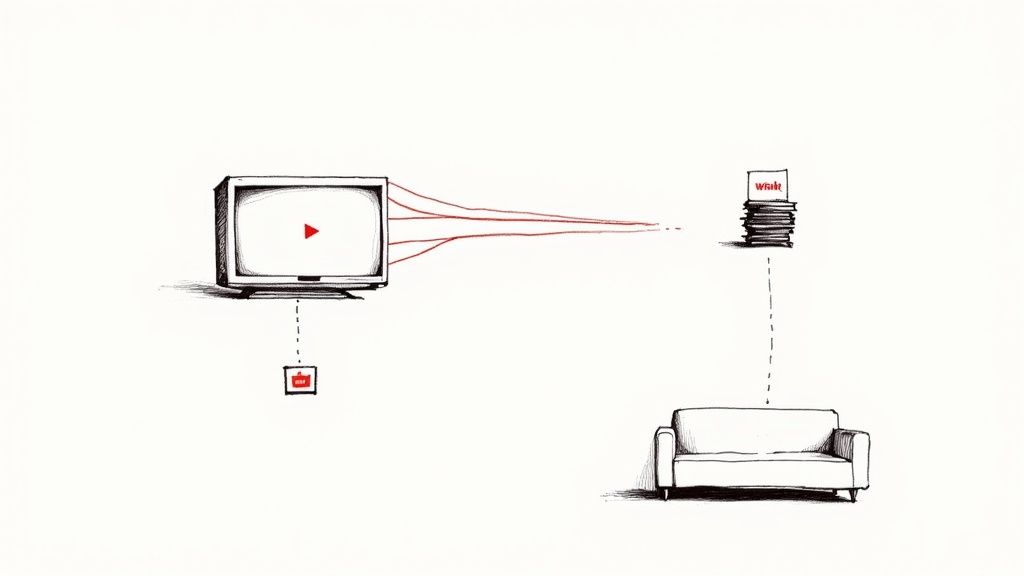
The Strategic Shift: From Store to Subscription
Netflix applied the Four Actions Framework to dismantle the traditional rental business and build a new one from scratch.
- Eliminate: They completely nuked the biggest annoyances: physical stores and late fees. This single move removed the two most significant sources of customer friction and operational cost.
- Reduce: The pressure of limited new releases and "due dates" was significantly downplayed. With a massive catalog and no return deadlines, the anxiety of renting was gone.
- Raise: Convenience was raised to an unprecedented level. Movies arrived in your mailbox, and later, streamed instantly. They also heavily invested in a recommendation algorithm, offering a level of personalization Blockbuster could only dream of.
- Create: Netflix created a subscription-based model for home entertainment, a concept that was entirely new to the industry. Later, they created another new market by producing original content like Stranger Things, transforming from a distributor into a global production powerhouse.
Actionable Takeaways for Founders
- Turn Industry Pains into Gains: Netflix identified the most hated parts of the rental experience (late fees, store visits) and built their entire value proposition around eliminating them. What are the biggest "necessary evils" in your industry that you can erase?
- Shift from Transaction to Relationship: Instead of a one-off rental transaction, Netflix built a long-term, subscription-based relationship. This created predictable revenue and immense customer loyalty. A product-market grid can help you map out how to build this kind of sticky, recurring value.
- Use Data as a Competitive Moat: From day one, Netflix used viewing data to refine its recommendation engine. This personalization created a better user experience and made it harder for customers to leave, a strategy that only grew more powerful with the shift to streaming.
3. Southwest Airlines - Cost Leadership with Experience
For decades, the airline industry was a cutthroat red ocean. Major carriers like Pan Am, TWA, and American Airlines competed head-to-head on luxury, expansive route networks, and premium services. They used a complex and expensive "hub-and-spoke" model, funneling passengers through major airports, which meant higher costs, longer layovers, and more expensive tickets.
Southwest Airlines took one look at this mess and decided to play a completely different game. Instead of competing to be the best luxury airline, they created a new market for affordable, no-frills air travel, becoming a legendary blue ocean strategy example by making flying as accessible and cheap as taking a bus.
The Strategic Shift: From Luxury Carrier to Flying Bus
Southwest meticulously applied the Four Actions Framework to dismantle the traditional airline model and build something new from the ground up.
- Eliminate: They got rid of everything that added cost and complexity without adding speed. Assigned seating, first-class cabins, in-flight meals, and the hub-and-spoke system were all thrown out the window.
- Reduce: They dramatically cut down on turnaround times at the gate. By using a single aircraft type (the Boeing 737), they simplified maintenance, training, and operations, getting planes back in the air faster than anyone else.
- Raise: They amped up what budget travelers actually cared about: flight frequency and friendly service. More direct, point-to-point flights meant more convenience. Their fun, personable staff created a brand identity that stood out in a stuffy industry.
- Create: Southwest created an entirely new model of low-cost, high-frequency, short-haul air travel. They effectively made flying a viable alternative to driving for millions of people who were previously priced out of the market, opening up a massive, uncontested customer base.
Actionable Takeaways for Founders
- Focus on Operational Excellence: Southwest's genius was in its operational model. By simplifying everything from their fleet to their boarding process, they created massive cost savings that they passed on to customers. What complexity can you eliminate from your operations?
- Build Culture as a Moat: Herb Kelleher famously said, "The business of business is people." Southwest's quirky, fun-loving culture isn't just a gimmick; it's a competitive advantage that's hard to copy and creates fierce customer loyalty.
- Simplify Your Offering: Don't try to be everything to everyone. Southwest ignored the business-class globetrotter and focused solely on the point-to-point budget traveler. This focus allowed them to dominate their niche before expanding.
4. Nintendo Wii - Gaming for Non-Gamers
In the mid-2000s, the console wars were a high-tech arms race. Sony's PlayStation and Microsoft's Xbox were locked in a brutal red ocean, battling over hardcore gamers by one-upping each other on processing power, graphical fidelity, and complex game controllers. It was a race to create the most powerful machine for an existing, and very specific, audience.
Nintendo, trailing in third place with the GameCube, decided to stop playing their game altogether. Instead of building a more powerful console, they created the Wii, a perfect blue ocean strategy example that targeted a massive untapped market: everyone else. They focused on fun and accessibility over raw power.

The Strategic Shift: From Hardcore to Household Fun
Nintendo’s strategy was a masterclass in value innovation, completely redefining what a video game console could be.
- Eliminate: They jettisoned the obsession with cutting-edge graphics and processing power, which were huge cost drivers. They also got rid of the complex, multi-button controllers that intimidated non-gamers.
- Reduce: The focus on violent, complex, and niche game genres was significantly downplayed. The need for a dedicated, hours-long gaming session was no longer the primary use case.
- Raise: They dramatically raised the accessibility and intuitive nature of gaming. The motion-sensing Wii Remote was so simple that anyone, from a toddler to a grandparent, could pick it up and play Wii Sports in minutes.
- Create: Nintendo created a new form of social, active, family-centric entertainment. They introduced motion controls as the primary input, turning gaming into a physical activity that was fun to watch and play, bringing video games out of the basement and into the living room.
Actionable Takeaways for Founders
- Look for the Non-Consumers: Sony and Microsoft were fighting over existing gamers. Nintendo looked at the billions of people who didn't play video games and asked, "Why not?" Identify who your industry is actively ignoring and build for them.
- Simplify to Innovate: Instead of adding more features, Nintendo removed complexity. This radical simplification made their product accessible and desirable to a much larger audience. Ask what you can take away to create a better experience. A traditional look at the video game market would focus on more power, but Nintendo proved simplicity wins.
- Change the Context of Use: The Wii wasn't just for teenage boys in their rooms; it was for family gatherings, parties, and even nursing homes. By creating new use cases, Nintendo expanded the entire market.
5. Yellow Tail Wine - Wine Accessibility
For decades, the wine industry was built on a foundation of snobbery and complexity. Established vineyards in France and California competed fiercely on heritage, terroir, and awards, targeting a small, knowledgeable base of wine connoisseurs. It was an intimidating world full of tannins, aging potential, and complex terminology, effectively locking out the average person.
Australian winemaker Casella Wines looked at this exclusive, high-brow market and saw a massive untapped audience: everyone else. They launched Yellow Tail in 2000 not as a better wine, but as a completely different kind of drink, creating a perfect blue ocean strategy example by making wine simple, fun, and accessible.
The Strategic Shift: From Connoisseur to Casual
Yellow Tail applied the Four Actions Framework to uncork a new market of casual drinkers who just wanted something that tasted good.
- Eliminate: They scrapped all the intimidating wine jargon. Gone were mentions of tannins, oak, and complex aging processes. The focus was on the experience, not the education.
- Reduce: They simplified the product range. Instead of a confusing array of varietals and vintages, they launched with just two easy-to-understand options: a Chardonnay and a Shiraz. They also reduced the complexity of the flavor profile, aiming for consistency over vintage variation.
- Raise: They dramatically raised the approachability factor. The branding was fun and simple, featuring a colorful kangaroo. The flavor was fruit-forward and easy to drink, appealing directly to a palate more accustomed to beer or soda.
- Create: Yellow Tail created a new value proposition: a fun, simple, and reliable wine that required zero prior knowledge to enjoy. They also created a simple purchasing experience with the same bottle design for red and white, differentiated only by color.
By doing this, Yellow Tail didn't just sell wine; it sold confidence to a new generation of drinkers who had been ignored by the traditional industry.
Actionable Takeaways for Founders
- Demystify Your Industry: What jargon or complexity in your industry scares off new customers? Find ways to eliminate it. Make your product intuitive and your marketing language simple and direct.
- Target the "Non-Consumer": Yellow Tail went after beer drinkers and people who never bought wine. Look at adjacent markets and ask what's preventing them from using a product like yours. Creating a marketing positioning matrix can help you visualize these untapped segments.
- Focus on Consistency and Reliability: While traditional wineries celebrated the variation of vintages, Yellow Tail delivered the same great taste in every bottle. For new customers, this reliability builds trust and removes the risk of a bad purchase.
6. Uber - Taxi Industry Transformation
Before 2009, hailing a cab was a universal pain. You'd stand on a street corner, arm flailing, hoping a vacant taxi would magically appear. If you called a dispatcher, you were entering a black hole of uncertainty, with no idea when your ride would show up or how much it would cost. The taxi industry was a stagnant red ocean, protected by expensive medallions and plagued by terrible customer service.
Uber didn't just build a better taxi company; it sidestepped the entire industry. By leveraging the smartphone in everyone's pocket, Uber created a new market for on-demand private transportation, making the old taxi model almost irrelevant overnight. This move is a classic blue ocean strategy example of using technology to obliterate old-world friction.
The Strategic Shift: From Hailing a Cab to Summoning a Car
Uber applied the Four Actions Framework to dismantle the taxi industry's value curve and create a new one centered on convenience and transparency.
- Eliminate: They completely removed the need for street-hailing and calling a dispatcher. The costly and restrictive taxi medallion system was also bypassed.
- Reduce: They significantly reduced rider uncertainty about wait times and fare costs. The anonymity of both driver and passenger was also lessened through rating systems.
- Raise: They dramatically raised the level of convenience. A car could be summoned with a few taps, paid for seamlessly, and tracked in real-time.
- Create: Uber introduced dynamic pricing, a two-sided rating system for accountability, GPS tracking for safety and efficiency, and a cashless payment system. This created a new standard for on-demand mobility.
The result wasn't a better taxi; it was a completely new experience that made getting a ride as easy as ordering a pizza.
Actionable Takeaways for Founders
- Weaponize Convenience: Uber’s core innovation wasn't the car; it was the frictionless experience. Identify the biggest points of friction in your industry and ask how modern technology can eliminate them entirely.
- Build a Two-Sided Platform: Uber created value by connecting two distinct groups: riders who needed a lift and drivers who had a car. This model creates powerful network effects where more riders attract more drivers, and vice-versa.
- Turn Data into a Feature: Uber uses data for everything from dynamic pricing (Surge) to predicting demand and optimizing driver routes. Use the data you collect not just for internal insights but to create features that deliver tangible value back to the user.
7. Blue Apron - Meal Kit Convenience
Before meal kits, dinner was a binary choice for many busy professionals: spend time planning, shopping, and cooking a meal from scratch, or just give up and order expensive, often unhealthy, takeout. The grocery and restaurant industries were locked in a battle for the "what's for dinner" decision, but both came with significant trade-offs in time, money, or health.
Blue Apron looked at this dilemma and saw a massive untapped market. They didn't try to build a better grocery store or a faster delivery app. Instead, they pioneered a new category altogether, creating a perfect blue ocean strategy example that combined the convenience of takeout with the satisfaction and health benefits of home cooking.
The Strategic Shift: From Groceries to Guided Cooking
Blue Apron’s innovation came from applying the Four Actions Framework to the entire home-cooking experience.
- Eliminate: They got rid of the most tedious parts of cooking: meal planning and grocery shopping. They also eliminated food waste by providing perfectly measured ingredients.
- Reduce: The complexity and time commitment of cooking were drastically cut down. No more searching for obscure ingredients or spending hours prepping.
- Raise: They elevated the home-cooking experience by introducing new recipes and high-quality, often artisanal, ingredients that most people wouldn't normally buy. The sense of culinary discovery became a key feature.
- Create: They built an entirely new model: a subscription box that delivered a complete, guided cooking experience. This included pre-portioned ingredients and step-by-step recipe cards, turning cooking from a chore into a fun, educational activity.
Blue Apron’s rapid growth, leading to its 2017 IPO, demonstrated the massive demand for this new market. They made home cooking accessible and enjoyable for a whole new segment of customers.
Actionable Takeaways for Founders
- Solve Multiple Pain Points: Blue Apron didn't just solve one problem. It addressed time constraints, decision fatigue, food waste, and the desire for culinary variety all at once. Look for opportunities where you can bundle solutions to interconnected problems.
- Turn a Product into an Experience: They didn't just sell food; they sold the experience of becoming a better home cook. Focus on how you can add educational or entertainment value to your core offering to build a stronger connection with customers.
- Logistics are the Moat: Blue Apron’s success was heavily dependent on its supply chain and logistics. While this was also a major challenge, a complex operational advantage can be a powerful barrier to entry for competitors. Don't underestimate the power of operational excellence.
8. Airbnb - Home-Sharing Disruption
Before Airbnb, the hospitality industry was a classic red ocean. Big hotel chains like Hilton and Marriott competed fiercely on location, price, and amenities. They spent billions on real estate and staff, fighting over business travelers and vacationing families. The entire game was about standardized rooms and predictable service.
Airbnb entered this battlefield by refusing to play the game. They looked at the market and realized there was a massive, underutilized asset: people's spare rooms. Instead of building hotels, they built a platform, creating a new market that combined accommodation with local, authentic experiences. This move is a textbook blue ocean strategy example that turned the travel industry on its head.
The Strategic Shift: From Hotel Rooms to "Belonging Anywhere"
Airbnb applied the Four Actions Framework to redefine what it means to "stay" somewhere.
- Eliminate: They got rid of the biggest costs associated with the hotel industry: physical real estate, front desk staff, and standardized amenities. They didn't own a single room.
- Reduce: They significantly reduced the formality and impersonal nature of a hotel stay. Gone were the cookie-cutter lobbies and generic concierge services.
- Raise: They dramatically raised the sense of community and authenticity. Guests could live like a local, get insider tips from their host, and experience a neighborhood, not just a tourist district.
- Create: Airbnb created an entirely new value proposition: a platform built on trust (via reviews), a sense of belonging, and a unique variety of stays. They introduced the ability to rent entire homes, unique spaces like treehouses, and later, curated local "Experiences."
This shift created a new market of travelers who valued authenticity and connection over the predictable comfort of a hotel, unlocking massive value on both the guest and host side.
Actionable Takeaways for Founders
- Leverage Underutilized Assets: What resources in your industry are being ignored? Airbnb saw value in empty bedrooms. Uber saw it in idle cars. Look for the hidden capacity that a platform model can unlock.
- Build a Community, Not Just a Customer Base: Airbnb's success hinges on trust between strangers. They invested heavily in profiles, secure payments, and a two-way review system to build a community. Focus on facilitating human connection, not just transactions.
- Redefine the Value Proposition: Instead of selling a "room for the night," Airbnb sold the idea of "belonging anywhere." Frame your product around the emotional outcome or experience, not just its functional features. This differentiation is key to creating a blue ocean.
9. Spotify - Music Industry Transformation
In the early 2000s, the music industry was a battlefield. Record labels were suing their own customers for illegal downloading on platforms like Napster, while Apple's iTunes dominated the legal digital market with a clunky, pay-per-song model. It was a red ocean of furious artists, angry consumers, and terrified executives clinging to the concept of physical and digital ownership.
Spotify sailed into this chaos with a revolutionary idea: what if you didn't have to own music at all? Instead of competing with iTunes on price per track or fighting pirates with lawsuits, they created a new market built on access, not ownership. This pivot is a textbook blue ocean strategy example that reshaped an entire industry.
The Strategic Shift: From Ownership to Access
Spotify applied the Four Actions Framework to dismantle the old model and build a new one from the ground up.
- Eliminate: They got rid of the need to purchase individual songs or albums. This also removed the main incentive for illegal downloading: the high cost of building a music library.
- Reduce: They significantly lowered the barrier to entry. Instead of paying $0.99 per song, users could access millions of tracks for free with ads or for a low monthly fee.
- Raise: They dramatically increased discovery and personalization. Features like Discover Weekly and personalized playlists offered a level of curation and convenience that buying individual tracks could never match.
- Create: They introduced a new model of "all-you-can-eat" music streaming. They added social sharing features, collaborative playlists, and a seamless multi-device experience, turning solitary listening into a connected activity.
This shift created a new market of subscribers who valued access and discovery over ownership, leaving the old download-to-own model in the dust.
Actionable Takeaways for Founders
- Shift the Model from Product to Service: Spotify sold access, not a product. Ask yourself if your customers truly need to own your offering, or if a subscription-based access model could provide more value and a stickier revenue stream.
- Leverage Personalization as a Moat: Spotify’s algorithms are its secret sauce, keeping users engaged by constantly serving them music they’ll love. Investing in powerful personalization can create a deep, competitive advantage.
- Build an Ecosystem, Not Just a Feature: Spotify didn't just stream music; it created a platform for discovery, sharing, and eventually, podcasts and audiobooks. Think about how you can expand your initial offering to become an indispensable part of your user's daily life.
10. Decathlon - Sports Retail Democratization
The traditional sporting goods market was a high-stakes game. Brands like Nike and Adidas focused on elite athletes, charging premium prices for high-performance gear backed by celebrity endorsements. Retailers were mostly middlemen, caught between managing expensive brand inventory and competing on price for a limited set of customers. It was a classic red ocean of brand-versus-brand combat.
Decathlon entered this arena and decided not to play the game at all. Instead of focusing on pro athletes, they targeted the massive, underserved market of beginners, families, and casual sports enthusiasts. They created a new space by making sports accessible and affordable for everyone, a perfect blue ocean strategy example of market creation through democratization.

The Strategic Shift: From Brand Palace to Sports Superstore
Decathlon used the Four Actions Framework to dismantle the traditional retail model and build something entirely new.
- Eliminate: They removed expensive, big-name brands from their shelves. This cut out the middleman markup and the need for costly marketing campaigns tied to star athletes.
- Reduce: They dramatically lowered the complexity of the shopping experience. Instead of countless competing products, they offered a curated selection of their own in-house brands, simplifying choice for customers.
- Raise: They significantly raised the value-for-money proposition. By controlling the entire process from design to sale, they could offer good-quality gear at prices competitors couldn't touch.
- Create: They built an all-in-one destination for sports. They introduced vertically integrated design and manufacturing, product tiers for all skill levels (from beginner to advanced), and a "try before you buy" store format, turning their locations into experience hubs.
This strategy allowed them to become Europe's largest sporting goods retailer, proving that you don't need to chase elite customers to win.
Actionable Takeaways for Founders
- Serve the Underserved: Instead of fighting for the top 10% of the market, look at the 90% everyone else is ignoring. Decathlon found its blue ocean by serving beginners and casual users.
- Own Your Value Chain: Vertical integration gave Decathlon unmatched control over cost, quality, and innovation. Ask yourself: what part of my supply chain can I bring in-house to create a competitive advantage and deliver more value to my customers?
- Make Affordability a Feature, Not a Compromise: Decathlon didn’t just make cheap products; they engineered affordability into their business model. This created a powerful, defensible moat that premium brands struggle to cross.
Blue Ocean Strategy — 10 Examples Compared
| Example | Implementation Complexity 🔄 | Resource Requirements ⚡ | Expected Outcomes ⭐📊 | Ideal Use Cases 💡 | Key Advantages ⭐ | |---|---:|---:|---|---|---| | Cirque du Soleil - Entertainment Without Stars | High 🔄 (complex artistic production, training) | High ⚡ (capital, specialized talent, stage tech) | Premium pricing, new market segment, strong brand equity 📊 | Premium live experiences; arts-driven differentiation 💡 | Creates wholly new value factors; high margins ⭐ | | Netflix - Home Entertainment Disruption | Medium‑High 🔄 (technology + content strategy) | Very high ⚡ (infrastructure, content licensing/production) | Recurring revenue, scale, personalized engagement 📊 | Subscription media platforms; customer-retention models 💡 | Data-driven personalization and strong network effects ⭐ | | Southwest Airlines - Cost Leadership with Experience | Medium 🔄 (operational redesign, culture change) | Moderate ⚡ (fleet standardization, crew training) | Low-cost leadership, reliable profits, high utilization 📊 | High-frequency transport for price-sensitive travelers 💡 | Operational efficiency and simplified operations ⭐ | | Nintendo Wii - Gaming for Non‑Gamers | Medium 🔄 (hardware UX innovation) | Moderate ⚡ (R&D for motion controls, ecosystem) | Rapid mass-market adoption; market expansion to non‑gamers 📊 | Products targeting non‑consumers and casual users 💡 | Broadens customer base via accessible interaction model ⭐ | | Yellow Tail Wine - Wine Accessibility | Low 🔄 (simplified branding/positioning) | Low‑Moderate ⚡ (consistent production, distribution) | Fast share growth and high-volume sales 📊 | Consumer goods aiming to convert adjacent categories (e.g., beer drinkers) 💡 | Low barrier to entry; approachable branding and consistency ⭐ | | Uber - Taxi Industry Transformation | High 🔄 (platform engineering, marketplace ops, regulation) | High ⚡ (tech, driver onboarding, legal costs) | Rapid scale, network effects, improved convenience 📊 | On‑demand, two‑sided marketplaces and local services 💡 | Convenience, transparent pricing, scalable network effects ⭐ | | Blue Apron - Meal Kit Convenience | High 🔄 (perishable logistics, subscription ops) | High ⚡ (fulfillment centers, sourcing, marketing) | Recurring revenue & engagement but churn/logistics risk 📊 | Subscription services solving multiple friction points (time + skill) 💡 | Integrated solution that reduces customer friction ⭐ | | Airbnb - Home‑Sharing Disruption | High 🔄 (trust systems, regulatory complexity) | Moderate‑High ⚡ (platform, community management, legal) | New category creation, asset utilization, global scale 📊 | Asset‑light marketplaces focused on experience and lodging 💡 | Authentic local experiences and vast, low‑capex inventory ⭐ | | Spotify - Music Industry Transformation | High 🔄 (licensing + personalization tech) | High ⚡ (licensing fees, engineering for recommendations) | Large user base, piracy reduction, rich user-data insights 📊 | Digital access/subscription models for content industries 💡 | Massive catalog + strong personalization and discovery ⭐ | | Decathlon - Sports Retail Democratization | Medium 🔄 (vertical integration, broad SKU management) | Moderate‑High ⚡ (manufacturing, retail footprint, logistics) | Democratized access, scale, high turnover and loyalty 📊 | Mass‑market retail focused on affordability and variety 💡 | Cost control through vertical integration; broad assortment ⭐ |
So, How Do You Find Your Blue Ocean?
We've just surfed through a whole lot of strategic genius. From Cirque du Soleil ditching the three-ring circus drama to Nintendo making your grandma a video game champion with the Wii, the pattern is crystal clear. These game-changing blue ocean strategy examples aren't about out-muscling the competition. They're about making the competition irrelevant.
The big takeaway isn't that you need a once-in-a-century idea that falls from the sky. It's about a fundamental shift in perspective. Every company we looked at, from Netflix to Airbnb, essentially looked at a crowded, bloody "red ocean" of rivals fighting over the same scraps and said, "Nah, I'm good."
They didn't just build a better version of what already existed. They redefined the problem entirely.
The Common Threads of Blue Ocean Success
So, what's the secret sauce? After dissecting these ten examples, a few core principles jump out. These aren't just theories; they are the practical foundations you can build on.
-
Focus on Non-Customers: Nintendo didn't try to win over hardcore PlayStation fans. They went after parents, kids, and seniors who had never touched a controller. Yellow Tail Wine didn't appeal to snobby connoisseurs; they targeted casual drinkers who just wanted something that tasted good. Who is your industry actively ignoring? That’s where the gold is.
-
Eliminate and Reduce: What does everyone in your industry think is absolutely essential? Southwest Airlines got rid of assigned seating and free meals. Cirque du Soleil cut the expensive animal acts and star performers. This isn't just about cutting costs; it's about removing distractions to focus on what truly creates new value.
-
Raise and Create: What new factors can you introduce that the industry has never offered? Blue Apron created the convenience of a perfectly portioned, home-delivered meal kit. Uber created on-demand ride-hailing with transparent pricing. This is where you introduce the "wow" factor that defines your new market space.
The goal is to stop thinking in terms of "better, faster, cheaper" and start thinking in terms of "different, simpler, more valuable." You're not playing the same game; you're inventing a new one where you're the only player.
Your First Step: Mapping the Battlefield
Okay, this all sounds great in a blog post. But how do you actually do it? The first, most critical step is to get an unflinchingly honest look at your current red ocean. You need to map out who’s in it, what they’re all fighting over (features, price points, marketing angles), and which customer segments are being underserved or completely ignored.
Doing this manually is a soul-crushing slog of spreadsheets, competitor website deep-dives, and late-night Googling. You could sign up for powerful market research tools like Ahrefs or Semrush, but they can be seriously expensive and are often built more for SEO keyword battles than for true strategic analysis. A more modern and accessible alternative like Already.dev can automate this process for you.
The smarter move is to automate the reconnaissance. To find your blue ocean, you first need a perfect map of the red one. You need to see the entire competitive landscape, not just the players you already know about. This is how you spot the gaps. This is how you find the uncontested water. Don't just work harder on the same old strategies; find a new direction entirely.
Ready to find your own blue ocean without drowning in weeks of manual research? Already.dev uses AI to automatically map your entire competitive landscape, analyze feature sets, and identify the uncontested market space you've been looking for. Stop guessing and start navigating with a clear map by visiting Already.dev today.