Your Ultimate Comparative Market Analysis Template
Build a comparative market analysis template that gives you a real edge. Our guide shows startups how to analyze competitors and find winning insights.

A comparative market analysis template is your startup's cheat sheet for spying on the competition (legally, of course). It’s a simple way to organize all the messy details about other players in your space so you can spot their strengths, weaknesses, and where you fit in. Basically, it shows you who you're really up against and where the golden opportunities are hiding.
So, What Is a CMA and Why Should You Actually Care?

Let's cut the fluff. A Comparative Market Analysis (CMA) isn't some dusty business school term or a tool just for real estate agents. For a startup, it's your playbook. Flying blind and basing your price on a "gut feeling" is a fantastic way to go out of business. Taking a little time to build a solid CMA is probably the smartest thing you can do to make decisions with data instead of hope.
This isn't just about listing your rivals. It’s about building a living document where you compare everything from pricing and features to what their customers are complaining about on Reddit. The whole point is to stop guessing.
More Than Just Selling Houses
The whole CMA thing was ripped off from the real estate world. Agents use it to figure out a home's value by looking at what similar houses nearby just sold for. It's how they avoid listing a mansion for the price of a shack.
Just like a house's value is all about "location, location, location," your startup's value is all about its place in the market. Your competitors are your neighborhood. And if you don't know the neighborhood, you're gonna get lost.
Why This Is Non-Negotiable for Your Startup
A good CMA template is a Swiss Army knife for a new business. It’s not a boring report you make once and then forget about; it’s a hands-on tool that shapes your entire game plan.
Here’s why it’s a game-changer:
- It Defines Your Position: You’ll instantly see where you stand. Are you the cheap option? The fancy, premium choice? Or the weird niche player with one killer feature?
- It Guides Your Pricing: Peeking at what everyone else charges is Step #1 for setting your own prices. You can't just pull a number out of thin air.
- It Reveals Market Gaps: You might just stumble upon a group of customers everyone else is ignoring. That’s where the magic happens.
- It Beefs Up Your Investor Pitch: Investors have heard it all. A solid CMA proves you've actually done your homework and aren't just winging it.
> A great CMA turns "we think" into "we know." It replaces your wild guesses with cold, hard facts, giving you the confidence to make bold moves.
Basically, this analysis helps you dodge rookie mistakes, like building something nobody wants or jumping into a market so crowded you can't breathe. It's the boring-but-essential work that makes everything else click. For a deeper look, check out our complete guide on market analysis for startups.
Building Your CMA Template From the Ground Up
Alright, enough talk. Let’s get our hands dirty and build this thing. Staring at a blank spreadsheet is the worst, so we'll break it down column by column. A useful comparative market analysis goes way beyond just listing competitor names.
We're going to build a framework that captures the details that actually matter—the juicy stuff that separates the winners from the wannabes.
Here's a look at the essential columns I'd put in any CMA template worth its salt.
Core CMA Template Fields
| Field/Category | What to Track | Why It Matters | | :--- | :--- | :--- | | Company & Website | The competitor's name and a link to their homepage. | The obvious starting point. Your home base for all your snooping. | | Target Audience | Who they're really trying to sell to. | "B2B SaaS" is useless. Get specific: "B2B SaaS for dentists who hate paperwork." Specificity is key. | | Core Value Proposition | Their main one-sentence pitch. | This is the promise they make to customers. It's usually plastered right on their homepage. | | Pricing & Tiers | List their plans and what you get with each. | This shows you how they squeeze money out of people and what they think is most valuable. | | Marketing Channels | How they get customers (e.g., SEO, paid ads, TikTok dances). | Tells you where they're spending their money. Are they content nerds or ad junkies? | | Killer Features | The top 3-5 features people actually love. | Don't list everything. Focus on what makes them special. | | Known Weaknesses | What people complain about online. | Find the chinks in their armor. G2, Capterra, and Reddit are goldmines for this stuff. | | "Secret Sauce" Notes | Your gut feelings, observations, and random thoughts. | Is their brand voice hilarious? Is their support amazing? What's the one thing they do that's hard to copy? |
Getting these basics down is half the battle. It’s like setting up the board before you play chess—you have to know who the pieces are before you can start planning your attack.
Digging Deeper with Advanced Fields
Now for the fun part. The table above is your foundation, but the real magic happens when you start connecting the dots. These next bits are where you'll find the insights most people are too lazy to look for.
> A good CMA template doesn't just collect data; it forces you to ask the right questions. Each column should make you rethink your own strategy.
Here’s how to level up your analysis:
- Marketing Angles & Tone: How are they getting the word out? Are they all-in on SEO? Running cheesy LinkedIn ads? Note their main channels and the vibe of their messaging.
- Killer Features: As mentioned in the table, you need to list their top 3-5 features. Seriously, don't just copy and paste their features page. Dig into reviews to find the handful of things people can't shut up about.
- Noticeable Weaknesses: Time to play detective. What do customers complain about most? Is their app ugly? Is support a nightmare? Is it missing a key feature? Again, review sites and Reddit are your best friends.
- "Secret Sauce" Notes: This is a crucial column for your gut feelings. What’s their unique vibe? Is their brand fun or corporate and stuffy? What's the one intangible thing they do that nobody else can replicate?
By tracking this stuff, your comparative market analysis template becomes a living weapon. It’s no longer just a static document but a source of strategic intel you can use over and over.
To take this even further, you can integrate these findings into a broader document. Our guide on creating a market research report template shows you exactly how to do that.
How to Find the Right Data on a Budget
Alright, so you've got your shiny new comparative market analysis template ready to go. Great. But an empty template is pretty useless. Now for the real work: filling it with good info without going broke.
Don't worry, you don't need a huge budget to be a data spy. It’s about knowing where to look and being a little scrappy. We're talking about digging through competitor websites, sifting through customer reviews, and lurking on social media.
Of course, you could throw money at the problem. Big-shot SEO tools like Ahrefs or Semrush are awesome, but let’s be real, they can be super expensive, often costing hundreds of dollars a month. That’s tough when you’re a startup.
Smart Automation and Clever Manual Tricks
The good news? You have other options. Smarter, more affordable tools like already.dev can automate a huge chunk of this research for you, pulling in competitor data so you're not stuck manually copying and pasting until your eyes cross.
The secret is to blend some clever manual digging with smart automation. This combo gives you the most complete picture.
This simple flow chart lays out the journey from a blank spreadsheet to a killer action plan.
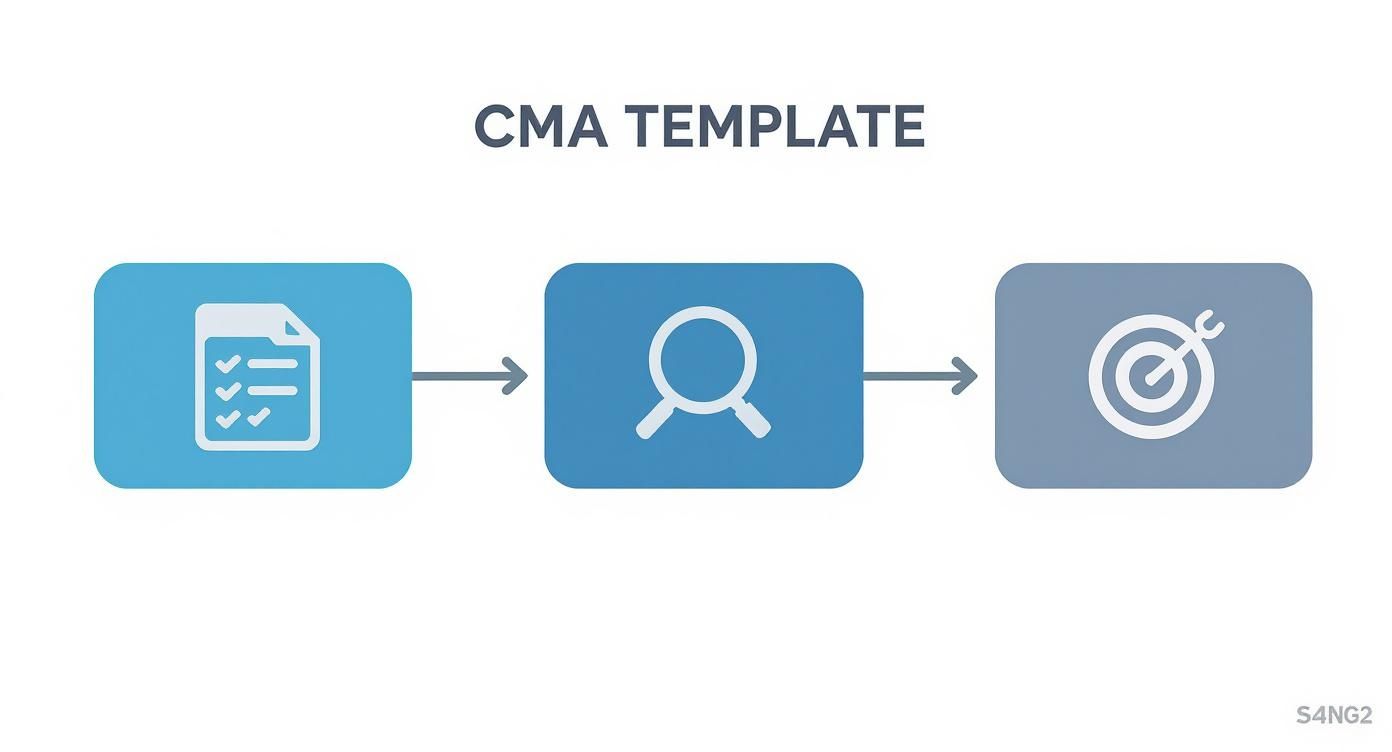
As you can see, it's a pretty straightforward path: figure out what you need to know, grab the data, and then turn it into a strategy that actually works.
Your Budget-Friendly Data Sources
Ready to start digging? Here’s your spy starter pack—places you can find incredibly valuable intel for free.
- Customer Review Sites: Platforms like G2, Capterra, and Trustpilot are pure gold. You're getting unfiltered feedback on what customers love and, more importantly, hate about your competitors. Pro tip: focus on the 1-star and 3-star reviews. That’s where the real dirt is.
- Social Media & Forums: Jump on Reddit, X (formerly Twitter), and relevant Facebook Groups and search for your competitors' names. This is where you find the raw, honest conversations. What are people always complaining about? What do they wish the product could do?
- Competitor Websites & Blogs: Don't just glance at their homepage. Dive deep into their case studies to see who their ideal customers are. And definitely sign up for their newsletter; it’s a direct line into their marketing playbook.
> Your competitors' biggest weaknesses are usually hiding in plain sight, buried in a Reddit thread or a one-star G2 review. Your job is to find those patterns and turn their customer complaints into your next killer feature.
As you build out your CMA, knowing the right questions for market research to ask will keep you from getting lost in a sea of useless data. By combining these manual deep dives with an automated tool like already.dev, you can build a comprehensive market picture without breaking the bank.
Turning Your Data Into a Winning Strategy
So, you’ve got a spreadsheet packed with data. Now what? A filled-out comparative market analysis template is just a collection of facts until you connect the dots. Information without a plan is just noise.
This is where you switch from data collector to strategist. Your job is to comb through everything to find the gaps and golden opportunities your competitors are missing.
From Data Points to Strategic Plays
Let's walk through a real-world example. Imagine you’re building a new project management app. Your template is loaded with info on giants like Asana and Trello. As you scan the columns, a pattern emerges.
Maybe you notice every major player targets huge companies. Their pricing is a complex maze, their feature lists are a mile long, and their marketing is all boring corporate jargon.
But then you dig into the customer reviews you logged in your template. Small marketing agencies and freelancers are screaming into the void. They don't need fancy charts; they just want simple task tracking that isn't ugly.
That’s your gap. That’s the opportunity everyone else is ignoring.
> The best ideas don't come from finding a competitor's weakness and copying it. They come from spotting a whole group of people that's being ignored and building something just for them.
When you analyze the data this way, you stop trying to build a slightly better version of what's already out there. Instead, you're carving out a niche where you can be the undisputed champ for a specific audience. These findings become the bedrock of your entire plan, and our guide to building a go-to-market strategy can show you how to execute on it.
Spotting Your Unique Angle
Your unique angle is born from these kinds of observations. It could be one of several things, all discovered by picking apart your CMA.
- A Feature Gap: Is there a critical integration everyone is missing? For our project management app, maybe it’s a direct link to accounting software like FreshBooks, which freelancers love.
- A Pricing Opportunity: If all your competitors have confusing, per-seat pricing, maybe your angle is a dead-simple, flat monthly fee. No tiers, no complexity.
- A Marketing Blind Spot: Are they all pumping out boring blogs? Maybe you can win by creating hilarious content on TikTok or sponsoring newsletters that creative people actually read.
Sometimes, inspiration comes from weird places. For instance, global real estate data can reveal shifting trends. You can find more insights on these global real estate trends to see how big-picture economics can light a fire under your strategic thinking. The point is, look everywhere for an edge.
Common CMA Mistakes That Can Sink Your Startup
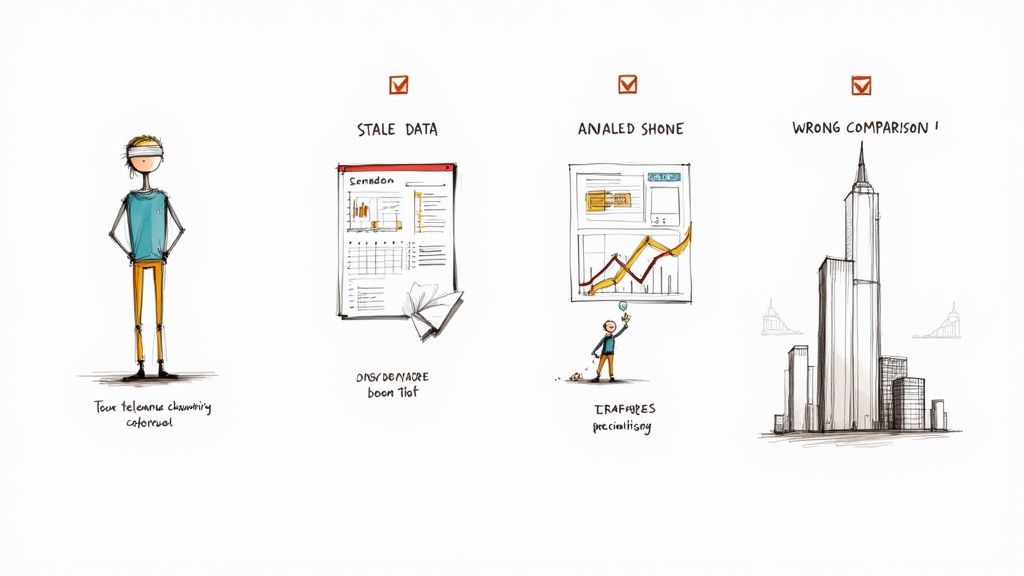
Putting together a CMA is a great move. But let's be real—doing it wrong is worse than not doing it at all. It's a huge waste of time that can point your startup in the completely wrong direction.
So, welcome to the tough-love section. Let's walk through the classic blunders that tank otherwise promising startups.
We've all done it. You get so wrapped up in an idea that you start looking for data to prove you're right. That's confirmation bias, and it’s a silent startup killer. It turns your objective analysis into a personal pep rally.
Another classic mistake is comparing your tiny two-person team to a giant like Google. It’s silly and useless. Your analysis needs to focus on competitors you can actually fight, not industry titans with infinite money.
The Trap of Stale and Irrelevant Data
Using old data is like navigating with a map from 1920—you’re going to end up in a ditch. Markets change fast. What was true six months ago might as well be ancient history. This is especially true in fast-moving sectors like real estate, where a comparative market analysis template has to be super fresh.
Take the U.S. housing market. It's a crazy dance of supply, demand, and interest rates. If you were using last year's sales data to price a house today, you'd be way off. You can read the full housing market outlook to get a sense of how quickly these things change.
> Your analysis is only as good as the data you feed it. Garbage in, garbage out. Make sure your info is fresh.
Analysis Paralysis and Other Fun Pitfalls
It's also super easy to get lost in the weeds. I've seen founders spend weeks collecting every data point imaginable until they’re drowning in spreadsheets. That's analysis paralysis. The goal isn’t to know everything; it's to know the right things.
Here are a few other common screw-ups to avoid:
- Ignoring Indirect Competitors: You might think your only rival is another software tool. But what about the consulting firm solving the same problem? Or the team that just uses a complex spreadsheet? They're your competition, too.
- Focusing Only on Features: A feature-by-feature list is just scratching the surface. You have to dig into their marketing, brand voice, and customer support. That's where the real battle is won.
- Forgetting to Update It: This isn't a one-and-done task. The market is always shifting. You need to refresh your analysis at least every quarter to stay ahead.
Dodge these mistakes, and your comparative market analysis template will transform from a chore into a powerful weapon.
Got Questions About Your CMA? We've Got Answers
You've done the hard work. Your comparative market analysis template is built, you've filled it with data, and you're already seeing things differently. But this is usually when a few tricky questions pop up.
Let's tackle the most common ones.
How Often Should I Refresh This Thing?
Think of your market like a live movie, not a static photo—it's always changing. A CMA you built six months ago is practically a historical artifact. For most startups, a quarterly refresh is the sweet spot.
It's frequent enough to catch important market shifts but not so often that you go crazy. That said, if you're in a super-competitive space (like AI), you might want to do a monthly check-in.
> Your CMA is a health check for your strategy. You don't go to the doctor every week, but you don't wait five years either. A regular refresh keeps you from making decisions based on old news.
What if a Competitor Hides Their Pricing?
Ah, the classic "Contact Us for a Demo" button. It's annoying, but it's not a dead end. When a company hides its pricing, it's a huge clue that they're targeting big enterprise clients with custom, expensive contracts.
Here’s how to play detective:
- Scour Review Sites: Dive into platforms like G2 or Capterra. You'd be amazed how often users mention what they're paying in detailed reviews.
- Become a "Potential Customer": No shame in this. Use a personal email, sign up for their demo, and play the part. You'll get an inside look at their sales pitch and probably their pricing.
- Hunt for Comparison Articles: Search for blog posts like "[Competitor Name] vs. [Other Competitor Name]." These articles often do the dirty work for you, breaking down pricing and features.
How Do I Handle International Competitors?
Just because a competitor is on the other side of the world doesn't mean you can ignore them. But analyzing them requires a little more nuance.
You need to add a layer of context. Think about things like local culture, the marketing channels that work in their region, and what their currency is worth. A price that seems crazy to you might be totally normal in their home market.
The goal isn't a perfect apples-to-apples comparison. It's to understand their business model in their own world. This insight is gold because it helps you predict what they might do if they ever decide to move onto your turf.
Ready to stop guessing and start winning? Already.dev can automate this entire intelligence-gathering process, giving you deep competitive insights in minutes, not weeks. Free yourself from the spreadsheet grind and build your strategy on a rock-solid foundation of data. Get started at https://already.dev.