How to Validate Your Startup Idea Without Wasting Time or Money
Discover how to validate startup idea with practical, low-cost steps from customer interviews to landing page tests that reduce risk and boost early traction.

Validating your startup idea is just a fancy way of saying: find proof that people will actually pay you for your thing. And finding it before you drain your savings account building it.
Think of it as a series of small, cheap experiments designed to answer the only question that matters—does anyone even care?
Your 'Genius' Idea Might Be a Terrible Business (And That's Okay)
Let's get real. That amazing idea that hit you at 2 AM? It feels like a guaranteed unicorn. You've probably already picked out the color for your future Tesla.
But here’s a dose of tough love every founder needs: most startup ideas are dead on arrival. Not because the founder was a bad coder or marketer, but because they built something nobody actually wanted. The startup graveyard is littered with beautifully engineered products that solved a problem no one had.
This guide is your roadmap to avoiding that fate. We’re going to stop thinking about validation as a chore and start treating it like a detective mission. Your goal isn't to prove you're a genius; it's to uncover the truth, as quickly and cheaply as possible.
The Number One Startup Killer
Forget about fancy tech or clever marketing. The biggest reason new ventures fail is a deafening silence from the market.
A famous CB Insights analysis of over 100 startup failures found that a staggering 42% of them died because of "no market need." More recent data shows that 34% of failed small businesses point to poor product-market fit, and another 22% blame bad marketing—all symptoms of the same core disease. These are problems that proper, early-stage validation is specifically designed to sniff out and fix.
This chart really drives the point home.
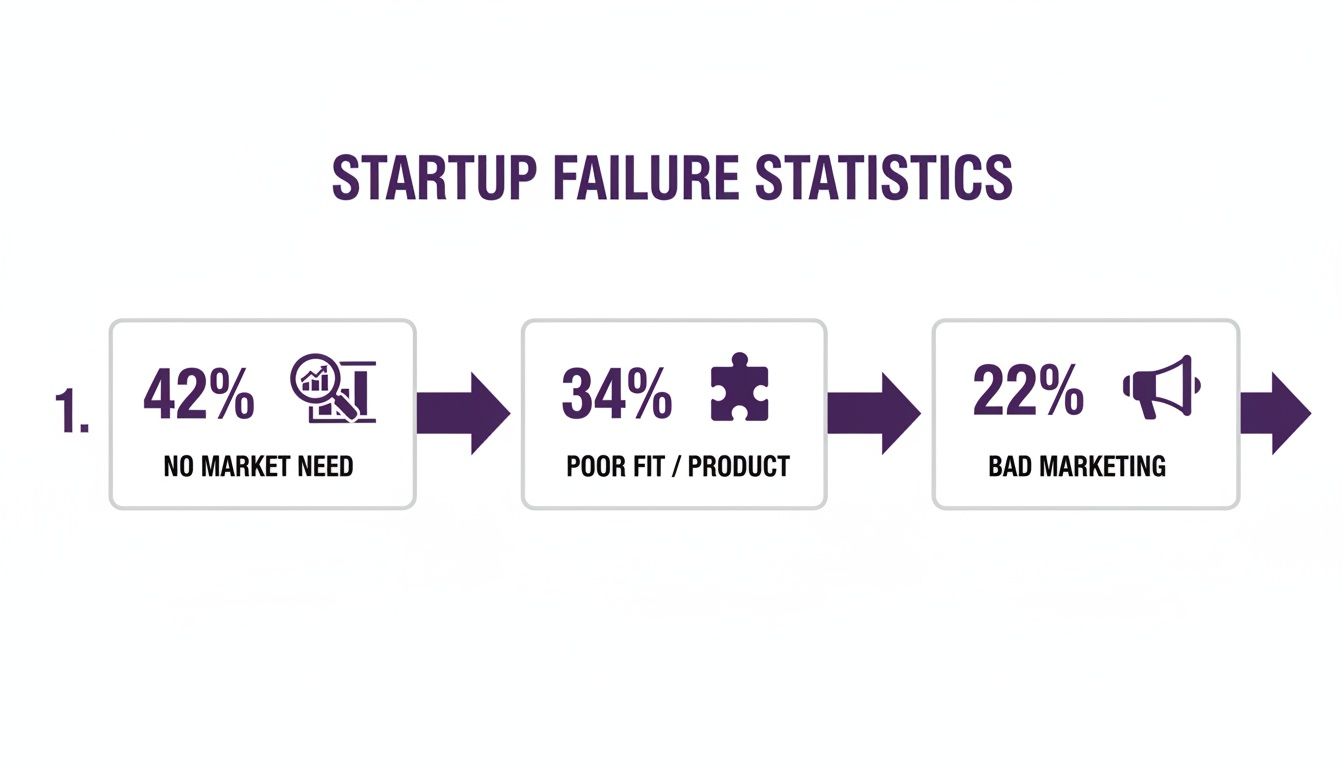
The numbers don't lie. Most failures aren't dramatic explosions; they're quiet deaths caused by a fundamental misunderstanding of the customer.
Fall in Love with the Problem, Not Your Solution
This is the most important mindset shift you need to make. Your idea? It’s just a guess. A hypothesis. Validation is how you test those guesses in the real world without going broke.
> Your job as a founder isn’t to be a brilliant inventor. It’s to be a relentless investigator who is obsessed with your customer's problems. If you can understand their pain better than they do, you'll find a solution worth building.
The truth is, your first idea is probably wrong. Or at least, it’s not quite right. And that’s fantastic news! Every failed experiment, every bit of blunt feedback, gets you one step closer to an idea that actually has a fighting chance. To get a better handle on this, it's worth learning how to validate product ideas fast.
This playbook will give you the practical, low-cost steps to get there. We’re going to stop guessing and start knowing.
Talk to Actual Humans (Yes, It's Scary)
Alright, you’ve made peace with the fact that your brilliant idea might just be a dud. That’s a huge step. Now comes the single most important—and, let's be honest, most uncomfortable—part of this whole process: talking to people.
And no, I don't mean your mom, your best friend, or your dog. They love you. They'll tell you what you want to hear. You need to talk to complete strangers who you think are wrestling with the problem you're trying to solve. So, close those 50 browser tabs and step away from the business plan. It's time to get out of the building.

This whole dance is called customer discovery. Think of yourself as a detective. Your mission is not to sell anything. I'll say it again for the people in the back: your goal is not to sell anything. The second you start pitching your amazing solution, you’ve already lost. You’re there to listen and learn, period.
Know Your Mission: Problem vs. Solution Interviews
You'll be having two very different kinds of conversations, and you absolutely need to know which one you're in.
- Problem Interviews: This is ground zero. Your only objective is to confirm that the problem you've assumed is real, painful, and happens often enough for a specific group of people to care. You're just exploring their world and their frustrations.
- Solution Interviews: Don't even think about doing this until you have solid proof from your problem interviews. This is where you might show a sketch, a mockup, or a super-basic prototype to see how they react to your specific take on a solution.
Jumping the gun and starting with a solution interview is a classic rookie mistake. It taints the feedback because you're forcing them to think about your idea instead of their reality.
Finding People to Interview (Without Being Weird)
This always feels like the hardest part, but it’s simpler than you'd think. You just need to show up where your target audience already hangs out.
Where to start looking:
- Online Communities: Reddit, Facebook Groups, industry-specific Slack channels, and forums are gold mines. Search for keywords related to the problem space. The key is to participate a little first—don't just drop in and spam a request for help.
- LinkedIn: Search for the job titles that fit your ideal customer profile. A polite, concise message asking for 15 minutes of their expertise on challenges in their industry can work surprisingly well.
- Local Meetups: Find events in your city related to your industry. People are there to network and are usually pretty open to a quick chat.
Finding the right people to talk to is a skill you'll hone over time. For a much deeper look, check out our complete guide on how to identify target customers, which breaks down this process even further.
What to Actually Ask Them
Here’s the golden rule of customer interviews: ask about the past, not the future. People are terrible at predicting what they would do, but they're great at telling you what they have done.
For the love of all that is holy, never ask questions like:
- "So, would you use a product that did X?"
- "How much would you be willing to pay for this?"
- "Do you think this is a good idea?"
These questions are bait for polite, useless answers. You'll get a bunch of "Yeah, sounds neat!" and learn absolutely nothing.
Instead, try these on for size.
Great Questions for Problem Interviews:
- "Could you walk me through the last time you had to deal with [the problem]?"
- "What was the most frustrating part about that whole process?"
- "What have you tried, if anything, to make this easier for yourself?"
- "If you've used other tools, what did you love or hate about them?"
- "What's your current workaround for this? (Are you using a messy spreadsheet, a bunch of sticky notes?)"
See the pattern? These are all open-ended questions that force them to tell a story about a real, past experience. You’re digging for emotion and details, not a simple "yes" or "no."
> Hot Tip: You're listening for "pain points" and "workarounds." If people aren't already trying to solve the problem with some duct-taped, hacky method, the pain probably isn't strong enough for them to ever pay for a real solution.
After about 10-15 of these conversations, you'll start hearing the same frustrations and even the same exact phrases over and over again. That's the signal you're looking for. That's the pattern that tells you you're onto something real. This is the qualitative data that will give you the confidence to move forward.
Map the Battlefield to Find Your Opening
So, you think you have no competitors? Let me stop you right there. That's not a good sign—it's a giant, flashing red flag.
It almost always means one of two things: you haven't looked hard enough, or there’s simply no market for what you're building. Every real problem has people trying to solve it already, even if their "solution" is just a clunky spreadsheet or a chaotic chain of sticky notes.
This is where competitive analysis comes in, but forget the boring kind that creates a spreadsheet nobody looks at twice. Think of this as a strategic mission to find your opening. Your job is to create a treasure map of the current landscape, highlighting where your rivals are strong, where they’re weak, and—most importantly—where they aren't even looking.

Honestly, this process is one of the most vital parts of validating a startup idea. It shows you the path of least resistance and greatest opportunity.
Uncover Your Three Types of Competitors
Your competition isn't just the company that looks exactly like yours. To really get the full picture, you need to hunt for three different kinds of rivals.
- Direct Competitors: These are the obvious ones. They're building a similar product for the same audience to solve the exact same problem. Think Lyft vs. Uber.
- Indirect Competitors: These guys solve the same core problem but with a totally different approach or for a slightly different customer. A fancy restaurant and a home meal kit both solve the "what's for dinner?" problem.
- Alternative Solutions (The 'Good Enough' Crew): This is the one most founders forget, and it's often the most dangerous. What are people doing right now to hack together a solution? Your biggest competitor might not be another startup; it could be a messy Google Sheet, a series of manual emails, or just hiring an intern.
To find these, you have to become a bit of a digital detective. Scour Reddit threads, Facebook groups, and niche industry forums. Look for phrases like "is there a tool for..." or "how do you handle..." and see what people are already using and, more importantly, complaining about.
Tools of the Trade
You can spend an absolute fortune on big-name SEO and market research platforms. Tools like Ahrefs or Semrush are incredibly powerful for a deep dive, but let's be real—they can be ridiculously expensive for an early-stage founder. You don't need a sledgehammer to crack a nut.
A much faster and more focused approach is to use a tool built for this specific job. For instance, Already.dev is designed to quickly map out the competitive landscape using AI, saving you dozens of hours of grunt work. It’s built to give you the strategic overview you need without the hefty price tag and steep learning curve. The whole point is to get answers fast so you can make decisions, not become a professional market researcher.
> Pro Tip: Don't just look at who's winning. Actively search for failed startups in your space. Use Crunchbase or just Google "[your idea] alternative" and see what pops up. A company's failure is a public post-mortem full of valuable lessons you don't have to pay for.
The Art of Gap Analysis
Okay, you've identified your competitors. Now the real work begins. This isn't about just copying features; it's about finding the gaps they've left wide open. This is your "gap analysis."
Look for these specific openings:
- The Ignored Audience: Who are they not serving? Maybe the big players focus exclusively on enterprise clients, leaving a massive opening for a tool tailored to freelancers or small businesses.
- The Missing Feature: Listen to their customers. Seriously. Read their reviews on sites like G2 or Capterra, browse their support forums, and check their social media mentions. What are people constantly begging for that the company just refuses to build? That’s not a feature request; it’s a potential business model.
- The Unmet Emotion: Is their brand cold and corporate? Is their user experience a total nightmare? You can often win by offering a simpler, more delightful, or more human-centric solution to the exact same problem.
- The Overlooked Channel: Where aren't they marketing? If they're throwing all their money at Google Ads, maybe there's a huge, untapped opportunity on TikTok or through niche industry newsletters.
This intelligence is pure gold. It helps you carve out a unique value proposition that isn't just another "me too" offering. If you want to dig deeper into this, our guide on creating a competitive landscape analysis framework offers a structured way to turn this research into a real strategic advantage.
This analysis is what stops you from building a slightly worse version of something that already exists and points you toward a space you can truly own.
See If People Actually Bite with a Few Cheap Experiments
Okay, you’ve done your homework. You’ve talked to real people and scoped out the competition. Now for the moment of truth. It’s time to stop asking people what they would do and start measuring what they actually do. Talk is cheap, but a click—or even better, an email address—is a genuine signal of intent.
This is where you shift from being a detective to being a scientist. We're going to run a few fast, cheap experiments to see if we can catch some real, quantifiable interest. And the best part? You can get started with less than $100 and a free weekend.
First, Build a Simple Landing Page
Your first experiment is a simple, one-page website. It has one job and one job only: to get a visitor to say, "Yes, I want this." That's it. This isn't your permanent company website; think of it as a finely tuned instrument built specifically to test your core value proposition.
It’s basically a movie trailer for your product. It needs to be clear, compelling, and leave people wanting more.
What your landing page absolutely needs:
- A Killer Headline: Honestly, this is 80% of the battle. It must clearly state the benefit for your ideal customer. Don't try to be clever; be direct. "Manage All Your Social Media in One Place" is infinitely better than "Synergize Your Digital Footprint."
- A Simple Sub-headline: Give them a little more context. Who is this for? How does it solve their specific problem?
- Three Key Benefit Bullets: Forget features; focus on outcomes. Instead of "Advanced AI scheduling," try "Save 10 hours a week on content planning." People buy the result, not the technology.
- One Crystal-Clear Call to Action (CTA): This is your big, shiny button. The most effective CTA for a validation page is something like "Join the Private Waitlist" or "Get Early Access." Make it impossible to miss and don't give them other options. One button, one goal.
That’s all. Seriously. Don't get bogged down building an "About Us" page or a blog. Speed is your most valuable asset right now.
Now, Add a Little Fuel to the Fire
A great landing page with zero visitors is like a billboard in the middle of the desert. Pointless. You need to drive a small, highly targeted group of people to it to see what happens. The goal isn't to go viral; it's just to get enough data to make a smart decision.
Your budget for this can be tiny. I'm talking $50 to $100.
> My go-to move here is running super-targeted ads on whatever platform your audience lives on. If you're targeting B2B professionals, LinkedIn ads or even Reddit ads aimed at specific subreddits can be absolute gold. For a consumer product, Facebook or Instagram ads usually work wonders.
The secret sauce is targeting. Don't just show your ad to "males aged 25-40." Get surgical. Target by job title, specific interests, or membership in certain online groups. You want to make sure the people seeing your ad are the exact same type of people you interviewed earlier.
The Only Metric That Really Matters
Once traffic starts hitting your page, you need to obsess over one number above all others: the conversion rate. This is simply the percentage of visitors who took the desired action—in this case, filling out your form.
This single metric tells you an incredibly powerful story about your idea and your messaging.
So, what's a "good" number? Thankfully, this isn't some abstract concept. Data from pre-launch tools shows that hitting a conversion rate above 20% for email sign-ups is a very strong signal. In fact, some of the most successful pre-launch campaigns average around a 35% opt-in rate. If you’re struggling to get 5-10% of your hyper-targeted traffic to give you an email, that's a huge red flag that people won't be lining up to pay you later. You can dig deeper into these benchmarks and see how they define startup validation metrics.
Here’s a quick guide to interpreting your results:
| Conversion Rate | What It Probably Means | | :-------------- | :---------------------------------------------------------------------------------------------------------- | | Below 5% | Danger Zone. Either your ad targeting is completely off, or the problem you're solving just isn't painful enough. Back to the drawing board. | | 5% - 10% | Lukewarm. You might be onto something, but your message isn't connecting. It's time to A/B test some new headlines and benefits. | | 10% - 20% | Getting Warm. This is a promising signal. People are definitely interested, but it's not a screaming "take my money!" just yet. | | Above 20% | Hot! You've clearly hit a nerve. A conversion rate this high from cold traffic means your value prop is strong and compelling. |
If your numbers are low, don't panic! This is precisely why we do this. You just learned something incredibly valuable without writing a single line of code or spending a fortune. Now you can go back, tweak your headline, rephrase your benefits, and run another $50 experiment. This is how you iterate your way to an idea people will actually pay for.
Making Sense of It All: Time to Pivot or Proceed
Alright, let's take a breath. You've talked to strangers (and survived!), mapped out the competition, and even spent a few bucks watching real people interact with your landing page. Your brain is probably swimming in a messy soup of interview notes, conversion rates, and competitor features.
So, what now?
This is where all that hard work pays off. It’s time to synthesize everything you’ve learned and make one of the most critical decisions in your startup's life: do you proceed, pivot, or pull the plug?
This step is what separates the founders who succeed from the ones who burn through their savings on a hunch. It's about looking at the data with brutal honesty, even if it tells you something you don't want to hear.
Combining What They Said with What They Did
You’ve gathered two very different types of data, and both are crucial. Think of it like trying to solve a puzzle with two different kinds of pieces.
-
Qualitative Data (The "Why"): These are the stories, emotions, and direct quotes from your customer interviews. Did you hear the same frustrations over and over? Did people's eyes light up when you described a potential solution? This is your evidence of the problem's intensity.
-
Quantitative Data (The "What"): This is the hard math from your experiments—your landing page conversion rate, ad click-through rate, and waitlist sign-ups. This is your evidence of the solution's appeal.
You absolutely need both. Glowing interview feedback without any sign-ups probably means you found a real problem, but your solution stinks. High sign-ups from people you never spoke to could mean you’re attracting the wrong audience entirely. The magic happens when both sets of data point in the same direction.
The Pivot, Proceed, or Perish Framework
Let’s keep this simple. Based on everything you've learned, you have three clear paths forward. Be honest with yourself about which bucket you fall into.
-
Proceed with Confidence: This is the dream scenario. Your interviews uncovered a painful, recurring problem, and your landing page converted at 15-20% or higher. The language people used in interviews matched the messaging that got them to click. You have a clear signal to move forward.
-
Pivot with Insight: Maybe your interviews revealed a totally different—but much more painful—problem than the one you started with. Or your landing page bombed, but a specific niche (like project managers, but not marketers) converted really well. A pivot isn't a failure; it’s a smart course correction based on real evidence. You're not starting over; you're just aiming at a better target.
-
Pull the Plug (For Now): The people you interviewed were polite but didn't seem to have any real pain. Your landing page conversion rate was abysmal (below 5%). Nobody is trying to hack together a workaround for this "problem." This is a tough pill to swallow, but it’s a massive win. You just saved yourself months or years of building something nobody wants.
> Killing an idea isn't a sign of failure. It's a sign of a smart, disciplined founder who values their time and money. It’s a successful validation test that says, "Not this one. Next."
This validation data is also your secret weapon for the future. Investors increasingly expect this kind of proof long before a full product exists. An unvalidated idea is basically invisible. Having hard evidence is what will convince co-founders, early hires, and investors that you’re actually onto something.
If you need help digging through the noise to find clear patterns, our guide on market research data analysis provides some practical frameworks to make sense of it all.
Answering Your Top Validation Questions
We've walked through the whole playbook, but I know what you're thinking. The validation process is notorious for kicking up a dust storm of "what ifs" and "am I even doing this right?" that can bring your momentum to a screeching halt.
Let's cut through the noise and tackle the big questions—the ones that keep founders up at night.
How Much Money Should I Spend on Validation?
As close to zero as you can get. Seriously. The whole point of this early game is to maximize learning while minimizing cash burn. Your budget for everything—interviews, a quick landing page, a tiny ad experiment—should easily stay under $200.
You're investing your time and brainpower, not your life savings. Lean on free survey tools, use a simple landing page builder, and only spend enough on ads to see if you get a flicker of interest. Every dollar you save now is a dollar you can invest smarter later, armed with real evidence. For a deeper dive into this lean approach, check out a practical guide to validating your SaaS idea.
What if Someone Steals My Idea?
Ah, the classic. This is the boogeyman in every first-time founder's closet, and it’s almost always a phantom. Let me be blunt: your idea is worthless. It's the execution that matters.
The odds of someone hearing your idea, having the same burning passion, dropping everything in their life, and then magically out-executing you are practically zero. Compare that to the massive risk of you spending the next year of your life building something that nobody wants. It’s not even close.
> Secrecy is the enemy of feedback. Hiding your "genius" idea in a bunker just starves it of the oxygen it needs to survive. Get out there, talk about it, and focus on learning faster than anyone else.
How Many People Do I Need to Talk To?
There’s no magic number, but there is a magic signal: you're done when you can predict what the next person is going to say.
You'll start to see strong patterns emerge after talking to just 10-15 people who fit your specific target customer profile. If every conversation feels like you're starting from scratch with a brand new set of problems, your audience is way too broad. You need to niche down.
- For interviews: You're not looking for statistical proof. You're hunting for deep, qualitative insights. When you hear the same pain points over and over, you've hit a nerve.
- For landing pages: You need a bit more volume for the numbers to mean anything. A handful of visitors won't tell you much, even with a high conversion rate. Aim for at least a few hundred visitors to get a real signal.
The goal isn't just to collect data; it's to gather enough stories and numbers to turn your next step from a wild guess into a confident move.
Ready to stop guessing who your competitors are and start mapping the battlefield with precision? Already.dev uses AI to do in minutes what used to take weeks of manual research. Uncover every direct rival, indirect threat, and even failed attempts in your space before you write a single line of code. Start your free trial at https://already.dev and build with confidence.