What is a value proposition: A simple guide to win customers
Discover what is a value proposition and learn to craft one that clearly wins customers. Includes practical examples and templates to get results.

Sure, the term "value proposition" sounds like something you'd hear in a stuffy boardroom. But let's cut through the jargon. At its core, a value proposition is your company’s promise to a customer. It answers one critical question: "Why should I buy from you and not the other guy?"
So, What Is a Value Proposition, Really?
Think of it like the bio on a dating profile. You’ve got seconds to grab someone's attention, explain what makes you a great catch, and convince them you’re a better bet than the hundreds of other profiles they could swipe on. That's a value proposition in a nutshell. It has to be compelling, honest, and instantly signal whether you're a good match.
It's not a catchy slogan ("Just Do It") or a dry feature list ("Our software has 12 integrations"). It's the fundamental reason your business exists in the eyes of your customer. Get this right, and everything else in your marketing and sales gets a whole lot easier. Get it wrong, and you're just another voice lost in the noise.
Why It's More Than Just Marketing Fluff
A weak or non-existent value proposition is a notorious startup killer. This isn't just fluffy marketing talk—it's a lifeline. A staggering 42% of new ventures crash simply because they built something nobody actually needed. Ouch.
The stakes are high. U.S. Bureau of Labor Statistics data shows that 20.4% of small businesses folded within their first year, with that number climbing to 65.1% by the decade's end. Startups that nail their value proposition early on dramatically improve their odds. If you want to dig deeper into these startup challenges, you can find more insights at Azola Creative.
> A value proposition is the bridge between what you build and why anyone should care. It forces you to stop talking about your product's features and start talking about your customer's future.
The 3 Core Ingredients of a Strong Value Proposition
So, what's in the secret sauce? Any strong value proposition is built from just three key ingredients. Nail these, and you're golden.
Here's the simple recipe.
| Component | What It Means | Quick Example | | :--- | :--- | :--- | | Relevance | How your product solves a customer’s problem or improves their situation. | "Struggling to track employee expenses? We simplify that." | | Specific Value | The exact, quantifiable benefits a customer will get. | "Save your finance team 10 hours a week on expense reports." | | Differentiation | Why customers should choose you over the competition. | "Unlike manual spreadsheets, our app automates receipt capture." |
When these three elements click together, your "why pick me?" message becomes crystal clear. It's the difference between a company that thrives and one that fades away because nobody understood what it was for.
The Essential Building Blocks of a Powerful Value Prop
So you get the big picture: a value proposition is your "why pick us?" elevator pitch. But how do you actually build one that doesn't sound like corporate fluff? It’s not magic; it’s a recipe. You just need the right ingredients.
A killer value prop is built from three core components: relevance, specific value, and unique differentiation. Get these three right, and you'll have a message that cuts through the noise and grabs your ideal customer by the collar.
Let's break it down.
Start with Blinding Relevance
First up, relevance. This is all about solving a real, burning problem your customer actually has. It's that "aha!" moment when someone lands on your page and thinks, "Finally, someone gets it."
Think about it: nobody wakes up wanting to buy "synergistic workflow solutions." They wake up stressed because their team is blowing deadlines and communication is a total mess. A relevant value prop speaks directly to that stress, not your fancy features. To really get this right, you first have to achieve customer profiling mastery to understand what your audience truly cares about.
If your message isn't relevant, you've lost before you've even started. It's like trying to sell a steak to a vegetarian—it doesn’t matter how good the steak is.
Quantify with Specific Value
Next, you need to deliver specific, measurable value. Vague promises are the kryptonite of a good value prop. "Improves productivity" is forgettable and weak. "Saves your team 10 hours a week" is a promise they can take to the bank.
We're all wired to understand concrete numbers and clear outcomes. Specifics help us visualize the benefit and justify the cost.
Here’s a quick comparison:
- Vague: "We make accounting easier."
- Specific: "Send professional invoices in 30 seconds and get paid twice as fast."
See the difference? The second one paints a vivid picture. It’s not just "easier"; it’s faster payments and less time wasted. The more specific you are, the more believable your promise becomes.
> Your customers don't buy products; they buy better versions of themselves. Specific value shows them exactly what that better version looks like.
Prove Your Unique Differentiation
Finally, you have to answer the toughest question: "Why should I pick you?" With a dozen other companies claiming to solve the exact same problem, you need to show what makes you the only real choice. And no, "we're better" doesn't count.
Your differentiation is your secret sauce. It's the one thing you do that your competitors can't (or just don't).
- Is it your technology? "The only tool that automates X without manual data entry."
- Is it your business model? "Get enterprise-level features at a small business price."
- Is it your service? "24/7 support from real humans, not bots."
Your unique differentiator is your knockout punch. It’s what makes you memorable and gives customers a rock-solid reason to choose you. A great way to visualize where you stand is by using a marketing positioning matrix to map out your unique space.
When you combine these three ingredients—relevance, specific value, and differentiation—you create a value proposition that does the heavy lifting for you.
Crafting Your Value Proposition Step by Step
Alright, theory time is over. Let's get our hands dirty and actually build this thing. Crafting a value proposition isn't about waiting for a magical bolt of inspiration; it's a straightforward process. We're going to use a simple 4-step method to get you from a blank page to a powerful statement that works.
This diagram shows how the core elements we're about to work on flow together. It all starts with being relevant, then proving your value, and finally, highlighting what makes you unique.
Each step builds on the last. You're creating a solid foundation for a message that resonates because it’s both logical and completely focused on the customer.
Step 1: Uncover the Real Job to Be Done
First things first: get inside your customer's head. Forget what you think their problem is. Your mission is to figure out their "job-to-be-done" (JTBD). The idea is simple: customers don't "buy" products; they "hire" them to do a job.
Someone doesn't buy a drill because they want a drill. They hire it to make a hole. The real job is hanging a picture to make their house feel more like a home. So, what’s the real job your customers are hiring your product to do?
To figure this out, talk to them. Not with surveys, but with real conversations. Ask open-ended questions like:
- "Walk me through the last time you dealt with [the problem you solve]."
- "What was the most frustrating part of that?"
- "What else have you tried to fix this?"
Listen for the exact words they use. Steal their language! If they say they feel "bogged down by paperwork," that's a thousand times better than your "streamlined document management solution." Nailing this first step is so critical. If you need a deeper dive, check out our guide on how to identify target customers.
Step 2: Spy on Your Competitors the Smart Way
Once you know the customer's job, it's time to see who else is applying for the same position. You need to know what your competitors are promising. Manually Googling for hours is a soul-crushing time suck.
You could use big, expensive SEO tools like Ahrefs or Semrush, but they can be overkill (and pricey) for this task. A smarter, faster alternative for startups is already.dev, which can turn what would be 40 hours of manual competitor research into a 4-minute, AI-powered report. It doesn't just find direct rivals; it uncovers indirect threats and even failed attempts, giving you a full 360-degree view.
Your goal here is simple:
- List their promises: What value are they claiming to offer?
- Find the gaps: Where are they weak? What are they not saying?
- Read their reviews: What do their customers love and hate? The 1-star and 3-star reviews are pure gold.
This isn't about copying anyone. It's about finding the open lane where you can win.
Step 3: Brainstorm Your Unique "How"
Now you have the two most important puzzle pieces: your customer's real problem and what the competition is already offering. This is where you connect the dots with your unique solution. How do you solve the job-to-be-done in a way that's better, faster, or different?
This is your unique differentiator. It’s not just a feature; it’s the way you deliver value. Maybe it's your technology, your business model, or your incredible customer support.
> Your value proposition isn't just what you do. It's the intersection of what your customer needs and what your competitors aren't providing.
Get your team together and brainstorm. No bad ideas. Write down every possible way you deliver unique value. Push past the obvious stuff. Is it your dead-simple onboarding? Your fanatical support? Your focus on a very specific niche? This is what will make your promise believable. To deepen your understanding of practical application, explore this guide on how to create a value proposition that actually wins customers.
Step 4: Write, Rewrite, and Simplify
You've done the hard work. Now it's time to put it into words. Your first draft will probably be terrible. That's okay. The goal is clarity and simplicity. No jargon. No buzzwords. Write it like you're explaining it to a friend.
Here are a couple of fill-in-the-blank templates to get you started:
-
Geoff Moore's Template: For (target customer) who (statement of the need or opportunity), the (product name) is a (product category) that (statement of key benefit). Unlike (primary competitive alternative), our product (statement of primary differentiation).
-
Steve Blank's XYZ Formula: We help (X - target customer) to do (Y - the job) by doing (Z - your secret sauce).
Use these as a starting point, not a final destination. Write a dozen versions. Read them out loud. Does it sound like something a human would actually say? Keep trimming until you can't remove another word without losing the core meaning.
Great Value Proposition Examples You Haven't Seen Before
Enough with the same old examples. We've all heard the stories about Apple, Slack, and Uber a million times. Let’s look at some fresh, clever value propositions from companies you can actually learn from.
We’re going to dissect a few examples from some brilliant, if lesser-known, companies. For each one, we’ll break down exactly why it works using our simple framework: relevance, specific value, and differentiation.
Example 1: The B2B SaaS Hero
First up is Gong. They have a "revenue intelligence" platform that records and analyzes sales calls. Sounds dry, but their value proposition is anything but.
Instead of a snoozer like "We provide AI-powered sales call analysis," they hit you with: "Unlock reality. Win more deals."
This is pure genius. It speaks directly to their audience—sales leaders who are sick of guessing why deals are falling through.
- Relevance: It zeroes in on the burning pain of not knowing what’s really happening on sales calls.
- Specific Value: The benefit is crystal clear—more revenue. They back this up on their site with case studies showing customers boosting win rates by 20% or more.
- Differentiation: That "unlock reality" phrase is a quiet jab at the old way of doing things—relying on messy CRM notes and gut feelings. They’re positioning themselves as the single source of truth.
It's a fantastic example of a B2B company that sidesteps the jargon and focuses entirely on the outcome.
Example 2: The Niche E-commerce Disruptor
Next, let's look at Andie Swim. They sell swimsuits online, an incredibly crowded market. How do you stand out? You craft a value proposition that tackles the single biggest headache of swimsuit shopping.
Their promise isn't about having the "most stylish" suits. Instead, it’s all about the fit: "Swimwear designed for you, by you. Finally."
They built their entire experience around a detailed Fit Quiz and use feedback from thousands of women to design their products. They aren't just selling bikinis; they're selling confidence and an end to that soul-crushing dressing room experience.
- Relevance: They tap into the universal dread of finding a swimsuit that actually fits and makes you feel good.
- Specific Value: The promise is a perfect fit, saving you the time and emotional energy of trying on dozens of bad options.
- Differentiation: While other brands chase trends, Andie uses a data-driven approach to nail the fit, making them a more reliable, less stressful choice.
> A great value proposition doesn’t sell a product; it sells an escape from a problem. Andie sells an escape from the fitting room nightmare.
Value Proposition Showdown: Good vs. The Vague
To really hammer this home, let's compare some strong value propositions against the vague, forgettable fluff we see all the time.
| Company Type | Vague (and Forgettable) Prop | Specific (and Powerful) Prop | Why It Works | | :--- | :--- | :--- | :--- | | Project Management Tool | "Streamline your workflows." | "The all-in-one toolkit that replaces five different apps." | It quantifies the benefit (consolidation) and highlights a clear pain point (too many tools). | | Meal Delivery Service | "Healthy eating made easy." | "Get a nutritionist-designed meal on your table in 15 minutes." | It’s specific about the time saved and adds credibility with "nutritionist-designed." | | Cybersecurity Software| "Next-gen security solutions." | "Protect your small business from ransomware for less than a cup of coffee a day." | It names a specific threat, targets an audience, and makes the cost relatable. |
As you can see, the vague examples are full of empty buzzwords. The powerful ones are packed with concrete promises that speak directly to a customer's world. They are simple, direct, and impossible to misunderstand.
Testing if Your Value Proposition Actually Works
So, you’ve crafted what you think is a killer value proposition. That's great. Now for a dose of reality: until a real customer pays you for it, your value proposition is just a well-written guess.
A guess won’t pay the bills. The good news? You don’t need a massive budget to figure out if you’re on the right track. You can test your hypothesis with some quick, cheap, and effective techniques.
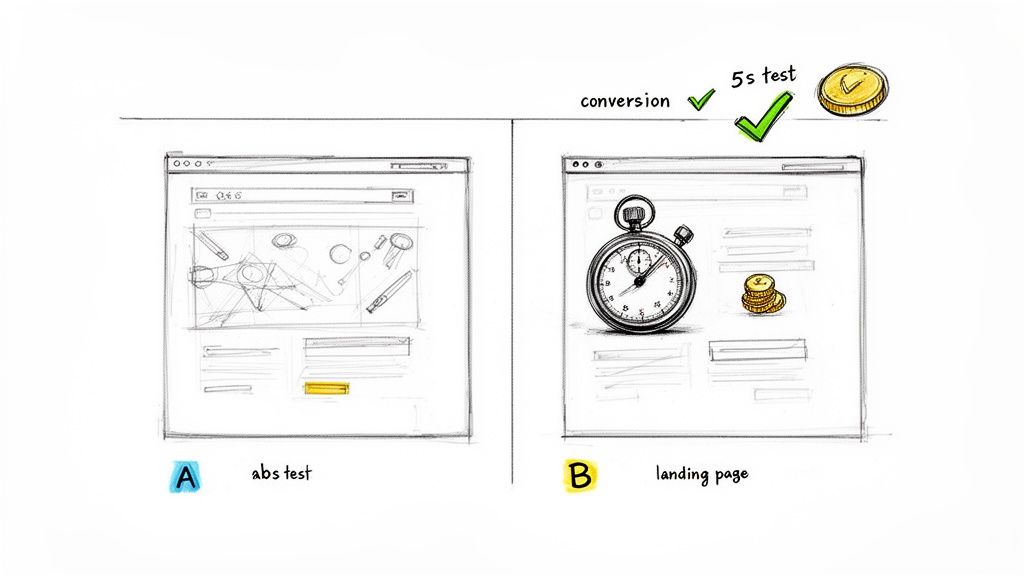
The goal here is simple: get real-world feedback that validates your message. Testing isn't a "nice-to-have" step; it’s critical. A clear value proposition can supercharge your lead generation, with some studies showing conversion rate boosts of 38-64% when your message nails customer pain points.
Run a Simple Landing Page A/B Test
This sounds way more complicated than it is. An A/B test is just showing two different versions of your headline to visitors to see which one performs better.
Here’s how to do it on the cheap:
- Create two versions of your landing page. Keep everything the same except for the main headline, which should feature your different value proposition ideas.
- Drive a little traffic. Run a small, targeted ad campaign, sending half the traffic to Page A and half to Page B.
- Measure one thing. Look at which page gets more sign-ups, downloads, or whatever your main goal is.
The winner is the version that got more people to act. Simple. You now have data telling you which message connects.
Use the 5-Second Test for Instant Clarity
Your value proposition has to be understood instantly. If someone has to read it three times to "get it," you've already lost. This is where the 5-Second Test comes in handy.
> The concept is brutally effective: you show someone your webpage for just five seconds, then take it away. After, you ask them three simple questions: What does this company do? Who is it for? What’s the main benefit?
If they can’t answer those questions correctly, your value proposition is too complicated. It’s a gut check that forces you to simplify your message until it’s impossible to misunderstand. The feedback is raw, immediate, and incredibly valuable. This is a core part of the larger journey toward validating product-market fit.
Listen to Your Customers (Seriously)
This might be the most powerful and overlooked testing method of all. Your customers are giving you the perfect language to use every day—you just have to listen.
Get on sales calls. Read support tickets. Conduct customer interviews. Pay attention to the exact words your customers use to describe their problems and the value they get from your solution.
Do they say they "streamline workflows," or do they say they "hate chasing down approvals"? Do they talk about "synergizing operations," or do they say "this saves me from a million spreadsheets"?
Steal their language. When your value proposition uses the same words your customers use, it connects on a much deeper level. It proves you understand their world.
Common Questions About Value Propositions
Alright, we've covered a lot of ground. But a few nagging questions are probably still rattling around in your head. Let’s tackle some of the most common ones.
No fluff, just straight-to-the-point answers.
How Is a Value Proposition Different from a Slogan?
This is a classic. They sound similar, but they have completely different jobs.
A slogan or tagline is a short, catchy marketing phrase designed to be memorable. It’s about evoking a feeling. Think of Nike’s "Just Do It." It’s inspiring, but it doesn't tell you what Nike sells or why their shoes are any better than Adidas.
A value proposition, on the other hand, is the substance. It's a clear promise that explains:
- What problem you solve.
- For whom you solve it.
- Why you're the best choice.
Your value prop is the "why" behind your company. The slogan is the catchy one-liner you stick on a billboard. One is substance, the other is style.
Can My Company Have More Than One Value Proposition?
Absolutely. In fact, you probably should.
While your company will have an overarching value proposition, you can—and should—create different, more focused value props for different customer segments or products.
Imagine you sell software to both tiny startups and massive enterprise clients. Their needs are worlds apart.
- The startup is worried about cost and complexity. Their value prop might be: "Get enterprise-grade analytics without the enterprise price tag."
- The enterprise client is obsessed with security and scalability. Their value prop could be: "The only SOC 2 compliant analytics platform that scales with your global team."
It's the same core product, but the promise is tweaked to speak directly to what each audience cares about.
How Often Should I Revisit My Value Proposition?
Your value proposition isn’t something you "set and forget." It's a living statement that needs to evolve with your business.
> A good rule of thumb is to review it at least once a year or whenever there's a major shift—a new product launch, a new competitor, or a big change in your customers' needs.
If you launch a game-changing feature, your value prop should reflect that. If a competitor starts offering something that used to make you unique, it’s time to sharpen your message. Staying relevant means staying vigilant.
What Is the Biggest Mistake Startups Make?
Oh, this one’s easy. The single biggest mistake is focusing on product features instead of customer benefits.
Founders fall in love with their product’s cool specs and the clever code that makes it all tick. But here’s the cold, hard truth: your customers don’t care. They don’t care about your "AI-powered algorithm" or your "asynchronous architecture."
They only care about what it does for them.
Does it save them time? Make them more money? Take away a massive headache? Always, always, always frame your value in terms of the customer’s outcome. People don't buy features; they buy a better version of themselves.
Crafting and testing your value proposition is a continuous journey, but you don't have to do it blind. For a data-driven shortcut, already.dev turns what used to be 40 hours of painful competitor research into a 4-minute, AI-powered report, giving you the clarity you need to build a message that wins. Check out Already.dev to see how it works.